


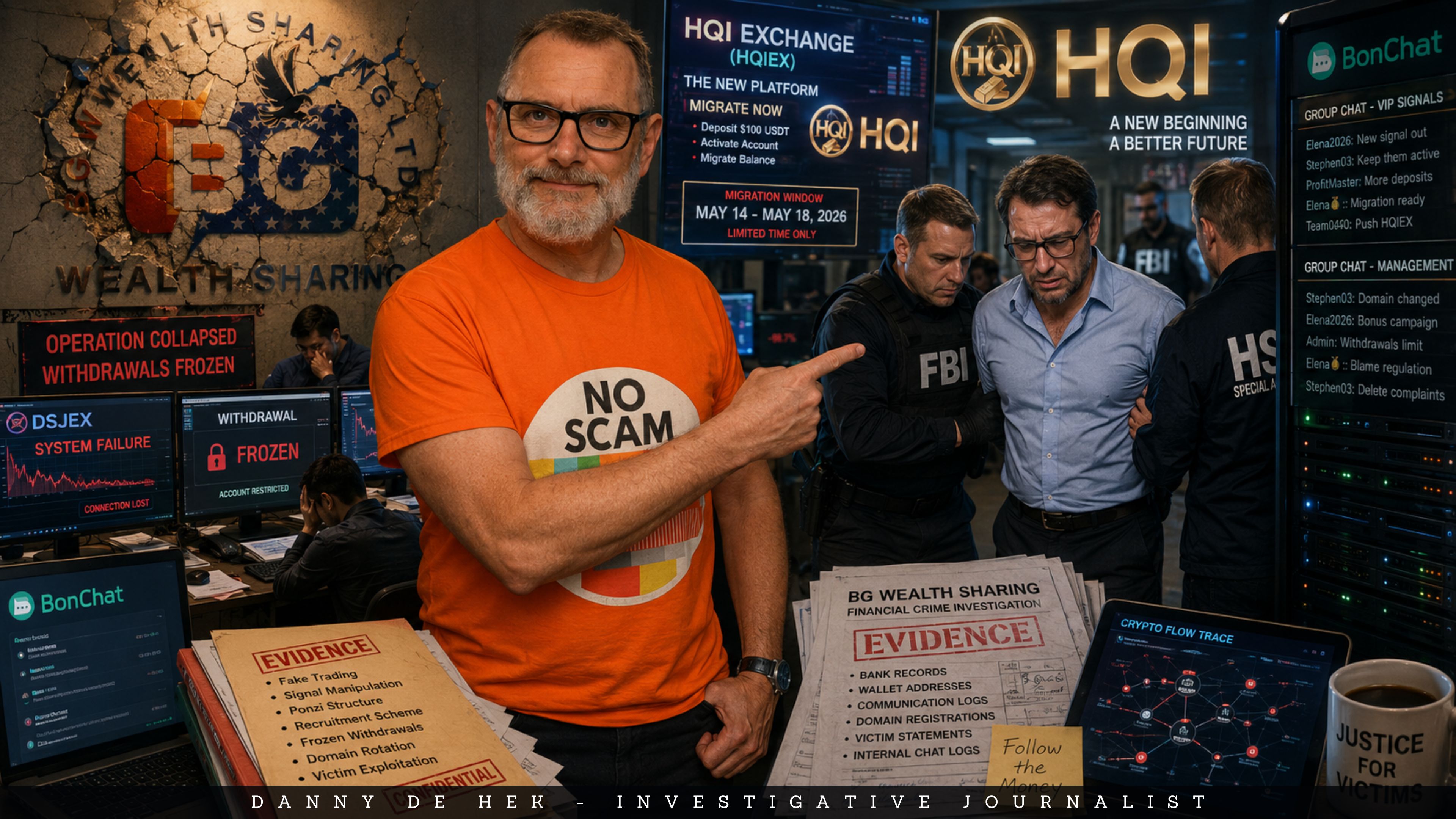
“Just deposit another $100 and your frozen funds will be restored.”
That’s the pitch now being pushed onto victims of BG Wealth Sharing and DSJEX as the collapsed operation attempts to reinvent itself yet again under a new name: HQI Exchange, also known as HQIEX.
Over the past few days I’ve been flooded with screenshots, BonChat messages, wallet addresses, migration instructions, phishing warnings, and desperate messages from victims who were told their original balances had been “transferred” to a brand-new platform.
According to the people behind the operation, all members needed to do was register on HQIEX, deposit another $100 USDT, and continue following the signal trades while the system “migrated” their funds from the frozen DSJEX infrastructure.
If you’ve been following my investigations into BG Wealth Sharing, none of this will sound new. The names change. The websites change. The excuses change. But the underlying mechanics remain almost identical. We are once again looking at a classic “click-a-button” crypto Ponzi operation built around fake trading narratives, social pressure, endless recruitment, withdrawal restrictions, and psychological conditioning designed to keep victims emotionally invested long after the system has already collapsed.
What makes this latest phase particularly disturbing is that the operators appear to be targeting the very same victims who already lost money in BG Wealth Sharing and DSJEX. Instead of accepting responsibility for the collapse, they’ve simply reframed the failure as a “migration event,” convincing people that the problem wasn’t the scam itself — it was merely the old platform.
The “Migration” Narrative Begins
The migration instructions being circulated through BonChat and Telegram groups follow a very specific pattern. Members were informed that DSJEX was under “regulatory investigation” and therefore unable to continue operating normally. To “protect members,” BG Wealth Sharing allegedly decided to move everyone onto a new cooperative platform called HQIEX.
Victims were instructed to register using domains such as hqi22.com, hqi23.com, hqi25.com, hqi37.com, and hqi38.com.
They were then told to deposit at least $100 USDT to activate the new account before their balances could be migrated.
This wasn’t presented as optional. Messages repeatedly stressed there was a limited migration window between May 14th and May 18th, 2026, warning that anyone who failed to complete the process in time risked losing access to their funds entirely. That kind of artificial urgency is one of the oldest manipulation tactics in the book. It forces victims to make emotional decisions before they have time to stop and critically assess what’s actually happening.
One message attributed to Stephen Beard stated:
“The entire transition process lasting a total of five days. All members are required to complete their account registration, activation, and balance migration within the designated timeframe.”
That wording is important because it creates the illusion that people still possess real balances waiting to be transferred somewhere. But there’s currently no evidence showing legitimate assets were actually migrated between regulated exchanges. Instead, what victims appear to be seeing are numbers displayed inside another cloned interface designed to maintain confidence long enough to extract additional deposits.
Browser Warnings, Phishing Flags, And Disposable Domains
Almost immediately after these HQIEX domains began circulating, browser security systems started flagging them.
Some domains displayed “Dangerous site” warnings. Others were flagged for suspected phishing activity. In my own testing, several of the domains promoted inside BG Wealth Sharing chats were already triggering security alerts before the migration process had even properly begun.
That alone should have stopped people in their tracks.
But what’s more interesting is the pattern behind the domains themselves.
I was told BG Wealth Sharing may have registered over 9,000 domains. I cannot independently verify that figure. However, I personally verified approximately 850 related domains before I stopped checking. Even at that lower number, it strongly suggests a massive domain-rotation strategy designed to keep the operation alive as domains become blocked, blacklisted, reported, or abandoned.
A tip of the hat to Oz from BehindMLM, who independently documented a large cluster of HQIEX-related domains including hqiex.com, hqi2.com, hqi3.com, hqi5.com, hqi6.com, hqi7.com, hqi9.com, hqi10.com, hqi11.com, hqi12.com, hqi15.com, hqi16.com, hqi17.com, hqi18.com, hqi19.com, hqi20.com, hqi21.com, hqi22.com, hqi23.com, hqi25.com, hqi26.com, hqi27.com, hqi28.com, hqi30.com, hqi31.com, hqi35.com, hqi36.com, hqi37.com, and hqi38.com — many of which were privately registered in March and May 2026 and match the exact migration links being circulated to BG Wealth Sharing victims right now.
According to BehindMLM’s investigation, Cloudflare had already begun disabling access to some HQIEX infrastructure due to fraud concerns. That lines up almost perfectly with the phishing and dangerous-site warnings victims were already encountering while trying to register accounts.
The operators also appear to have quickly shifted toward using “/h5” mobile-style subdirectories after some domains became restricted, another sign they were actively adapting infrastructure on the fly to keep the system operational.
None of this resembles the behaviour of a legitimate financial platform.
The Same Ponzi Mechanics Are Still There
Despite the rebrand, the underlying mechanics appear virtually identical to BG Wealth Sharing and DSJEX.
Members are still instructed to perform multiple “signal trades” each day by following prompts inside the platform. The process itself requires no trading skill whatsoever. Users simply click buttons, copy trades, and watch numbers increase on a screen.
The illusion works because people mistake interface activity for actual profitability.
One of the most important observations made by Oz in the BehindMLM review was this:
“Why get randoms to click a button in a dodgy app when you could just execute the trades yourself?”
That single question completely dismantles the entire business model.
If genuine profitable algorithmic trading existed, there would be no need for thousands of random retail users manually clicking buttons several times per day to “activate” trades. The reality is that these systems rely on creating engagement and dependency while using fresh deposits to maintain withdrawal activity for earlier participants.
The HQIEX instructions being circulated now still revolve around:
- daily signal trades,
- recruitment structures,
- activation deposits,
- artificial trading-volume requirements,
- and withdrawal restrictions.
Victims were even warned that withdrawing funds before completing required “trading volume” targets could result in a 99% handling fee.
That is not normal exchange behaviour.
That is coercion.
The Psychology Behind The Recovery Trap
What we’re witnessing now is something far more dangerous than a standard Ponzi collapse.
This has evolved into what many investigators would describe as a secondary recovery scam — a situation where victims who already lost money are psychologically manipulated into paying additional fees under the belief they can recover their original balances.
One message from a victim inside the system stood out to me:
“We put in way more than $100 before. It’s worth trying to get our money back.”
That mindset is exactly what the operators are exploiting.
By the time people reach this stage, many are emotionally exhausted, financially stressed, and desperate for hope. The scammers understand this. They know victims are far more likely to send “just one more payment” if they believe recovery is possible.
And this is where the operation becomes particularly manipulative.
Instead of admitting the system failed, the narrative becomes:
- “the exchange is under investigation,”
- “withdrawals are temporarily frozen,”
- “your funds are safe,”
- “your balance has been migrated,”
- “just complete activation,”
- “just complete trading volume,”
- “just trust the process.”
The scam survives by preventing victims from emotionally accepting the loss.
The BonChat Infrastructure And “Elena”
Much of the coordination now appears to be happening inside BonChat groups rather than public-facing support systems.
Victims are instructed to contact handlers using names like:
- Elena2026
- Stephen03
- Elena🍋
One screenshot I reviewed showed a message from “Elena” instructing users to provide both their DSJ and HQI account identifiers while ensuring at least $100 remained available in the account for activation purposes.
Another showed users complaining they had already sent the activation money but were receiving no response.
This is important because legitimate exchanges do not operate like underground chat-room syndicates manually coordinating account migrations through anonymous messaging apps.
The structure appears highly centralized despite pretending to be decentralized.
Even more telling is that team hierarchy still appears to matter. One message openly stated:
“You can get into BG 040 by registering on the new platform.”
That suggests the original recruitment genealogy and team structure remain intact. In other words, this does not appear to be a genuine migration into an independent exchange. It appears to be continuity of the same network under a fresh skin.
Wallets, USDT, And The Illusion Of Legitimacy
The recharge pages being shown to victims are heavily focused around USDT on the TRC20 network, another common feature in these operations due to the speed and low transaction costs involved.
One wallet address supplied during the HQIEX activation process was: 38tny1275DpPQrrnemV1JyDXY4n2e83gLd (bitref.com)
- 38tny1275DpPQrrnemV1JyDXY4n2e83gLd (Victims Deposits)
- 348bufXfdFKpfwEvDtqLYBVqnrWz5mksoD (Victims Deposits)
- 3QEUr5FYWNFxJe1tUdk7JiDCGoGa6WXpbf (Wallet Consolidation / Hopping)
That wallet should absolutely be preserved and investigated further alongside any related transaction hashes and funding flows.
The platform itself presents the familiar illusion of legitimacy:
- crypto charts,
- balances,
- trading dashboards,
- “futures” sections,
- and polished mobile interfaces.
But slick interfaces do not prove real trading is taking place.
In fact, many of these cloned “click-a-button” platforms are little more than cosmetic frontends designed to simulate activity while controlling deposits and withdrawals internally.
And when the collapse finally accelerates, the operators simply:
- freeze withdrawals,
- rotate domains,
- demand new fees,
- disable old websites,
- and migrate victims into the next version.
We’ve seen this pattern before.
We are watching it happen again now.
The Illusion Changes, The Pattern Stays The Same
The most dangerous thing about HQIEX is not the technology.
It’s the emotional manipulation.
The operators appear to understand exactly how to keep victims psychologically trapped:
- offer hope,
- create urgency,
- preserve fake balances,
- promise recovery,
- and make the next payment feel small compared to the original loss.
That’s why people continue following them even after withdrawals collapse.
And unfortunately, some of the same promoters who pushed BG Wealth Sharing and DSJEX now appear to be actively encouraging victims to migrate into HQIEX while presenting it as a solution rather than a continuation of the problem.
At this stage, the similarities are impossible to ignore.
The same mechanics.
The same narratives.
The same domain rotation.
The same signal-trading fiction.
The same pressure tactics.
The same endless cycle of “just one more step.”
Only the logo changed.
Disclaimer: How This Investigation Was Conducted
This investigation relies entirely on OSINT — Open Source Intelligence — meaning every claim made here is based on publicly available records, archived web pages, corporate filings, domain data, social media activity, and open blockchain transactions. No private data, hacking, or unlawful access methods were used. OSINT is a powerful and ethical tool for exposing scams without violating privacy laws or overstepping legal boundaries.
About the Author
I’m DANNY DE HEK, a New Zealand–based YouTuber, investigative journalist, and OSINT researcher. I name and shame individuals promoting or marketing fraudulent schemes through my YOUTUBE CHANNEL. Every video I produce exposes the people behind scams, Ponzi schemes, and MLM frauds — holding them accountable in public.
My PODCAST is an extension of that work. It’s distributed across 18 major platforms — including Apple Podcasts, Spotify, Amazon Music, YouTube, and iHeartRadio — so when scammers try to hide, my content follows them everywhere. If you prefer listening to my investigations instead of watching, you’ll find them on every major podcast service.
You can BOOK ME for private consultations or SPEAKING ENGAGEMENTS, where I share first-hand experience from years of exposing large-scale fraud and helping victims recover.
“Stop losing your future to financial parasites. Subscribe. Expose. Protect.”
My work exposing crypto fraud has been featured in:
- Coffeezilla 2026): Featured in the investigation exposing the alleged $328M Goliath Ventures Ponzi scheme
- Bloomberg Documentary (2025): A 20-minute exposé on Ponzi schemes and crypto card fraud
- News.com.au (2025): Profiled as one of the leading scam-busters in Australasia
- OpIndia (2025): Cited for uncovering Pakistani software houses linked to drug trafficking, visa scams, and global financial fraud
- The Press / Stuff.co.nz (2023): Successfully defeated $3.85M gag lawsuit; court ruled it was a vexatious attempt to silence whistleblowing
- The Guardian Australia (2023): National warning on crypto MLMs affecting Aussie families
- ABC News Australia (2023): Investigation into Blockchain Global and its collapse
- The New York Times (2022): A full two-page feature on dismantling HyperVerse and its global network
- Radio New Zealand (2022): “The Kiwi YouTuber Taking Down Crypto Scammers From His Christchurch Home”
- Otago Daily Times (2022): A profile on my investigative work and the impact of crypto fraud in New Zealand




Leave A Comment