


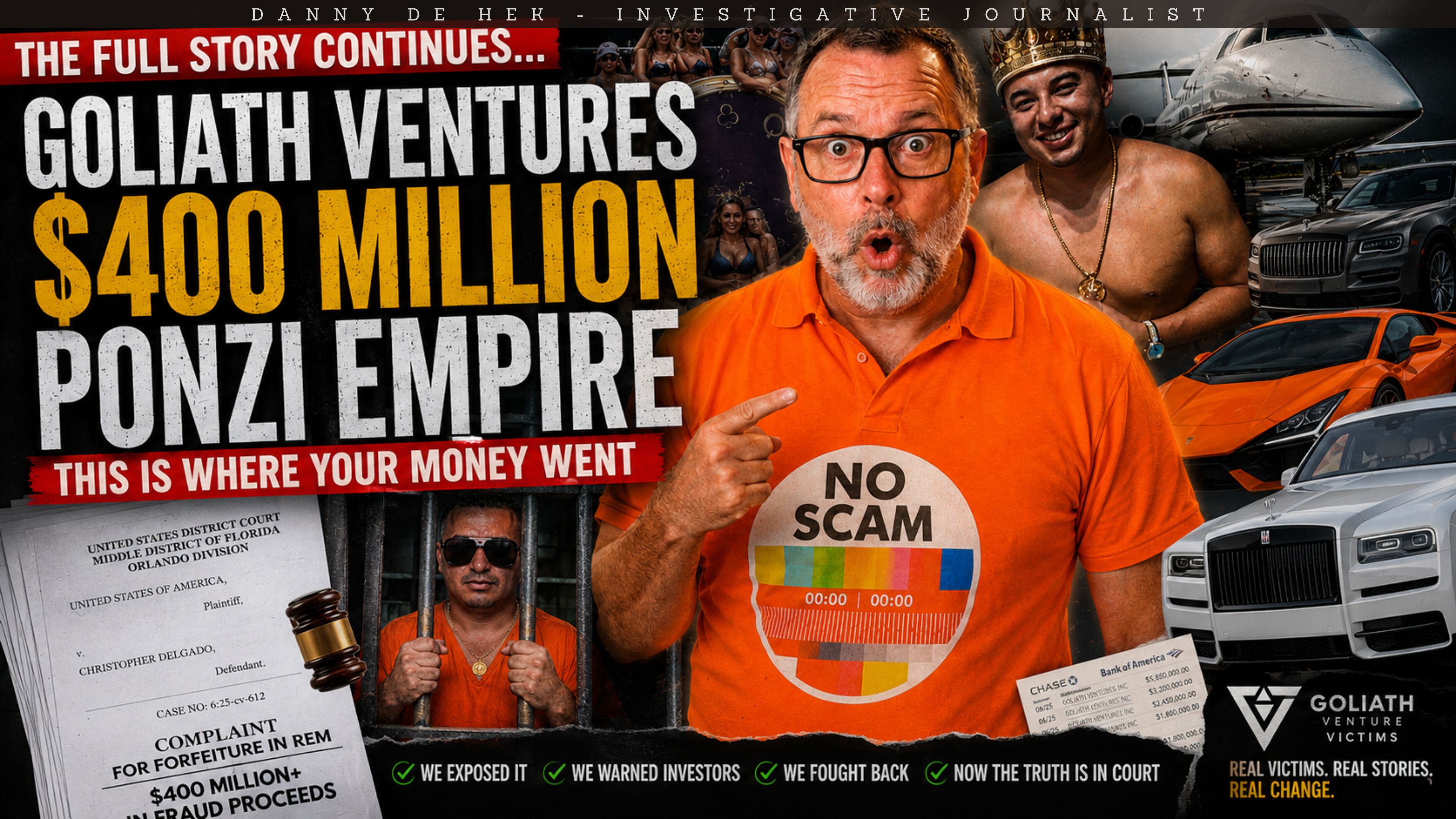
“While investors waited for withdrawals, the mansions and Lamborghinis kept arriving.”
On May 22, 2026, the United States Attorney’s Office for the Middle District of Florida announced a major Civil Forfeiture Action targeting properties, luxury vehicles, and other assets allegedly purchased using proceeds from the Goliath Ventures fraud scheme.
For anyone who has followed my investigation into Christopher Delgado and Goliath Ventures over the past year, this filing provides one of the clearest windows yet into where investigators say the money actually went.
And the picture painted by federal prosecutors is staggering.
This wasn’t just about crypto.
It wasn’t just about liquidity pools.
And it certainly wasn’t just about “bad investments” or “market conditions.”
 According to the United States Government, approximately $400 million flowed through the Goliath Ventures operation between January 2023 and January 2026 while more than 1,000 investors were told their money was being deployed into sophisticated cryptocurrency liquidity pool strategies capable of generating stable passive returns.
But according to investigators, the overwhelming majority of that money never went where investors believed it was going.
Instead, prosecutors describe a system where investor funds were recycled to pay earlier investors while enormous amounts of money flowed into luxury mansions, high-end commercial real estate, exotic vehicles, extravagant events, luxury travel, and personal enrichment.
And once you start following the money trail laid out in these filings, the scale becomes difficult to comprehend.
The Financial Flow Investigators Traced Is Extraordinary
One of the strongest aspects of the forfeiture complaint is how detailed the financial tracing appears to be.
Investigators describe money moving through traditional bank accounts, cryptocurrency wallets, shell entities, commercial properties, and luxury purchases in a way that paints a very clear picture of how prosecutors believe the operation functioned internally.
According to the complaint:
- Approximately $253 million flowed into a JPMorgan Chase account associated with Goliath Ventures
- Approximately $75 million flowed into Bank of America accounts
- Approximately $62 million was received through Coinbase cryptocurrency wallets
- Approximately $165 million moved between bank accounts and cryptocurrency wallets
- Only around $1 million appears to have actually been deployed into liquidity pools
That final figure is devastating.
Think carefully about what investigators are saying.
A company promoted as a sophisticated cryptocurrency investment operation allegedly raised approximately $400 million, yet federal investigators say only a tiny fraction of that money appears to have actually touched the liquidity pool strategies investors believed they were participating in.
That’s not a small accounting discrepancy.
That strikes directly at the core narrative investors were sold from the very beginning.
According to prosecutors, investor money instead sat inside traditional bank accounts or stablecoin holdings while payouts to earlier investors were funded using incoming deposits from newer investors.
That is the same core structure investigators repeatedly identify in large-scale Ponzi schemes.
And this is where modern crypto fraud becomes incredibly dangerous.
Most investors do not know how to independently verify decentralized finance activity. They cannot audit liquidity pools themselves. They cannot properly verify wallet movements. They cannot determine whether smart contracts are genuinely generating returns or whether dashboard balances are simply being manipulated internally.
So instead, they rely on something else.
They rely on confidence.
They rely on visible success.
They rely on social proof.
They rely on the appearance of legitimacy.
And according to prosecutors, Goliath Ventures projected exactly that image.
The Banking Trail Raises More Red Flags
Another important part of the filing is the banking trail itself. Investigators say money connected to Goliath Ventures moved through a network of accounts at JPMorgan Chase, Bank of America, Luminate Bank, and City National Bank, with Delgado controlling at least 30 bank accounts, often through companies created to receive and move investor funds.
The filing says investor money was not just deposited into one simple business account. It was moved between accounts, entities, banks, and cryptocurrency wallets so frequently that investigators said there often appeared to be no legitimate business purpose for the transfers. That detail matters because this was not the clean financial footprint of a transparent investment operation. It looked like a maze.
The complaint also identifies key accounts that directly received victim deposits: $253 million into Goliath’s JPMC 0305 account, $8.5 million into GVI International’s JPMC 7812 account, $75 million into Goliath’s BOA 9136 account, $22 million into GVI International’s BOA 0475 account, and $41.9 million into Goliath’s LMB 1353 account.
The bank closures are also important. According to the filing, JPMorgan Chase closed Goliath accounts in June 2025, and Bank of America closed Goliath accounts in January 2026. Investigators noted that banks close accounts when they are concerned about high-risk or criminal activity, including activity consistent with a Ponzi scheme, such as large volumes of inconsistent wire deposits, rapid unexplained transfers between accounts, and rapid deposit growth tied to a vague business model.
The Real Estate Portfolio Shows Where Millions Were Going
One of the most shocking aspects of the forfeiture complaint is the extraordinary amount of luxury real estate purchased using investor money. When the properties are listed with purchase prices and dates, the scale of the spending spree becomes immediately apparent.
Federal prosecutors are now seeking seizure of the following properties:
- 5271 Isleworth Country Club Drive, Windermere, Florida — Purchased September 5, 2025 — $8.5 Million
This mansion is the centerpiece of the filing. Located in one of Florida’s most exclusive gated communities, Isleworth is known for celebrity residents, elite athletes, executives, private golf communities, and extreme affluence. Prosecutors allege this property was acquired while investors believed their money was actively generating profits through crypto liquidity pools. The contrast between investor expectations and the actual use of funds is stark. - 141 South Phelps Avenue, Winter Park, Florida — Purchased July 31, 2025 — $3.2 Million
This property sits in a high-end community known for luxury homes, boutique shopping, and upscale dining. According to prosecutors, investor money was used to finance the purchase while participants were told their funds were safely invested. - 189 South Orange Avenue, Units 1800S, 1810S, 1820S & 1870S, Orlando, Florida — Purchased May 29, 2025 — $3.2 Million
These downtown Orlando commercial condominium units were purchased for use as office space. Investigators emphasize that these acquisitions reinforced the image of legitimacy, creating credibility and emotional trust for investors visiting these offices. - 7333 Bella Foresta Place, Sanford, Florida — Purchased August 5, 2024 — $1.65 Million
This residential property represents another high-value acquisition, contributing to what prosecutors describe as a rapidly expanding luxury portfolio financed through investor funds. - 222 Pawnee Trail, Kissimmee, Florida — Purchased December 5, 2024 — $862,500
Another property in the Orlando area, purchased with funds entrusted by investors who were led to believe their capital was being actively deployed in crypto investments. - 17416 Bal Harbour Drive, Winter Garden, Florida — Purchased February 13, 2025 — $740,000
This acquisition further demonstrates the systematic pattern of luxury purchases using investor money while Goliath Ventures presented itself as a legitimate investment operation. - 746 Cavan Drive, Apopka, Florida — Purchased December 20, 2021 — $725,000
The final property targeted in the complaint, included as part of the broader portfolio of residential real estate allegedly financed with investor funds.
Taken together, prosecutors estimate that approximately $14 million in investor money was spent acquiring these residential properties in the Orlando area between August 2024 and September 2025 alone. This figure illustrates the scale and speed at which wealth was allegedly extracted from investors and redirected into high-value real estate, all while participants were reassured their funds were generating returns in cryptocurrency liquidity pools.
This portfolio shows clearly how the illusion of a profitable crypto investment was maintained through visible, tangible symbols of luxury and success.
The Vehicle Collection Reads Like A Luxury Dealership Inventory
The vehicle list contained in the forfeiture complaint reads less like normal executive ownership and more like the inventory sheet of an exotic car showroom.
Federal prosecutors are seeking forfeiture of multiple luxury vehicles allegedly purchased or maintained using investor funds, and unlike earlier summaries circulating online, the filing provides specific purchase dates and purchase prices.
According to the complaint, the vehicles include:
- 2025 Lamborghini Revuelto — Purchased April 22, 2025 — $719,517.01
- 2024 Rolls Royce Ghost — Purchased April 21, 2025 — $379,995
- 2024 Bentley Bentayga — Purchased April 9, 2025 — $285,540
- 2024 Lamborghini Huracán EVO Spyder — Purchased March 30, 2025 — $473,723
- 2025 Cadillac Escalade V — Purchased March 19, 2025 — $238,561.25
- 2024 Lincoln Navigator L — Purchased March 4, 2025 — $125,862.37
- 2023 Rolls Royce Cullinan — Purchased October 27, 2023 — $472,350
- 2022 Mercedes Benz Sprinter — Purchased September 5, 2023 — $235,804.96
- 2022 GMC Sierra HD — Purchased October 23, 2022 — $93,963
- 1951 Mercury — Purchased April 12, 2024 — $52,000
- 2017 Mercedes Benz C300 — Purchased January 12, 2024 — $15,000
The scale of the spending is extraordinary. Prosecutors describe investor money being used not only to purchase these vehicles outright, but also to maintain loans, leases, insurance obligations, and other ongoing expenses tied to the luxury vehicle collection.
That distinction matters.
Because investigators are not describing isolated spending decisions or occasional luxury purchases.
They are describing investor money allegedly sustaining an entire luxury lifestyle ecosystem designed to project wealth, success, and legitimacy.
And once again, this follows a familiar pattern seen repeatedly in major financial fraud cases.
The wealth is not hidden.
It is displayed publicly.
Because the display itself helps attract more money.
The $9 Million Miami Christmas Party Should Shock Every Investor
One of the most disturbing allegations in the forfeiture complaint involves the extraordinary spending on luxury events while investors were reportedly experiencing withdrawal delays and growing concerns about access to their money.
According to federal prosecutors, approximately $9 million was spent hosting a Goliath Christmas party in Miami during December 2025.
Nine million dollars.
That number alone is difficult to comprehend.
At roughly the same time, investors were reportedly being told there were:
- Banking complications
- Compliance reviews
- Audit delays
- Administrative issues
- Technical withdrawal problems
That contrast is extraordinary.
Because while ordinary investors were allegedly being reassured that temporary delays were normal and their funds remained secure, prosecutors say millions were simultaneously being spent on luxury parties, entertainment, private transportation, chartered travel, exclusive venues, and maintaining the image of unstoppable financial success.
The filing also references extravagant gatherings held at luxury locations including the Four Seasons Resort Orlando, reinforcing what investigators describe as a carefully maintained image of wealth, exclusivity, and credibility.
And this matters more than many people realise.
Luxury environments are not just cosmetic in operations like this.
They serve a psychological purpose.
High-end venues, expensive presentations, visible wealth, and elite social settings create emotional confidence. They lower skepticism. They encourage investors to believe they are participating in something sophisticated, successful, and financially powerful.
That emotional reinforcement becomes incredibly effective once early payouts begin circulating and members start publicly defending the opportunity.
And once emotional belief replaces critical due diligence, warning signs become far easier to rationalise away.
That is one of the oldest and most effective psychological tactics used in large-scale financial fraud schemes.
The Dashboard Created The Illusion Of Stability
One of the most dangerous tools in modern crypto fraud is the investor dashboard.
Victims log into a portal and see balances increasing steadily month after month. The numbers look professional. The interface appears polished. Returns seem stable and predictable. Everything feels controlled, successful, and reassuring.
That visual reassurance is incredibly powerful.
Because once investors begin seeing account balances growing consistently on a screen, many stop independently verifying what is actually happening behind the scenes.
According to federal prosecutors, the balances displayed inside the Goliath Ventures investor portal were manipulated and not tied to genuine profit-generating investment activity.
That allegation is critical.
Because the dashboard itself becomes emotional reinforcement.
Investors see positive balances.
They receive early payouts.
They watch their accounts supposedly grow month after month.
And gradually, the platform itself becomes the “proof” they rely on instead of independently verifying the underlying investment activity.
According to investigators, early payouts strengthened confidence even further, encouraging many participants to reinvest profits, increase deposits, and reassure other investors that the system was legitimate.
That is how schemes like this survive much longer than outsiders expect.
Early participants receive money.
Those participants publicly defend the opportunity.
Success stories spread socially through private groups, presentations, testimonials, and community pressure.
And once confidence begins spreading emotionally between investors, skepticism often starts disappearing.
That’s when the psychological trap tightens.
People stop relying on evidence and begin relying on belief.
And by the time withdrawal problems begin appearing publicly, many investors are already emotionally committed to defending the system because accepting the truth means confronting the possibility they were manipulated from the very beginning.
That emotional attachment is one of the most powerful forces sustaining large-scale Ponzi schemes.
The illusion survives for as long as confidence survives.
And once the flow of new money slows down, the illusion usually collapses very quickly.
Why Intelligent People Stayed Inside The System
One of the hardest things for outsiders to understand is why intelligent people remain invested even after serious warning signs begin appearing publicly.
But after years investigating operations like this, I can tell you the answer is usually not stupidity.
It is psychological entrapment.
According to the filing, investors received repeated reassurances that delays were temporary and everything remained under control. Some were encouraged to reinvest profits rather than withdraw them, while others were told audits, compliance reviews, banking delays, and technical complications were temporarily slowing withdrawals.
That creates an incredibly powerful emotional trap.
Because by that stage, investors are no longer simply protecting money.
They are protecting:
- Hope
- Pride
- Relationships
- Identity
- Reputation
- The belief they made a smart financial decision
And walking away means confronting the terrifying possibility they were manipulated all along.
That reality can be emotionally devastating.
It also explains why schemes like this often continue functioning long after major warning signs become publicly visible.
Once people become emotionally invested in an opportunity, they often begin defending it publicly because accepting the truth means accepting that friends, family members, colleagues, or entire communities may also have been pulled into the same system.
That social and emotional pressure becomes incredibly powerful.
And by the time confidence finally breaks, many victims have already spent months — or years — psychologically defending the very operation that ultimately caused the damage.
The Bigger Picture Is Impossible To Ignore
When you step back and look at the broader picture outlined in the government’s filing, the mechanics become painfully familiar.
According to investigators, the operation combined:
- Luxury optics
- Technical crypto jargon
- Consistent payout narratives
- Emotional reassurance
- High-end events
- Visible wealth
- Investor dashboards
- Social proof
- Manufactured credibility
All wrapped around what prosecutors describe as a classic Ponzi-style structure dependent on a constant flow of new investor money.
Despite all the modern crypto branding, the core mechanics described in the filing appear remarkably old-fashioned.
Money came in.
Confidence was maintained.
Luxury was displayed.
Early payouts reinforced belief.
And according to federal prosecutors, enormous amounts of investor money flowed into personal enrichment while victims believed sophisticated investment activity was taking place behind the scenes.
That’s one of the most important lessons in cases like this.
Fraud at this scale rarely presents itself as chaos.
It presents itself as success.
People saw luxury homes, exotic vehicles, professional offices, major events, polished presentations, and apparent financial growth. To many investors, those visible symbols of wealth became proof that the operation was legitimate.
But according to investigators, much of that image was being sustained using the very money investors believed was safely generating passive income behind the scenes.
The tragedy is that many victims likely continued believing right until the very end.
Because the illusion was never built on transparency.
It was built on confidence.
And confidence can survive far longer than the truth.
The Warning Signs Were Visible Long Before The Collapse
What makes this case even more disturbing is that many of the warning signs were already visible long before federal prosecutors filed this forfeiture action.
Investors had begun reporting delayed withdrawals, inconsistent explanations, banking excuses, compliance delays, and growing difficulties accessing funds while Goliath Ventures continued projecting an image of extraordinary success online and at live events.
At the same time, critics, whistleblowers, independent investigators, and victims raising concerns were often dismissed, mocked, or accused of spreading fear and negativity. That pattern is common in large-scale financial fraud operations because maintaining confidence becomes critical to keeping new money flowing into the system.
And while ordinary investors were being reassured everything remained under control, prosecutors now allege millions of dollars were continuing to flow into mansions, luxury vehicles, office space, events, travel, and personal enrichment behind the scenes.
For Many Victims, This Filing Will Be Emotionally Devastating
For many victims, the hardest part of reading this filing will not simply be the dollar figures.
It will be seeing exactly where prosecutors say the money went.
Luxury mansions.
Exotic vehicles.
Commercial office space.
Multi-million-dollar events.
Private travel.
Visible wealth displayed publicly while ordinary investors believed their money was safely generating passive income behind the scenes.
That reality is emotionally crushing for many people because these weren’t faceless transactions on a spreadsheet. These were retirement funds, savings accounts, business capital, borrowed money, and in some cases entire life plans entrusted to what investors believed was a legitimate opportunity.
And according to federal prosecutors, while many investors were waiting for withdrawals, reassurance, and answers, millions of dollars were allegedly continuing to flow into luxury assets, extravagant spending, and the carefully maintained image of success.
That is the part many victims will struggle to process the most.
Not just the money that was lost.
But the confidence, trust, and belief that was exploited along the way.
And for many victims, another question still remains unanswered.
Who else knew?
Because while Christopher Delgado is now at the centre of the federal case, many investors, whistleblowers, and independent investigators believe there were numerous other individuals who helped promote, defend, market, operate, and financially benefit from the Goliath Ventures operation along the way.
Some of those people publicly projected extreme wealth.
Some aggressively reassured investors everything was safe.
Others allegedly helped maintain confidence while withdrawals were already becoming difficult.
And many victims are still waiting to see whether additional individuals connected to the operation will eventually face scrutiny, civil action, or criminal charges of their own.
That unanswered question continues hanging over the entire case.
“The investors were sold passive income and financial freedom. What prosecutors say they funded instead was a luxury empire built on confidence, illusion, and other people’s money.”
Disclaimer: How This Investigation Was Conducted
This investigation relies entirely on OSINT — Open Source Intelligence — meaning every claim made here is based on publicly available records, archived web pages, corporate filings, domain data, social media activity, and open blockchain transactions. No private data, hacking, or unlawful access methods were used. OSINT is a powerful and ethical tool for exposing scams without violating privacy laws or overstepping legal boundaries.
About the Author
I’m DANNY DE HEK, a New Zealand–based YouTuber, investigative journalist, and OSINT researcher. I name and shame individuals promoting or marketing fraudulent schemes through my YOUTUBE CHANNEL. Every video I produce exposes the people behind scams, Ponzi schemes, and MLM frauds — holding them accountable in public.
My PODCAST is an extension of that work. It’s distributed across 18 major platforms — including Apple Podcasts, Spotify, Amazon Music, YouTube, and iHeartRadio — so when scammers try to hide, my content follows them everywhere. If you prefer listening to my investigations instead of watching, you’ll find them on every major podcast service.
You can BOOK ME for private consultations or SPEAKING ENGAGEMENTS, where I share first-hand experience from years of exposing large-scale fraud and helping victims recover.
“Stop losing your future to financial parasites. Subscribe. Expose. Protect.”
My work exposing crypto fraud has been featured in:
- Coffeezilla 2026): Featured in the investigation exposing the alleged $328M Goliath Ventures Ponzi scheme
- Bloomberg Documentary (2025): A 20-minute exposé on Ponzi schemes and crypto card fraud
- News.com.au (2025): Profiled as one of the leading scam-busters in Australasia
- OpIndia (2025): Cited for uncovering Pakistani software houses linked to drug trafficking, visa scams, and global financial fraud
- The Press / Stuff.co.nz (2023): Successfully defeated $3.85M gag lawsuit; court ruled it was a vexatious attempt to silence whistleblowing
- The Guardian Australia (2023): National warning on crypto MLMs affecting Aussie families
- ABC News Australia (2023): Investigation into Blockchain Global and its collapse
- The New York Times (2022): A full two-page feature on dismantling HyperVerse and its global network
- Radio New Zealand (2022): “The Kiwi YouTuber Taking Down Crypto Scammers From His Christchurch Home”
- Otago Daily Times (2022): A profile on my investigative work and the impact of crypto fraud in New Zealand




Leave A Comment