


“Investigative journalism isn’t about giving powerful people a comfortable platform. It’s about asking the questions they don’t want answered.”
Over the last eight months I’ve spent countless hours investigating Goliath Ventures Inc, speaking with victims, whistleblowers, insiders, blockchain researchers, and people directly connected to the operation.
Long before mainstream media showed up, many of us were already documenting the impossible returns, frozen withdrawals, luxury spending, recruitment tactics, offshore narratives, and the panic happening behind the scenes while ordinary people were still pouring money into the scheme.
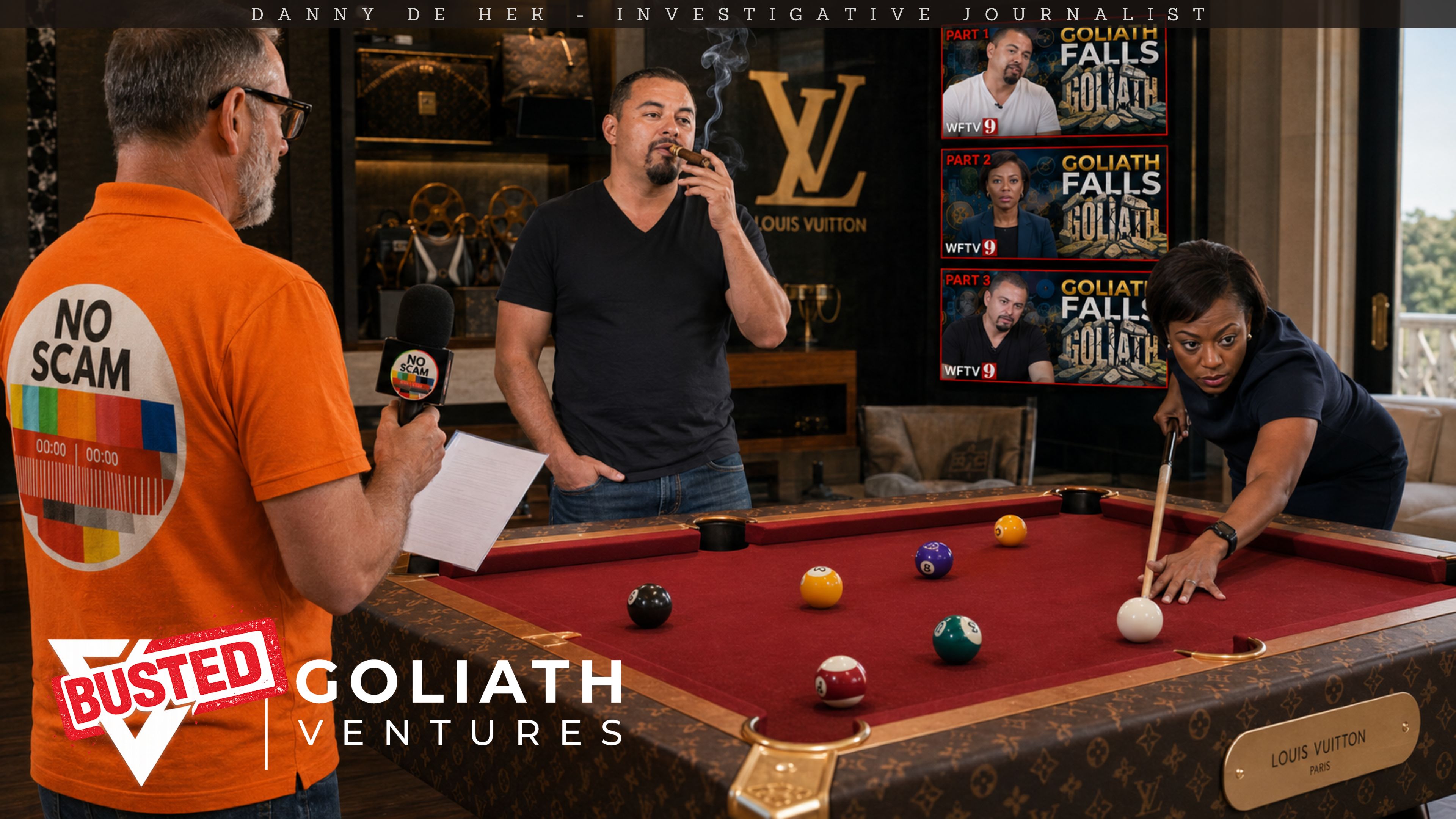
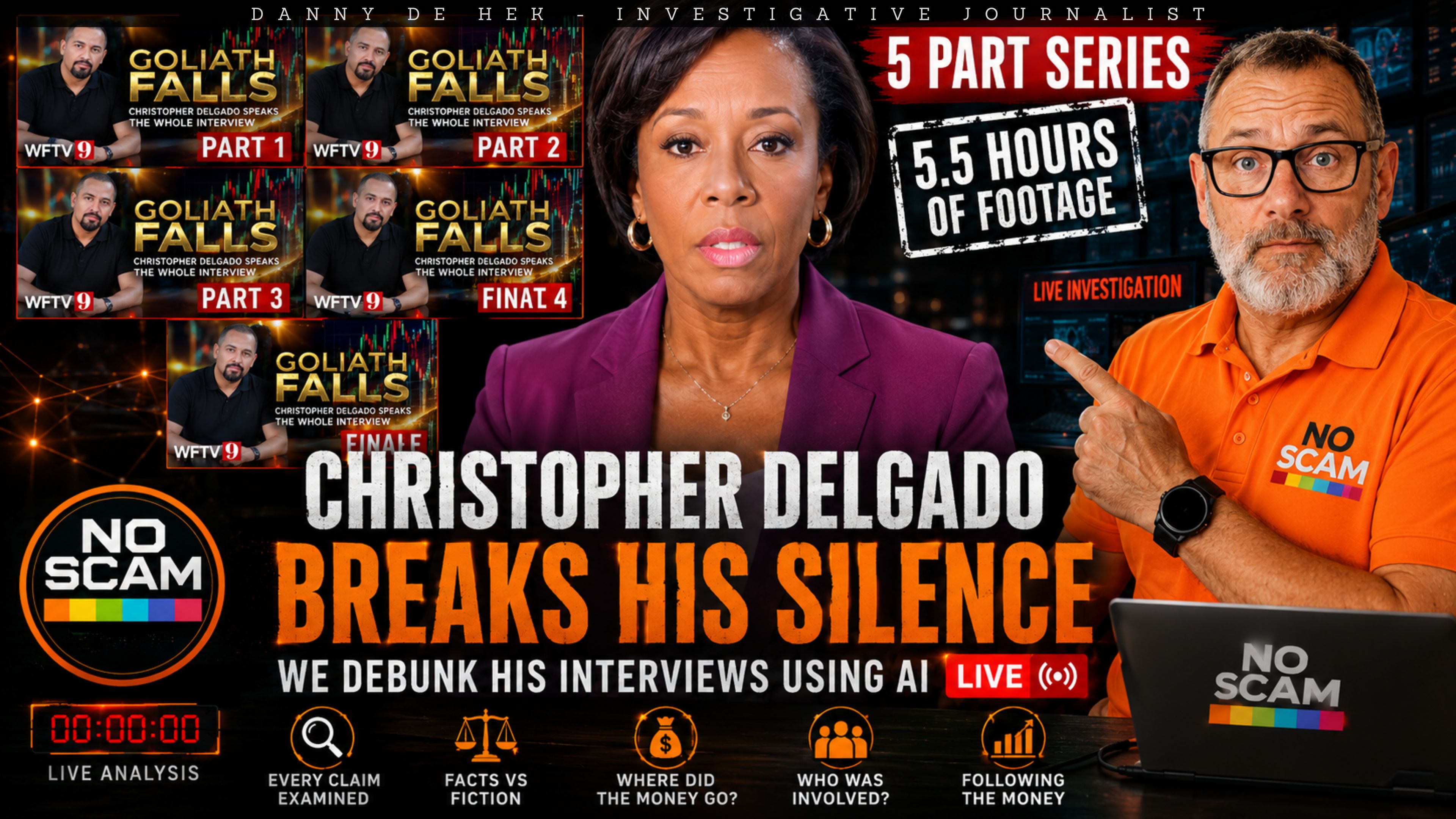
That’s why so many victims were furious watching the recent WFTV / Channel 9 interviews conducted by Daralene Jones with Christopher Delgado.
Instead of a hard-hitting investigative interview, viewers got a series of short edited segments that often felt more like a controlled public relations exercise than genuine accountability. Christopher Delgado was repeatedly allowed to emotionally frame himself as a businessman whose company “got away from him,” instead of being aggressively challenged over the mechanics of a Ponzi scheme that destroyed lives.
If you had never followed the Goliath story before, you might genuinely walk away thinking this was some startup founder who made a few bad decisions under pressure.
But that’s not what happened.
This was a man promising investors 3% to 8% monthly returns while living like a billionaire:
- Mansions
- Rolex collections
- Private jet travel
- Lamborghinis
- Dubai apartments
- Celebrity connections
- Luxury events
- Massive alcohol tabs
- Lifestyle marketing designed to attract trust
Meanwhile, victims were cashing out pensions, retirement accounts, mortgages, and life savings believing their money was safely invested.
This Didn’t Feel Like A Real Investigation
The biggest problem with these interviews is not that Christopher Delgado was given airtime. The problem is that he was largely allowed to control the emotional narrative without serious interruption.
At no point did the interviews truly drill into the impossible mathematics behind the business model.
At no point did Daralene Jones aggressively challenge how a company with no verified revenue stream could legally pay investors up to 8% every month.
At no point did she force him to explain how investor money was allegedly being recycled while he continued living an extraordinary luxury lifestyle.
Instead, the interviews repeatedly drifted into sympathy-building territory:
- His childhood
- His stress
- His emotions
- His fear of failure
- His intentions
- His regret
But victims didn’t lose retirement funds because Christopher Delgado had a difficult upbringing.
They lost money because they trusted a man projecting extraordinary wealth and success while the operation was collapsing behind the scenes.
One of the most frustrating parts for many victims is that mainstream media seems more interested in interviewing Christopher Delgado than aggressively investigating the wider network around him.
Why not identify the promoters?
Why not question the executives?
Why not approach the people appearing in recruitment videos?
Why not investigate the people earning commissions?
Why not examine the lifestyle marketing machine that helped pull victims into the scheme?
That’s what real investigative journalism is supposed to do.
You don’t wait at the bottom of the cliff after the bodies pile up.
You investigate the people pushing others toward the edge.
“You’re Not A Professional Journalist”
Daralene Jones reportedly did not want to speak with me because apparently I’m “not a professional journalist.”
That’s ironic considering independent investigators and whistleblowers were publicly exposing Goliath Ventures long before these interviews aired.
While traditional media was absent:
- Victims were documenting withdrawal freezes
- Researchers were tracing wallets
- Independent investigators were archiving evidence
- Whistleblowers were exposing contradictions
- Journalists like Coffeezilla were digging into the mechanics of the operation
The people who actually followed this collapse in real time were largely ignored while Christopher Delgado was handed a public platform to reshape the narrative before potentially spending decades behind bars.
And that’s exactly why victims are angry.
Because many of us have watched this unfold in real time.
We watched the lifestyle marketing.
We watched the recruitment.
We watched the impossible returns.
We watched the “trust me bro” culture around Christopher Delgado.
We watched ordinary people being emotionally manipulated into believing they had finally found financial freedom.
And now, after everything has collapsed, mainstream media turns up and allows Christopher to explain himself largely on his own terms from inside a luxury mansion allegedly purchased using investor money.
That’s not what victims wanted to see.
The Questions Daralene Jones Should Have Asked Christopher Delgado
- Christopher, before Goliath started using new investor money to pay existing investors, what legitimate revenue streams was the company actually generating?
- Can you show a single independently audited trading record proving Goliath consistently generated enough profit to legally pay investors 3% to 8% every month?
- If the Dubai fund supposedly held the money, what was the legal name of the fund, who controlled it, and why has nobody independently verified its existence?
- At what exact point did you realise investor withdrawals depended on new investor money coming in?
- Once you realised that, why did you continue accepting new investors instead of shutting the company down immediately?
- Why were you buying luxury mansions, Lamborghinis, private jet flights, Rolex watches, and spending allegedly over $100,000 on alcohol in a single night while investors believed their money was safely invested?
- How many properties did you personally purchase using funds connected to Goliath Ventures?
- Why did a company that supposedly had liquidity problems continue throwing extravagant events and lifestyle marketing campaigns instead of preserving capital?
- Did you deliberately use wealth, celebrity connections, luxury branding, and exclusivity to make investors trust you?
- If this was simply a “failed startup,” why were investors being promised fixed monthly returns instead of normal high-risk startup equity outcomes?
- What actual product was Goliath developing that you claim would eventually “fix everything”?
- Where are the developers, contracts, source code, partnerships, patents, or launch agreements connected to this supposed crypto product?
- Why did investors continue receiving contracts and promises while withdrawals were already freezing behind the scenes?
- Did any lawyer, accountant, compliance officer, or executive ever warn you that Goliath was operating like a Ponzi scheme?
- How much money did you personally withdraw or benefit from before the collapse of Goliath Ventures?
- Did you ever consider selling your luxury assets to repay investors before federal authorities intervened?
- Why should victims believe you are remorseful now when your luxury lifestyle continued right up until the collapse?
- You claim you never intended to run a Ponzi scheme — but isn’t continuing to take investor money after knowing the business could not meet withdrawals the very definition of fraud?
- If federal investigators had not intervened, would Goliath Ventures still be accepting investors today?
- You say you are cooperating now, but why didn’t you come forward voluntarily before the collapse instead of waiting until after investors lost hundreds of millions of dollars?
- If you truly believed the business could be saved by the “crypto product” you’ve mentioned, why did you and your inner circle continue heavy personal spending and asset purchases right up until the federal intervention instead of redirecting every available dollar into verifiable product development?
- Christopher, you and your partners repeatedly claimed that family funds invested in Goliath were “insured” or otherwise protected — what was the exact name of the insurance policy or guarantor?
- Why did Goliath continue accepting large wire transfers even after whistleblowers say redemption requests were already being delayed or denied?
- When was the exact moment you realised there wasn’t enough money for the next month’s payout?
- Some investors say hypercompounding was heavily pushed over monthly withdrawals. Who created the hypercompounding model and why was it encouraged?
- Christopher, have you personally lost money in scams or Ponzi schemes before, and were any of those models used as inspiration for Goliath Ventures?
- Why should the public believe these interviews were about accountability instead of damage control and sentence mitigation before more co-conspirators are exposed?
Victims Wanted Accountability — Not A Redemption Arc
Victims didn’t need another emotional interview about Christopher Delgado’s feelings.
They needed accountability.
They needed someone willing to challenge the fantasy, the lifestyle marketing, the impossible returns, the offshore stories, the luxury spending, and the people surrounding the operation.
They needed somebody willing to ask why a company with no proven sustainable revenue model was promising extraordinary monthly returns while its leadership lived like celebrities.
They needed somebody willing to challenge the narrative that this was simply a startup that “failed.”
Because startups fail all the time.
Startups don’t normally promise fixed monthly returns while investors unknowingly fund luxury mansions, exotic cars, private jets, celebrity events, and lavish lifestyles.
And this is why so many victims no longer trust mainstream media to tell these stories properly.
Too often the people doing the real investigative work are ignored until after the collapse.
Too often victims are treated like background characters while the scammers become the centrepiece of the story.
Too often journalists confuse access with accountability.
And right now, after watching these interviews, a lot of victims feel like Christopher Delgado was given an opportunity to soften his image instead of being truly challenged about the devastation left behind.
Because at the end of the day, this wasn’t just a failed business.
Real people lost real money.
And many of them are still waiting for real answers.
Disclaimer: How This Investigation Was Conducted
This investigation relies entirely on OSINT — Open Source Intelligence — meaning every claim made here is based on publicly available records, archived web pages, corporate filings, domain data, social media activity, and open blockchain transactions. No private data, hacking, or unlawful access methods were used. OSINT is a powerful and ethical tool for exposing scams without violating privacy laws or overstepping legal boundaries.
About the Author
I’m DANNY DE HEK, a New Zealand–based YouTuber, investigative journalist, and OSINT researcher. I name and shame individuals promoting or marketing fraudulent schemes through my YOUTUBE CHANNEL. Every video I produce exposes the people behind scams, Ponzi schemes, and MLM frauds — holding them accountable in public.
My PODCAST is an extension of that work. It’s distributed across 18 major platforms — including Apple Podcasts, Spotify, Amazon Music, YouTube, and iHeartRadio — so when scammers try to hide, my content follows them everywhere. If you prefer listening to my investigations instead of watching, you’ll find them on every major podcast service.
You can BOOK ME for private consultations or SPEAKING ENGAGEMENTS, where I share first-hand experience from years of exposing large-scale fraud and helping victims recover.
“Stop losing your future to financial parasites. Subscribe. Expose. Protect.”
My work exposing crypto fraud has been featured in:
- Coffeezilla 2026): Featured in the investigation exposing the alleged $328M Goliath Ventures Ponzi scheme
- Bloomberg Documentary (2025): A 20-minute exposé on Ponzi schemes and crypto card fraud
- News.com.au (2025): Profiled as one of the leading scam-busters in Australasia
- OpIndia (2025): Cited for uncovering Pakistani software houses linked to drug trafficking, visa scams, and global financial fraud
- The Press / Stuff.co.nz (2023): Successfully defeated $3.85M gag lawsuit; court ruled it was a vexatious attempt to silence whistleblowing
- The Guardian Australia (2023): National warning on crypto MLMs affecting Aussie families
- ABC News Australia (2023): Investigation into Blockchain Global and its collapse
- The New York Times (2022): A full two-page feature on dismantling HyperVerse and its global network
- Radio New Zealand (2022): “The Kiwi YouTuber Taking Down Crypto Scammers From His Christchurch Home”
- Otago Daily Times (2022): A profile on my investigative work and the impact of crypto fraud in New Zealand




Leave A Comment