


“The truth doesn’t become clearer because someone says it with confidence. It becomes clearer when the evidence begins to tell its own story.”
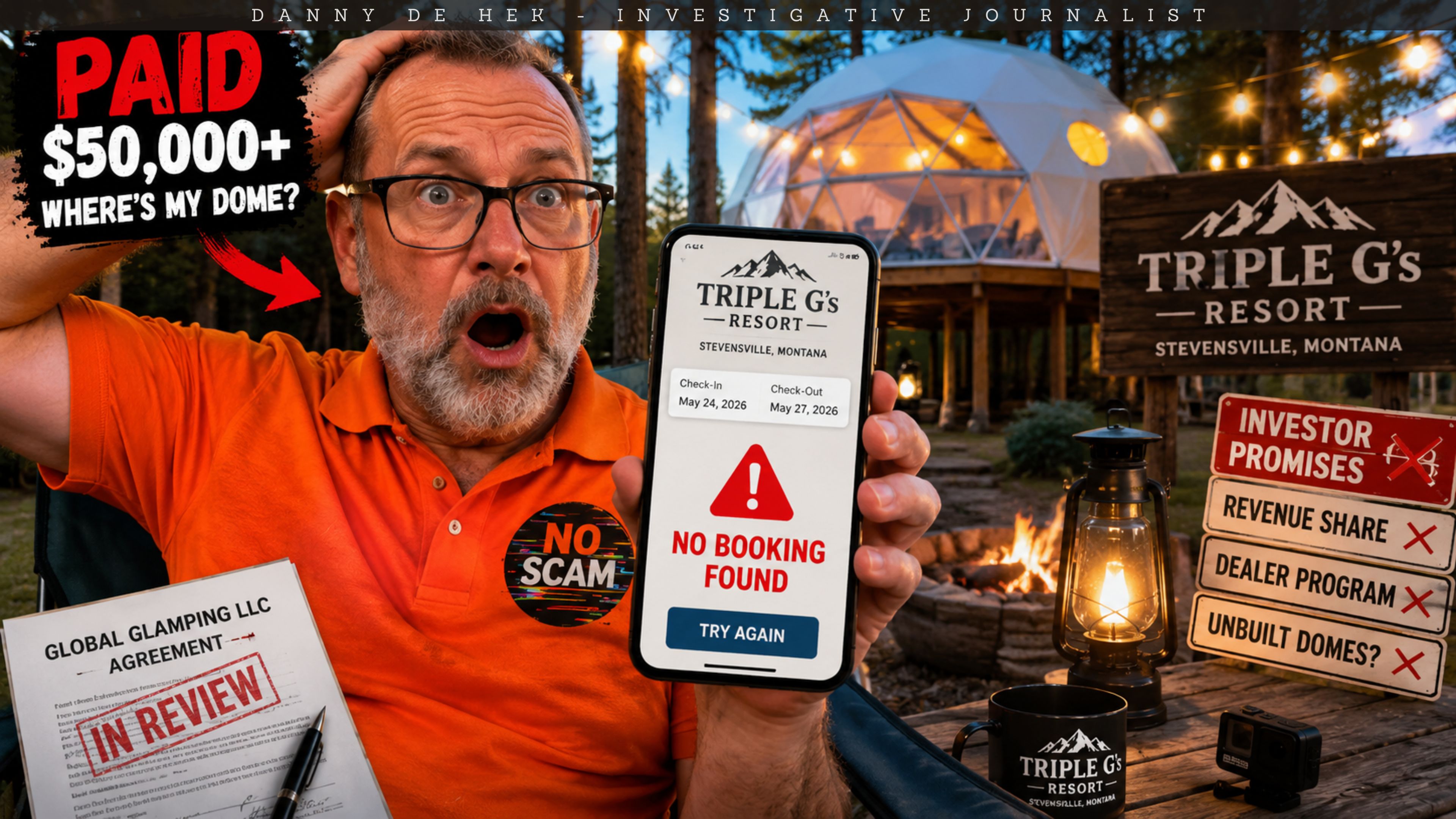
When I first received an email about Global Glamping, I almost dismissed it. My investigations normally centre on cryptocurrency Ponzi schemes, fake AI trading platforms and multi-level marketing frauds, not luxury glamping resorts in Montana.
On the surface, this appeared to be a business helping people build geodesic domes, launch eco-tourism ventures and create unforgettable outdoor experiences. It certainly didn’t fit the usual profile of the scams I spend my days exposing.
That changed with a single phone call.

The caller told me he had invested US$98,000 into Global Glamping’s Short-Term Rental (STR) Revenue Share Program. He believed he was purchasing a luxury geodesic dome that would be professionally managed, rented to holidaymakers and generate passive monthly income. For several months, payments even appeared in his bank account exactly as promised. Then the payments stopped. He says he later discovered the dome he had supposedly invested in had never been built. If that allegation is true, it raises a very obvious question: where did those earlier payments actually come from?
As I started pulling on that thread, more people came forward. Another investor described wiring US$82,000 after being shown what she believed were existing revenue-producing domes. Others claimed they had paid for dealership opportunities, glamping structures, consulting services and business packages that never materialised as they had expected. Their stories were different in the details, but they shared strikingly similar themes — ambitious promises, substantial upfront payments, mounting delays and increasingly difficult communication.
Over the following weeks, I began piecing the puzzle together. I interviewed investors, examined contracts, reviewed wire transfers, analysed archived websites dating back nearly a decade, compared marketing material, studied promotional videos, obtained court records and tracked an expanding network of companies linked to Devon Allan Towle. I also found something that made this investigation far more interesting than a simple contractual dispute. Unlike many of the outright scams I investigate, parts of this business appear to have been entirely genuine. Triple G’s Resort, one of the properties associated with Global Glamping, has accumulated hundreds of largely positive guest reviews, suggesting that at least some aspects of the hospitality business were operating successfully.
That distinction matters.
This investigation is not about claiming that every guest had a bad experience or that every part of Global Glamping was fictitious. In fact, the evidence suggests many people genuinely enjoyed their stay at Triple G’s Resort. Instead, the questions centre on a different side of the business — the sale of glamping structures, revenue-share investments, dealership opportunities and development packages worth tens of thousands of dollars. Those are the transactions now sitting behind multiple lawsuits, investor complaints and allegations that promised projects, structures or income were never delivered.
Before publishing this investigation, I have provided Devon Allan Towle with a detailed right of reply, giving him the opportunity to respond to the evidence, answer the questions raised by investors and explain his side of the story. If he responds, his answers will be included fairly and accurately. Until then, what follows is a reconstruction of the evidence currently available — a story that begins with a dream of building luxury glamping resorts, but ultimately leads somewhere far more complicated.
How Global Glamping Presented Itself
 To understand why so many people trusted Global Glamping, you first have to understand how the business presented itself to the world. This wasn’t a hastily thrown together website promising impossible riches or guaranteed overnight success. It was a polished brand built around the booming outdoor hospitality industry, complete with professional photography, detailed business packages, financing options, investor presentations and an image of credibility that would have appealed to many aspiring entrepreneurs.
The company’s central message was simple: Global Glamping wasn’t just selling geodesic domes—it was helping ordinary people build profitable glamping businesses. Whether you already owned land, dreamed of starting an eco-tourism venture or simply wanted passive income through a managed investment, Global Glamping claimed it had a solution. Visitors were encouraged to “Build Your Glamping Dream” with expert guidance covering everything from site planning and permitting through to marketing, bookings and long-term business growth.
The website described the business as a “full-stack concept-to-glampsite company”, claiming to help landowners, lifestyle entrepreneurs and investors launch profitable outdoor hospitality businesses. Prospective clients were told they could access custom-designed glamping structures, investor-ready financial projections, financing solutions, sustainable off-grid products and ongoing coaching after their site opened. It presented Global Glamping as a one-stop shop capable of taking someone from an idea on paper to a fully functioning luxury glamping destination.
For those who didn’t own land—or simply wanted a more passive role—the company promoted something altogether different. Its Short-Term Rental (STR) Revenue Share Model promised investors the opportunity to purchase a glamping structure located at one of Global Glamping’s own developments while the company handled the bookings, guest management and day-to-day operations. The website claimed investors would receive 42.5% of the revenue generated by their unit, describing it as a hands-free income stream where, in the company’s own words, “We handle the operations. You collect the cash flow.”
Global Glamping also marketed itself as a company with an impressive track record. Visitors were told founder and CEO Devon Allan Towle had transformed a single piece of raw Montana land into a thriving glamping business, generating $10,000 in revenue before a single structure was built and later producing $40,000 in bookings from a single yurt with 93% occupancy. The website further claimed the business had helped launch 48 or more glamping structures across Montana, Utah, Michigan and New York, while repeatedly highlighting references to Forbes, Hipcamp and other achievements intended to reinforce the company’s reputation.
None of those claims, on their own, prove wrongdoing. Successful businesses often promote their achievements, and there’s nothing inherently suspicious about helping people build glamping resorts or selling luxury accommodation. In fact, after reviewing hundreds of cryptocurrency investment schemes over the years, one of the reasons this investigation caught my attention was precisely because Global Glamping appeared to be attached to a genuine business operating in a real industry. That is what makes the questions raised by investors so important. If people were persuaded to invest because of these representations, the obvious question becomes whether the business consistently delivered what its marketing promised. That is where the investigation begins to take a very different turn.
The First Complaint That Landed In My Inbox
Like many of my investigations, this one didn’t begin with a court document or a government warning. It started with an email from someone who had been quietly following my work for several months. They had watched me expose cryptocurrency Ponzi schemes, fake investment platforms and multi-level marketing frauds, and believed the same investigative approach might help uncover what they alleged had happened to them through Global Glamping.
The first message was brief but immediately caught my attention.
“Hi Danny, that’s the website above. The company is called Global Glamping. The CEO is Devon Allan Towle, a scammer using the faith angle. I called the Montana Attorney General’s office and they know all about him and are investigating. Looks like another Ponzi scheme. Recently saw posts on Reddit, so people are starting to complain. My husband wired the money for a dome in Stevensville, MT. It was never built. Another scammer, unbelievable.”
At that stage, I treated the email exactly as I treat every allegation that arrives in my inbox—with caution. People can misunderstand contracts, businesses can experience genuine delays, and emotions often run high when large sums of money are involved. One person’s account is never enough to reach a conclusion. My job isn’t to amplify accusations; it’s to test them against evidence.
Then, almost immediately, another investor contacted me independently.
This individual described investing US$98,000 into Global Glamping’s STR Revenue Share Program. According to his account, he was told a luxury geodesic dome had already been built and that he would receive rental income from guests staying in the accommodation. For several months, payments were deposited into his bank account, apparently reinforcing the belief that everything was operating exactly as promised. It was only later, he says, that he discovered the dome had never been constructed. He now believes those earlier payments could not have been genuine rental income because, according to him, there was no completed structure capable of generating bookings.
 His account didn’t stop there. He explained that he and other investors had retained lawyers, spending thousands of dollars pursuing legal action, only to be warned that continuing the litigation might simply mean “throwing good money after bad.” He also claimed that investigators had identified Numerous LLCs Associated with Devon Allan Towle, making it difficult to trace where funds had ultimately gone. Whether those allegations can be proven remains an important question, but they immediately told me this investigation was likely to be far more complex than a single unhappy customer disputing a contract.
At that point, I made a conscious decision not to rush into publishing anything. Instead, I began doing what I always do—asking for contracts, bank records, emails, text messages, promotional material and anything else that could either support or contradict the allegations being made. If this was simply a failed business venture, the documents would likely show that. If it was something more serious, the evidence would begin to reveal a pattern. As more victims came forward, that pattern became increasingly difficult to ignore.
A Story That Didn’t Start In 2026
One of the advantages of investigating modern businesses is that very little ever truly disappears from the internet. Companies rebrand, websites are redesigned, domains expire and social media pages are deleted, but archived copies often remain. Before I looked at a single lawsuit, I wanted to understand how Global Glamping had evolved over time. That meant going back to the earliest digital footprints I could find.
Using the Internet Archive’s Wayback Machine, I began tracing Devon Allan Towle’s online business history. What emerged wasn’t a business that suddenly appeared out of nowhere in 2024 or 2025. Instead, it revealed an entrepreneur who had spent years building different ventures, each appearing to build upon the last. Some focused on digital marketing, others on custom structures, outdoor hospitality, wellness retreats and eventually investment opportunities centred around luxury glamping developments.
One of the earliest businesses I found was WDMC (We’re DAT Marketing Company). Archived versions of the website date back to 2017, with Devon identifying himself as the company’s founder. WDMC promoted website design, branding, social media management, paid advertising, reputation management and lead generation. Reading through those pages, it became obvious that Devon understood online marketing exceptionally well. The website wasn’t simply selling services—it was teaching businesses how to build trust, generate leads and increase conversion rates through carefully designed landing pages and sales funnels. Looking back, many of those same marketing techniques would later appear throughout the Global Glamping websites.
The next step in that evolution appears to have been 406 Structures, a Montana-based business promoting custom buildings, sheds and cabins. Archived pages describe professionally designed structures, quick delivery, high-quality construction and free design consultations with “406 Structures CEO – Devon.” Although the business focused on physical buildings rather than glamping resorts, it represented another step towards what would eventually become Global Glamping’s broader business model. Instead of simply marketing websites, the focus had shifted to marketing structures.
From there, the trail continued through a growing collection of brands and domains, including Wellness Glamping, ELUV8, Triple G’s Resort, and several others connected directly or indirectly through shared contact details, branding, telephone numbers, email addresses or overlapping marketing material. None of that is improper in itself. Many entrepreneurs operate multiple businesses. What interested me was how these companies appeared to complement one another. Rather than existing independently, they seemed to form part of a larger commercial ecosystem where accommodation, construction, consulting, marketing, financing and investment opportunities all intersected.
That historical context proved invaluable. It showed that Global Glamping wasn’t an isolated idea that appeared overnight. It was the product of years of development, branding and business experimentation. Understanding that evolution helped explain why many investors felt confident placing their trust in the company. By the time they encountered Global Glamping, they weren’t looking at a brand that appeared brand new—they were looking at what seemed to be the latest chapter in an established and growing business story. The question I still needed to answer was whether the reality behind that story matched the image being presented to prospective clients.
The First Court Case Changed Everything
Up until this point, I had been piecing the investigation together from interviews, contracts and archived websites. Those sources were invaluable, but they still represented individual experiences and marketing material. What I wanted next was something entirely different—documents filed under oath in a court of law. Court records don’t automatically prove every allegation made by the parties, but they do establish timelines, identify the people involved and often reveal details that would never appear in a glossy sales presentation.
It didn’t take long before one of my Avengers uncovered the first major lawsuit and shared the court filings with me, allowing the investigation to move in an entirely new direction.
Buried within the federal court filings was a case that immediately caught my attention because it pre-dated many of the investors who had recently contacted me. This wasn’t a dispute arising in 2025 or 2026. The litigation traced back to 2021, demonstrating that disagreements involving Global Glamping’s business model had surfaced years earlier.
According to the complaint, TJ Brindley, Jake Firth and Sean Culver entered into agreements with Global Glamping LLC and Devon Allan Towle after being presented with what was described as a turnkey investment opportunity. Rather than purchasing cryptocurrency or shares in a company, they were buying accommodation units that were to be placed on Global Glamping property and professionally managed as short-term rentals.
The court documents describe a marketing presentation that would sound familiar to anyone who has reviewed Global Glamping’s later Revenue Share material. Investors were told they could purchase fully managed accommodation units, receive monthly income and rely on Global Glamping to operate the business on their behalf. The complaint further alleges that the units were represented as being owned by Global Glamping and ready to generate income once installed.
Those allegations immediately stood out because they echoed many of the themes I had already heard from more recent investors. Different years. Different products. Different contracts. Yet remarkably similar expectations. Investors believed they were purchasing identifiable accommodation assets that would be managed for them while generating ongoing rental income.
It’s important to be precise here. A complaint is not proof. The allegations contained within court filings represent one side’s account of what occurred. However, what happened after those allegations were filed is no longer simply a matter of competing versions of events. As I continued reading through the docket, I discovered that the litigation eventually resulted in a settlement agreement, followed by a Federal Default Judgment when the agreed payments were allegedly not completed. That judgment forms one of the most significant pieces of documentary evidence uncovered during this investigation because it demonstrates that disputes over Global Glamping’s investment model were not isolated complaints posted online—they had already progressed through the United States federal court system years before many of the current investors became involved.
At that moment, the investigation changed direction. I was no longer asking whether recent investors had experienced similar problems. I was now asking a much larger question: if comparable allegations had already resulted in federal litigation years earlier, what, if anything, had changed before new investors continued entering Revenue Share agreements, dealer programmes and structure purchases? That question would become one of the central themes running throughout the rest of this investigation.
The Federal Judgment Wasn’t The End Of The Story
One of the assumptions people often make is that once a lawsuit is filed, the underlying problem simply disappears. Sometimes that’s true. Businesses settle disputes every day without admitting liability, and commercial disagreements are part of doing business. But what caught my attention here wasn’t simply that Global Glamping and Devon Allan Towle had been sued—it was what appeared to happen afterwards.
According to the federal court record, the parties eventually entered into a settlement agreement intended to resolve the dispute. On paper, that should have brought the matter to an end. Instead, the court documents show that the settlement itself later became the subject of further legal action after the plaintiffs alleged that the agreed payments had not been made in full. Ultimately, the court entered a default judgment against Global Glamping LLC and Devon Allan Towle, awarding more than US$205,000, together with prejudgment interest and legal costs.
That judgment is significant for a number of reasons. First, it establishes that the dispute progressed well beyond an unhappy customer posting complaints online. Secondly, it demonstrates that the allegations were serious enough to result in formal litigation and, ultimately, a judgment entered by a United States federal court. Finally—and perhaps most importantly for this investigation—it raises questions about what happened next.
As I compared the timeline of that litigation against Global Glamping’s marketing, something immediately stood out. The business didn’t appear to retreat from promoting investment opportunities. Archived websites, promotional videos, dealer programmes and Revenue Share offerings continued to appear after the earlier litigation had begun. The marketing became more sophisticated, not less. New websites were launched, additional business models were introduced and prospective clients continued to be invited to book consultations, purchase structures and invest in managed glamping developments.
That doesn’t automatically mean anything improper occurred. A company involved in litigation is still entitled to trade, and many businesses continue operating while defending legal proceedings. However, from an investigative perspective, the chronology matters. If earlier investors were alleging they had paid substantial sums for accommodation units that never generated the promised returns, it becomes important to understand what information was available to later investors before they committed their own money. Were they aware of the earlier litigation? Were they told about the federal judgment? Or did they believe they were investing in a business with an entirely clean history?
Those questions became even more pressing as additional victims began sharing their own documents with me. One after another, they described contracts signed years after the original federal case had commenced. Different locations. Different agreements. Different dollar amounts. Yet many of the underlying expectations sounded remarkably familiar: purchase a structure, allow Global Glamping to manage it, and receive income generated by paying guests. It was becoming increasingly difficult to ignore the similarities, and I realised the only way to properly understand them was to examine each investor’s experience individually before stepping back to see the broader pattern.
The Victims Started Finding Each Other
One of the most striking aspects of this investigation wasn’t something I discovered in a court file or on an archived website. It was watching complete strangers realise they weren’t alone.
When I first spoke with Roman D. Sturn, he believed his situation was unique. He had invested US$98,000 into what Global Glamping described as its Short-Term Rental (STR) Revenue Share Program. He explained that he had been told his dome was built, operational and generating rental income. Monthly payments even appeared in his bank account for several months, reinforcing his confidence that the investment was performing exactly as promised.
It was only later, he says, that he discovered the dome had never actually been constructed.
That revelation prompted him to start asking questions—not just of Global Glamping, but of other investors. As he searched online, he began finding Reddit discussions, Better Business Bureau complaints and eventually other people who believed they had experienced similar problems. By the time he contacted me, he was already aware of several investors with comparable stories.
As my investigation progressed, those isolated conversations gradually evolved into something much more organised. Investors who had never previously spoken to one another agreed to share contracts, emails, payment records and timelines. Some had invested in the Revenue Share Program. Others had purchased dealership opportunities. Others believed they were buying completed glamping structures or business development packages.
Despite those differences, certain themes appeared repeatedly.
Investors consistently described:
- significant upfront payments;
- detailed sales presentations;
- regular communication during the sales process;
- changing timelines after funds were transferred;
- increasing difficulty obtaining updates; and
- eventually reaching a point where communication either slowed dramatically or stopped altogether.
That doesn’t mean every investor had an identical experience, nor does it prove every allegation being made. Every contract stands on its own facts, and each person’s circumstances deserve to be considered individually. However, from an investigative standpoint, independently identifying similar patterns across multiple witnesses is significant. It provides a basis for asking whether those experiences are isolated contractual disputes or whether they form part of a broader picture.
As more people came forward, another common theme emerged. Almost everyone expressed regret that they hadn’t spoken to other investors before committing their money. Several told me that if they had known lawsuits were already underway, or that others were alleging similar experiences, they would have approached the opportunity very differently.
That is one of the reasons I publish investigations like this.
My objective isn’t to tell people what conclusions they should reach. It is to assemble the available evidence in one place so prospective investors, regulators, journalists and existing victims can see the broader picture for themselves. Individually, each complaint may appear to be an unfortunate business dispute. Collectively, they raise questions that deserve careful examination. And as the number of witnesses continued to grow, so too did the volume of documentary evidence supporting their accounts.
Carrie Kopp’s Story Raises Even More Questions
As the investigation gathered momentum, another investor contacted me whose experience added an entirely new dimension to the story. Carrie Kopp, from Illinois, didn’t simply hand me a few emails or a copy of her contract. She opened her entire file, allowing me to reconstruct almost every stage of her dealings with Global Glamping from the very first consultation through to the eventual breakdown of the relationship.
Over several days I reviewed well over one hundred screenshots, contracts, Calendly invitations, sales presentations, follow-up emails, marketing brochures, text messages and supporting documentation. Rather than relying on memories months after the events occurred, much of Carrie’s experience could be followed almost day by day through contemporaneous records. That chronology would ultimately become one of the cornerstone pieces of evidence in this investigation.
What immediately stood out was how professional the sales process appeared.
It wasn’t a high-pressure sales pitch or a hastily arranged phone call. Instead, it unfolded over several weeks through scheduled consultations, detailed written correspondence and carefully prepared marketing material. Carrie asked thoughtful questions about insurance, maintenance, expected occupancy, operating costs, dealer opportunities and projected returns. From the documents I reviewed, she appeared to be conducting exactly the sort of due diligence any prudent investor should undertake before committing a substantial amount of money.
The responses she received were equally detailed.
According to the emails I reviewed, discussions covered projected occupancy rates, nightly accommodation prices, expected annual revenue, dealer commissions, marketing support, booking optimisation, franchise arrangements and ongoing coaching. The impression created throughout the correspondence was that Global Glamping possessed an established system built upon practical experience rather than theory.
Then something happened that would become one of the most important factual questions in the entire investigation.
Carrie initially believed she was exploring the development of her own glamping project. As the discussions progressed, however, that proposal appears to have shifted. Instead of developing accommodation on her own land, the opportunity evolved into purchasing an interest in what were represented as six existing revenue-producing domes located in Washington State. That transition is documented throughout the correspondence, but one question remains unanswered:
Why did the proposal change?
At this stage of the investigation, I’m not suggesting that changing an investment proposal is, by itself, evidence of wrongdoing. Business opportunities evolve all the time. However, when an investor commits US$82,000 based upon one understanding of how the investment will operate, and the structure of that investment later appears to change significantly, it becomes an important issue requiring explanation.
That wasn’t the only question raised by Carrie’s documents. During our discussions she also pointed me towards another detail that I found particularly interesting. The funds she transferred were not, according to the records she provided, paid directly to Global Glamping LLC. Instead, they were wired to WDMC LLC—a separate company that, as I’ve already discussed, has its own history dating back years before Global Glamping was established. Whether there was a legitimate commercial reason for that arrangement is something I have specifically asked Devon Allan Towle to explain as part of his right of reply. At the very least, it demonstrates how closely intertwined the various businesses appear to have become, and why understanding the relationship between those entities is an important part of this investigation.
Following The Money
One of the advantages of having multiple victims come forward at the same time is that you begin seeing details that might otherwise be overlooked. As I compared contracts, bank records and wire confirmations from different investors, I wasn’t just looking at how much money had been invested—I was looking at where that money actually went.
That exercise quickly became more complicated than I expected.
Investors had been dealing with what they believed was Global Glamping LLC, yet the documents revealed payments flowing through a variety of different entities. Some funds were paid to Global Glamping LLC, others to WDMC LLC, while public records revealed numerous other limited liability companies associated with Devon Allan Towle over the years. On its own, operating multiple LLCs is not unusual. Many business owners separate different parts of their operations into individual legal entities for taxation, liability or operational reasons. The existence of multiple companies is not, by itself, evidence of wrongdoing.
The difficulty arises when investors are left uncertain about which company they were actually contracting with, which entity received their money, and which business ultimately carried the obligation to perform under the agreement. That distinction becomes particularly important if disputes later arise, because legal responsibility may depend on which entity signed the contract and accepted the funds.
As more documentation arrived, another pattern began to emerge. Several investors told me they had attempted to trace where their money had gone after projects stalled or communication deteriorated. In doing so, they discovered what they believed to be a web of interconnected companies that appeared to overlap through shared management, addresses, websites or banking arrangements. Some had already spent considerable sums instructing lawyers to investigate those relationships, only to discover that following the money through multiple entities could become an expensive exercise in its own right.
During my own research, I identified businesses and brands connected to Devon Allan Towle that included Global Glamping, WDMC, 406 Structures, Triple G’s Resort, ELUV8, Wellness Glamping and several others operating under different names and domains over the years. Again, I want to emphasise that entrepreneurs frequently own multiple businesses, and there may be entirely legitimate commercial reasons for doing so. However, because several investors have specifically questioned how funds moved between these entities, understanding those relationships forms an important part of this investigation.
For that reason, one of the questions I have put directly to Devon Allan Towle in my right of reply is straightforward. Can he explain the role each company played, why different entities received investor funds in different circumstances, and how those businesses interacted with one another? If there is a legitimate commercial explanation, this is precisely the sort of information that deserves to be placed on the public record alongside the allegations made by investors.
The Better Business Bureau Complaints Tell A Consistent Story
By this stage of the investigation, I had spoken with multiple investors, reviewed contracts, examined bank records and worked through a growing collection of court documents. I then turned my attention to another source of information that often proves valuable in investigations like this—the Better Business Bureau (BBB) Scam Tracker.
The BBB Scam Tracker should never be treated as proof that misconduct has occurred. Anyone can submit a complaint, and the allegations are not independently verified by the BBB before publication. However, when multiple complaints emerge from different parts of the country describing remarkably similar experiences, they become another piece of evidence that deserves careful consideration alongside everything else.
What immediately stood out was the consistency.
One complaint described an investor who said they had invested US$98,000 into Global Glamping’s Revenue Share Program after being told their dome had been built and was generating rental income. According to the complaint, payments were made for several months before the investor allegedly discovered the structure had never been constructed.
Another complaint came from an investor who said they had invested US$80,000, alleging that Global Glamping failed to build the promised dome before communication ceased.
A third complaint involved the purchase of three geodesic domes for approximately US$25,000. According to that report, delivery dates were repeatedly delayed, communication became increasingly difficult and the buyers eventually discovered other complaints relating to the business while trying to understand what had happened.
A fourth complaint described an alleged US$60,000 dealership investment, with claims that promised domes, websites and dealership services were never delivered as expected.
What struck me wasn’t the dollar amounts—although together they represented hundreds of thousands of dollars. It was the recurring themes.
Across the complaints, investors repeatedly referred to:
- substantial upfront payments;
- geodesic domes or dealership opportunities;
- promised business or investment returns;
- delays or projects that allegedly never materialised;
- increasing difficulty contacting Global Glamping; and
- significant financial losses.
None of these complaints, standing alone, establish liability. They represent the experiences reported by the individuals who submitted them. However, they become considerably more significant when viewed alongside the contracts, emails, lawsuits and witness interviews already forming part of this investigation.
Perhaps the most important observation is this: the BBB complaints were not what started my investigation—they simply echoed patterns I had already identified independently. By the time I discovered them, I had already interviewed investors, reviewed contracts and traced the history of Global Glamping’s marketing. Rather than changing the direction of the investigation, the BBB reports appeared to reinforce questions that were already emerging from the documentary evidence.
As I continued assembling the chronology, another source of information would prove equally revealing—not from investors, but from ordinary travellers who believed they had simply booked a weekend glamping getaway. Their experience would add an entirely different perspective to the story.
When Guests Started Asking Questions
Until this point, nearly every person I had spoken with had one thing in common—they had invested money into Global Glamping in some form. Then I came across something completely different.
It wasn’t an investor.
It wasn’t a lawsuit.
It wasn’t even someone looking to buy a dome.
It was a family who had simply booked a glamping holiday through Airbnb.
In June 2026, Angie Gift Dalton shared photographs and videos on Facebook after arriving at what she believed would be a luxury geodesic dome experience in Montana. Her post quickly attracted significant attention because the reality she encountered appeared dramatically different from the images used to market the accommodation.
According to her account, she and her family had booked the stay months in advance after being impressed by the listing photographs. She described being excited to finish their Montana holiday with what she expected would be a memorable glamping experience. Instead, she said that when they arrived late in the evening, something immediately felt wrong.
The access road to the domes was blocked.
As they made their way towards the accommodation, she says the property appeared abandoned and unfinished. The photographs she published showed damaged structures, debris, overgrown vegetation and what appeared to be incomplete or neglected facilities.
She wrote:
“When we first pulled in, something definitely felt off about everything.”
The situation became even more concerning when, according to her account, a man unexpectedly approached them on a bicycle and offered them a cabin instead. Feeling uncomfortable, they declined, left the property and contacted Airbnb, which she says refunded their booking.
After returning home, Angie says she began researching Global Glamping online.
Her Facebook post concluded:
“Google ‘Global Glamping scam’ for yourself and see what we found! FBI investigations, many scandals, fraud, misrepresentation, etc… we are convinced this is going to end in a Netflix documentary!!”
I want to be careful here.
Angie’s experience is not evidence that fraud occurred. It represents the observations of a guest who believed the property did not match her expectations and who chose not to stay. However, her photographs are relevant because they provide a visual snapshot of one of the locations associated with Global Glamping at a time when investors were simultaneously alleging that promised developments had stalled or failed to materialise.
What makes her post particularly interesting is that it came from someone with no apparent financial interest in the broader dispute. She wasn’t trying to recover an investment or enforce a contract. She was simply documenting what she says she encountered after arriving for a holiday.
That distinction matters.
Throughout this investigation I’ve found myself separating two very different sides of Global Glamping’s business. On one hand, there are guests who appear to have enjoyed their stays, reflected in the strong Google reviews for Triple G’s Resort. On the other, there are investors, dealership purchasers and now at least one disappointed guest whose experiences raise questions about whether every property and every opportunity was being presented as it actually existed.
As more evidence continued arriving from victims, one thing became increasingly apparent. This wasn’t a story that could be understood by looking at a single website or a single lawsuit. It required examining the entire business ecosystem—and perhaps most importantly, comparing what people were told with what they later discovered for themselves.
Looking Beyond The Marketing
One of the biggest mistakes an investigator can make is focusing on a company’s current website while ignoring everything that came before it. Websites change. Pages disappear. Claims are quietly rewritten. Businesses rebrand. Fortunately, the internet has a long memory.
Using archived copies preserved by the Wayback Machine, I began reconstructing the evolution of Devon Allan Towle’s online presence. Rather than finding a single business, I found a growing network of websites, each representing a different chapter in the story.
Among the domains I examined were:
- glamping.global (also redirected from globalglamping.com)
- 406structures.com
- wdmc4u.com
- wellnessglamping.com
- eluv8.shop
- triplegsresort.com
- glodomes.com
Viewed individually, each website appears to serve a legitimate commercial purpose. One promotes digital marketing services. Another sells custom buildings. Another advertises glamping accommodation. Others focus on wellness retreats, apparel, or geodesic domes. None of that is inherently unusual.
What interested me was how they appeared to build upon one another.
The earliest archived websites show Devon promoting digital marketing through WDMC (We’re DAT Marketing Company). Years later, the focus shifted towards custom structures through 406 Structures, before expanding into geodesic domes, glamping developments, dealer programmes and eventually passive investment opportunities through Global Glamping.
Rather than creating entirely unrelated businesses, the progression appeared remarkably logical.
Marketing expertise became structure sales.
Structure sales became glamping developments.
Glamping developments became investment opportunities.
Investment opportunities expanded into financing, dealership programmes and managed revenue-share models.
From a business perspective, that’s an ambitious strategy. If successful, it creates multiple income streams that complement one another. A customer might begin by booking a holiday, decide to purchase a dome, then become a dealer or investor. Every website effectively became another doorway into the same commercial ecosystem.
That observation also helps explain why many investors told me they never questioned the company’s credibility. They weren’t dealing with a single landing page created a few weeks earlier. They were looking at years of branding, multiple established websites, active social media accounts, promotional videos, genuine accommodation properties and a business story that appeared to have evolved naturally over time.
As I continued comparing archived websites with more recent marketing, another pattern became obvious. The language changed, but the core message remained remarkably consistent. Whether someone visited a website in 2021 or 2025, they were repeatedly presented with the same underlying themes: experience, credibility, rapid business growth, expert guidance and the opportunity to profit from the growing popularity of luxury outdoor accommodation.
Those marketing claims would become increasingly important as I compared them against what investors later told me actually happened.
The Revenue Share Model Deserves Close Examination
As I dug deeper into the evidence, I kept coming back to one part of Global Glamping’s business that appears repeatedly throughout investor interviews, contracts and marketing material—the Short-Term Rental (STR) Revenue Share Model.
Unlike customers purchasing a dome for their own property, Revenue Share investors were being offered something quite different. They weren’t expected to source land, obtain permits, manage bookings or clean accommodation between guests. Instead, the proposition was marketed as a passive investment where Global Glamping would do the heavy lifting while investors shared in the revenue generated by their individual structure.
The company’s website described the model in straightforward terms.
Investors were invited to purchase a luxury glamping unit located at one of Global Glamping’s developments. The company would handle the bookings, maintenance, guest management and day-to-day operations, while investors would receive 42.5% of the income generated by their unit each month. At the end of the investment period, investors were told they would have several options, including selling their structure or exercising what the company described as a buy-back option.
On paper, it was an attractive proposition.
For someone interested in the rapidly growing glamping industry, it appeared to remove many of the headaches normally associated with owning short-term accommodation. There was no need to purchase land, employ staff or advertise the property. According to the marketing, investors simply purchased a structure while Global Glamping managed everything else.
As I reviewed contracts and correspondence from multiple investors, however, I noticed that the Revenue Share model also created one significant point of reliance.
Everything depended on trust.
Investors generally had no direct control over the property, no day-to-day oversight of operations and no independent way of verifying occupancy, revenue or operating costs. They were relying almost entirely on information provided by Global Glamping regarding the status of their investment and the income it was supposedly generating.
That reliance becomes particularly important when viewed alongside the allegations now being made by several investors.
One investor alleges he was told his dome had already been constructed and was producing rental income when, according to him, it had never been built. Another says she invested after being shown what she believed were existing revenue-producing domes in Washington. Others describe expectations that specific structures would be developed, managed and placed into service before those plans allegedly changed or stalled.
I’m not suggesting those allegations have been proven. They remain allegations, and I have specifically invited Devon Allan Towle to respond to each of them as part of his right of reply. However, they do highlight why the Revenue Share model sits at the centre of this investigation. If investors are purchasing a passive income stream rather than taking possession of a physical asset themselves, confidence in the operator becomes absolutely fundamental. Once that confidence begins to erode, so too does the entire investment proposition.
As I continued comparing contracts with promotional material, another question began emerging—one that wasn’t about the Revenue Share model itself, but about how different opportunities appeared to evolve during the sales process. That became particularly apparent when I reconstructed the timeline of one investor’s journey from her very first consultation through to wiring more than US$82,000.
Reconstructing One Investor’s Journey
One of the advantages of receiving such a large volume of documentation from Carrie Kopp was that I wasn’t forced to rely on hindsight. Instead of trying to piece together fragmented memories months after the events occurred, I was able to reconstruct the relationship almost exactly as it unfolded through emails, Calendly bookings, contracts, presentations and written correspondence.
The timeline begins in January 2026 with an introductory consultation between Carrie and Devon Allan Towle. Shortly afterwards, she received what prospective clients would likely have considered a professional onboarding package. There were polished follow-up emails, a detailed Dream Packages brochure, automated marketing sequences and invitations to schedule further consultations. The overall impression was that of an established business with a structured sales process rather than an improvised sales pitch.
The marketing material itself painted an ambitious picture.
Carrie was introduced to concepts such as “Speed to Market,” “Credibility That Converts,” and a “plug-and-play ecosystem” that promised to help clients bypass many of the traditional hurdles involved in launching a glamping business. References to Forbes, Hipcamp, investor support and comprehensive development services were woven throughout the material, reinforcing the impression that Global Glamping had already refined a successful business model.
What impressed me most, however, wasn’t the sales material.
It was Carrie.
Long before transferring any money, she asked sensible, detailed questions that many investors never think to ask. She wanted to understand zoning requirements, insurance, maintenance costs, expected occupancy, operating expenses, franchise fees, booking systems and even whether Devon had previously been involved in litigation. Reading through the correspondence, I was left with the impression that she wasn’t acting impulsively. She appeared to be carrying out the sort of due diligence that financial advisers regularly encourage before making a substantial investment.
The responses she received were equally detailed. Occupancy rates were discussed. Revenue projections were provided. Dealer opportunities were explained. Financial models were shared. At no point did the correspondence suggest she was being rushed into making an immediate decision. Instead, the process unfolded over several weeks, allowing confidence and familiarity to develop before any funds changed hands.
Then the story takes an interesting turn.
From everything I’ve reviewed, Carrie initially appears to have been exploring the possibility of developing her own glamping project. Yet somewhere during the sales process, that proposal evolved into something very different. Instead of establishing accommodation on her own property, the opportunity became an investment involving six domes represented as existing or planned revenue-generating assets in Washington State.
Exactly when that transition occurred—and perhaps more importantly, why—is one of the questions I have specifically put to Devon Allan Towle in my right of reply.
That question matters because it goes to the heart of informed decision-making. Investors are entitled to change their minds, and businesses frequently adapt proposals to suit a client’s circumstances. But where an investment changes significantly during negotiations, understanding how and why that occurred is essential. The documentary trail suggests the opportunity Carrie ultimately invested in was materially different from the one she first discussed. Whether that evolution was properly explained is something that deserves a clear answer, supported by the documents rather than hindsight alone.
The Right Questions Needed To Be Asked
By the time I had spoken with several investors, reviewed court records and reconstructed Carrie’s timeline, I reached a point where it would have been irresponsible to continue the investigation without giving Devon Allan Towle an opportunity to respond.
That has always been an important part of my investigative process.
Too many online commentators publish allegations without ever contacting the person at the centre of the story. I take a different approach. If someone is facing serious allegations, particularly those involving substantial financial losses, they deserve the opportunity to explain their side of the story before conclusions are drawn.
With that in mind, I sent Devon a detailed right of reply outlining the evidence I had gathered and inviting him to address a series of specific questions. These weren’t designed as “gotcha” questions. They were based directly on contracts, investor correspondence, court records and marketing material that had already come into my possession.
Among the issues I asked him to explain were:
- the multiple lawsuits filed against him and Global Glamping;
- the allegations that some investors paid for domes they say were never built;
- why certain investor funds appear to have been paid to WDMC LLC rather than Global Glamping LLC;
- how the STR Revenue Share Model operated in practice;
- the relationship between the various companies connected to his business activities;
- whether all investor projects were completed as represented; and
- the growing number of complaints now appearing across public forums and the Better Business Bureau.
I also asked him to clarify several factual matters that had emerged repeatedly during my investigation.
For example, Global Glamping’s website states that the company has helped launch 48 or more glamping structures across multiple states. I asked whether that figure referred to structures the company owned, supplied, managed, consulted on or merely assisted in some capacity. That distinction matters because different readers could reasonably interpret the statement in different ways.
Likewise, I asked him to explain how the Revenue Share model was structured from both a legal and operational perspective. If investors were purchasing interests in specific accommodation units, how were those units identified? How were occupancy and revenue verified? What reporting did investors receive? These are straightforward questions that any prospective investor would likely want answered before committing tens of thousands of dollars.
At the time of writing, I am still awaiting Devon’s substantive response.
If he provides additional documents, explanations or evidence that materially changes the picture presented in this investigation, I will update this article accordingly. Fairness requires nothing less. My objective has never been to tell only one side of the story. It is to present the evidence as completely and accurately as possible, allowing readers to understand both the allegations and any explanations offered in response.
That commitment to fairness is particularly important in an investigation like this, where genuine hospitality businesses, multiple legal entities, ongoing litigation and competing factual claims all intersect. The stronger the allegations become, the more important it is that every party has an opportunity to be heard.
Looking At The Bigger Picture
I’ve spent years investigating cryptocurrency Ponzi schemes, fake AI trading platforms and MLM investment programmes. At first glance, Global Glamping doesn’t fit neatly into any of those categories. There are no trading bots promising 3% per day. There are no blockchain buzzwords or fictional exchanges. There are no anonymous founders hiding behind cartoon avatars.
Instead, this investigation centres on something much more tangible.
There are real businesses.
Real accommodation.
Real properties.
Real contracts.
And, according to the people I’ve interviewed, very real financial losses.
That distinction is important because not every failed business is fraudulent, and not every disappointed investor has been scammed. Markets change. Projects run over budget. Construction is delayed. Businesses fail every day without anyone acting dishonestly.
At the same time, history has shown that the existence of a legitimate business does not automatically validate every investment opportunity built around it.
One of the recurring themes throughout this investigation has been the difference between Global Glamping’s accommodation business and Global Glamping’s investment business.
For example, Triple G’s Resort currently enjoys an impressive 4.8-star Google rating from well over one hundred guests. Those reviews suggest many visitors genuinely enjoyed their stay. That is evidence I cannot simply ignore because it doesn’t fit a convenient narrative. If people had positive experiences at the resort, then those experiences deserve to be acknowledged.
Equally, I cannot ignore the evidence pointing in the opposite direction.
Multiple investors have now provided contracts, payment records and correspondence alleging they paid substantial sums for dealership opportunities, Revenue Share investments or glamping structures that they say were never delivered as represented.
Multiple lawsuits have been filed.
A federal judgment has already been entered in one case.
The Better Business Bureau contains numerous complaints describing remarkably similar experiences.
Independent witnesses who had never previously met have shared documents that appear to follow comparable timelines.
None of those facts prove every allegation.
But neither can they simply be dismissed as coincidence.
As an investigator, I’m not interested in defending or condemning anyone. My role is to examine the evidence, identify patterns and ask the questions that any reasonable prospective investor would want answered before committing tens of thousands of dollars.
That’s exactly what this investigation seeks to do.
The more evidence I uncovered, the less this became a story about a single unhappy investor.
It became a story about patterns.
Patterns in the marketing.
Patterns in the contracts.
Patterns in the promises.
Patterns in the complaints.
And perhaps most importantly, patterns that now deserve careful scrutiny by anyone considering doing business with Global Glamping or any of the associated companies connected to Devon Allan Towle.
Where The Investigation Goes From Here
This investigation is still in its early stages.
Since I first published that I was looking into Global Glamping, more investors have continued to contact me. Several have shared contracts, bank records, wire transfer confirmations, email correspondence, text messages and promotional material that had never previously been made public. Others have pointed me towards lawsuits, archived websites and business records that help build a much clearer picture of how the business evolved over time.
One thing has become obvious throughout this process: the evidence is still growing.
Every time I think I’ve reached the end of the paper trail, another witness comes forward with additional documentation. In several cases, people have contacted me after discovering they weren’t alone. Until now, many believed they were simply dealing with an isolated contractual dispute. It was only after reading public complaints, court filings or speaking with other investors that they realised their experiences appeared to mirror those of others.
That is one of the reasons I have deliberately chosen not to rush this investigation.
Rather than publishing sensational headlines based on a single interview, I have spent weeks gathering source material, verifying timelines and comparing documents from multiple independent witnesses. Wherever possible, I’ve relied on contemporaneous evidence rather than hindsight. Emails sent at the time, signed agreements, bank records and archived webpages often provide a much more reliable account than memories reconstructed months or years later.
As this investigation continues, there are still several important questions that remain unanswered.
Among them are:
- How many people invested in Global Glamping’s various programmes?
- How much money was invested across the different business models?
- How many projects were successfully completed compared with those that were not?
- What became of the structures that investors believed they had purchased?
- How were investor funds allocated between the various companies connected to the business?
- What explanations, if any, will Devon Allan Towle provide in response to the evidence presented in this investigation?
Those are not rhetorical questions. They are genuine questions that deserve clear, evidence-based answers.
If additional victims come forward, I encourage them to provide original documentation wherever possible. Contracts, invoices, payment confirmations, bank records, emails, text messages and photographs are all considerably more valuable than recollections alone. Likewise, if current or former employees, contractors or business associates possess information that helps explain how Global Glamping operated behind the scenes, I would be interested in reviewing that material as part of this ongoing investigation.
Finally, I want to reiterate something that has guided every investigation I’ve undertaken over the years.
This article is not a finding of liability, nor is it a substitute for a court proceeding. It is an investigative examination of publicly available records, documentary evidence supplied by multiple witnesses, archived marketing material and interviews conducted during the course of my research. Where allegations have been made, I have identified them as such. Where court judgments exist, I have referred to the public record. Where facts remain disputed, I have invited Devon Allan Towle to respond and will fairly publish any substantive response he provides.
Investigations like this are rarely finished in a single article.
More often, they become living documents that grow as new evidence emerges. Based on the number of people who have already contacted me—and the volume of material I continue to receive—I suspect this will be one of those investigations.
A Personal Note To Devon Allan Towle
Devon, if you’re reading this, I want you to know that I haven’t spent weeks investigating your business because I have a personal grudge against you. Before this investigation began, I had never spoken to you. I didn’t know your name, your businesses or your background. Like many of the people who have now contacted me, I discovered Global Glamping because someone believed they had been seriously wronged and asked me to take a closer look.
I’ve built my reputation over many years by investigating organised fraud. Sometimes those investigations uncover genuine Ponzi schemes. Sometimes they reveal misleading business practices. Occasionally they uncover nothing more than failed business ventures and broken promises. I don’t start with a conclusion and then look for evidence to support it. I start with the evidence and let it lead me wherever it goes.
That’s exactly what I’ve done here.
Since beginning this investigation, I’ve reviewed thousands of pages of material. I’ve spoken with multiple investors. I’ve examined contracts, wire transfers, court filings, archived websites, promotional videos, marketing presentations and business records. I’ve deliberately sought out information that both supports and contradicts the allegations being made against you because that’s how responsible investigative journalism should be conducted.
You’ll notice throughout this article that I’ve acknowledged evidence which reflects positively on your business. Triple G’s Resort appears to have many satisfied guests, and I have said so. I’ve recognised that operating multiple LLCs is not, in itself, evidence of wrongdoing. I’ve repeatedly distinguished between allegations, established facts and unresolved questions. That wasn’t accidental. It was intentional.
Before publishing this investigation, I also gave you an opportunity to respond.
My right of reply wasn’t a token gesture. It was a genuine invitation to explain the issues raised by investors, the lawsuits, the judgments, the complaints and the documentary evidence I’ve reviewed. If there are explanations that place these matters into a different context, I want to hear them. If there are factual inaccuracies in this investigation, I will correct them. If there are documents that materially change the picture, I will review them with an open mind.
My audience expects me to be fair.
Victims deserve to have their stories heard.
Equally, the person at the centre of an investigation deserves the opportunity to respond.
If your explanation is supported by evidence, I will publish it.
If your response raises additional questions, I’ll investigate those too.
That’s how journalism is supposed to work.
At the end of the day, this investigation isn’t about me, and it isn’t even about you. It’s about the people who entrusted substantial sums of money to your businesses and are still searching for answers. They deserve clarity. They deserve transparency. Most importantly, they deserve an explanation that addresses the evidence rather than avoiding it.
The door remains open. If you’d like to sit down for an interview, provide documentation or respond to any aspect of this investigation, I’ll consider it fairly and publish your response in full where appropriate. That’s a standing invitation, and it remains open regardless of when you decide to accept it.
This Investigation Continues
When I started looking into Global Glamping, I expected to review a few contracts, speak with one or two investors and perhaps write a short article about a business dispute.
Instead, I’ve uncovered a growing body of evidence spanning multiple years, multiple lawsuits, multiple business entities and a steadily increasing number of people who all describe remarkably similar experiences.
Some of those experiences are supported by contracts.
Some are supported by bank records.
Some are supported by court filings.
Others are supported by archived websites, marketing material and contemporaneous correspondence.
Collectively, they raise important questions that deserve answers.
As this investigation continues, I expect additional investors, former employees, contractors and business associates may come forward with further information. If that happens, I’ll continue reviewing the evidence objectively and updating this article accordingly.
If you’ve had dealings with Global Glamping, Devon Allan Towle, or any of the associated businesses discussed in this investigation, I’d like to hear from you.
I’m particularly interested in original source material, including:
- signed contracts;
- wire transfer confirmations;
- invoices;
- emails;
- text messages;
- WhatsApp conversations;
- photographs;
- promotional material; and
- any other documents that help establish what was represented and what ultimately occurred.
Likewise, if Devon Allan Towle wishes to respond to any aspect of this investigation, my invitation remains open. If he provides evidence that materially changes the facts presented here, or offers explanations that deserve to be included, I will review that material fairly and update this investigation where appropriate.
The objective has never been to win an argument.
It’s to establish the facts.
And at this stage, there are still far more questions than answers.
Disclaimer: How This Investigation Was Conducted
This investigation relies entirely on OSINT — Open Source Intelligence — meaning every claim made here is based on publicly available records, archived web pages, corporate filings, domain data, social media activity, and open blockchain transactions. No private data, hacking, or unlawful access methods were used. OSINT is a powerful and ethical tool for exposing scams without violating privacy laws or overstepping legal boundaries.
About the Author
I’m DANNY DE HEK, a New Zealand–based YouTuber, investigative journalist, and OSINT researcher. I name and shame individuals promoting or marketing fraudulent schemes through my YOUTUBE CHANNEL. Every video I produce exposes the people behind scams, Ponzi schemes, and MLM frauds — holding them accountable in public.
My PODCAST is an extension of that work. It’s distributed across 18 major platforms — including Apple Podcasts, Spotify, Amazon Music, YouTube, and iHeartRadio — so when scammers try to hide, my content follows them everywhere. If you prefer listening to my investigations instead of watching, you’ll find them on every major podcast service.
You can BOOK ME for private consultations or SPEAKING ENGAGEMENTS, where I share first-hand experience from years of exposing large-scale fraud and helping victims recover.
“Stop losing your future to financial parasites. Subscribe. Expose. Protect.”
My work exposing crypto fraud has been featured in:
- Coffeezilla 2026): Featured in the investigation exposing the alleged $328M Goliath Ventures Ponzi scheme
- Bloomberg Documentary (2025): A 20-minute exposé on Ponzi schemes and crypto card fraud
- News.com.au (2025): Profiled as one of the leading scam-busters in Australasia
- OpIndia (2025): Cited for uncovering Pakistani software houses linked to drug trafficking, visa scams, and global financial fraud
- The Press / Stuff.co.nz (2023): Successfully defeated $3.85M gag lawsuit; court ruled it was a vexatious attempt to silence whistleblowing
- The Guardian Australia (2023): National warning on crypto MLMs affecting Aussie families
- ABC News Australia (2023): Investigation into Blockchain Global and its collapse
- The New York Times (2022): A full two-page feature on dismantling HyperVerse and its global network
- Radio New Zealand (2022): “The Kiwi YouTuber Taking Down Crypto Scammers From His Christchurch Home”
- Otago Daily Times (2022): A profile on my investigative work and the impact of crypto fraud in New Zealand



Leave A Comment