




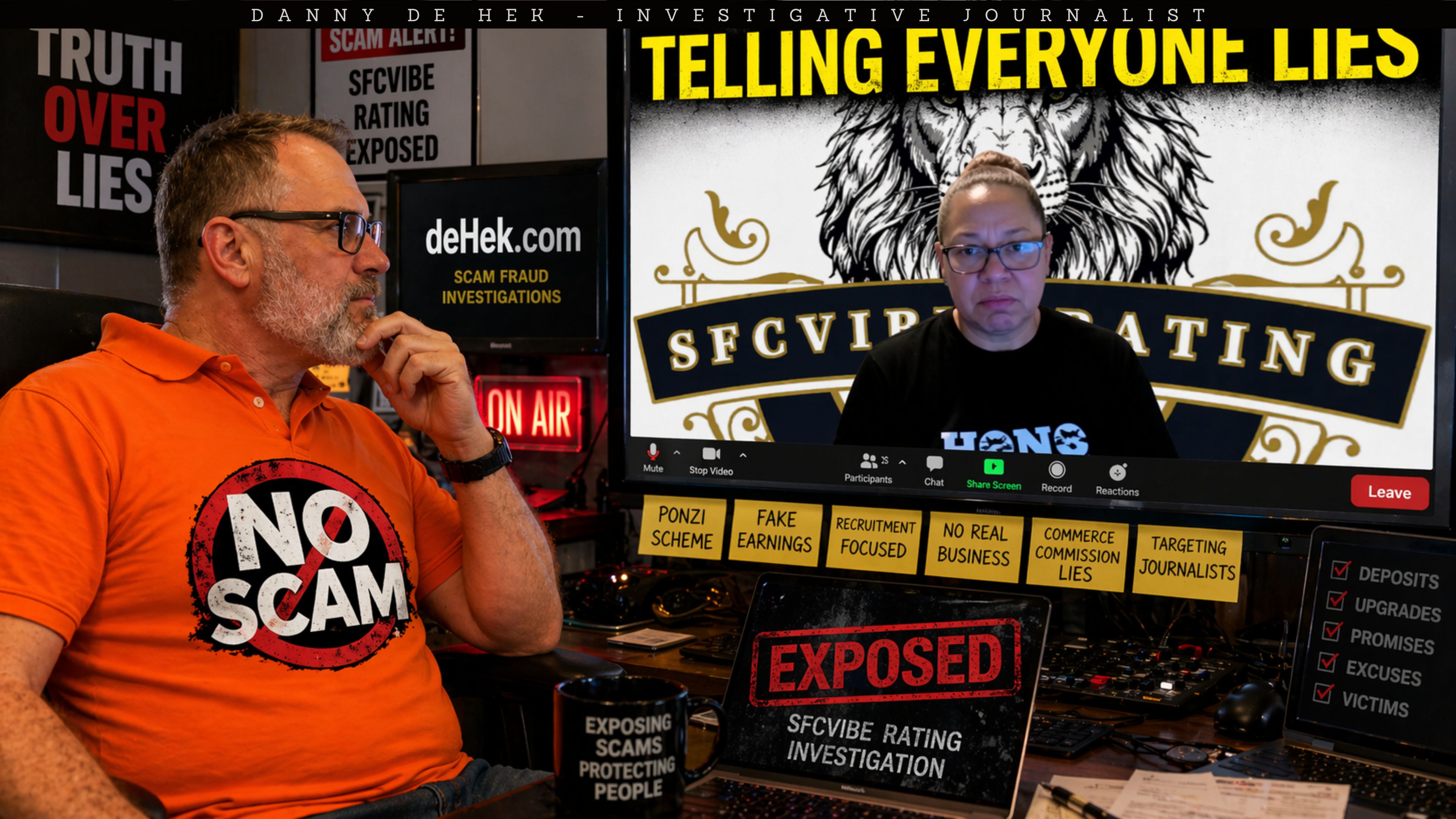

“If you have to pay money to get a job, it’s not a job — it’s a scam.”
A Christchurch family sits at home staring at empty accounts after trusting what they were told was a simple way to earn money online.
They weren’t gambling. They weren’t trading. They were told they’d be paid to rate movies. What followed was a chain of deposits, upgrades, pressure to recruit, and eventually, silence when they tried to withdraw.
This is the reality behind SFCVIBE Rating Limited — a platform presenting itself as a global film analytics company while now under investigation in New Zealand as a suspected pyramid scheme. Over the past few weeks, I’ve reviewed the media coverage, analysed the website, examined the company structure, tracked the app distribution, and compared the model to patterns I’ve seen in other schemes before.
What emerges isn’t just a questionable opportunity or a poorly explained business. It’s a recognisable and repeatable pattern — one built on deposits, tiers, recruitment, and manufactured credibility, now spreading through local companies, online groups, and a platform that raises serious questions about transparency, accountability, and consumer safety.
The story they sold
Before anyone lost money, SFCVIBE built a narrative designed to pass a casual credibility check. In late 2025, the company began publishing press releases presenting itself as a global film data platform, powered by artificial intelligence and operating across international markets. It spoke about analytics, audience insights, and digital infrastructure — language that sounds technical, legitimate, and forward-looking.
By October, that narrative escalated. The company claimed a $5 million global advertising campaign, along with “regional hubs” in cities like London, Tokyo, and Los Angeles. A month later, they introduced what they called a “User Growth Points System,” rewarding users for promoting the platform and increasing its visibility. On paper, it looked like engagement. In practice, it was structured promotion — turning users into marketers without calling it recruitment.
This is where the story becomes more important than the product. Because while the messaging became more polished, the underlying business model remained vague. There was no clear explanation of revenue, no verifiable client relationships, and no independent confirmation of the partnerships being referenced. The platform positioned itself as part of the global film industry — but provided no evidence of where the money was actually coming from.
And that’s the critical point. The narrative was designed to be convincing at a glance. It sounded like something real, something scalable, something already established. But when you look past the language and into the substance, the foundations are missing. And in cases like this, that gap between what’s claimed and what’s proven is where the real risk begins.
How the system actually works
Once you move past the branding, the structure becomes much clearer. Users are told they can earn money by completing simple tasks — typically rating movies or short video clips. But before they can begin, they are required to pay an upfront deposit to unlock access to the system.
The platform then introduces a tiered membership structure, ranging from entry-level accounts to high-tier packages costing thousands of dollars. Each level promises higher daily returns. The numbers are fixed, predictable, and scale directly with the amount deposited. That’s not how real work behaves — it’s how investment-style returns are presented inside a controlled system.
 The deeper you look, the more the mechanics align with something else entirely. Users are not just encouraged to complete tasks — they are incentivised to bring in others. Commissions are paid on recruitment, and those payments flow upward through the structure. The tasks themselves — clicking buttons, submitting ratings — serve as a visual layer, not an economic one.
A tip of the hat to Oz at BehindMLM, who has already classified SFCVIBE as part of the “click-a-button” Ponzi model — a system where there is no external revenue, and funds from new participants are used to pay earlier ones.
The New Zealand companies behind the operation
As I continued digging, something else stood out — SFCVIBE didn’t just exist online, it rapidly built a physical and corporate footprint across New Zealand. What initially looked like a single operation expanded into multiple locally registered companies, each tied to a different region and controlled by a different individual. On paper, these are separate New Zealand entities. But when you line them up, the pattern becomes difficult to ignore.
Companies Office records show at least five SFCVIBE-branded companies established within a short timeframe:
- SFCVIBE Rating Riccarton Limited (Incorporation 27 Jan 2026) – Director: Ronald Bernard Vaz 📞 (Christchurch)
- SFCVIBE Rating Dominion Limited (Incorporation 17 Feb 2026) – Director: Teupoo Ngametua (Auckland)
- SFCVIBE Rating Manukau Limited (Incorporation 19 Feb 2026) – Director: Fane Tupou Hafoka 📞 (Auckland)
- SFCVIBE North West Limited (Incorporation 27 Feb 2026) – Director: Robin Stanley Wheeler 📞 (Auckland)
- SFCVIBE Kawerau Limited (Incorporation 15 Apr 2026) – Director: Skyla Matenga (Kawerau)
All of these companies were incorporated between late January and mid-April 2026. Each has a single director, no listed ultimate holding company, and no constitution filed. That structure is not unlawful in itself — but it is unusual for a platform presenting itself as a globally coordinated operation with significant funding and international partnerships. There is no visible parent entity, no central governance, and no clear explanation of how these companies connect to the broader SFCVIBE platform.
One name is already firmly in the public domain. Ronald Vaz, the director of the Riccarton-based entity, has appeared in multiple New Zealand media reports as a spokesperson for the platform. He has publicly defended the model, denied it is a pyramid scheme, and attributed complaints to misuse by users. That places him directly in the operational narrative — not just as a listed director, but as someone actively promoting and representing the system locally.
Other directors are less visible in mainstream reporting, but their names have surfaced in community-level discussions and warning posts, particularly within Pacific community groups where concerns about SFCVIBE have been actively shared. It’s important to be clear — these discussions are not independently verified findings, but they do indicate that awareness of these individuals is circulating among communities being targeted by the scheme.
What this ultimately reveals is not proof of wrongdoing by any individual, but something just as important — a decentralised local structure, rolled out quickly, with identifiable individuals fronting different regions and no clear central oversight visible from the outside. In situations like this, that matters. Because if the system fails, the question becomes very simple:
Who is responsible, and where does accountability actually sit?
The early warnings — before New Zealand caught up
What stands out in this case is how early the warnings began overseas. In February 2026, the Consumer Council of Fiji issued a clear alert, describing SFCVIBE as a “sophisticated task-based pyramid scheme designed to defraud users.” They identified the key mechanics immediately — upfront payments, tiered access, and recruitment incentives driving the system. Those warnings didn’t come after a collapse — they came while the platform was still actively expanding.
At the same time, reports were already emerging of users being unable to withdraw funds. Conditions were being added, accounts were being restricted, and users were being told to complete more tasks or upgrade their level before accessing their money. These are not isolated complaints — they are consistent with how these systems behave when liquidity tightens, when more people try to take money out than are putting money in.
In New Zealand, the Commerce Commission has opened an investigation, confirming that SFCVIBE is a Suspected Pyramid Scheme under the Fair Trading Act. The case is active, and the outcome is still to be determined. But the warning is already there: exercise caution.
What’s harder to ignore is the gap between these warnings and the broader regulatory response. Despite widespread media coverage, international alerts, and a growing body of evidence, there has still been no public warning issued by the Financial Markets Authority at the time of writing. That’s not just a delay — it raises serious questions about response time and accountability.
I’ve already submitted a formal complaint to the FMA outlining the structure of the platform, the risks to New Zealand consumers, and the volume of publicly available evidence. The reality is, much of the early warning in cases like this is being driven by journalists, independent investigators, and community discussions, rather than by the regulator that’s expected to lead on financial risk. When that happens, it creates a gap — and that gap is where more people get pulled in before any formal warning appears.
At some point, the question needs to be asked: are regulators moving fast enough to keep up with how quickly these schemes operate, or are they relying on others to do the early work for them? Because when the warning signs are this visible, the issue isn’t whether action is needed — it’s whether it’s coming soon enough to make a difference.
The illusion of credibility
One of the most revealing parts of this investigation is how SFCVIBE builds trust. On the surface, their website appears to feature “news coverage” from major outlets like Yahoo Finance and AP News. But when you follow those links, they don’t lead to independent journalism — they lead back to press releases distributed by the company itself.
This is a well-known tactic. A company writes its own promotional content, pushes it through PR distribution networks, and then presents those placements as if they were earned media coverage. The same article appears across multiple platforms, creating the impression that “everyone is reporting on it.” In reality, it’s the same message, repeated without independent verification.
Once you recognise the pattern, the credibility starts to unravel. These aren’t investigations, they’re company-authored narratives, placed in environments that look like trusted news sources. For someone encountering this for the first time, it can be convincing — especially when the branding of those platforms is used to reinforce legitimacy.
At the same time, promoters have been telling users the platform is connected to major global brands — including companies like Walt Disney Company, Tesla, and Coca-Cola. There is no independently verified evidence supporting these claims. They function as credibility anchors, designed to lower scepticism and accelerate trust.
The website that tells the real story
When you strip away the marketing, the platform’s own website reveals more than any press release ever could. The income structure is laid out clearly: deposits unlock earning tiers, and each tier promises a fixed daily return. There is no ambiguity here — you pay money, and you are told what you will earn in return.
What’s missing is just as important as what’s present. There are no terms and conditions, no privacy policy, and no legal disclosures explaining user rights or obligations. The main domain leads directly to a login page, offering no transparency about who is running the system or how it operates. Even the contact email listed on the website is a Gmail address — and when I sent a formal right of reply to that address, it was returned as undeliverable:
“Address not found — Your message wasn’t delivered to fcvibe2020@gmail.com because the address couldn’t be found or is unable to receive email.”
That raises immediate concerns about whether there is any functional or accountable point of contact at all.
This isn’t a minor oversight. It’s a structural issue. A platform that handles deposits, user data, and financial transactions without basic legal documentation — and without a working contact channel — is operating without a defined framework of accountability.
The app that raises serious security concerns
Then there’s the app.
The website presents download buttons for the App Store and Google Play, alongside wording that explicitly suggests you are downloading a legitimate app from those platforms. But when you click those links, you are not taken to either store. Instead, you are directed to direct download files — a .mobileconfig profile for iOS and an .apk file for Android, hosted on their own domain.
That distinction matters. This isn’t just a technical workaround — it’s a mismatch between what is being presented and what is actually delivered. The branding and wording create the impression of App Store verification, but the reality is something entirely different. There is no Apple or Google review, no independent security checks, and no platform-level accountability.
To understand why this is significant, it’s worth looking at how these ecosystems normally operate. Getting an app approved on the App Store is deliberately difficult, particularly for platforms involving money, user accounts, or financial activity. Apple applies strict controls around security, privacy, and data handling. Even on Google Play, where the barriers are lower, there are still baseline protections — and yet we’ve already seen how fake apps, particularly in crypto, can slip through.
In previous investigations, I’ve seen operators go to extraordinary lengths to get around these restrictions — creating entirely separate brands, submitting “clean” versions of apps, and disguising the real functionality just to pass review. That behaviour, while deceptive, at least acknowledges one thing: App Store approval carries weight because it signals trust.
What makes this case different is that SFCVIBE hasn’t even attempted to meet that standard. Instead, it uses the appearance of App Store legitimacy while directing users to install files that bypass those protections entirely. That’s not just cutting corners — it removes the very safeguards designed to protect users in the first place.
A .mobileconfig file is not a standard app — it’s a configuration profile that can modify device settings, install certificates, and influence how a device connects to networks. An .apk file installed outside Google Play requires users to override built-in protections, opening the door to software that hasn’t been independently reviewed. I’m not suggesting what this specific software is doing, but the method itself introduces avoidable and unnecessary risk.
For a company presenting itself as a global, professional platform, this isn’t a minor technical detail — it’s a fundamental break from normal, transparent, and accountable practice.
Why people believe it
Despite everything that’s already out there — the warnings, the complaints, the structural red flags — people are still joining. And that’s worth understanding, because this is where these systems are most effective.
In the early stages, the platform works just enough to build belief. Small withdrawals may go through. Early participants may see returns. The dashboard shows growing balances, daily earnings, and structured progress, all designed to reinforce the idea that something legitimate is happening. From the inside, it doesn’t feel like a scam — it feels like a system that’s working.
That belief is then amplified through social proof. Friends invite friends. Family members bring each other in. WhatsApp and Telegram groups create a constant stream of screenshots, success stories, and encouragement. Once that network effect kicks in, doubt gets replaced with reassurance — not from the company, but from people you already trust.
But underneath that, the structure doesn’t change. The returns are not tied to any verifiable external activity. They depend on new money entering the system. And when that’s the case, the outcome is mathematically constrained. It doesn’t matter how convincing it looks or how many people believe in it — not everyone can win.
At some point, the balance shifts. More people try to withdraw than deposit. The system tightens. Conditions change. And the same mechanism that created belief at the start becomes the reason people are left holding the loss at the end.
The questions they should be able to answer
At its core, this isn’t complicated. If a business is legitimate, it should be able to withstand basic scrutiny. Not legal arguments. Not technical deflections. Just clear, direct answers to simple questions.
These are the kinds of questions anyone involved — or thinking about getting involved — should be asking. And more importantly, these are the kinds of questions that should be answered without hesitation.
- Can you confirm whether any law enforcement agency has ever contacted or investigated this business?
- Has the Commerce Commission reviewed or taken any interest in your model?
- How do you respond to claims that this structure resembles a pyramid scheme?
- What evidence exists to support claimed partnerships with major studios like Disney, Universal, or Sony?
- Where does the money actually come from that pays users for rating movies?
- Who are the paying clients, and can any of them be independently verified?
- If new deposits stopped today, how would existing users continue to be paid?
- What proportion of payouts comes from external revenue versus member deposits?
- Who is using the “movie rating” data being generated?
- Can a single real-world example be provided of a company paying for that data?
- Why would established studios outsource this work to unknown participants instead of using proven platforms?
- Do users earn more from completing tasks, or from recruiting other people?
- If someone chooses not to recruit, can they realistically earn the same income long-term?
- How is this different from a system where income depends on new participants joining?
- Are there conditions that can delay or restrict withdrawals?
- Why are users reporting they must upgrade or complete more tasks before accessing their funds?
- What is the longest verified withdrawal timeframe for a user in New Zealand?
- Why are multiple companies set up across New Zealand under different directors?
- Who is the ultimate parent entity behind these companies?
- Who is legally responsible for user funds in New Zealand?
- Is the business registered with any financial regulator in New Zealand?
- How do you respond to the ongoing Commerce Commission investigation?
- Why has there been no public support or statement from the Financial Markets Authority?
- Why does the website suggest downloading from official app stores while directing users to install files instead?
- Is the app actually listed on the Apple App Store or Google Play?
- Why are users being asked to install .mobileconfig and .apk files outside official platforms?
- Can written proof be provided for any claimed partnerships with global brands?
- Do any of those companies publicly acknowledge working with this platform?
- Why is there no independently verifiable confirmation of these relationships?
- Why does the official contact email return as undeliverable?
- What is the correct, working corporate contact for this business?
These are not unreasonable questions. They are the minimum standard of due diligence.
And if a system cannot answer them clearly, consistently, and with verifiable evidence — then the issue isn’t the questions.
It’s the answers.
The pattern is the warning
I’ve seen this model before. Different names, different branding, same mechanics.
A platform launches with a compelling story. It offers a simple task that looks harmless on the surface — rate a movie, click a button, complete a review. That task becomes the cover story for the payouts. Then the real structure starts to reveal itself: deposits to unlock access, tiers tied to spending, and recruitment incentives that keep fresh money flowing in. It scales quickly, often across multiple countries, and presents that speed as proof of legitimacy rather than a reason for caution.
What follows is usually just as predictable. In the early phase, the system appears to work. People receive small payouts, screens show growing balances, and promoters flood social channels with confidence-building noise. But once withdrawals begin to outpace deposits, the tone changes. Accounts are reviewed. Conditions are added. Support becomes harder to reach. Users are told to upgrade, wait, verify, or recruit. The language changes, but the direction is always the same — friction on the way out.
SFCVIBE fits that pattern with uncomfortable precision. The structure is there. The rewards model is there. The pressure to recruit is there. The credibility theatre is there. The warnings are already there. So are the reports of blocked withdrawals, the shaky app distribution, the missing legal pages, the broken contact channel, and the rapidly assembled network of local companies fronted by regional directors.
That doesn’t mean the final outcome has already been written. Investigations are ongoing, and regulators will make their own findings. But when a platform shows this many overlapping red flags across structure, behaviour, technology, and design, the pattern itself becomes part of the evidence. And in cases like this, the pattern is often the warning people ignore until it’s too late.
That is why this needs to be questioned now — carefully, critically, and in public — before more people find themselves on the wrong side of a system that was never built to protect them.
Disclaimer: How This Investigation Was Conducted
This investigation relies entirely on OSINT — Open Source Intelligence — meaning every claim made here is based on publicly available records, archived web pages, corporate filings, domain data, social media activity, and open blockchain transactions. No private data, hacking, or unlawful access methods were used. OSINT is a powerful and ethical tool for exposing scams without violating privacy laws or overstepping legal boundaries.
About the Author
I’m DANNY DE HEK, a New Zealand–based YouTuber, investigative journalist, and OSINT researcher. I name and shame individuals promoting or marketing fraudulent schemes through my YOUTUBE CHANNEL. Every video I produce exposes the people behind scams, Ponzi schemes, and MLM frauds — holding them accountable in public.
My PODCAST is an extension of that work. It’s distributed across 18 major platforms — including Apple Podcasts, Spotify, Amazon Music, YouTube, and iHeartRadio — so when scammers try to hide, my content follows them everywhere. If you prefer listening to my investigations instead of watching, you’ll find them on every major podcast service.
You can WORK WITH ME for dedicated access to my time and investigative services — including private consultations, scam-risk reviews, sponsored investigations, support sessions, livestream scam breakdowns, and interviews. I’m also available for SPEAKING ENGAGEMENTS, where I share first-hand experience from years of exposing large-scale fraud, investigating scams, and supporting victims.
“Stop losing your future to financial parasites. Subscribe. Expose. Protect.”
My work exposing crypto fraud has been featured in:
- Coffeezilla (2026): Featured in the investigation exposing the alleged $328M Goliath Ventures Ponzi scheme
- Bloomberg Documentary (2025): A 20-minute exposé on Ponzi schemes and crypto card fraud
- News.com.au (2025): Profiled as one of the leading scam-busters in Australasia
- OpIndia (2025): Cited for uncovering Pakistani software houses linked to drug trafficking, visa scams, and global financial fraud
- The Press / Stuff.co.nz (2023): Successfully defeated $3.85M gag lawsuit; court ruled it was a vexatious attempt to silence whistleblowing
- The Guardian Australia (2023): National warning on crypto MLMs affecting Aussie families
- ABC News Australia (2023): Investigation into Blockchain Global and its collapse
- The New York Times (2022): A full two-page feature on dismantling HyperVerse and its global network
- Radio New Zealand (2022): “The Kiwi YouTuber Taking Down Crypto Scammers From His Christchurch Home”
- Otago Daily Times (2022): A profile on my investigative work and the impact of crypto fraud in New Zealand






Leave A Comment