


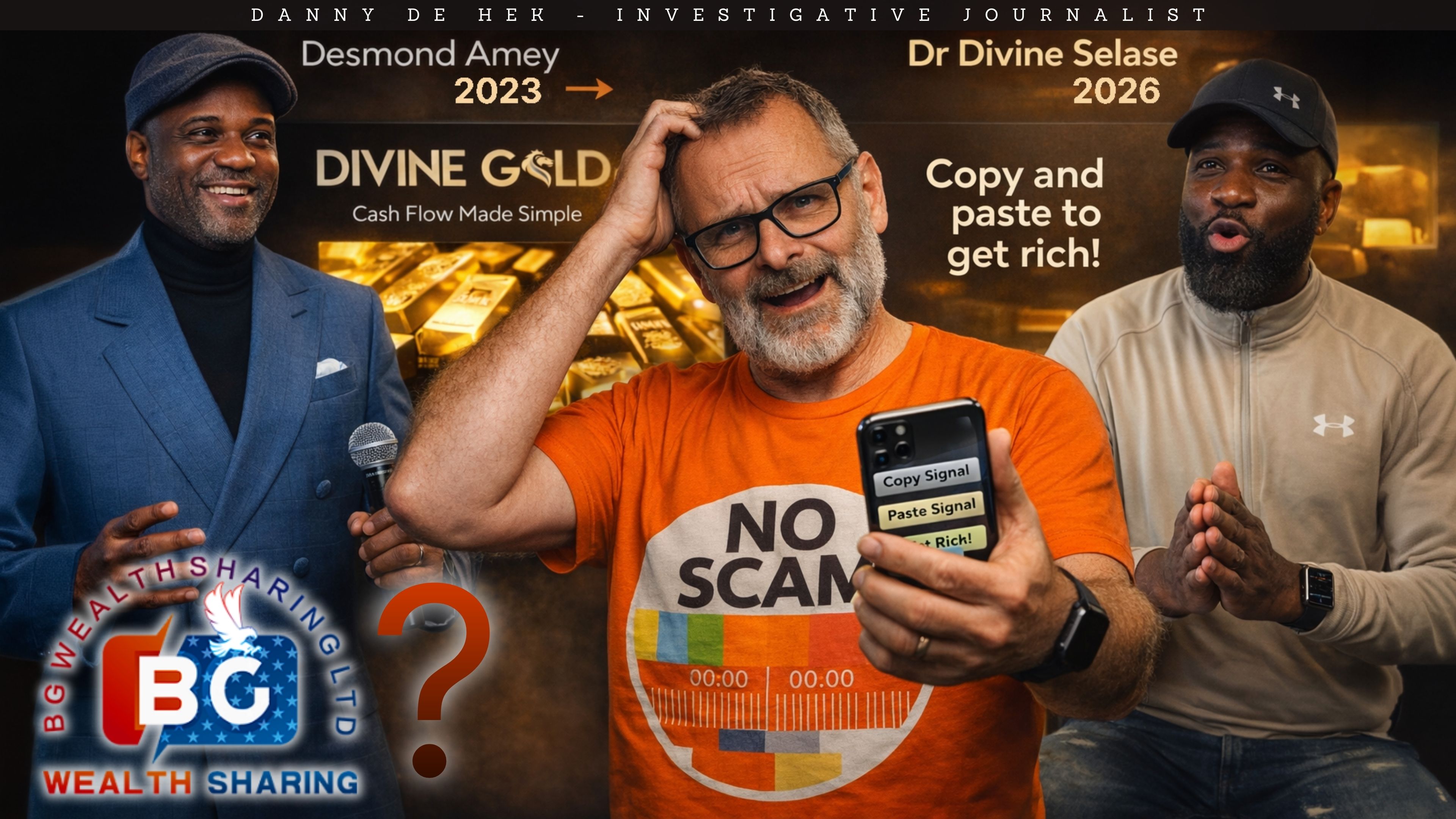
“The only skill you need… is to be able to copy & paste.”
I’ve heard that line before. Not once, not twice — but across multiple schemes that all promised simplicity, certainty, and a shortcut into financial freedom.
And every time, when you strip away the branding and the buzzwords, what you’re left with is the same underlying structure: remove the complexity, remove the risk conversation, and replace it with trust.
When I first covered Desmond Selase Amey back in 2023, he was promoting Hyperverse — a scheme that has since collapsed and been exposed as a multi-billion dollar Ponzi operation. I sat through hours of footage, breaking down the messaging, the structure, and the psychology behind it. At the time, the red flags were already there. Now, with the emergence of Divine Gold, those same patterns are resurfacing — almost word for word.
This isn’t about speculation. It’s about continuity. The same individual, now rebranded as “Dr Divine Selase,” the same style of messaging, and the same promise that financial success can be simplified down to something anyone can do — “all you need is a phone & wifi.”
The Sales Page That Tells You Everything
If you want to understand how these systems work, you don’t need to dig through hidden documents or leaked chats. Sometimes the most revealing evidence is right in front of you — in this case, a one-page website that lays out the entire model in plain sight.
At the very top, you’re hit with a series of bold claims:
- “Cash Flow Made Simple”
- “No Monthly Fee”
- “No Set Up Cost”
- “Leverage A Team Of Expert Traders”
On the surface, it sounds appealing. But take a step back and ask a simple question: if there’s no cost to the user, where is the money coming from?
They actually answer that question themselves:
“Our sponsors/broker covers the cost… They pay our trading team and leaders to grow a community and use their services.”
That line is critical. Because it confirms this is not primarily a trading service — it’s a broker-driven funnel. The goal is not just to help you trade. The goal is to get you onto a specific platform where activity generates revenue for the people at the top.
This is the same structure seen across:
- Forex signal groups
- Crypto trading communities
- Affiliate-driven broker schemes
The trading is the hook. The real business model sits behind it.
The “Too Good to Be True” Problem
The website even anticipates the obvious concern:
“You’re probably thinking, this is too good to be true?!”
That’s not reassurance. That’s pre-emptive objection handling — a common sales tactic designed to disarm scepticism before it fully forms.
Then come the performance claims:
“Weekly 86–95% success rate”
“Profit when we do”
These are not small statements. They are extraordinary claims — and extraordinary claims require verifiable evidence. There is none provided. No audited track record. No third-party verification. No independent data.
In legitimate trading environments, even highly experienced professionals struggle to maintain consistent returns, let alone success rates approaching 95%. So when numbers like this are presented without transparency, it’s not a sign of performance — it’s a sign of marketing.
And then there’s the simplicity:
“The only skill you need… is to be able to copy & paste.”
That’s not how financial markets work. That’s how financial illusions are sold.
Removing Risk From the Conversation
One of the most consistent patterns I’ve seen in these types of operations is the absence of risk. Not just minimised — completely sidelined.
On the Divine Gold page, you’ll find:
- No meaningful risk disclosure
- No discussion of potential losses
- No explanation of leverage or market volatility
Instead, the focus is on:
- Ease of entry
- Community support
- Daily guidance
You’re told:
“All that is required is a phone & wifi”
That line is doing a lot of work. It lowers the barrier to entry to almost zero, making participation feel safe, accessible, and low-risk. But the reality is very different. Trading — especially leveraged trading — is one of the highest-risk financial activities available.
When risk is removed from the conversation, it doesn’t disappear. It just gets transferred to the person who doesn’t fully understand it.
The Mentorship & Community Illusion
Another key element is the mentorship narrative. You’re not just joining a platform — you’re joining a community.
“Join our global community”
“Access to a mentorship group, guiding you every day”
“Holding the hands of newcomers”
This is where psychology comes into play. People don’t just invest in opportunities — they invest in people and environments. A strong community creates:
- Trust
- Accountability
- Emotional attachment
And once someone feels part of something, they are far less likely to question it.
The website reinforces this with claims like:
“Join 10K+ across both trading groups”
There’s no verification provided for that number, but it doesn’t need to be. Its purpose is to create social proof — the idea that thousands of others are already involved, so it must be legitimate.
This is the same mechanism I saw back in 2023 during the Hyperverse presentations. Different platform. Same psychological structure.
The Rebranding That Raises Questions
Then we come to the founders.
Desmond Selase Amey is now presented as:
“Dr Divine Selase… qualified senior financial broker & wealth creation expert”
There are no credentials listed. No regulatory body. No licence number. Just titles and claims.
This is the same individual who:
- Was issued a warning by the Financial Conduct Authority
- Had his company shut down by the High Court
- Was found to have misled investors
- Promoted Hyperverse
Now reappearing under a slightly altered name, with a new venture, making similar promises.
Alongside him is Briony Bender, positioned as a mentor and co-founder — someone who, based on previous accounts, was also involved in the earlier operation.
This isn’t a new team building a new idea. It appears to be a continuation of the same network, under a different brand.
The Mechanism Behind the Illusion
When you put all of this together, the structure becomes clear.
It’s not complicated. In fact, it’s deliberately simple:
- Attract users with free access and high success claims
- Build trust through community and mentorship
- Funnel users into a specific broker platform
- Generate revenue through trading activity and deposits
The key point here is that the user’s success is not required for the system to profit. As long as people are signing up, depositing funds, and placing trades, the machine continues to run.
That’s why the focus is always on:
- Getting started
- Joining the group
- Taking action
Not on:
- Long-term sustainability
- Verified performance
- Independent accountability
A Pattern That Speaks for Itself
I’m not here to tell people what to do with their money. But I am here to point out patterns when they repeat — especially when those patterns have already led to financial harm in the past.
Back in 2023, I documented Desmond Amey promoting a scheme that has since collapsed. Today, I’m looking at a new venture that follows the same structure, the same messaging, and the same psychological playbook.
That doesn’t automatically mean it will end the same way. But it does mean one thing very clearly:
The burden of proof is no longer on the public to trust — it’s on the operator to demonstrate that this is fundamentally different.
So far, based on the evidence available, that difference is not clear.
And when something looks this familiar, it’s usually for a reason.
Disclaimer: How This Investigation Was Conducted
This investigation relies entirely on OSINT — Open Source Intelligence — meaning every claim made here is based on publicly available records, archived web pages, corporate filings, domain data, social media activity, and open blockchain transactions. No private data, hacking, or unlawful access methods were used. OSINT is a powerful and ethical tool for exposing scams without violating privacy laws or overstepping legal boundaries.
About the Author
I’m DANNY DE HEK, a New Zealand–based YouTuber, investigative journalist, and OSINT researcher. I name and shame individuals promoting or marketing fraudulent schemes through my YOUTUBE CHANNEL. Every video I produce exposes the people behind scams, Ponzi schemes, and MLM frauds — holding them accountable in public.
My PODCAST is an extension of that work. It’s distributed across 18 major platforms — including Apple Podcasts, Spotify, Amazon Music, YouTube, and iHeartRadio — so when scammers try to hide, my content follows them everywhere. If you prefer listening to my investigations instead of watching, you’ll find them on every major podcast service.
You can BOOK ME for private consultations or SPEAKING ENGAGEMENTS, where I share first-hand experience from years of exposing large-scale fraud and helping victims recover.
“Stop losing your future to financial parasites. Subscribe. Expose. Protect.”
My work exposing crypto fraud has been featured in:
- Coffeezilla (2026): Featured in the investigation exposing the alleged $328M Goliath Ventures Ponzi scheme
- Bloomberg Documentary (2025): A 20-minute exposé on Ponzi schemes and crypto card fraud
- News.com.au (2025): Profiled as one of the leading scam-busters in Australasia
- OpIndia (2025): Cited for uncovering Pakistani software houses linked to drug trafficking, visa scams, and global financial fraud
- The Press / Stuff.co.nz (2023): Successfully defeated $3.85M gag lawsuit; court ruled it was a vexatious attempt to silence whistleblowing
- The Guardian Australia (2023): National warning on crypto MLMs affecting Aussie families
- ABC News Australia (2023): Investigation into Blockchain Global and its collapse
- The New York Times (2022): A full two-page feature on dismantling HyperVerse and its global network
- Radio New Zealand (2022): “The Kiwi YouTuber Taking Down Crypto Scammers From His Christchurch Home”
- Otago Daily Times (2022): A profile on my investigative work and the impact of crypto fraud in New Zealand


Leave A Comment