


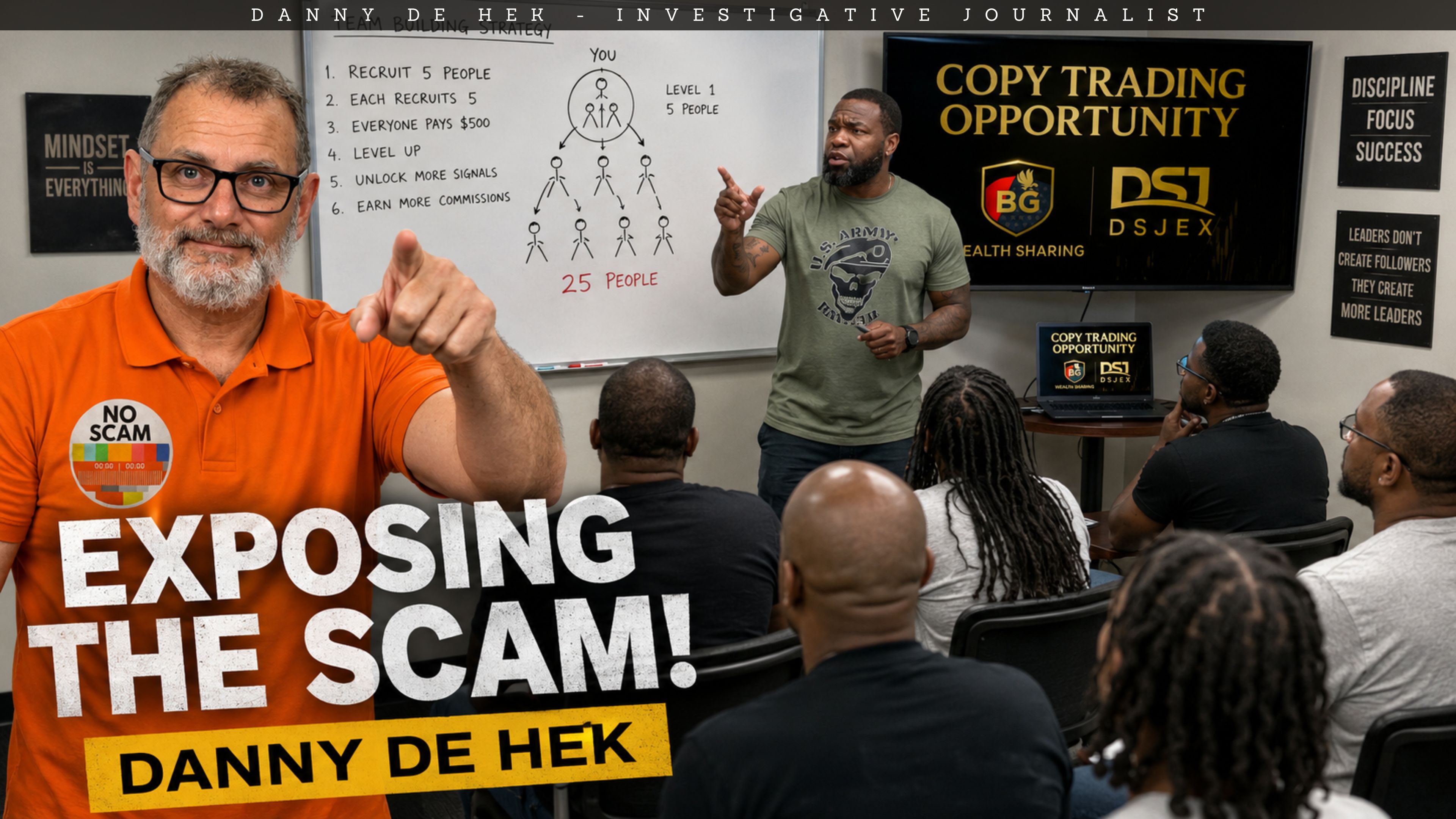
“I have made over $25,000 in less than 120 days using DSJ.”
— Terrance Hill, January 2026
Over the years I have investigated hundreds of Ponzi schemes, MLMs, crypto scams, click-a-button frauds and investment opportunities that promised financial freedom but ultimately delivered financial loss.
One pattern appears so frequently that it has become almost predictable.
The scheme collapses.
The anonymous operators disappear.
The victims are left wondering what happened.
And the promoters who spent months convincing people to join suddenly reappear as teachers, coaches, mentors, educators or financial experts offering the next solution.
That pattern is what led me to begin looking more closely at Terrance Hill.
For months, Hill was a visible promoter of BG Wealth Sharing and DSJ. He wasn’t simply sharing his personal experience. He was actively conducting training sessions, teaching recruitment strategies, explaining compensation structures, helping people build teams and encouraging participation in the program.
Today, however, Hill presents himself as someone who was simply documenting a journey and was misled along with everyone else.
After reviewing his videos, presentations and public statements, I believe there are important questions that deserve answers.
Building The Dream
When BG Wealth Sharing was attracting thousands of participants around the world, promoters worked tirelessly to create confidence in the opportunity.
One of those promoters was Terrance Hill.
In a January 2026 training session, Hill explained that he had made more than $25,000 in less than 120 days through DSJ. He told viewers he was leading a team of hundreds of people and openly shared strategies designed to help members build their organisations. He repeatedly referred to a “five by five” structure where participants would recruit five people who would then recruit five more.
The presentation wasn’t framed as a cautious review or independent analysis. It was a structured training session focused on helping participants advance through the ranks, qualify for promotions and increase their earnings within the system.
As I listened to the recording, it became clear that Hill was not standing on the sidelines observing events unfold. He was teaching others how to participate.
Teaching Recruitment As A Strategy
One of the most striking aspects of Hill’s presentations was the emphasis on duplication, recruitment and team building.
Throughout the training he explained how members could reach various leadership levels by recruiting others and helping those recruits do the same. He discussed promotion requirements, team sizes, leadership structures and the benefits associated with achieving higher positions.
He encouraged members to identify builders, support those builders and structure their organisations in ways that would maximise advancement within the compensation system.
Viewed in isolation, these conversations may appear routine to those familiar with network marketing. However, when examined in the context of what later happened, they take on a very different significance.
The success being promoted was tied directly to a system that ultimately collapsed, leaving many participants unable to access funds they believed belonged to them.
The question is not whether Hill believed the opportunity was genuine at the time.
The question is whether the level of confidence he projected was justified.
Day 108: The Evidence Gets Stronger
After drafting this article, I found another video from Hill titled BG Wealth Sharing (Day 108) and, in my opinion, it removes any serious doubt about the role he was playing.
In that video, Hill introduced the session as DSJ training and explained that the team had grown very quickly. He described himself as a 20-year Army veteran and stated he had been in the financial services industry for 17 years. He also told viewers that he understood money, had helped build wealth with his wife and that if he was going to lead anyone, financial peace of mind was the only place he could take them.
That matters because this was not casual commentary from someone watching from the outside. Hill positioned himself as someone with financial knowledge, leadership experience and a working system. He told people he brought opportunities to adults that were already working for him before moving directly into training people on how to use DSJ, how to copy and paste trade signals and how to build a team.
He also made it clear that people could make money in two ways: by copying and pasting trades and by building. From there, the message became even more direct. Hill explained that when someone became level one, they became a leader. He taught viewers how their first five recruits would determine how fast they could level up, encouraged them to aim for the third permanent signal, and explained that each person needed to come in with at least $500 to qualify properly.
What stood out most was the recruiting language. Hill told people not to overtalk the opportunity, to “peak” people’s interest, invite them to Tuesday night calls, leverage their sponsor, use leadership to close prospects, promote on social media, move people from public posts into private messages and create noise before others did.
He even said he was going to hold a withdrawal Zoom party because people kept asking whether withdrawals worked. That is important because withdrawal demonstrations are often used in these schemes to create confidence, reduce hesitation and convince people sitting on the fence that the opportunity is legitimate.
This video makes the later claim that Hill was merely documenting a journey much harder to accept. The evidence shows something more active. He was not only participating in BG Wealth Sharing; he was teaching others how to participate, how to recruit, how to qualify, how to promote and how to build confidence around the platform.
The Withdrawal Party
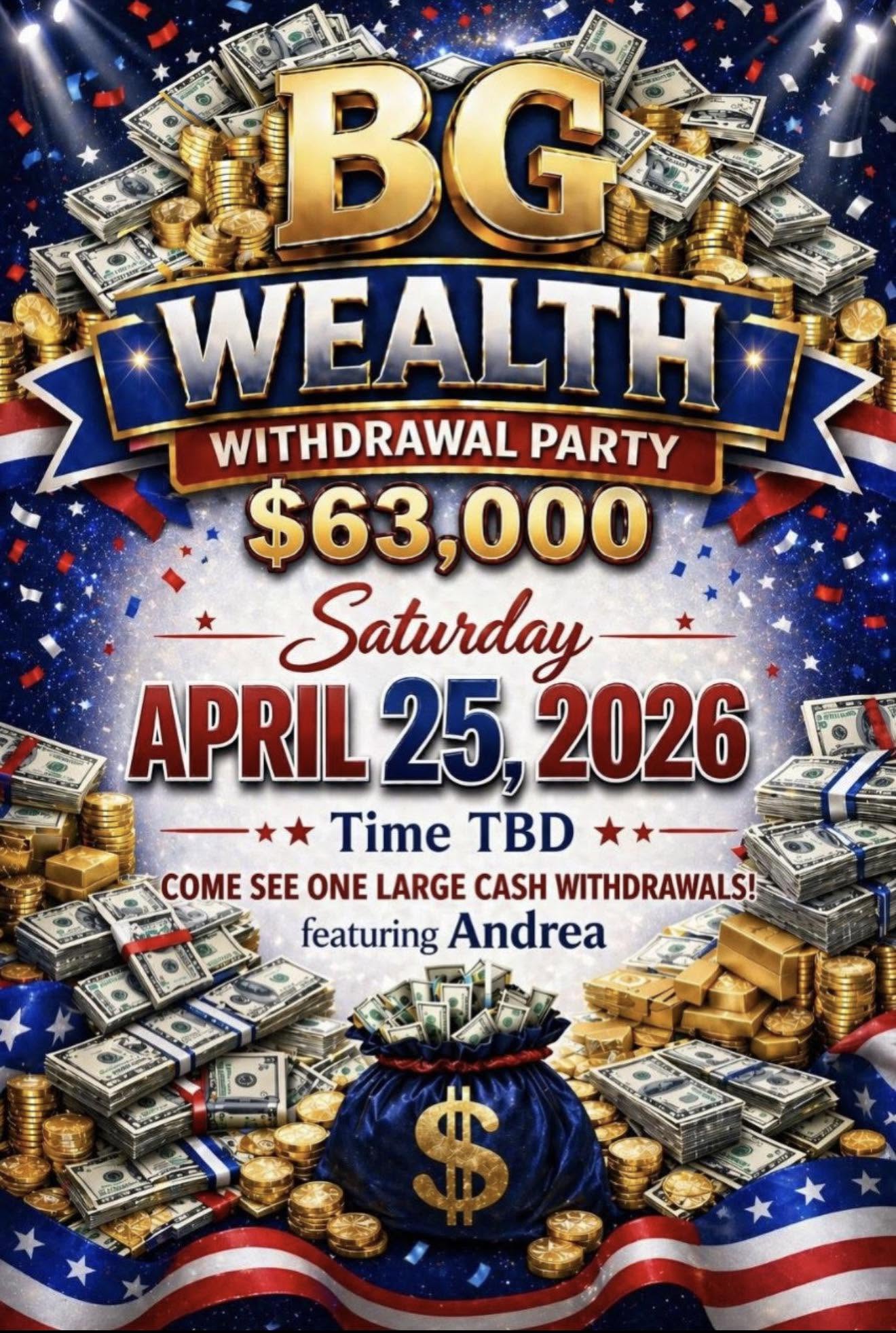
Perhaps one of the most revealing moments came when Hill announced what he described as a “withdrawal party.”
The purpose of the event was simple.
He wanted people to watch him withdraw money from the platform.
He openly stated that some individuals were waiting to see him complete a withdrawal before they committed themselves. The planned event was intended to demonstrate legitimacy, build confidence and encourage participation.
This is an important detail because many investment scams rely heavily on social proof.
People often trust what they can see.
When respected leaders, coaches or influencers publicly display successful withdrawals, it creates the impression that the underlying business is functioning exactly as advertised.
History has repeatedly shown that early withdrawals are often one of the most powerful tools used to convince larger numbers of people to participate.
That does not automatically mean the promoter understands what is happening behind the scenes.
However, it does demonstrate the significant influence that promoters can have over the decisions of others.
When The Story Changed
By May 2026 the tone had changed dramatically.
The confidence had disappeared.
The promises had disappeared.
The withdrawals had disappeared.
In a later video, Hill apologised to those who joined because of him. He stated that he had been misled and therefore had unintentionally misled others. He described BG Wealth Sharing as his first experience with what he believed was a Ponzi scheme and spoke openly about the emotional impact the collapse had on him and his team.
Unlike some promoters who vanished when the money stopped flowing, Hill remained visible and publicly acknowledged that things had gone wrong.
That deserves recognition.
However, accountability requires more than admitting something failed.
It also requires examining how people were persuaded to participate in the first place.
The same individual who later described himself as a victim had previously spent months teaching others how to build within the system.
That contradiction sits at the centre of this story.
From myEcon To BG Wealth Sharing
 As I dug deeper into Terrance Hill’s background, another piece of the puzzle began to emerge.
Long before BG Wealth Sharing appeared on the scene, Hill and his wife, Dazzarie Hill, were actively involved with myEcon, a long-running financial education and network marketing company. In a testimonial video, the couple credited myEcon with helping them achieve financial success. Hill stated that they had followed the company’s cash-flow strategies, retired from the United States Army, cash-flowed more than $1.2 million, achieved credit scores above 800, and built an investment portfolio worth hundreds of thousands of dollars.
What caught my attention was not simply their involvement with myEcon. It was the recurring appearance of another familiar name: Alvin Curry.
As I reviewed Terrance Hill’s social media activity, Curry appeared repeatedly. He was featured as a guest speaker at BG Wealth Sharing events, withdrawal parties, training sessions and promotional conferences. Event flyers promoted Curry alongside Hill as someone participants could learn from regarding trading, withdrawals, wealth creation and tax strategies. One Amarillo, Texas event promised attendees they could learn how to earn 1.2% daily, watch live withdrawals, receive investment training and discover tax strategies designed to help them keep more of their profits. Other promotional materials advertised withdrawal parties featuring Curry and presentations built around the BG Wealth Sharing opportunity.
What makes this significant is that these events do not appear to have been built from scratch. Instead, they appear to have leveraged an audience that already existed through years of financial education, network marketing and relationship building within myEcon. People rarely join investment schemes because a stranger approaches them out of nowhere. More often, they join because someone they already trust introduces the opportunity. Existing communities, established relationships and long-standing credibility become the bridge that carries people from one opportunity into the next.
Another interesting detail emerged during my research. Back in 2016, MLM watchdog BehindMLM reviewed myEcon and concluded that while the company offered financial education products and services, its compensation plan appeared heavily focused on affiliate recruitment. The review noted concerns that retail activity appeared secondary to recruitment and warned that if participant income was primarily derived from recruiting others, the model could operate as a product-based pyramid scheme. The review also observed that myEcon presentations focused heavily on growing recruitment teams and building what the company called a “baseshop” rather than emphasising retail customer sales.
 To be clear, myEcon is a separate company from BG Wealth Sharing, and I am not suggesting they are the same thing. However, the similarities in culture and messaging are difficult to ignore. The concepts promoted within myEcon — team building, duplication, recruitment, leadership development and leveraging existing relationships — are remarkably similar to the themes that appeared throughout Terrance Hill’s BG Wealth Sharing training sessions.
I have not found evidence that Alvin Curry publicly promoted BG Wealth Sharing on his own social media platforms to the same extent that Terrance Hill did. However, Curry’s repeated appearances throughout Hill’s promotional materials raise legitimate questions about the relationship between the two men and the role each played in presenting BG Wealth Sharing to prospective participants.
The broader pattern is difficult to ignore. A community originally built around financial education, cash-flow strategies and home-based business concepts appears to have become fertile ground for promoting a copy-trading investment opportunity that later collapsed. That does not automatically mean everyone involved understood what BG Wealth Sharing truly was. But it does help explain how trust, built over many years, can be transferred from one opportunity to another — and why so many people were willing to follow.
The Financial Expert Question
What caught my attention next was what happened after BG Wealth Sharing collapsed.
Rather than stepping away from financial education entirely, Hill quickly returned to discussing money, wealth creation, retirement planning, tax strategies and financial independence.
In subsequent presentations he discussed tax minimisation through home-based businesses, reducing tax obligations, cash-flow management, retirement preparation, inflation, debt reduction and investment concepts.
He presented detailed explanations about how Americans could legally reduce taxes through business deductions and repeatedly positioned himself as someone capable of helping people improve their financial future.
This raises an obvious question.
What qualifications does Terrance Hill possess that allow him to guide others on matters involving wealth creation, tax strategies, investments and financial planning?
I am not suggesting that formal qualifications are the only measure of competence.
Many successful people acquire knowledge through experience.
However, when an individual publicly positions themselves as a financial educator after promoting a collapsed investment scheme, it is reasonable to ask what expertise supports those recommendations.
The public deserves clarity.
A Familiar Pattern
One of the reasons I continue investigating schemes like BG Wealth Sharing is because the names change but the patterns rarely do.
People become emotionally invested in a financial opportunity.
Charismatic leaders emerge.
Recruitment becomes central to growth.
Success stories are celebrated.
Questions are dismissed.
Then eventually the entire structure begins to unravel.
When that happens, many promoters describe themselves as victims.
Sometimes they genuinely are.
Sometimes they lose money themselves.
Sometimes they are just as shocked as everyone else.
But being a victim does not automatically erase the role someone played in persuading others to participate.
That distinction matters.
The people who trusted these leaders often did so because they believed those leaders had done the research.
They believed someone had checked the facts.
They believed someone knew what they were talking about.
Questions That Remain Unanswered
As part of this investigation I have provided Terrance Hill with an opportunity to respond to a number of questions before publication.
Among them are questions regarding how many people joined through his efforts, how much compensation he received, what due diligence he conducted before promoting BG Wealth Sharing, what qualifications he possesses and what safeguards he now uses before recommending financial opportunities to others.
Those questions are important because this story is larger than one individual.
It speaks to a broader problem that exists throughout the world of investment schemes, MLM opportunities and wealth-building programs.
Too often people with influence promote opportunities they do not fully understand.
Too often confidence is mistaken for competence.
Too often ordinary people place their trust in individuals who appear knowledgeable without ever verifying whether that expertise actually exists.
If Terrance Hill responds, I will update this article and publish his comments in full.
Until then, the public record speaks for itself.
The videos remain online.
The presentations remain documented.
And the questions remain unanswered.
Disclaimer: How This Investigation Was Conducted
This investigation relies entirely on OSINT — Open Source Intelligence — meaning every claim made here is based on publicly available records, archived web pages, corporate filings, domain data, social media activity, and open blockchain transactions. No private data, hacking, or unlawful access methods were used. OSINT is a powerful and ethical tool for exposing scams without violating privacy laws or overstepping legal boundaries.
About the Author
I’m DANNY DE HEK, a New Zealand–based YouTuber, investigative journalist, and OSINT researcher. I name and shame individuals promoting or marketing fraudulent schemes through my YOUTUBE CHANNEL. Every video I produce exposes the people behind scams, Ponzi schemes, and MLM frauds — holding them accountable in public.
My PODCAST is an extension of that work. It’s distributed across 18 major platforms — including Apple Podcasts, Spotify, Amazon Music, YouTube, and iHeartRadio — so when scammers try to hide, my content follows them everywhere. If you prefer listening to my investigations instead of watching, you’ll find them on every major podcast service.
You can BOOK ME for private consultations or SPEAKING ENGAGEMENTS, where I share first-hand experience from years of exposing large-scale fraud and helping victims recover.
“Stop losing your future to financial parasites. Subscribe. Expose. Protect.”
My work exposing crypto fraud has been featured in:
- Coffeezilla 2026): Featured in the investigation exposing the alleged $328M Goliath Ventures Ponzi scheme
- Bloomberg Documentary (2025): A 20-minute exposé on Ponzi schemes and crypto card fraud
- News.com.au (2025): Profiled as one of the leading scam-busters in Australasia
- OpIndia (2025): Cited for uncovering Pakistani software houses linked to drug trafficking, visa scams, and global financial fraud
- The Press / Stuff.co.nz (2023): Successfully defeated $3.85M gag lawsuit; court ruled it was a vexatious attempt to silence whistleblowing
- The Guardian Australia (2023): National warning on crypto MLMs affecting Aussie families
- ABC News Australia (2023): Investigation into Blockchain Global and its collapse
- The New York Times (2022): A full two-page feature on dismantling HyperVerse and its global network
- Radio New Zealand (2022): “The Kiwi YouTuber Taking Down Crypto Scammers From His Christchurch Home”
- Otago Daily Times (2022): A profile on my investigative work and the impact of crypto fraud in New Zealand


Leave A Comment