


“A smart contract doesn’t make something honest — it just makes it run automatically.”
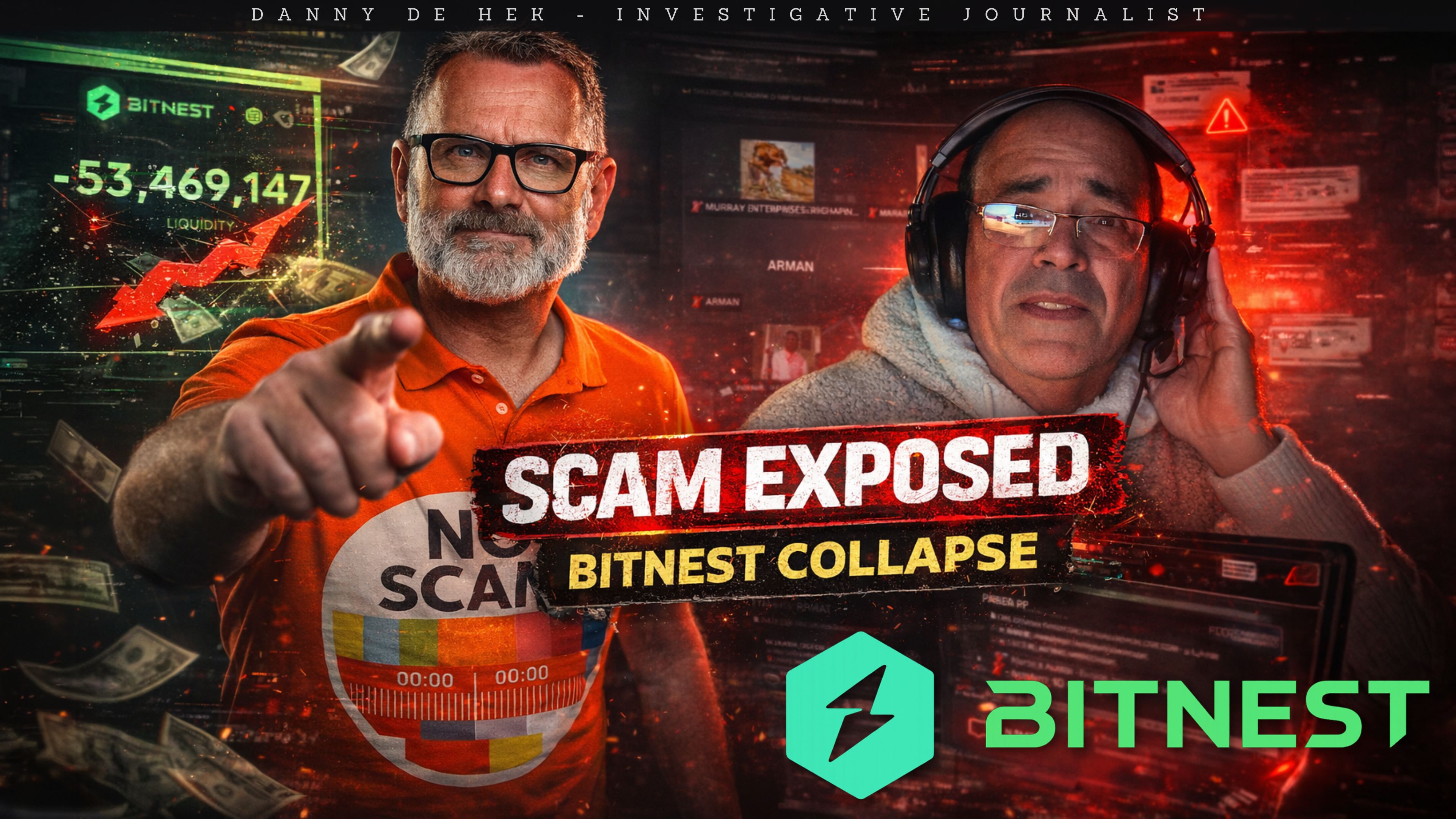
BitNest didn’t fail because of a bug. It failed because it was built to.
After spending months digging into this operation, reviewing the smart contracts, watching the marketing evolve, and personally attending Zoom meetings where this was pitched as a “financial revolution,” what’s now happening was not only predictable — it was inevitable. What we are seeing today is not a sudden collapse. It’s the natural end of a system that depended on belief, recruitment, and continuous inflow of new money.
BitNest was presented as a DeFi ecosystem, backed by smart contracts, audits, and blockchain transparency. To the average investor, that sounds sophisticated. It sounds safe. But once you strip away the language, the mechanics tell a very different story.
This blog is not speculation. It’s based on verifiable blockchain behaviour, documented patterns, and real-time observations of how this operation has unfolded — right up to the point where withdrawals stopped and the excuses began.
What a Smart Contract Actually Means
One of the biggest misunderstandings in crypto — and one that BitNest leaned on heavily — is the belief that smart contracts equal legitimacy.
They don’t.
A smart contract is nothing more than a piece of code that executes predefined actions. If certain conditions are met, it triggers a result. That’s all it does. It doesn’t evaluate whether the system is ethical, sustainable, or even legal. It simply follows instructions.
That distinction matters.
Because if you design a system where money flows from new participants to older ones, and you automate it with a smart contract, you haven’t created innovation — you’ve created an automated Ponzi system.
This is the core illusion BitNest relied on. The presence of code gave people confidence. The reality is, the code was simply executing a flawed economic model more efficiently.
 What the CertiK Audit Actually Revealed

BitNest frequently pointed to its CertiK audit as proof that everything was legitimate. On the surface, that sounds reassuring. CertiK is a recognised name in the space.
But when you actually read the audit, the picture changes quickly.
The audit identified several issues, including centralised admin control, reliance on third-party systems, and unlimited token approvals — all of which introduce risk. Even more important is what CertiK explicitly states: they do not validate the business model, the safety of the investment, or whether the system is sustainable.
That’s the part most promoters conveniently leave out.
An audit confirms that code behaves as written. It does not confirm that what’s written is fair, safe, or even rational. If the underlying system is broken, a clean audit doesn’t fix it — it just confirms the system will fail exactly as designed.
The Business Model — Where the Real Problem Sits
Once you move past the technical layer, the structure becomes much clearer.
BitNest offered fixed daily returns, incentivised recruitment through a multi-level commission structure, and required users to engage with a token economy built around Mellion Coin. These are not isolated features — they work together to create a system that depends on constant inflow.
At its core, the model relies on:
- New investors funding existing payouts
- Recruitment driving growth rather than product demand
- Artificial scarcity mechanisms to maintain perceived value
- Unverified external revenue claims
There is no evidence of sustainable, external income sufficient to support the returns being promised. Without that, the system can only function as long as new money keeps entering.
That’s not DeFi. That’s cashflow dependency disguised as innovation.
Why the Audit Changes Nothing
This is where many people get stuck.
They assume that because something is audited, it must be safe. But the reality is much simpler — and far less comforting.
You could write a smart contract that says:
- Pay early users using funds from new users
- Reward recruiters with commissions
- Lock funds into cycles that delay withdrawals
If that contract is coded correctly, it can pass an audit. And yet, the outcome is still the same — a system that collapses when inflow slows down.
That’s exactly what we’re seeing now.
The audit didn’t fail. The model did.
Recent Developments — The Collapse in Motion
Since publishing the earlier investigation, I’ve received consistent reports from inside the BitNest ecosystem — and what’s happening now follows a pattern I’ve seen many times before.
Withdrawals have slowed or stopped. Users are reporting locked accounts, unanswered questions, and vague explanations around USDT and USDC mismatches. None of these claims are backed by clear, verifiable data.
At the same time, public communication channels have been muted or restricted, while smaller, private groups have been created for top-level promoters. The message to the wider community is simple: wait, trust the process, stay calm.
Behind the scenes, it’s a different story.
Instead of restoring withdrawals, BitNest has shifted focus toward selling Mellion Coin, promoting nodes, and encouraging further investment. This is a critical red flag. When a platform stops paying out but continues asking for money, it’s not recovering — it’s extending its lifespan.
We’ve also seen domain changes, fragmented communication, and increasing pressure on leaders to maintain confidence within their downlines. These are not isolated issues. Together, they form a very clear picture.
This is what collapse management looks like.
The Role of Munir Ali Kaid-Al Jannedy
Throughout this process, one figure has remained highly visible: Munir Ali Kaid-Al Jannedy.
I personally attended and disrupted Zoom meetings where Munir confidently defended BitNest, dismissed criticism, and reassured participants that the system was legitimate. At the time, those statements helped reinforce trust within the community.
Now, with withdrawals failing and complaints escalating, the narrative has shifted to explanations and delays.
This matters.
Because when someone continues promoting and defending a system while people are losing access to their money, the issue is no longer misunderstanding — it becomes accountability.
Final Thoughts
What we are seeing now is not unusual. It’s not unexpected. And it’s not unique to BitNest.
It’s a pattern.
A compelling story. A technical framework that sounds complex enough to discourage scrutiny. Early payouts that build confidence. A growing community that reinforces belief. And then, slowly, the cracks begin to show — delayed payments, restricted communication, shifting narratives.
Until eventually, the system can no longer sustain itself.
The most important takeaway here is simple: technology doesn’t eliminate risk — it can just hide it more effectively.
If the economics don’t make sense, the system doesn’t make sense.
And when that happens, the outcome is always the same.
Disclaimer: How This Investigation Was Conducted
This investigation relies entirely on OSINT — Open Source Intelligence — meaning every claim made here is based on publicly available records, archived web pages, corporate filings, domain data, social media activity, and open blockchain transactions. No private data, hacking, or unlawful access methods were used. OSINT is a powerful and ethical tool for exposing scams without violating privacy laws or overstepping legal boundaries.
About the Author
I’m DANNY DE HEK, a New Zealand–based YouTuber, investigative journalist, and OSINT researcher. I name and shame individuals promoting or marketing fraudulent schemes through my YOUTUBE CHANNEL. Every video I produce exposes the people behind scams, Ponzi schemes, and MLM frauds — holding them accountable in public.
My PODCAST is an extension of that work. It’s distributed across 18 major platforms — including Apple Podcasts, Spotify, Amazon Music, YouTube, and iHeartRadio — so when scammers try to hide, my content follows them everywhere. If you prefer listening to my investigations instead of watching, you’ll find them on every major podcast service.
You can BOOK ME for private consultations or SPEAKING ENGAGEMENTS, where I share first-hand experience from years of exposing large-scale fraud and helping victims recover.
“Stop losing your future to financial parasites. Subscribe. Expose. Protect.”
My work exposing crypto fraud has been featured in:
- Bloomberg Documentary (2025): A 20-minute exposé on Ponzi schemes and crypto card fraud
- News.com.au (2025): Profiled as one of the leading scam-busters in Australasia
- OpIndia (2025): Cited for uncovering Pakistani software houses linked to drug trafficking, visa scams, and global financial fraud
- The Press / Stuff.co.nz (2023): Successfully defeated $3.85M gag lawsuit; court ruled it was a vexatious attempt to silence whistleblowing
- The Guardian Australia (2023): National warning on crypto MLMs affecting Aussie families
- ABC News Australia (2023): Investigation into Blockchain Global and its collapse
- The New York Times (2022): A full two-page feature on dismantling HyperVerse and its global network
- Radio New Zealand (2022): “The Kiwi YouTuber Taking Down Crypto Scammers From His Christchurch Home”
- Otago Daily Times (2022): A profile on my investigative work and the impact of crypto fraud in New Zealand





Leave A Comment