



When Scentsy consultants began quietly slipping out of the fragrance MLM in late 2025, the antiMLM community noticed. Scentsy had already been struggling — declining sales, compensation plan changes, layoffs, and a shrinking consultant base. But this time, something different was happening. Consultants weren’t just quitting; they were migrating somewhere new.
The name circulating in private messages and Facebook groups was Trunori. At first glace, Trunori looked like another wellness startup with glossy branding and vague promises. But as more Scentsy consultants began promoting it, the question became unavoidable: Who is behind Trunori — and why are so many people leaving a collapsing fragrance MLM to join a brand-new supplement one?
The answer reveals a familiar pattern: a Utah husband-and-wife MLM leadership team, a Mississippi shell LLC, Marketplace Global lineage, and a recruitment strategy built on emotional branding and “ethical MLM” rhetoric.
Trunori First Appears During Scentsy Exodus
The earliest signs of Trunori’s existence didn’t come from the company itself — they came from Scentsy consultants leaving en masse.
By late 2025, Scentsy consultants were Quietly Slipping Out of the fragrance MLM after years of declining sales, shrinking commissions, restructuring, and widespread burnout. Many were looking for a new “home,” and Trunori seemed to provide that. At first, it appeared to just be another wellness startup. But the migration pattern was too consistent to ignore.
The timing of Trunori’s emergence is not accidental. Scentsy’s decline created a perfect recruitment pool: thousands of consultants who were already trained in direct sales, already accustomed to team structures, and already looking for a new opportunity. Trunori positioned itself as everything Scentsy no longer felt like — fresh, modern, supportive, and full of possibility. The company was pulling people in and it was a company that didn’t want you to know who founded it.
A Company With No Founders — Until You Check the Paperwork
Trunori’s Website lists no founders, no executives, no scientists, and no leadership team. There is no “About Us” page, no corporate bios, and no transparency about who is running the company. But Mississippi’s Business Registry fills in the blanks.
Trunori Scientific LLC was formed on November 13, 2025. The listed members are Danielle Collins of West Point, Utah; Christopher “Chris” Collins, also of Utah; and Donald O. King III of Corinth, Mississippi, who serves as the registered agent. This is the only official record of who owns the company, and it reveals a structure that is extremely common in MLM launches: Utah leadership paired with a Mississippi registration, a state known for minimal disclosure requirements and low-visibility corporate filings.
Trunori – Mississippi Limited Liability Company Certificate of Formation
The real story, however, lives on social media.
The Utah Couple Behind Trunori
Danielle Collins is the public face of Trunori — but only on her Personal Facebook, not the corporate site. In December 2025, she published a long, emotional post describing how she and her husband, Chris, “built” the company together. She wrote about designing the products, writing the policies and procedures, shaping the culture, and creating a compensation plan that she framed as “service-based” rather than hype-driven. Her tone was reflective, intentional, and deeply personal, the kind of language founders use when they want to position their company as a mission rather than a business.
She also hosted public Zoom calls, invited recruits to learn about the products, and spoke only about “our company” and “our vision.” Her posts made it clear that she is not a distributor. She is the architect of Trunori’s identity.
Christopher “Chris” Collins, meanwhile, is the strategist. His Facebook Posts reveal decades of MLM field experience — the kind of insider knowledge that comes from building teams, studying compensation plans, and watching the industry shift over time. In a March 1 post, he celebrated Trunori’s first month by announcing that the company had paid “nearly half a million dollars in commissions” in just eleven days of customer activity. He framed it as proof of momentum, integrity, and impact, and emphasized that the company was still in pre-launch. This is classic MLM momentum messaging, designed to attract leaders from other companies by implying explosive early success.
Together, Danielle and Chris form the classic MLM founder duo: she handles branding, culture, and emotional narrative; he handles field strategy, recruitment psychology, and compensation dynamics. Their partnership mirrors the structure of other Utah-based MLMs, from Young Living and doTERRA to Q Sciences, Modere, and MPG.
The Collins’ MLM Lineage and Road to Trunori
Danielle and Chris did not arrive in the network-marketing world as newcomers. They entered the industry long before Trunori existed, and their own public statements show that they built their careers inside the MLM ecosystem rather than outside of it. The clearest and most verifiable chapter in their history is their involvement with MPG (Marketplace Global), a wellness-focused MLM selling pH-balancing supplements, fulvic acid blends, detox formulas, and alkaline-themed health products. MPG operates using a binary compensation structure and a recruitment-driven model that rewards team growth as much as product sales, placing it firmly within the traditional wellness MLM landscape.
The couple’s connectiong to MPG is not inferred — it is directly confirmed by Danielle herself. In a Facebook post dated November 24, 2025, she announced that she and Chris had officially resigned from MPG to build their own network-marketing company.
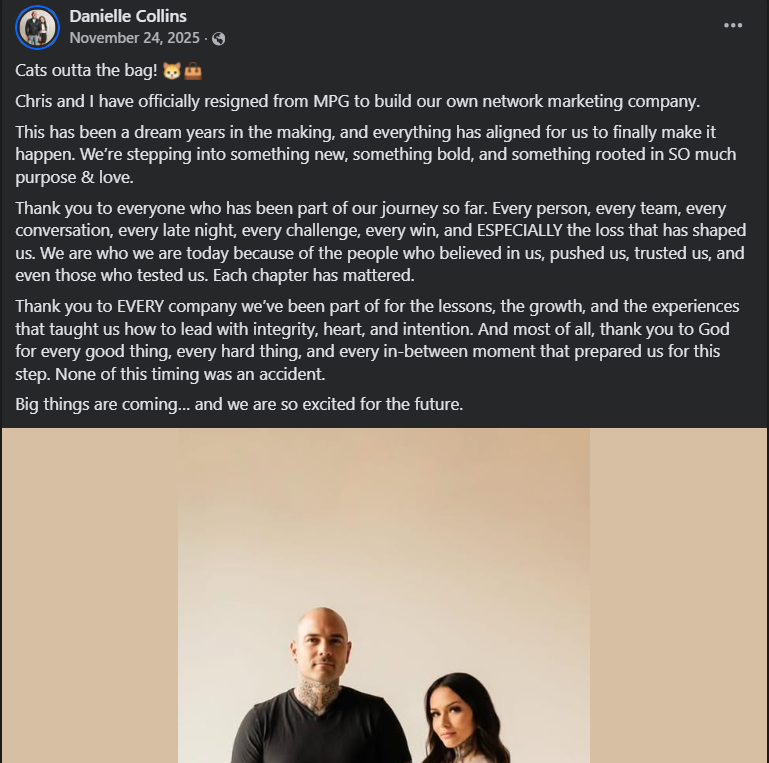
The post reads as a formal transition point in their careers: she thanks “every company we’ve been a part of,” acknowledges the lessons and losses that shaped them, and frames the move as the culmination of years of preparation. Her language makes it clear that both she and Chris were deeply embedded in the MLM world, working together as a married leadership team, and that their decision to launch Trunori was not a departure from MLM culture but a continuation of it.
Understanding this context reframes Trunori’s origin story. Publicly, Trunori is presented as something bold, new, and purpose-driven, but Danielle’s and Chris’s own words reveal a different reality. Trunori emerges directly from their experience inside MPG and the broader MLM industry. Their resignation from MPG to “build our own network-marketing company” shows that Trunori was conceived as an MLM from the beginning — not as an innovation, not as a reinvention, but as the next step in a familiar MLM founder pipeline. Rather than breaking from the industry, the couple simply moved from participating in an existing wellness MLM to creating one of their own, carrying forward the same structures, strategies, and cultural patterns they had already been working within for years.
Donald O. King III and His Mississippi Court Case
While Danielle and Chris Collins serve as the public-facing architects of Trunori’s culture and recruitment engine, the company’s third founder, Donald O. King III, plays a very different role and carries a very different history. King is the Mississippi-based member listed on Trunori Scientific LLC’s formation documents, and his presence explains why a Utah-run MLM chose to register in a state with minimal disclosure requirements and a reputation for corporate opacity.
But King is not simply a passive registered agent. He has been involved in litigation that raises questions about his business practices and the kind of corporate environment Trunori is being built upon.
In Epic Medical LLC v. Advanced Respiratory Solutions Inc., Donald O. King III, and Dusty D. Kyle, a 2021 Mississippi Court Of Appeals Case, King was named as a defendant in a dispute involving business dealings connected to medical equipment and services. The case appears in the Mississippi appellate record and is publicly accessible through legal databases.
The lawsuit centered on allegations involving contractual disputes and financial obligations between the parties. While the appellate decision does not accuse King of criminal wrongdoing, the fact that he was a named defendant in a civil dispute involving business conduct is significant — especially when evaluating the leadership of a new MLM that is already positioning itself as an “integrity-based” alternative to the industry’s reputation.
King’s involvement in this case matters for several reasons.
First, it establishes that he has a history of being entangled in business litigation — something that should always raise caution when evaluating the leadership of a company that will be handling consumer money, distributor commissions, and large volumes of product transactions.
Second, it highlights the structural reality of Trunori’s formation. Danielle and Chris Collins are based in Utah, the epicenter of MLM culture, but they chose to register their company in Mississippi — a state where King is located and where corporate filings require far less transparency. Mississippi’s business environment allows LLCs to list minimal information, making it harder for consumers, regulators, and journalists to trace ownership, financial responsibility, or corporate accountability.
Third, King’s presence on the LLC suggests he is more than a paperwork placeholder. His inclusion as a member — not merely a registered agent — indicates he has an ownership stake or operational role in Trunori. That means the company’s foundation is not just built on the Collins’ MLM experience and emotional branding, but also on the business history of a man who has previously been involved in litigation over contractual and financial disputes.
In an industry already plagued by instability, lawsuits, and opaque leadership structures, the presence of a founder with a documented civil case in his background is not a trivial detail. It adds another layer of risk to a company that is already operating without public financial disclosures, without transparent leadership bios, and without third-party verification of its products or business practices.
Trunori markets itself as a company built on integrity, transparency, and doing things “the right way.” But the inclusion of Donald O. King III — and his history in Mississippi’s court system — complicates that narrative. It raises questions about why the company chose Mississippi as its legal home, what role King plays behind the scenes, and whether the company’s leadership structure is as clean and values-driven as the branding suggests.
This is the only verifiable public record connected to King — and that fact alone raises questions. The lack of additional public records on King does not mean he has a clean or troubled history — it means he has a hidden one. There are no interviews, no business profiles, no public statements, no LinkedIn presence, and no corporate bios. For a founding member of a company claiming to be built on integrity and transparency, that absence is striking.
In a legitimate wellness company, founders are visible, accountable, and transparent. In Trunori, one-third of the ownership is a man whose only documented business footprint is a civil lawsuit involving financial disputes — and whose current role remains entirely undisclosed.
That silence speaks louder than any branding slogan.
What Trunori Really Is: Products, Promises, Manipulation and Safety Concerns
Trunori presents itself as a modern wellness company built on integrity, science, and community. But when you strip away the branding, the emotional storytelling and the aesthetic polish, what emerges is a familiar MLM structure selling unregulated supplements with big promises, vague science, and a recruitment engine powered by emotional vulnerability.
Understanding what Trunori actually is requires looking at three layers: the products, the psychology, and the safety.
The Products: Supplements With Fast-Feeling Promises and Slow-Moving Transparency
Trunori’s product line is positioned as a new standard in wellness — clean, intentional, and “felt within 30 minutes” with visible results “within 30 days.” These are classic MLM claims designed to create urgency and excitement. The company describes its offerings as dietary supplements developed with “world-class laboratories,” but provides no publicly available third-party testing, no transparent ingredient breakdowns, and no clinical data.
Like all supplement companies operating under US law, Trunori includes the required disclaimer that its products are not evaluated by the FDA and are not intended to diagnose, treat, cure, or prevent disease. That legal language is a shield, not a scientific endorsement. It means the products go to market without pre-approval, without safety testing, and without proof of effectiveness.
The “feel it fast” promise is especially telling. In the supplement world, that usually means stimulants, nootropics, or blends designed to create a noticeable sensation — energy, tingling, appetite suppression, or mood elevation. These effects can be appealing, but they can also mask risks, especially for people with heart conditions, anxiety disorders, or those taking prescription medications.
Without full ingredient transparency, consumers are being asked to trust the brand rather than the data. And in an industry where “proprietary blends” often hides exact dosages, trust is not a safety mechanism.
The Emotional Engine: How Trunori Recruits Through Belonging, Redemption, and Identity
Trunori’s real product isn’t a supplement — it’s a story. The company’s founders, Danielle and Chris Collins, have built a brand identity rooted in emotional resonance rather than scientific rigor. Their messaging is crafted to appeal to people who feel burned, overlooked, or disillusioned by previous MLM experiences.
The emotional manipulation follows a predictable pattern.
First, they position themselves as the ethical alternative. Danielle speaks about “fixing the industry,” “doing the right thing when no one is watching,” and “rewarding service, not hype.” This frames Trunori as morally superior to other MLMs, even though it uses the same compensation structure and recruitment model.
Second, they sell belonging. Their posts are saturated with language about family, community, and unconditional acceptance: “Every single person belongs” and “We’re building something family-like.” For people leaving Scentsy or other MLMs feeling abandoned or ashamed, this is a powerful hook.
Third, they offer redemption. Chris’s posts speak directly to people who have been hurt by the industry, promising that Trunori is a place where they can “dream again” and “believe one last time.” This is not accidental — it’s targeted messaging aimed at vulnerable recruits who are primed to hope that this time will be different.
Finally, they manufacture urgency. Chris’s claims that Trunori paid “nearly half a million dollars in commissions” in just eleven days is a textbook FOMO tactic. It’s not a transparent financial disclosure; it’s a recruitment tool designed to make people feel like they’re missing out on a once-in-a-lifetime opportunity.
Together, these tactics create a psychological environment where skepticism feels disloyal, caution feels negative, and joining feels like a moral and emotional choice rather than a financial one.
Medical Claims: The Legal Line and the Reality of MLM Testimony Culture
Officially, Trunori cannot claim that its products treat or cure any medical condition. The law is clear: dietary supplements cannot be marketed as medicine. But in MLMs, the most powerful claims never come from the corporate website — they come from the field.
Reps often share personal stories about improved mood, weight loss, hormone balance, sleep, inflammation, or chronic conditions. These “testimonials” are framed as personal experiences, but they function as medical claims in disguise. They create the impression that the products have therapeutic effects without the company having to say so directly.
This pattern is so common that the FDA and FTC have repeatedly issued warnings to MLMs for allowing reps to make illegal disease claims. Even when companies tell distributors not to do it, the incentive structure rewards those who share dramatic stories.
Trunori’s “feel it fast, see it fast” messaging is primed for exactly this kind of testimony culture. When a product promises noticeable effects within minutes or days, reps are encouraged — implicitly or explicitly — to attribute any change in mood, appetite, energy, or sleep to the supplement. That’s how medical claims spread without ever appearing on the official website.
Safety: What We Know, What We Don’t, and Why It Matters
The most important question — are Trunori’s products safe? — is also the hardest to answer, because the company has not provided the information needed to evaluate safety meaningfully.
In the supplement industry, safety depends on several factors: ingredient transparency, dosage accuracy, third-party testing, contamination screening, and clear warnings about interactions with medications or medical conditions. Without these, consumers are operating in the dark.
Turnori’s branding emphasizes intention, integrity, and “world-class laboratories,” but branding is not evidence. Without independent testing, consumers cannot know whether the products contain stimulants, diuretics, hormone-active botanicals, or other compounds that may pose risks.
The MLM structure adds another layer of concern. Reps are financially incentivized to encourage high usage, dismiss side effects as “detox,” and frame discomfort as part of the process. This culture can discourage people from listening to their own bodies or seeking medical advice when something feels wrong.
The truth is simple: without transparent data, no one can say whether Trunori’s products are safe. And in an industry where supplements are not tested before they reach the market, caution is not negativity — it’s common sense.
How Trunori’s Compensation Plan Actually Works
Trunori promotes its compensation plan as something revolutionary — “built right,” “service based,” and “designed to reward integrity.” Strip that away and you realize the structure is the same one used by every Utah-based wellness MLM: a layered, volume-driven system where the majority of payouts come from recruitment, not retail sales. The company has not released a full public compensation document, but the founders’ own posts, the early commission claims, and the structure of comparable MLMs make the mechanics unmistakable.
At the most basic level, Trunori reps earn money in three ways: retail commissions, fast-start bonuses, and team-based residual commissions. Retail commissions are the smallest piece. Reps earn a small margin — typically between 10% to 25% — when they sell products directly to customers at full price. But in MLMs, most purchases come from within the distributor network, not from outside customers, which means retail commissions rarely add up to meaningful income.
The real money, at least for the people at the top, comes from recruitment. Trunori’s plan is built around personal volume (what a rep buys), group volume (what their team buys), and rank qualifications that require maintaining a certain number of active recruits beneath them. To unlock higher commissions, a rep must not only purchase product themselves each month but also recruit others who do the same. Those recruits must then recruit more people, who must also stay active. This creates a cascading structure where the majority of commissions flow upward from the purchases of the people below.
Fast-start bonuses are the first hook. these are paid when a new recruit signs up and places an initial order. In most wellness MLMs, these bonuses range from $20 to $100 per recruit, depending on the size of the order. They are designed to create early excitement and reward aggressive recruiting. They also inflate early commission numbers — something Chris Collins leaned on heavily when he announced that Trunori paid “nearly half a million dollars in commissions” in just eleven days. That figure almost certainly includes fast-start bonuses tied to internal purchases, not retail sales.
Once a rep builds a team, they begin earning residual commissions on the purchases of the people beneath them. These commissions are typically paid out as a percentage of group volume — often between 3% and 10% per level, depending on rank. But to qualify for these payouts, a rep must maintain their own monthly purchase requirement and ensure that their recruits do the same. If someone in their downline stops buying, the rep’s rank can collapse, and their income can drop overnight. This creates constant pressure to recruit, retain, and encourage ongoing purchases.
Leadership bonuses are the highest tier of the plan. These are reserved for reps who build large, active downlines and maintain high monthly volume. They often include matching bonuses, generational bonuses, and rank-up rewards. These bonuses are where the top 1% of earners make their money — but they are mathematically impossible for the majority of participants to achieve. For every person who reaches a leadership rank, dozens or hundreds beneath them must remain active, purchasing product each month, and earning little to nothing.
This is the fundamental truth of Trunori’s compensation plan: it is not designed to reward selling products to customers. It is designed to reward building a downline of people who buy products every month. The structure requires constant recruitment, constant purchasing, and constant belief. It rewards the people at the top with the money spend by the people at the bottom. And because the company has not released an income disclosure statement, recruits have no way of knowing how many people earn money, how many lose money, or how much product is sold to real customers.
Trunori may present itself as a new kind of MLM, but its compensation plan is built on the same mathematics that define the industry: for a small number of people to earn large commissions, the majority must spend more than they make. The branding is modern, the language is therapeutic, and the founders speak in the vocabulary of integrity and community — but the financial structure is unchanged. It is a recruitment-driven model where the product is the opportunity itself, and the real revenue comes from the people trying to climb the ladder.
Why I Cannot Recommend Trunori — And Why Walking From One MLM Into Another Is a Trap, Not a Fresh Start
Trunori presents itself as a bold new beginning, but the company’s origin story tells a different truth. Danielle and Chris Collins did not step into this venture as innovators or industry outsiders. They came directly from MPG (Marketplace Global), a wellness MLM built on binary legs, recruitment-driven commissions, and supplement-based product claims. Their own Facebook announcement confirms they resigned from MPG specifically to “build our own network-marketing company,” framing Trunori not as a reinvention, but as a continuation of the same business model under a new banner.
This matters because MLMs are not simply companies — they are ecosystems built on emotional pressure, recruitment dependency, and the constant promise of transformation. When leaders move from one MLM to another, they bring the same structures, the same tactics, and the same financial incentives with them. The language may shift, the branding may soften, and the product line may be repackaged, but the underlying mechanics remain unchanged. A binary compensation plan is still a binary compensation plan. A recruitment-driven model is still a recruitment-driven model. And a wellness MLM built by former wellness-MLM leaders is not a fresh start; it’s a replication.
The Collins’ transition from MPG to Trunori also highlights a pattern that is common across the industry. High-ranking distributors often leave established MLMs once they have learned the system well enough to build their own version of it. They take the culture, the scripts, the leadership style, and the compensation logic with them, and they rebuild it in a form where they sit at the very top. This is not empowerment — it is consolidation. It ensures that the people who once relied on an upline now become the upline, with all the financial advantages that come with ownership.
For consumers and potential recruits, this creates a dangerous illusion. Trunori is marketed as something new, ethical, purpose-driven, and community-focused, but its founders’ own history shows that it is structurally indistinguishable from the MLM they just left. When a company is born from the same incentives, the same compensation logic, and the same leadership culture, it cannot offer a fundamentally different outcome. It can only offer a different aesthetic.
This is why I cannot recommend Trunori. Not because Danielle and Chris lack passion or ambition, but because passion and ambition do not change the mathematics of an MLM. Walking from one MLM into another does not break the cycle — it reinforces it. It ensures that the same people who once benefited from the system now benefit even more, while the people entering at the bottom face the same statistical realities that have defined the industry for decades. A new name does not make an old model safer. A new logo does not make a binary plan fair. And a new company built by former MLM leaders is not a fresh start; it is the same trap with a different door.
As someone who spent years inside the industry myself — first in the health-and-wellness world with ItWorks and later as a Scentsy consultant — I cannot in good conscience recommend that anyone join Trunori. I’ve lived the promises, the pressure, the emotional manipulation, and the financial strain that come with these companies, and I’ve watched too many good people blame themselves for systems designed to fail them. My concern is not with the consultants who sign up hoping for a better life; it’s with the model that exploits their hope. I care deeply about the people being recruited into Trunori, and I genuinely hope they find opportunities that honor their time, their labor, and their worth — far outside the cycle of MLMs.
By Beth Gibbons (Queen of Karma)
Beth Gibbons, known publicly as Queen of Karma, is a whistleblower and anti-MLM advocate who shares her personal experiences of being manipulated and financially harmed by multi-level marketing schemes. She writes and speaks candidly about the emotional and psychological toll these so-called “business opportunities” take on vulnerable individuals, especially women. Beth positions herself as a survivor-turned-activist, exposing MLMs as commercial cults and highlighting the cult-like tactics used to recruit, control, and silence members.
She has contributed blogs and participated in video interviews under the name Queen of Karma, often blending personal storytelling with direct confrontation of scammy business models. Her work aligns closely with scam awareness efforts, and she’s part of a growing community of voices pushing back against MLM exploitation, gaslighting, and financial abuse.





Leave A Comment