


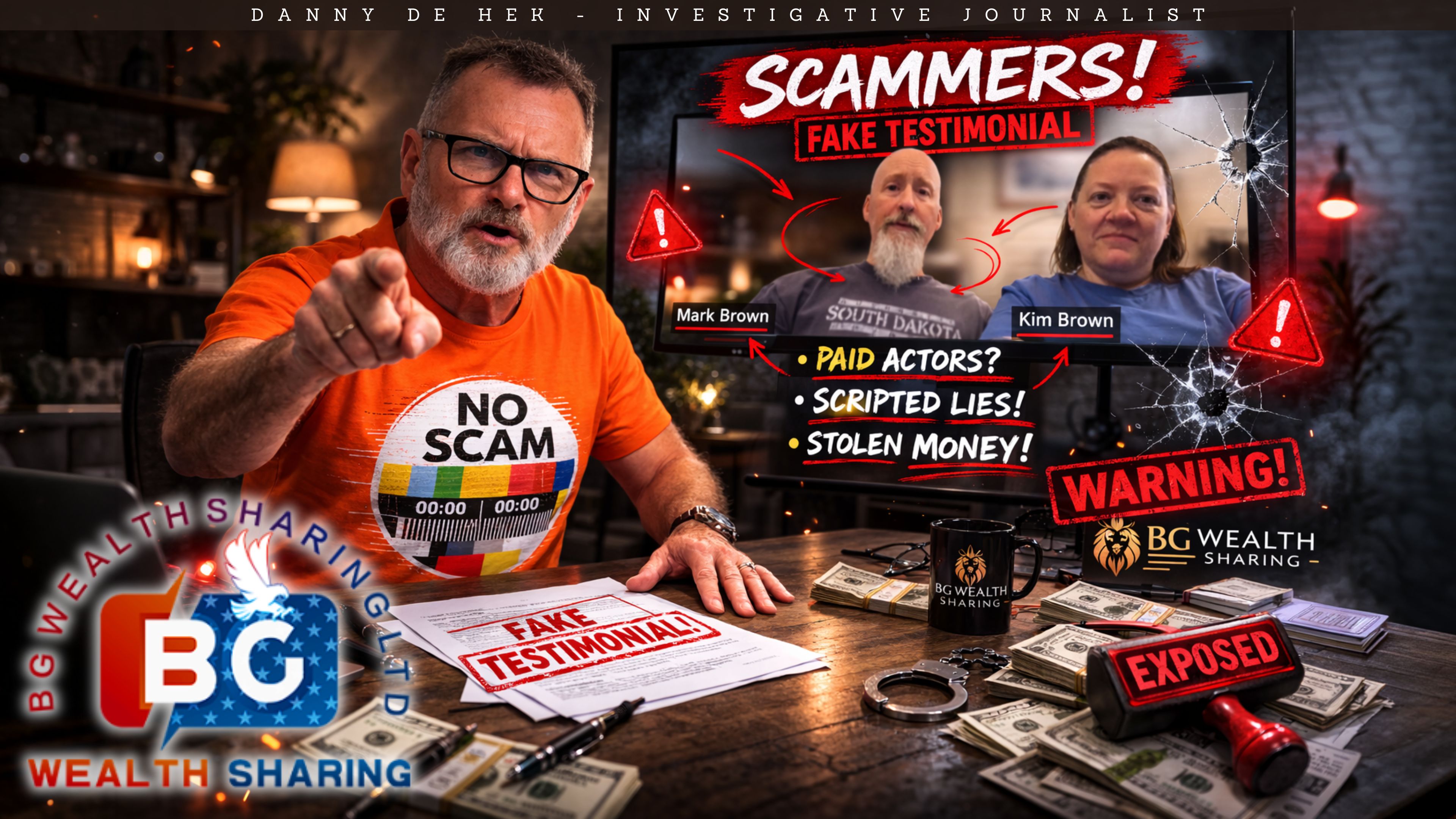

“Every Ponzi scheme looks real at the top — because it’s funded by the people at the bottom who haven’t realised they’ve lost everything yet.”
People often believe testimonials are proof. That if someone is withdrawing money, showing results, and confidently sharing their experience, the opportunity must be legitimate. That scams only become obvious after they collapse, when the damage is already done and the excuses begin.
This BG Wealth Sharing video exposes how wrong that assumption is.
What Mark and Kim Brown present as success is not evidence of a functioning investment platform — it is a real-time example of how a Ponzi scheme operates while it is still paying out, where early participants receive withdrawals, build confidence, and then use that experience to recruit others into the system that is funding them. The more convincing the story, the more people join, and the longer the illusion survives.
This article is not written in hindsight. It’s written while promotion is still active, while recruitment is still happening, and while people are still watching videos like this and asking themselves the most dangerous question of all:
“What have I got to lose?”
What This Testimonial Actually Is
What we’re watching here is not a couple casually sharing their journey. It is a structured narrative that follows a very familiar pattern — one that has been repeated across countless schemes over the years. It begins with skepticism, moves into observation, then into participation, followed by escalation, and finally into promotion. Each step is presented as a personal decision, but when you step back, it forms a clear recruitment pathway.
Mark explains how he watched a friend for 90 days making what he believed were consistent returns before deciding to join. That’s not due diligence — that’s outsourcing trust to someone else’s apparent success. Kim follows shortly after, initially cautious, then quickly convinced. Within a matter of weeks, both move from testing the system to committing significant money.
At that point, the story shifts.
They’re no longer just participants. They begin talking about sharing it with others, building teams, and encouraging people to get involved. What’s presented as “helping people” is, in reality, expanding the structure that sustains the payouts they’re receiving.
The Escalation Trap
What Mark and Kim describe isn’t unique — it’s the exact progression seen in almost every Ponzi scheme, and it’s one of the most effective psychological traps because it feels rational while it’s happening. They didn’t jump in blindly with large amounts. They started cautiously, testing the waters with a few hundred dollars, watching the numbers move, seeing what appeared to be consistent returns, and convincing themselves that what they were seeing must be real. That early “proof” is what lowers the guard. It creates a sense of control, a belief that they’ve found something others haven’t.
From there, the decision to increase their investment doesn’t feel reckless — it feels logical. If $300 or $500 appears to be working, then putting in $5,000 seems like a smart move, not a risky one. That’s how the system is designed to pull people deeper. The platform doesn’t need you to understand it — it just needs you to trust what you’re seeing.
But the most revealing part isn’t the money they put in. It’s what they say afterwards.
Kim openly admits their biggest mistake was not telling people sooner.
That single statement says everything.
Because at that point, they’ve crossed the line from participant to promoter. They’re no longer just observing results — they’re actively encouraging others to join. And that only makes sense if the system depends on new people entering behind them. If this were genuine trading, their returns wouldn’t be influenced by how many people they bring in. The fact that they regret not recruiting earlier tells you exactly where the real money is coming from.
Not from trading.
From people.
Too Good To Be True — And Designed That Way
The claims made in this video don’t just stretch credibility — they completely ignore basic financial reality. Turning a few thousand dollars into a six-figure account within a year, withdrawing tens of thousands per month, and maintaining account growth at the same time is not just unlikely, it’s mathematically unsustainable.
They describe a system with near-perfect accuracy, where losses are recovered and profits are consistent. That kind of performance doesn’t exist in real trading. Markets don’t behave that way, and no system can eliminate risk while producing guaranteed returns.
What they’re actually describing is not a trading environment, but a controlled system where outcomes are presented, not independently verified. The simplicity of “copy and paste” trading isn’t innovation — it’s a mechanism designed to keep participants engaged while removing the need for understanding.
The more effortless it sounds, the more dangerous it is.
The Money Isn’t Coming From Trading
One of the most important misconceptions in this entire video is the belief that profits are being generated from trading activity. Mark states that everything after their initial withdrawal is “profit” generated from trades.
That belief is central to the illusion.
Because based on everything we know — from identical schemes, from regulatory warnings, and from the structure itself — those funds are not coming from trading. They are coming from new participants entering the system.
This is what allows early users to withdraw money and build confidence. It creates the appearance of legitimacy, which is then used to attract more people. It is a cycle that continues until the inflow of new money can no longer support the outflow of withdrawals.
At that point, everything stops.
CR Group LLC (UICEX): The Same Playbook, Same Ending
We’ve already seen how this story ends.
With CR Group LLC (UICEX), the platform operated in a very similar way — structured trading claims, community-based recruitment, and steady withdrawals that built confidence. Everything appeared to be working until the moment people tried to take their money out.
That’s when the rules changed.
Members were told they needed to pay a 20% “verification fee”, calculated on their account balance, before any withdrawal could be processed. They were given a deadline. If they didn’t comply, their funds would be locked for years.
That was the turning point.
The illusion of control disappeared, and the reality became clear — the money was never accessible in the way people believed.
The New Zealand Financial Markets Authority has already identified that BG Wealth Sharing follows the same behavioural pattern. That connection matters, because it shows this isn’t a new opportunity.
It’s the same structure, repeating itself under a different name.
Six Countries Have Already Warned About This
While this couple is promoting BG Wealth Sharing as a legitimate opportunity, regulators across the world have already issued clear warnings.
In the United Kingdom, the Financial Conduct Authority warned that BG Wealth Sharing and its associated platforms are not authorised to provide financial services. In Australia, ASIC placed the operation on its Investor Alert List as an unlicensed entity. In Canada, the Alberta Securities Commission confirmed it is not registered and offers no investor protection.
The National Reserve Bank of Tonga went further, explicitly calling it a cryptocurrency investment scam, describing fake trading, blocked withdrawals, and fee demands. The New Zealand FMA has linked it to known scam patterns and similar operations, including CR Group LLC. The Philippines SEC has formally identified it as an unregistered securities scheme with Ponzi characteristics, warning that promoters and recruiters may face criminal liability.
Different countries. Different regulators. Same conclusion.
The Clawback Reality Nobody Thinks About
Right now, Mark and Kim believe they are winning. They are withdrawing money, planning their future, and making decisions based on what they think is sustainable income.
But there is a reality they haven’t considered.
When Ponzi schemes collapse, the legal process doesn’t just target the operators. It extends to the money that has already been paid out. This is where clawbacks come into play.
If you have received profits from a Ponzi scheme, those funds can be legally reclaimed — even if you believed the system was legitimate, and even if you have already spent the money. The law doesn’t treat those profits as earnings. It treats them as funds that belong to other victims.
And if you have actively promoted the scheme, recruited others, or encouraged people to invest, your position becomes even more exposed.
The lifestyle being built now — the house, the vehicles, the withdrawals — can quickly turn into long-term debt and legal obligation.
This Video Isn’t Just A Story — It’s A Record
What makes this situation more serious is that this testimonial isn’t private.
It’s public.
Mark explains how he recruits people. Kim talks about encouraging others to join. They both describe building teams and expanding their network. That’s not just a personal experience being shared — it is a documented example of how the scheme is being promoted.
And when investigations happen, when complaints are filed, and when legal action begins, that kind of documentation matters.
Because it shows not just participation — but active involvement in bringing others into the system.
A Pause Before The Next Decision
This article is not for people who have already lost everything.
It’s for those watching videos like this and thinking they’ll try it with a small amount, just to see how it works. For those who believe they can get in early, take profits, and get out before anything goes wrong.
That belief is what keeps these systems alive.
And the only reason people like Mark and Kim are able to withdraw money today is because someone else is about to take their place at the bottom.
This is the moment where people either step back and look at the evidence — or step forward and become part of the cycle.
Because by the time it becomes obvious to everyone, it’s already too late.
And the question is no longer “what have I got to lose?”
It’s how much of it can I get back — if anything at all.
Disclaimer: How This Investigation Was Conducted
This investigation relies entirely on OSINT — Open Source Intelligence — meaning every claim made here is based on publicly available records, archived web pages, corporate filings, domain data, social media activity, and open blockchain transactions. No private data, hacking, or unlawful access methods were used. OSINT is a powerful and ethical tool for exposing scams without violating privacy laws or overstepping legal boundaries.
About the Author
I’m DANNY DE HEK, a New Zealand–based YouTuber, investigative journalist, and OSINT researcher. I name and shame individuals promoting or marketing fraudulent schemes through my YOUTUBE CHANNEL. Every video I produce exposes the people behind scams, Ponzi schemes, and MLM frauds — holding them accountable in public.
My PODCAST is an extension of that work. It’s distributed across 18 major platforms — including Apple Podcasts, Spotify, Amazon Music, YouTube, and iHeartRadio — so when scammers try to hide, my content follows them everywhere. If you prefer listening to my investigations instead of watching, you’ll find them on every major podcast service.
You can BOOK ME for private consultations or SPEAKING ENGAGEMENTS, where I share first-hand experience from years of exposing large-scale fraud and helping victims recover.
“Stop losing your future to financial parasites. Subscribe. Expose. Protect.”
My work exposing crypto fraud has been featured in:
- Bloomberg Documentary (2025): A 20-minute exposé on Ponzi schemes and crypto card fraud
- News.com.au (2025): Profiled as one of the leading scam-busters in Australasia
- OpIndia (2025): Cited for uncovering Pakistani software houses linked to drug trafficking, visa scams, and global financial fraud
- The Press / Stuff.co.nz (2023): Successfully defeated $3.85M gag lawsuit; court ruled it was a vexatious attempt to silence whistleblowing
- The Guardian Australia (2023): National warning on crypto MLMs affecting Aussie families
- ABC News Australia (2023): Investigation into Blockchain Global and its collapse
- The New York Times (2022): A full two-page feature on dismantling HyperVerse and its global network
- Radio New Zealand (2022): “The Kiwi YouTuber Taking Down Crypto Scammers From His Christchurch Home”
- Otago Daily Times (2022): A profile on my investigative work and the impact of crypto fraud in New Zealand


Leave A Comment