


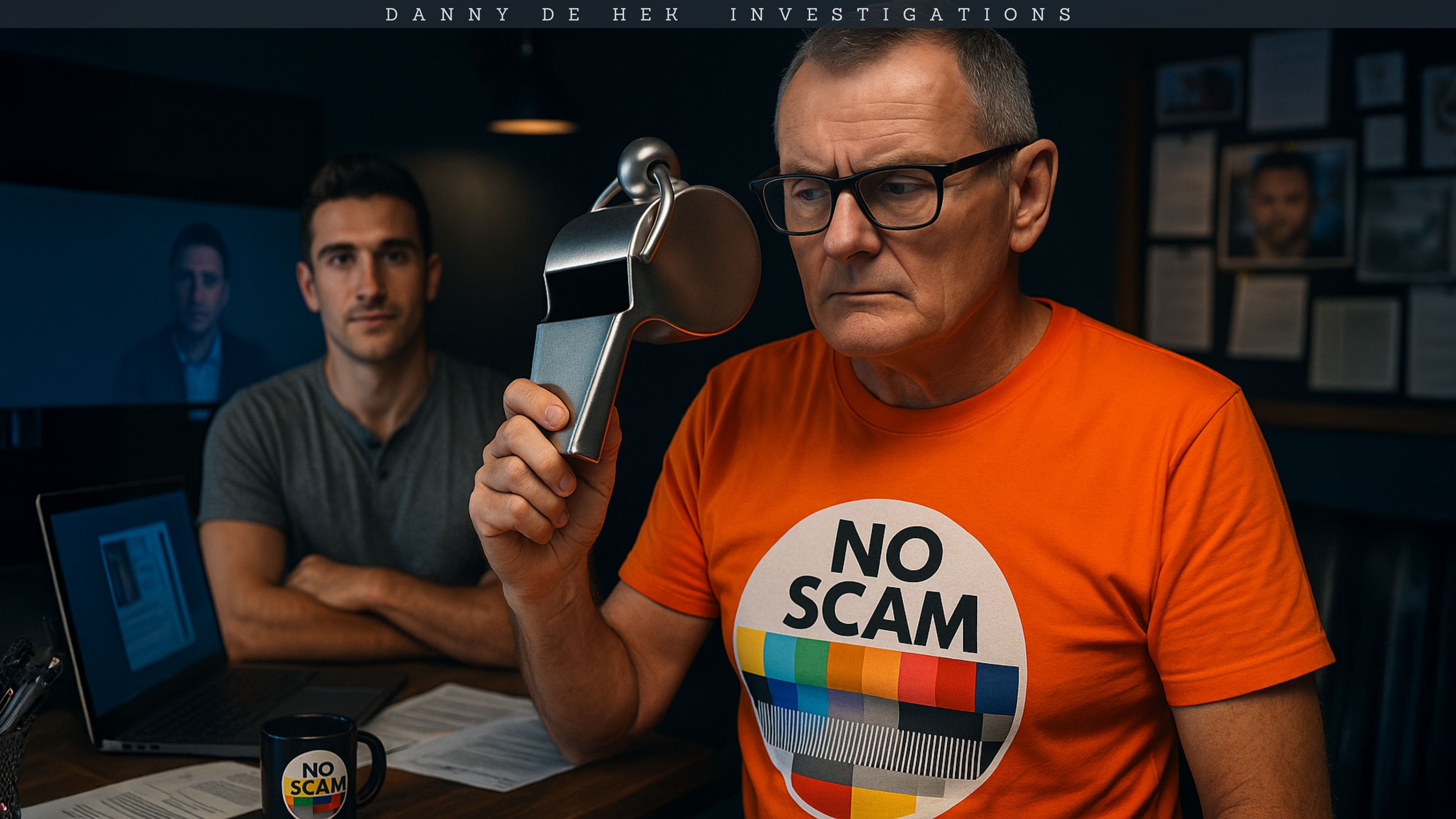
The purpose of this blog is simple — to show what a real whistleblower looks like, and what one doesn’t.
There’s a growing misconception that if someone books time with me, shares a few vague comments, or claims to be an “insider,” they automatically earn permanent anonymity. That’s not how this works. My time is for people who want to help uncover the truth — not for those who want to protect themselves while pretending to cooperate.
This story is a perfect example. The individual involved contacted me directly, provided confirmation that they had invested in Goliath Ventures Inc., and even admitted to withdrawing more than they originally put in. Yet when given the opportunity to help expose the people behind this scam, they refused.
What they didn’t realise is that silence isn’t protection — it’s evidence.
In this blog, I’ll walk you through how this contact unfolded, how we confirmed who they really were, and how their behaviour highlights the difference between a genuine whistleblower and someone just trying to cover their tracks.
When “Reaching Out” Really Means “Checking If You’re Caught”
It began like so many others: a short message, an alias, and a request for information.
Through my website, someone booked a 20-minute consultation with me — an Express Chat designed for people who want expert insight into scams, fraud, or crypto-related investigations. These sessions are usually for victims, journalists, or whistleblowers who want to share genuine intelligence.
The message they submitted was brief but revealing:
“Was in Goliath but since pulled my funds. Thank you. Wanted to understand more on the investigations from the authorities. Thanks.”
The person used the name J Bob and paid the $50 koha contribution for the session. On the surface, it looked like a normal consultation. But when we checked the details, we discovered something far more significant.
The email address was real. When we went to Goliath’s official website and used the “forgot password” function, the system confirmed that this email was registered inside their platform. That proved we were dealing with a genuine Goliath investor — someone who had actually been inside the system.
This was not a casual onlooker. This was an investor who had put money into a company promising guaranteed 60 percent annual returns, a company now facing multiple investigations across different agencies.
And rather than coming forward to help, they had booked time with me to see what I knew.
The Call That Exposed Everything They Didn’t Say
When the meeting began, I was ready to listen.
He appeared calm, polite, and professional — the kind of person you might expect to find in a boardroom, not in the middle of a crypto scandal. From the moment he spoke, it was clear he wasn’t calling to confess or expose anything. He was calling to test the waters.
He confirmed right away that he had invested in Goliath Ventures Inc., and that he had already “pulled his funds.” When I asked how much, he admitted it was around $100,000. Then came the line that set the tone for the rest of the call:
“I took out everything,” he said.
“So, you took out more than you put in?” I asked.
“Yep,” he replied without hesitation.
It was said casually — like someone talking about a stock trade, not a fraudulent investment. That single answer told me everything I needed to know: this wasn’t a victim trying to make things right. This was someone who’d already made a profit and was now worried the house of cards was collapsing.
He said he’d started getting “freaked out” after reading some of my blogs and decided to withdraw before things “went sideways.” When I pointed out that taking out more than he invested meant he’d profited from other people’s losses, he said quietly,
“That’s the risk. I’m prepared for that.”
That line stuck with me — I’m prepared for that.
It’s what people say when they’ve already accepted the trade-off: make money while you can, and hope no one catches you later.
Challenging the Fantasy: 60% Returns, Invisible Insurance, and a 12-Minute “Investor Call”
Once the basics were out of the way, I wanted to test how deep his denial ran.
I asked whether he genuinely believed the kind of returns Goliath Ventures was promising — 60 percent per year, guaranteed, supposedly backed by an insurance policy no one had ever seen.
“Well, I’ve been in crypto for a while,” he said. “There are people who generate significant returns. But yeah, when you say guaranteed… that’s where it gets weird.”
Weird. That was the word he chose. Not impossible, not fraudulent — just weird.
He explained that Goliath claimed to make its money through “liquidity swaps” and “blockchain technology,” yet admitted he had never seen any proof of mining, trading, or even a functioning operation behind the scenes. Then he mentioned a Q3 investor call that supposedly gave everyone confidence.
“It was about twelve minutes long,” he said. “No one could see how many people were in it, and you couldn’t ask questions.”
Twelve minutes. No questions. No visibility. For a company handling millions in supposed investment capital, that isn’t a meeting — it’s theatre.
When I pointed out how absurd it was that people kept believing the illusion, he didn’t argue. He just wanted to know how much trouble he might be in.
When the “Whistleblower” Started Fishing for Intelligence
That’s when the tone of the conversation shifted.
He wasn’t asking about victims or recovery anymore — he wanted to know who I was talking to.
“How involved are the authorities?” he asked. “Are you in contact with the SEC? The FBI? How does that even work?”
It was the kind of question that makes every investigator sit up. Real whistleblowers never ask who we’re working with — they tell us who they’ve talked to. That’s how you tell the difference between cooperation and curiosity.
I reminded him that this investigation involved multiple agencies — six at the time — but that I couldn’t share details. His response wasn’t relief or understanding; it was frustration.
He wanted reassurance. He wanted to know how much danger he was in.
I told him plainly that I couldn’t discuss active investigations, especially not with someone who’d just admitted to profiting from the same company being investigated. His answer was cautious but revealing:
“I don’t know what the truth is,” he said. “That’s why I wanted to talk to you.”
But he did know the truth. He’d lived it, signed the contract, and taken the money. What he really wanted was to know how much I knew — and whether I’d already connected his name to the scheme.
The Contract Game: Copy, Paste, and Evade
Once I realised he wasn’t going to offer names, I decided to test how cooperative he really was.
I asked whether he still had the contract he’d signed with Goliath Ventures. His voice changed instantly — polite but guarded.
“Yeah, I’ve got it somewhere,” he said. “I can send it over.”
 A few hours later, an email arrived. Attached wasn’t a scanned document, but a Plain-Text-File.pdf — no signatures, no letterhead, and no metadata. Just words that could have been copied and pasted by anyone.
I wrote back:
“It’s just the original document or just the words — no letterhead?”
Fifteen minutes later, another message came in — this time from a different name: “Carlo Jonston.”
It simply read:
“Here’s original.”
Attached was a Redacted.pdf titled Goliath Ventures JV Agreement.
The document looked official — neatly formatted, filled with legal language — but it was the same template dozens of other investors had already shared. The usual promises were there:
- Guaranteed 60% annual return.
- Principal fully insured and reimbursed.
- Coverage for cybercrime, fraud, and “reputation management.”
It read like an insurance brochure for imaginary events.
I even showed him how to properly redact a document to protect his privacy while keeping it legally useful. He thanked me — then never followed through with anything more substantial.
That was the moment I realised he wasn’t afraid of exposure. He was afraid of being traced.
The “Guaranteed” Contract That Guarantees Nothing
The contract he proudly sent me was supposed to prove he’d been part of something legitimate — a joint venture, not an investment, with “guaranteed” returns and insurance coverage to make everyone feel safe.
On paper, it looked impressive. In reality, it was a Frankenstein of contradictions.
The terms jumped between legal jargon and marketing spin — a sure sign that the person who wrote it knew how to sound professional without actually being accountable.
The final paragraph was the biggest giveaway. It read:
“Additional details regarding all insurance related coverages are available upon request by emailing: agreement@goliathventuresinc.com.”
Think about that for a second.
A company claiming to guarantee investor funds through multiple layers of cybercrime, fraud, and reputation insurance — yet they can’t even name the insurer. No underwriter. No policy number. No reference to a registered provider. Just a Gmail-style inbox where you can “request more details.”
That’s not insurance — that’s improv.
If you invested $100,000 into a so-called “joint venture” and the only way to find out who’s insuring your money is to email the same people taking your money, you’re not protected — you’re being played.
He said he was a “small fish,” but he still put in around $100,000 and collected $3,000 a month for five months. That’s $15,000 of other people’s money. A return rate that should make any logical adult stop and think.
But logic doesn’t live in Ponzi-land.
What these contracts do brilliantly is prey on people’s fear of missing out and love of official paperwork. The pages look legitimate, the formatting looks professional, and the promise of a guarantee switches off the part of the brain that asks, “Hang on… who’s paying for this?”
If you’re signing something that guarantees 60% annual returns but can’t tell you who’s guaranteeing it — you’re not an investor. You’re a volunteer in your own mugging.
The Question That Broke the Illusion
By this point, I’d given him every opportunity to do the right thing. He’d sent the contract, confirmed his investment, and admitted he’d made a profit — all while claiming he wanted to “help.” So, I asked the one question that separates a whistleblower from a bystander:
“As this is anonymous, can you please tell us the name of the person who referred you into Goliath?”
Fifteen words. That’s all it took to expose his real motive.
His reply came minutes later:
“It’s a long-time friend. Unfortunately, I can’t.”
That was it — no hesitation, no apology, no explanation. Just a polite refusal to help identify the people still recruiting victims.
At that moment, his status changed. He wasn’t a whistleblower anymore. He was a silent investor protecting a friend — someone who’d happily banked the profits while others were losing their savings.
I sent one final message, short and sharp:
“Unfortunately, you’re not really a whistleblower then, are you? We protect whistleblowers. It’s your choice — but at the moment, you look like you’re just covering your own ass. If you hold back information, then you’re not helping. You’re facilitating a scam.”
He never replied.
The Anonymous Email That Wasn’t So Anonymous
Before our video call ended, he’d dropped one last line that stuck with me:
“Maybe you’ll get something in your inbox one day — maybe from a different email address.”
At the time, it sounded harmless. But sure enough, not long after, an email landed from a new name: “Carlo Jonston.”
It included the contract he’d promised — the same redacted PDF we’d already discussed — and an attempt to look like it came from a different person.
But here’s the problem with trying to play cloak-and-dagger games with an investigator: digital footprints don’t lie.
We’d already matched the writing style, the metadata, and the timeline. Even the phrasing was identical. This wasn’t a mysterious insider trying to help. It was the same investor, testing whether I’d spot the switch.
He honestly thought that by sending an “anonymous” follow-up from another address, I’d treat him like a separate source — one I’d automatically protect.
Meanwhile, we’d already reset his password on the Goliath Ventures website and confirmed he was still in their system.
So, when that second email arrived, it wasn’t a surprise.
It was confirmation.
The whistleblower fantasy had become a full-blown act — a man pretending to cooperate while carefully staying one step away from accountability.
The Difference Between a Whistleblower and a Witness Protecting Themselves
What happened next is a textbook case of why people confuse self-preservation with whistleblowing.
A genuine whistleblower comes forward with everything they know — names, documents, contracts, wallet addresses, emails, referrals. They accept the risk because they believe in doing what’s right. They expose the rot so others don’t fall for it.
But this wasn’t that.
This was a witness testing boundaries, trying to see how much he could say without incriminating himself. He wanted to appear helpful enough to earn my protection, but not helpful enough to cause problems for his friends — or himself.
He said things like:
“I just wanted to understand the severity of what I’d been part of.”
and
“I’m prepared for the risk.”
But when given the opportunity to help prevent others from being defrauded, he refused. He’d rather protect his “long-time friend” than help uncover the truth.
A whistleblower breaks silence. A bystander polishes their excuses.
And in this case, his “anonymous” act only proved that he understood exactly what he was hiding.
In the end, I realised he wasn’t afraid of me exposing him — he was afraid of being listed as what he truly was: a person of interest in a multimillion-dollar Ponzi scheme.
Filling the Gaps He Left Behind
When someone refuses to cooperate, it doesn’t stop the investigation — it just confirms we’re getting close.
He didn’t give us a name, but he gave us enough breadcrumbs.
During the call, he admitted that the person who brought him into Goliath Ventures was “a long-time friend” — someone “I’d know by name.”
That one line opened a whole new avenue.
We’d already cross-referenced investor contracts, referral trees, and regional patterns. The dots kept circling back to Canada, and to three familiar names that have surfaced repeatedly across multiple reports: Jayson Jay Newton, Marty Berthimer, and Vince Gratta.
Each of them has been linked to investor onboarding in North America — all promising that same “guaranteed 60% annual return” and “insured principal.”
So, when our polite Canadian caller said he “couldn’t” reveal who brought him in, it didn’t take much to join the jigsaw pieces together. His refusal didn’t protect his friend’s identity — it only helped confirm it.
That’s the irony of working with people who think silence keeps them safe. Every time they choose not to answer a question, it usually points us exactly where we need to look.
Silence Isn’t Safety — It’s Participation
When you talk to enough so-called “whistleblowers,” you start to see a pattern. They don’t call because they want justice. They call because they want reassurance. They want to know if the storm is coming — and if their name is already on the list.
This Canadian investor was no different. He’d convinced himself that pulling his funds made him innocent, even though he’d pocketed profits from what we now know was other people’s money. He kept saying he’d “done the right thing,” but the right thing isn’t quietly cashing out and hoping no one notices.
He’s since been added to our Persons of Interest list — not out of revenge, but accountability. You can’t profit from a Ponzi and then hide behind the word whistleblower.
Real whistleblowers risk something. They help investigations move forward. They name names, supply evidence, and tell the truth even when it’s uncomfortable.
People like “J Bob” want to look like whistleblowers without acting like them.
They hide behind fake emails, vague language, and redacted contracts — all while pretending that silence equals safety. But silence only helps one side: the scammers still recruiting new victims.
So if you’re thinking of reaching out — do it properly. Bring evidence, not excuses. Because if you’ve profited from a scam and choose to protect the people behind it, you’re not a whistleblower. You’re part of the cover-up.
The Takeaway: You Can’t Hide Behind Good Intentions
At the end of the day, this story isn’t just about one investor hiding behind a fake name. It’s about the growing number of people who think moral neutrality will save them when the lights come on.
You can’t make money from a Ponzi scheme, email the investigator for reassurance, and then pretend you’ve done your part. That’s not courage — it’s cowardice dressed as cooperation.
We’ve reached the point where even educated professionals are convincing themselves that “pulling out early” makes them innocent. It doesn’t. It just means someone else took the hit for your profit.
So if you ever find yourself saying, “I was in it, but I got my money back,” understand what that really means:
You didn’t escape the scam — you benefited from it.
Whistleblowers don’t hide behind redacted PDFs, anonymous emails, or “long-time friends.” They don’t need to be chased or coaxed or guilt-tripped. They come forward because silence is no longer an option.
And for everyone still sitting on the fence: you can’t whistle with your mouth shut.
Previously in This Series on Goliath Ventures
- Glossy Promises, Shaky Contracts
Goliath Ventures Exposed – Glossy Promises, Shaky Contracts, and the Dark Reality of Guaranteed Returns
Where it all began: inflated promises of 60% returns backed by contracts that were flimsy at best. - The Compliance Illusion
Goliath Ventures Exposed Part 3: Christopher Delgado, Matt Burks, BlackBlock and the Compliance Illusion
The smoke-and-mirrors routine — how Burks and BlackBlock tried to pose as “independent” while being insiders. - The Smear Campaign Claim
Chris Lord Delgado Claims “Smear Campaign” – Goliath Ventures Exposed in My Full Response
Delgado’s pushback — calling legitimate questions a “smear campaign” while victims kept piling up. - The Bookkeeper’s Vanishing Act
The Bookkeeper’s Vanishing Act: Chris Delgado, Nadia Bringas, and Goliath Ventures
When the money trail grew hot, Bringas dissolved her company in Florida overnight and popped back up in Wyoming. - The Fake Audit
Pull Money While You Can! Goliath Ventures Ponzi Exposed by FAKE Audit. Florida Ponzi Scheme SCAM
A so-called “audit” that turned out to be nothing more than a Mailchimp blast with zero financial data. - The Missing FinCEN Registration
Goliath Ventures Inc (Christopher Delgado) and the Missing FinCEN Registration: Why It Matters
Digging into why a real investment firm would never operate without this registration — unless it was hiding. - Collapse and Clawbacks
Goliath Ventures Inc Florida Ponzi Collapse, Coming Clawbacks and Arrests
The unraveling accelerates: clawbacks loom, and indictments draw closer. - The Securities Question
The Unregistered Securities Problem: Why Goliath Ventures’ Contracts Are Likely Illegal
Breaking down why Goliath’s contracts were never legal in the first place — a fatal flaw in their setup. - What Real Funds Look Like
What Real Quant Funds Look Like Vs. Goliath Ventures, FL Ponzi Scam
Today’s deep dive: exposing how every part of Goliath’s structure collapses under scrutiny. - Stolen money, gifts, and uneconomical deals
Who Is Still Profiting From Goliath Ventures Inc, Orlando Ponzi? Don’t Drop The Soap.
Unusual developments connected to the Goliath Ventures Ponzi scheme, which is now imploding. - FBI Director Kash Patel, Ron DeSantis and even Andrew Tate
Goliath Ventures Ponzi: Verlin Sanciangco & My Liquidity Partner (MLP) Scam Rebranded.
Goliath Ventures Inc ponzi scheme has been running for a lot longer than most people realize. - I just got sued for telling the truth
Danny vs Goliath: New Zealand Journalist Sued by Christopher Delgado’s GOLIATH VENTURES INC.
I uncovered what I believe is a large-scale Ponzi scheme. - You now have 3 copyright strikes
Dirty Tactics: How GOLIATH VENTURES INC Is Abusing YouTube’s Copyright System to Silence Journalism.
Your channel (as well as YouTube channels associated with it) is scheduled to be terminated in 7 days. - Crypto Crash!
Crypto Prices Crash! GOLIATH VENTURES Investors Should Be Very Worried.
Questions Goliath Ventures Investors Should Be Asking - Filed a 22‑page Motion to Dismiss
Florida Orlando Ponzi Scheme Sues New Zealand Journalist, $150,000 Bribe Attempt.
This lawsuit isn’t about protecting a reputation—it’s about damage control and intimidation. - You didn’t escape the scam — you benefited from it
Whistleblower or Opportunist? The Anatomy of a Non-Whistleblower Who Protected Goliath Ventures. (this article)
To show what a real whistleblower looks like, and what one doesn’t.
Disclaimer: How This Investigation Was Conducted
This investigation relies entirely on OSINT — Open Source Intelligence — meaning every claim made here is based on publicly available records, archived web pages, corporate filings, domain data, social media activity, and open blockchain transactions. No private data, hacking, or unlawful access methods were used. OSINT is a powerful and ethical tool for exposing scams without violating privacy laws or overstepping legal boundaries.
About the Author
I’m DANNY DE HEK, a New Zealand–based YouTuber, investigative journalist, and OSINT researcher. I name and shame individuals promoting or marketing fraudulent schemes through my YOUTUBE CHANNEL. Every video I produce exposes the people behind scams, Ponzi schemes, and MLM frauds — holding them accountable in public.
My PODCAST is an extension of that work. It’s distributed across 18 major platforms — including Apple Podcasts, Spotify, Amazon Music, YouTube, and iHeartRadio — so when scammers try to hide, my content follows them everywhere. If you prefer listening to my investigations instead of watching, you’ll find them on every major podcast service.
You can BOOK ME for private consultations or SPEAKING ENGAGEMENTS, where I share first-hand experience from years of exposing large-scale fraud and helping victims recover.
“Stop losing your future to financial parasites. Subscribe. Expose. Protect.”
My work exposing crypto fraud has been featured in:
- Bloomberg Documentary (2025): A 20-minute exposé on Ponzi schemes and crypto card fraud
- News.com.au (2025): Profiled as one of the leading scam-busters in Australasia
- OpIndia (2025): Cited for uncovering Pakistani software houses linked to drug trafficking, visa scams, and global financial fraud
- The Press / Stuff.co.nz (2023): Successfully defeated $3.85M gag lawsuit; court ruled it was a vexatious attempt to silence whistleblowing
- The Guardian Australia (2023): National warning on crypto MLMs affecting Aussie families
- ABC News Australia (2023): Investigation into Blockchain Global and its collapse
- The New York Times (2022): A full two-page feature on dismantling HyperVerse and its global network
- Radio New Zealand (2022): “The Kiwi YouTuber Taking Down Crypto Scammers From His Christchurch Home”
- Otago Daily Times (2022): A profile on my investigative work and the impact of crypto fraud in New Zealand

Leave A Comment