


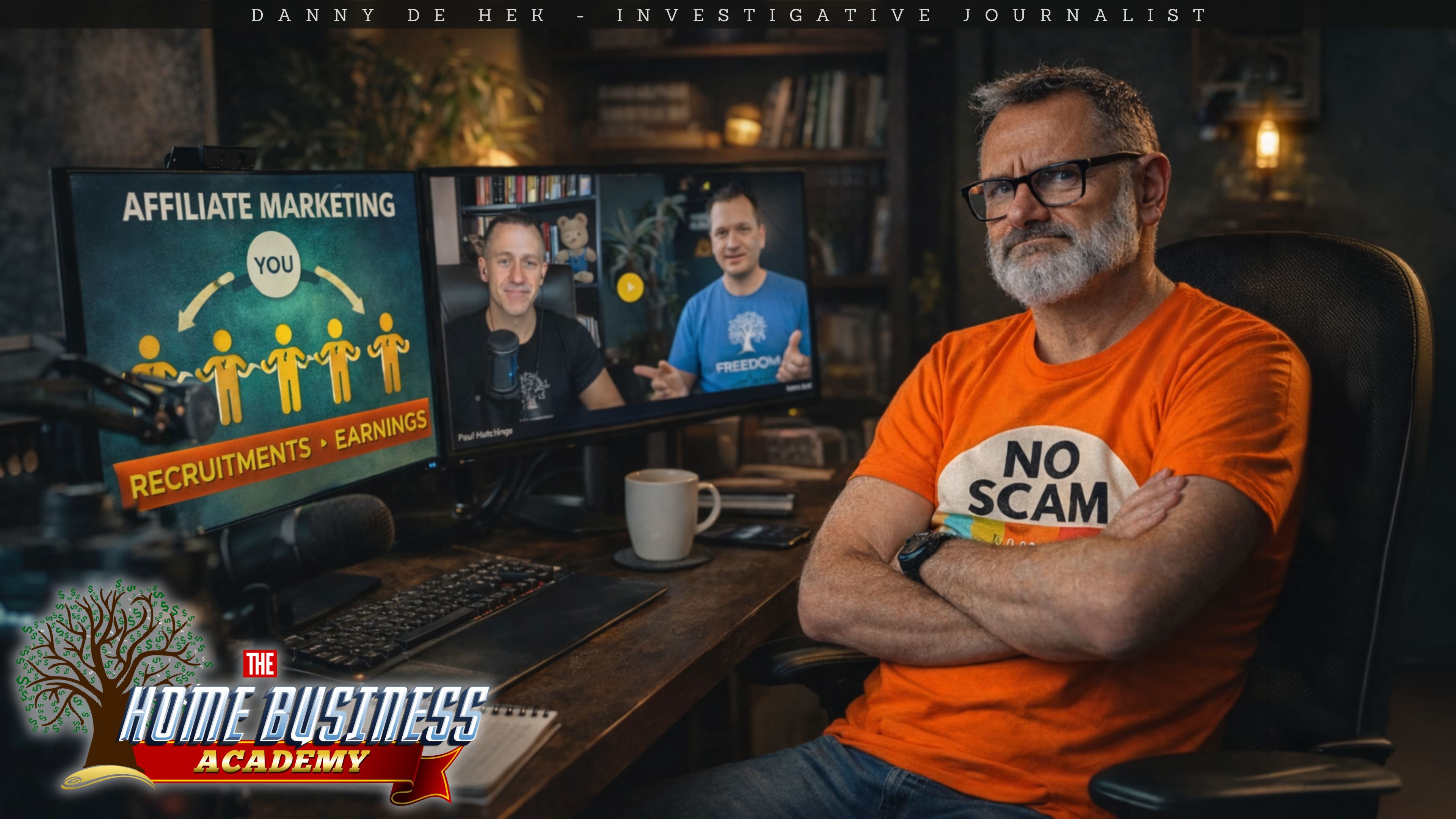
“If you’re asked to trust a system before you even know who’s behind it… you’re not being offered an opportunity, you’re being led into a funnel.”
Before we get into the detail, you need to understand something very clearly. This blog wasn’t written off speculation or assumption — it started with a real enquiry from a 78-year-old pensioner who was sent an affiliate link and simply wanted to know whether the opportunity behind it was legitimate.
The link led to a basic sign-up page asking for nothing more than a name and email, with little context about the company, the product, or what you were actually stepping into.
That alone raises questions.
Because legitimate businesses typically make it clear who they are and what they offer at the point of entry, rather than requiring users to move through a funnel before understanding the full picture. So instead of following the process as intended, I stepped back and started digging — using open-source intelligence, direct testing of the funnel, and analysis of publicly available material to trace everything back to The Home Business Academy and understand how the system operates.
This matters because what you’re about to read is not just a surface-level review. It’s a breakdown of a polished, structured, and carefully engineered system designed to feel simple, supportive, and legitimate — particularly to people who are new, curious, or looking for a straightforward way to make money online.
That’s what makes it effective.
People aren’t entering this thinking they’re taking a risk. They’re entering because they believe they’ve found something safe, stable, and already figured out for them — a system they can plug into and follow. But the deeper you go — stepping outside of the funnel and examining the structure, the pricing, the commissions, the terms, and even the cancellation process — the more that narrative begins to shift.
Because behind the clean design, the confident messaging, and the promise of “done-for-you” success, there is a system that raises legitimate questions about transparency, sustainability, and who this actually works for.
And once you see how all of the pieces connect, one thing becomes very clear:
This doesn’t just deserve scrutiny — it demands it.
The Hook: 80% Commissions and “Residual Income While You Sleep”
At the centre of their entire pitch is one number:
80% commissions.
It’s repeated constantly, reinforced at every stage, and positioned as something rare, powerful, and difficult to ignore.
And that’s not accidental.
Because before you’ve even had a chance to understand the system, the structure, or what’s actually being sold… you’ve already been anchored to the idea of high returns.
In their own presentation, they go as far as describing themselves as:
“the undisputed heavyweight residual income champion of the world”
That kind of language is designed to build belief early, establish authority, and position the opportunity as something proven — something that stands above everything else in the space.
And once that idea takes hold, something interesting happens.
People stop asking how the system works… and start focusing on what they could earn.
Because when you hear “80% commissions,” your brain naturally starts doing the math.
What if I get a few people in?
What if this actually works?
What if this is the one that’s different?
And that’s exactly the point.
The number isn’t just a feature of the business.
It’s the hook that draws attention before the underlying structure has been fully understood.
The Math That Sounds Simple… Until You Look Closer
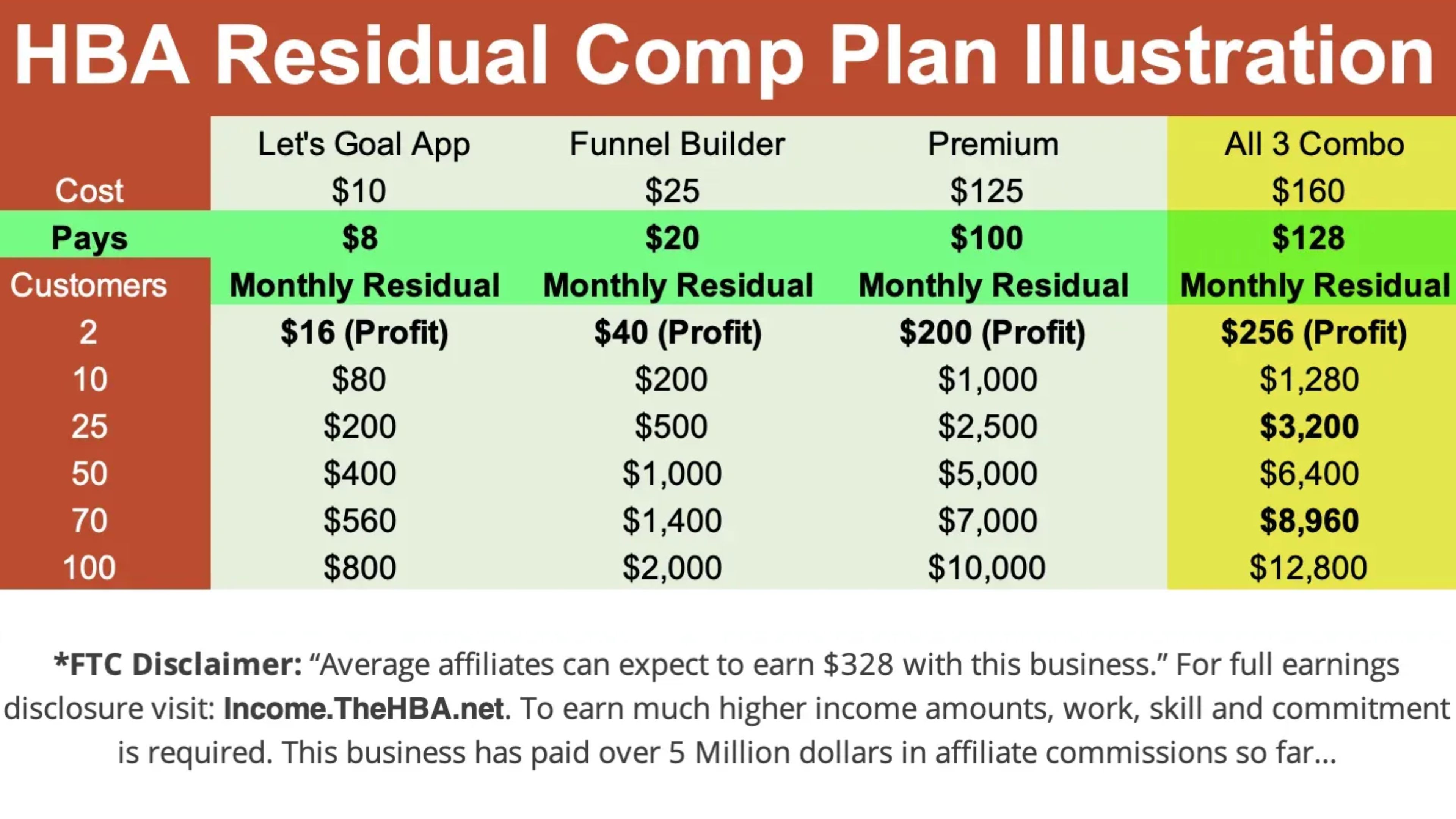
They present the numbers in a way that feels simple, achievable, and within reach — two referrals puts you into profit, twenty-four gets you to around $3,000 per month. It’s clean, easy to follow, and positioned to feel realistic rather than exaggerated.
That’s where the appeal comes from.
Because instead of sounding like a bold promise, it’s framed as a structured path — something that could be built over time through consistency and effort.
But that’s only one side of the story.
In the same presentation, they include a line that changes the context:
“Results not typical. Average affiliate earns $346.”
That figure matters.
Because while the headline focuses on income potential, the disclosed data reflects what many participants are actually experiencing — and it sits far below the numbers being highlighted.
Once you place those two side by side — the projected earnings and the average outcome — the gap becomes clear.
And when that gap exists within a system that requires ongoing monthly payments to remain eligible for commissions, it raises a broader question about how the model works in practice.
Not for the top performers.
But for the average person entering the system.
“You Don’t Have to Sell” — But You Still Have to Recruit
One of the most telling parts of the presentation comes when they introduce the AI-powered funnel, positioned as a system that reduces the need for traditional selling. The idea is simple — the funnel captures leads, emails follow up automatically, and the AI answers questions and guides the decision-making process.
That’s the promise.
In their own words, “you might not have to sell, you might not have to close…” — which sounds appealing, especially to people who are new or uncomfortable with sales. It creates the impression that much of the process is handled for you, reducing friction and making it feel more accessible.
But that raises an obvious question.
If you’re not selling… what role are you actually playing?
The answer becomes clearer when you look at how the system operates.
Your primary role is to drive people into the funnel.
Once someone enters, much of the process is automated — the system presents the information, builds interest, and leads the person toward becoming a paying subscriber. From there, participants are shown how to use the same structure to bring others into the system.
That’s where the focus shifts.
Because this isn’t centred on selling a product in isolation — it’s built around bringing new people into a structured system, with automation used to streamline the process once they arrive.
And that raises a broader question about where the emphasis really sits.
The “Affiliate Program” Claim Doesn’t End The MLM Questions
One of Mike Hobbs’ repeated talking points is that this is “not MLM” and “not network marketing,” but rather a one-level affiliate program. That distinction is clearly important, and it’s emphasised throughout the presentation as a way to separate The Home Business Academy from the stigma often associated with multi-level marketing.
But simply applying a different label doesn’t change how a model functions in practice.
Because when you look at how the compensation is presented, the structure still centres around bringing people into the system, getting them onto monthly subscriptions, and demonstrating how many customers are needed to reach a target income. The focus is not on broad retail demand or independent product uptake — it’s on how participation translates into recurring income.
That’s the real emphasis.
Mike explains that this gives individuals control because they don’t need a downline and can focus on their own customers. On the surface, that sounds more straightforward than traditional MLM structures. But the underlying message remains consistent: bring in enough paying users, and the residual income increases over time.
And that matters.
Because the way the model is presented places financial focus on how many people you can personally introduce and retain within the system, rather than on external demand for the products themselves. Whether those participants are described as customers, affiliates, or members, the key question remains the same.
What is the primary driver of revenue?
If participation is largely motivated by the income opportunity attached to the products — rather than independent demand for the products themselves — then it becomes reasonable to examine how the structure operates, regardless of the terminology used.
Mike also makes another point worth noting. He suggests that with a small number of sales, even an average participant can begin generating income. However, this sits alongside the company’s own income disclosure, which reports average annual earnings of approximately $346. That contrast highlights a gap between the illustrated earning scenarios and the reported outcomes for many participants.
And that gap matters more than the label.
Because when a compensation model is framed around monthly residual income, customer targets, and sign-up-driven earnings, it invites closer examination of how it compares to other recruitment-influenced business models it seeks to distinguish itself from.
So the more relevant question isn’t what it’s called.
It’s whether the structure, incentives, and outcomes align with the way it’s being presented.
And this is where the model becomes easier to visualise.
The company’s own compensation illustration focuses heavily on how many paying customers are needed to reach specific monthly income targets, with clear projections tied directly to personal sign-ups and ongoing subscriptions. Rather than emphasising independent product demand, the model is presented through participant-driven growth, where income increases as more people are brought into the system and maintained on recurring payments.
That doesn’t determine what the model is.
But it does highlight where the financial emphasis is placed — and why it’s important to look beyond the label and examine how the system operates in practice.
The Product vs The Opportunity — Which Comes First?
To their credit, there are products.
A habit tracker.
A funnel builder.
AI tools.
Training and coaching.
On the surface, that gives the impression of value — something tangible sitting behind the opportunity. But the way these products are introduced is what matters, because they’re not positioned as standalone solutions to real-world problems.
They’re positioned as part of a compensation structure.
That distinction matters.
Because instead of leading with what the product does or why someone would genuinely need it, the focus is placed on how it pays, how it fits into the system, and how it can be used to generate commissions.
And this pattern doesn’t just appear inside the platform itself.
Even so-called “independent” reviews often lead straight back into the same funnel, using tracked affiliate links that financially reward the person promoting it. In one case, a Medium article presenting itself as a review redirects readers into thehba.app funnel with an embedded affiliate ID, reinforcing that the content isn’t evaluating the system from the outside — it’s feeding people into the same system.
That’s important.
Because it shows how tightly controlled the narrative can become.
And then there’s a line that stands out:
“You’re not just buying air…”
That statement says more than it’s intended to.
Because strong, legitimate products don’t need to justify their existence. They don’t need to reassure people that something real is being exchanged — the value speaks for itself.
When that reassurance becomes part of the pitch, it raises a simple but important question.
Is the product the reason people are buying in…
or is it the opportunity attached to it that’s doing the real work?
The Subscription Model That Keeps You Locked In
The full system can cost up to $160 per month to stay fully active, depending on which products you’re using. That alone isn’t unusual — many online tools operate on subscriptions — but the way it’s tied to earnings is where things change.
Because there’s a condition attached.
If you don’t stay active… you don’t earn commissions.
That shifts the entire dynamic.
What starts out looking like an opportunity quickly becomes something you have to maintain, because your ability to earn is directly linked to your ongoing payments. It’s no longer just about using a product or building something over time.
It’s about remaining eligible.
Even in their own explanations, this requirement is made clear. In one presentation, it’s stated directly that in order to earn commissions, you must first own the products yourself. That means ongoing payments aren’t optional if you want to participate fully — they are built into the structure of how income is generated.
And that creates a subtle but very real pressure.
Because stepping away doesn’t just mean cancelling a subscription, it means losing access to the income stream, the structure you’ve built, and any momentum you believe you’ve created inside the system.
So the decision isn’t simply “Is this worth it?”
It becomes:
“Can I afford to stop?”
When Leaving Becomes the Hardest Part
At some point, every legitimate business should make it straightforward for customers to leave.
That’s part of trust.
But what happens here feels noticeably different.
When attempting to cancel a membership, you’re not taken directly to a simple cancellation page. Instead, you’re first directed to a 13-minute video, which you’re encouraged to watch before completing the process.
And this isn’t just a set of instructions — it functions as a retention layer.
The video walks through common reasons people cancel and responds to them. If you didn’t get results, it suggests you may not have fully engaged with the system. If you felt stuck, it directs you back toward the community and training. If you’re struggling financially, it encourages you to reconsider leaving.
The message is consistent.
The issue isn’t necessarily the system.
It’s that you may not have given it enough time.
And that’s where it becomes worth examining.
Because instead of a clean, immediate exit, the process introduces an additional layer of messaging at the exact moment a user is trying to stop paying. The language leans heavily on goals, progress, and future outcomes, all tied back to the idea of remaining inside the system.
Only after that do you reach the actual cancellation steps.
And even then, it’s not immediate.
You’re required to:
- Request a secure login link
- Wait for it to arrive
- Access a separate system
- Manually cancel each subscription
In testing, this process did not function as expected.
No email arrived within the stated timeframe, no access was granted, and no clear confirmation was provided. While this may not reflect every user’s experience, it does raise questions about reliability and consistency.
Which leads to a simple but important question.
If joining is fast and frictionless, but leaving involves additional steps, delays, or uncertainty…
what does that suggest about how the system is designed?
The Turnkey System — Or “Automated No Help”?
One of the more revealing moments comes from Mike Hobbs himself, where he says:
“When you see an automated system… run.”
That’s presented as a reflection of his own experience — a caution that many people would normally take seriously.
And yet, the current pitch centres around a fully automated turnkey system, positioned as the solution. A system designed to build the funnel, send the emails, handle objections, and guide prospects through to a sale.
That’s the shift.
Because what was once framed as something to be cautious of is now being presented as the advantage — something that removes complexity and makes the process easier to follow.
But it raises an obvious question.
If automation was previously something to avoid… what makes this version different?
And more importantly, is the automation actually providing independent value, or is it replacing human interaction with a standardised, repeatable process designed to move people through the same journey each time?
The AI That Sells — And Why That Matters
One of the biggest selling points is their AI assistant, “Sage,” which is positioned as a tool to support the sales process and make everything easier for the user. It’s designed to answer questions, guide conversations, and help prospects move forward without the need for constant input.
On the surface, that sounds efficient — even appealing.
But when you look closer, the role it plays is more significant.
Because this isn’t just about support.
It’s about influence within a structured environment.
The AI responds to questions, addresses objections, and reinforces key messages — all within a system designed to deliver consistent, repeatable interactions. It follows a defined path, guiding users through the same journey each time.
That changes the dynamic.
Because when human interaction is reduced or removed, what remains is a predefined experience — one designed to minimise friction and keep people moving forward through the process.
And that raises an important question.
Are people making decisions based on independent understanding…
or are they being guided through a standardised conversion process designed to lead toward a specific outcome?
The “Proven Results” — Without Full Context
They highlight numbers designed to impress.
A 6% conversion rate, rapid company growth, and millions paid out in commissions — all presented as evidence that the system is working and gaining traction.
On the surface, that sounds convincing.
Because figures like that create the impression of momentum, success, and legitimacy.
But there’s a limitation.
Those figures only show one side of the equation.
They don’t indicate how many people entered the system to generate those results, how many remain actively paying, or how many did not see a return on what they put in.
And that context matters.
Without it, those numbers don’t represent overall outcomes — they represent selected highlights.
Once you factor in their own income disclosure, which shows the average affiliate earning approximately $346 per year, the picture begins to shift.
Now those headline figures don’t necessarily reflect widespread success.
They suggest that a smaller set of outcomes may be representing a much larger group of participants.
And that raises a more important question.
Not how much has been paid out…
but how those earnings are distributed across everyone involved.
The Real Job: Traffic, Not Business
Right at the end of the presentation, they make a statement that cuts through the messaging:
“You have to get people to the funnel.”
That’s the role being described.
Not building a product. Not supporting customers. Not developing something new. The emphasis is on one core activity — bringing people into the system.
Because once the traffic is there, the rest of the process is already in place.
The funnel captures attention, emails follow up, the AI responds to questions, and the system guides individuals toward becoming paying subscribers. It’s a structured process designed to operate consistently, with minimal variation.
And that’s where the focus sits.
Not on building a traditional business from the ground up, but on feeding a pre-built system that relies on a continuous flow of new participants.
Not entrepreneurship in the conventional sense…
but traffic generation into a system designed to handle the rest.
The Pattern That Keeps Repeating
When you step back and look at the full picture, the pattern becomes clear.
The messaging leans heavily on income potential, while the products themselves sit in the background as supporting elements rather than the primary focus. The structure relies on a steady flow of new participants, with earnings linked to activity within the system rather than clearly demonstrated independent demand.
At the same time, the available data shows that many participants earn relatively little, despite how the opportunity is presented. And because commissions are tied to remaining active, the model reinforces ongoing payments as part of participation, not just a one-time decision.
Layered on top of that is a structured, automated sales process — one that delivers consistent messaging, reduces friction, and guides people through a similar journey from entry to purchase.
And when outcomes fall short…
the explanation is often framed around individual effort, consistency, or level of engagement, rather than the structure itself.
Which leaves a final point worth considering.
If the structure is consistent, the outcomes are consistent, and the explanations follow a similar pattern…
then it becomes reasonable to ask whether that pattern is simply coincidental —
or part of how the system is designed to operate.
Questions That Don’t Have Clear Answers
At this point, it’s worth stepping back and asking a few simple, practical questions based on what’s been presented.
If a company claims to pay out 80% of its revenue in commissions, while also covering development, infrastructure, support, payment processing, and ongoing operations — how is the remaining portion structured to sustain the business long-term? And if charitable donations are also part of that model, where do those funds come from, and how are they accounted for?
The company also states that it has paid out over $7 million in commissions over time. Based on their 2024 disclosure, which suggests an estimated annual revenue of around $1.4 million, this raises a natural question about how those payouts have been sustained across multiple years.
That doesn’t imply anything on its own.
But it does highlight the importance of understanding how the model performs over time, not just in a single snapshot, particularly when such a high percentage of revenue is being distributed back out as commissions.
The charity claim itself raises further questions.
References are made to providing meals to children in need, but there’s limited publicly available detail around which organisations are involved, how those contributions are calculated, or whether there is any independent verification or reporting to support those claims.
Then there’s the structure of the system.
If the primary activity is driving people into a funnel, and earnings are tied to bringing in participants who also pay monthly, it becomes reasonable to ask how much of the revenue is coming from independent product demand, and how much is influenced by participation in the opportunity itself.
Because that distinction matters.
A product-led business grows because people want the product.
A system-led model grows because people are motivated by the income opportunity attached to it.
And when those two things become blurred, it becomes harder to separate value from structure.
These aren’t accusations.
They’re questions that benefit from clear, transparent answers, especially for anyone considering getting involved.
The Part They Don’t Tell You
There’s a line in the presentation that captures the core idea behind the model:
“You do the work once… and get paid again next month.”
It sounds appealing.
Simple. Predictable. Almost effortless.
But when you place that idea alongside the actual data, the average earnings, the subscription requirements, and the way the system is structured, a different picture begins to form.
Because recurring income doesn’t come from nowhere.
It’s generated from ongoing payments within the system.
And that means the people who benefit most are those positioned to receive those payments consistently — not necessarily the average participant entering the system and trying to build momentum.
For many participants, the experience may not align with the way the opportunity is presented.
The numbers already point in that direction.
And once you look at how everything fits together, it becomes easier to understand why that gap can exist.
Because the real story isn’t in the headline.
It’s in what happens after you join — how the system operates over time, what’s required to stay active, and how outcomes vary across participants.
“The question isn’t whether the system pays — it clearly does.
The question is how many people realistically reach the level where it works… and how those outcomes are distributed across everyone involved.”
Right of Reply — The Company Responds
Following this investigation, I provided The Home Business Academy with a right of reply.
To their credit, they responded in detail and provided supporting material, including:
- Evidence of over $7 million in commissions paid
- Documentation relating to charitable donations to Feed My Starving Children
- Clarification that their model operates as a single-tier affiliate structure, rather than multi-level marketing
And on paper, that distinction is important.
Affiliates do not earn from a downline. There are no overrides, no team commissions, and no income generated from other affiliates’ activity.
However, even with that clarification, the underlying structure still raises important questions.
Because when you look at how income is generated in practice…
it still depends on bringing paying customers into the system.
The compensation model shows that meaningful income is tied to the ability to consistently refer and retain subscribers over time.
And that creates a dynamic where outcomes are influenced not just by product use…
but by a participant’s ability to continuously attract new people into the same structure.
So while the company is correct in stating that it is not multi-level in design…
the experience for some participants may still share similarities with other recruitment-influenced models.
And that’s where the questions remain.
Full response provided below for transparency:
Dear Danny,
Thank you for the opportunity to respond.
Before addressing your specific questions, we must correct a critical misunderstanding that appears to underpin your inquiry: The Home Business Academy is not, and has never been, a multi-level marketing company, network marketing organization, or multi-tier compensation program.
HBA operates a single-tier affiliate program. Affiliates earn commissions exclusively on their own personal sales. When a customer they personally referred continues their monthly subscription, the affiliate who made that sale earns a recurring commission on that customer’s ongoing payments. This is standard recurring affiliate income — the same model used by virtually every subscription-based affiliate program in the SaaS and digital product space.
What does not happen — and this is the critical distinction — is that affiliates earn absolutely nothing from sales made by other affiliates. There are no overrides, no downline commissions, no team bonuses, and no income earned from recruiting other affiliates. An affiliate could refer a hundred other affiliates to the program, and they would earn zero dollars from any of those affiliates’ sales activity. If you make a sale, you earn money. If you don’t, you don’t. There is no relying on a downline or getting paid from anyone else’s work.
This is a standard affiliate model no different from Amazon Associates, Shopify, or any major SaaS referral program. Given that this distinction is foundational, we want to ensure it is accurately reflected in any published reporting. Characterizing our business as MLM or network marketing would be factually incorrect.
With that established, we are happy to address your specific questions:
Commission Structure & Sustainability
We are able to pay 80% commissions because we keep our overhead intentionally low. We do not carry debt, and we handle all custom programming and software development for our products in-house rather than outsourcing — which eliminates what would otherwise be significant ongoing costs. The company operates sustainably on the remaining 20% of revenue and has done so continuously since we launched in 2016. Nearly a decade of sustained operations on this model speaks for itself.
Product Value
Every product we sell includes proprietary software tools, training built from years of real-world marketing experience, and live coaching. Our members have access to live interactive sessions on Zoom five days per week where they receive direct help and support — this is not prerecorded content or material freely available on the internet.
To give you a clear picture of what our members actually receive:
- HBA Funnel Builder includes a full funnel and website building tool — comparable to standalone platforms that typically charge $97 to $297 per month on their own.
- Let’s Goal is a proprietary productivity and personal development app that replaces multiple standalone software subscriptions members would otherwise need.
- HBA Premium includes a suite of proprietary tools: a Short Form Video smart posting tool that automates social media content distribution, an Email Writing Tool for crafting marketing emails on any subject, an Image Generation tool for creating YouTube thumbnails and marketing graphics, and custom in-house AI models built on real-world marketing experience — giving members access to specialized AI-powered tools without paying for additional subscriptions elsewhere.
- Financial Literacy Academy includes tax guidance from world-renowned attorney Mark Kohler, as well as a proprietary software tool called Bank Beater Pro that allows users to track and manage their debts and develop accelerated payoff strategies.
In addition, every paying customer receives access to our built-in Email Marketing Tool, eliminating the need to pay for expensive third-party autoresponder services for their newsletters and email campaigns.
These are real-world value products with functional software tools that members use regardless of whether they ever participate in the affiliate program. Our products are built to stand on their own merits. They are not packaging designed to justify an income opportunity — they are legitimate educational and software products that happen to also have an affiliate program attached.
Commission Verification
You referenced our public claim of over $5.5 million in commissions paid. As of today, our back-office reporting shows total all-time commissions paid of over $7 million — meaning our public figure was actually understated. Our platform tracks every commission in real time, and these figures are reported to the IRS annually. Please see the attached screenshot from our Commission Management dashboard for verification. There is nothing secretive about our payouts. Everything is transparent and verifiable.
Charitable Contributions
We contribute to Feed My Starving Children (fmsc.org). A percentage of the company’s profits is sent to them every month. This is not a marketing claim — it is a verified, ongoing relationship. Attached you will find:
- A screenshot showing donation receipt emails from Feed My Starving Children confirming consistent monthly contributions going back years
- A framed certificate from FMSC recognizing that Home Business Academy provided 67,649 nutritious meals to starving children in 2022
- A photo from an in-person FMSC meal packing event organized by our community on November 12, 2024, where our members packed 12,528 meals and presented a $7,000 donation
- A voicemail from Feed My Starving Children thanking The Home Business Academy for our contributions
Our community doesn’t just write checks — our members show up in person to pack meals.
Domains & Websites
To clarify, our official company domains are thehba.app, thehomebusinessacademy.com, and thehba.net. The other domains you listed are not owned or operated by our company. Those are independently created by individual affiliates to promote HBA, which is standard practice in affiliate marketing. Affiliates are independent marketers who build their own websites and content, just as affiliates do for Amazon, ClickBank, or any other affiliate program. We do not control or manage third-party affiliate websites.
Cancellation Process
Members can cancel at any time through the platform in their back office, or by writing to our support team. The video included in the cancellation flow is an educational walkthrough that shows members where they can find help and resources if they need assistance with anything — as many members canceling are simply unaware of the support available to them. The cancel button is located directly beneath the video for anyone who still wishes to proceed. Cancellation is not restricted or prevented at any point.
Zoom Compliance
Our use of Zoom is fully compliant with their terms. Their prohibition applies to multi-level marketing businesses, which we are not.
Income Disclosures
We publish income disclosures voluntarily because we value transparency. Results vary by individual effort, which we disclose clearly. And because ours is a single-tier affiliate program, this is not an abstract statement — it is simply math. You make a sale, you get paid. You don’t make a sale, you don’t get paid. There is no income based on the hope that other people will do the work for you, and no earnings generated without direct personal effort. An affiliate’s income is a direct, measurable result of their own activity and nothing else.
We welcome accurate, good-faith journalism and trust the information provided here, along with the attached documentation, is sufficient to ensure factual reporting.
Sincerely,
Mike Hobbs & Paul Hutchings
Co-Founders, The Home Business Academy
Attachments:
- Commission Management Dashboard — All Time Commissions Paid
- Feed My Starving Children — Donation Receipt Emails
- FMSC Certificate — 67,649 Meals Provided in 2022
- FMSC Meal Packing Event — November 12, 2024
- FMSC Thank You Voicemail — March 11, 2026
No further response was received following this exchange.
The information provided has been included in full for transparency. Readers are encouraged to review both the response and the evidence presented throughout this investigation before forming their own conclusions.
This article is based on publicly available information and personal testing of the system. It is intended for informational purposes and published in the public interest.
Disclaimer: How This Investigation Was Conducted
This investigation relies entirely on OSINT (Open Source Intelligence), meaning the information presented is based on publicly available sources, including websites, marketing materials, videos, domain data, and other openly accessible content.
All observations are derived from independent analysis, testing of publicly accessible systems, and review of materials provided by the company itself, including their right of reply.
No private data, unauthorised access, or unlawful methods were used at any stage.
This article reflects analysis, opinion, and commentary on the structure, claims, and publicly presented information, and is published in the public interest to support transparency and informed decision-making.
About the Author
I’m DANNY DE HEK, a New Zealand–based YouTuber, investigative journalist, and OSINT researcher. I name and shame individuals promoting or marketing fraudulent schemes through my YOUTUBE CHANNEL. Every video I produce exposes the people behind scams, Ponzi schemes, and MLM frauds, holding them accountable in public.
My PODCAST is an extension of that work. It’s distributed across 18 major platforms, including Apple Podcasts, Spotify, Amazon Music, YouTube, and iHeartRadio, so when scammers try to hide, my content follows them everywhere. If you prefer listening to my investigations instead of watching, you’ll find them on every major podcast service.
You can BOOK ME for private consultations or SPEAKING ENGAGEMENTS, where I share first-hand experience from years of exposing large-scale fraud and helping victims recover.
“Stop losing your future to financial parasites. Subscribe. Expose. Protect.”
My work exposing crypto fraud has been featured in:
- Bloomberg Documentary (2025): A 20-minute exposé on Ponzi schemes and crypto card fraud
- News.com.au (2025): Profiled as one of the leading scam-busters in Australasia
- OpIndia (2025): Cited for uncovering Pakistani software houses linked to drug trafficking, visa scams, and global financial fraud
- The Press / Stuff.co.nz (2023): Successfully defeated $3.85M gag lawsuit; court ruled it was a vexatious attempt to silence whistleblowing
- The Guardian Australia (2023): National warning on crypto MLMs affecting Aussie families
- ABC News Australia (2023): Investigation into Blockchain Global and its collapse
- The New York Times (2022): A full two-page feature on dismantling HyperVerse and its global network
- Radio New Zealand (2022): “The Kiwi YouTuber Taking Down Crypto Scammers From His Christchurch Home”
- Otago Daily Times (2022): A profile on my investigative work and the impact of crypto fraud in New Zealand






Leave A Comment