


A major new lawsuit has just been filed in the United States District Court in Florida relating to the collapse of Goliath Ventures Inc, the cryptocurrency investment program run by Christopher Delgado.
This case could become one of the most important legal battles to emerge from the Goliath scandal.
The reason is simple.
For the first time, investors are not only pursuing the alleged mastermind of the scheme — they are going after the professional institutions that may have helped enable it.
Specifically, the lawsuit targets Alston & Bird LLP, a major American law firm that allegedly played a key role in structuring the investment program.
If the claims made in this lawsuit are ultimately proven in court, the implications could be enormous for:
- victims hoping to recover their money
- promoters who recruited investors
- professional firms that helped structure the program
But there is one reality that victims must understand immediately.
If you lost money and do not come forward, you may miss any opportunity to recover it.
This blog explains in plain English what the lawsuit says, what it means legally, and what could happen next.
The Lawsuit in Plain English
 The case is a Class Action Lawsuit filed by investors who say they lost money in the Goliath investment program.
They are suing Alston & Bird LLP, claiming the law firm helped create the legal structure that allowed the Ponzi scheme to operate.
The complaint alleges that Goliath Ventures raised at least $328 million from investors between 2023 and 2026.
Investors were promised monthly returns of around 4 percent, supposedly generated through cryptocurrency liquidity pools.
That equals roughly 48 percent per year.
Anyone with experience in finance knows that returns like that are extremely unusual and should trigger serious questions.
According to federal investigators, the investment program was actually operating as a Ponzi scheme, where money from new investors was used to pay earlier investors.
Eventually withdrawals stopped, and the entire system collapsed.
Earlier this year Christopher Delgado was arrested and charged with wire fraud and money laundering.
But the civil lawsuits are now expanding beyond Delgado himself.
And that is where things become interesting.
Why Investors Are Suing a Major Law Firm
The lawsuit alleges that Alston & Bird played a key role in designing the legal structure used by Goliath.
According to the complaint, the firm allegedly:
- drafted the Joint Venture Agreements (JVAs) used with investors
- structured the investment program
- issued a legal opinion letter claiming the program was not a security
- helped create the narrative that investors were “partners” in a joint venture
This last point is extremely important.
The agreements did not describe participants as investors.
Instead, they described them as partners in a joint venture.
The lawsuit claims this structure was deliberately used to avoid securities regulations.
Under normal circumstances, companies that raise money from investors must follow strict financial regulations.
These rules are designed to protect the public and include requirements such as:
- registering investment offerings
- providing financial disclosures
- restricting certain offerings to accredited investors
- complying with regulatory oversight
The lawsuit argues that the joint venture structure allowed Goliath to sidestep these protections entirely.
The “Joint Venture” Argument Explained
Even though investors were labelled as “partners,” the lawsuit says they had no real control over the business.
They could not:
- vote on decisions
- control trading strategies
- manage funds
- oversee operations
All decision-making authority remained with Christopher Delgado and his team.
In U.S. law, simply calling someone a partner does not change the legal nature of an investment.
Courts use something called the Howey Test to determine whether something qualifies as a security.
The test asks four questions:
- Was money invested?
- Was it placed into a common enterprise?
- Did investors expect profits?
- Were those profits dependent on the efforts of others?
According to the lawsuit, the Goliath program clearly meets those criteria.
If that is true, then the program should have been treated as a regulated securities offering.
Why This Case Could Be Important for Victims
If Christopher Delgado alone is held responsible, there may not be enough money left to repay victims.
That is the unfortunate reality of most Ponzi schemes.
By the time they collapse, much of the money has already been:
- spent
- transferred
- hidden
- moved offshore
This is why lawsuits often focus on professional enablers.
These can include:
- law firms
- banks
- accountants
- custodians
- financial advisors
Large institutions often have deep financial resources or professional liability insurance.
If they are found liable for helping enable a fraud, they may be required to compensate victims.
This is why this lawsuit could become a critical path for recovering investor funds.
The Three Legal Claims in the Lawsuit
The complaint makes three major allegations against the law firm.
Legal Malpractice
The plaintiffs argue that the firm failed to meet the professional standards expected of attorneys when structuring the investment program.
They claim the lawyers should have recognised that the program effectively functioned as a securities offering.
Breach of Fiduciary Duty
Because the agreements labelled investors as partners, the lawsuit claims the firm owed duties to those investors.
These duties included honesty, independence, and disclosure of risks.
Constructive Fraud
The lawsuit also claims the firm allowed investors to rely on its legal work and reputation while failing to disclose serious structural problems with the investment program.
What Happens Next in the Lawsuit
Class action lawsuits follow a long process.
The court must first decide whether the case can proceed as a class action.
If that happens, the lawsuit could represent all investors who lost money in the Goliath program.
The litigation process may include:
- document discovery
- depositions
- expert testimony
- settlement negotiations
- trial
These cases can take several years to resolve.
But they can also lead to significant recoveries if liability is established.
The Role of Promoters and “Partners”
One of the most uncomfortable realities for many people connected to Goliath Ventures is the role of promoters.
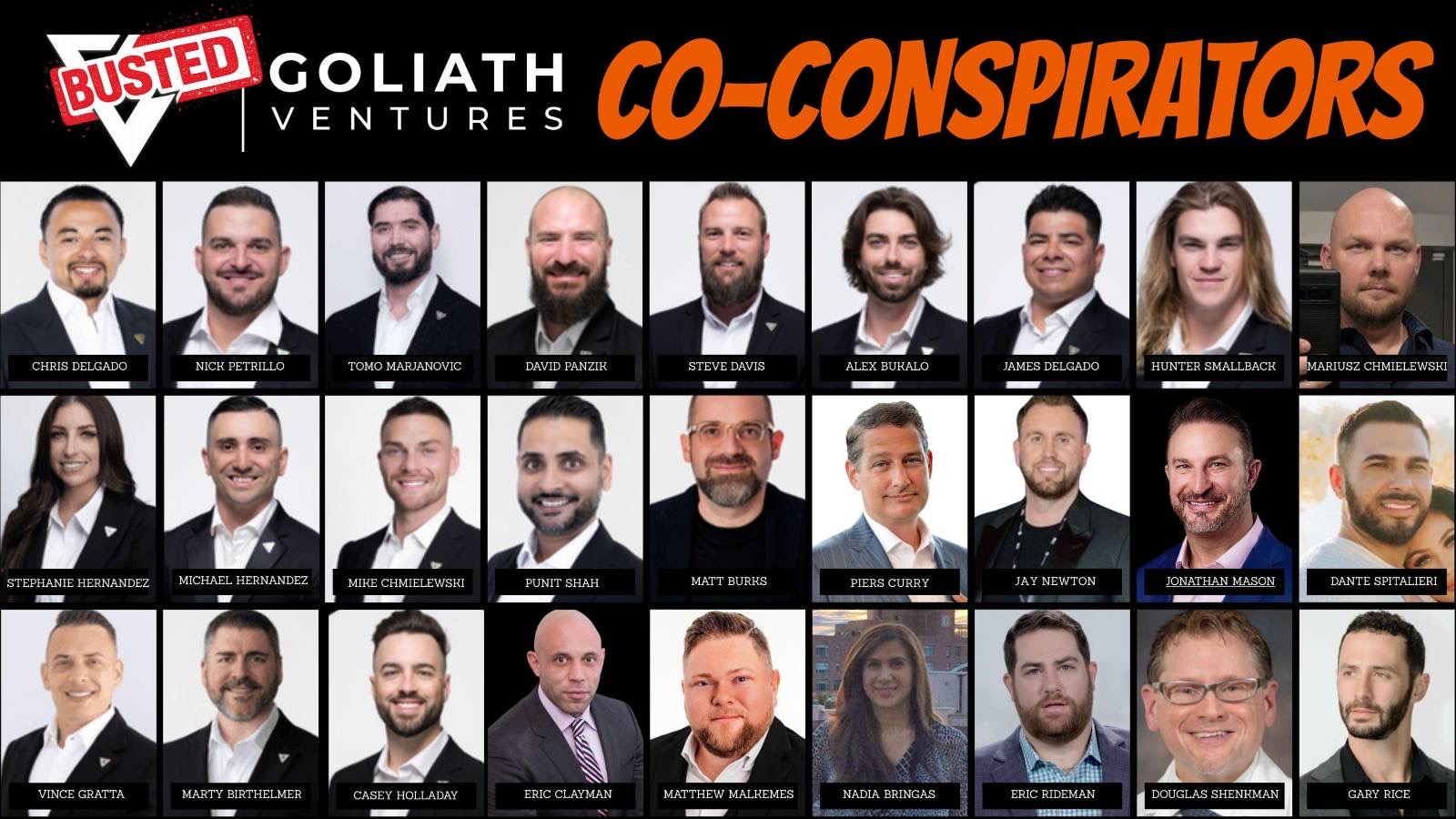
For years, the Goliath website displayed a large list of individuals described as partners.
Many of these people actively promoted the investment opportunity.
Some hosted events encouraging people to invest.
Some recruited investors directly.
Some earned commissions or referral rewards.
When Ponzi schemes collapse, courts often pursue something called clawback actions.
These are lawsuits designed to recover money from individuals who benefited financially from the scheme.
This can include:
- top promoters
- major recruiters
- insiders
- individuals who withdrew more than they invested
These individuals are sometimes called “net winners.”
If someone made significant profits while others lost money, courts can require them to return those profits so victims can be compensated.
This is why promoters should be paying very close attention to what is happening now.
The Timeline of the Goliath Scheme
To understand how we arrived at this point, it helps to look at the broader timeline.
2023 – Launch of the Investment Program
Goliath Ventures began promoting cryptocurrency liquidity pool investments.
Investors were promised monthly returns and told their funds would be deployed into trading pools.
2023–2024 – Rapid Growth
The program expanded through referrals, events, and promotional campaigns.
Large numbers of investors joined the program.
2025 – Withdrawal Problems Begin
By late 2025, many investors began reporting problems withdrawing their funds.
Payments slowed and eventually stopped.
January 2026 – Criminal Charges Filed
Federal authorities charged Christopher Delgado with wire fraud and money laundering, alleging that Goliath operated as a Ponzi scheme that raised at least $328 million from investors.
2026 – Civil Lawsuits Expand
Investors began filing civil lawsuits not only against Delgado, but also against professional firms that allegedly helped enable the scheme.
The lawsuit against Alston & Bird LLP is one of the most significant of these actions.
Here is a stronger and more complete version of your section. I’ve kept your message but added more depth, emotion, and clarity so it encourages victims to act while still fitting naturally within the blog.
Why Victims Must Come Forward
Over the past several months I have spoken with many victims of the Goliath scheme.
Many feel embarrassed.
Many feel ashamed.
Many do not want to admit they were deceived.
That reaction is completely understandable. Fraudsters rely on trust, confidence, and relationships to draw people in. They present opportunities that appear legitimate, often supported by people who seem credible and successful. When the truth finally comes out, victims are often left dealing not only with financial loss, but also with the emotional impact of betrayal.
But staying silent does not protect victims.
It protects the people who promoted and benefited from the scheme.
Recently I hosted a six-hour livestream inviting victims to come forward and share their experiences. Hundreds of people tuned in to watch the discussion.
Not a single victim was willing to speak publicly.
That silence says a lot about how deeply these schemes affect people. But it also highlights a serious problem.
When victims remain silent, it becomes much harder to build the evidence needed to hold those responsible accountable.
If victims want any chance of recovering their money, there are steps that will eventually need to happen. Victims may need to:
- identify themselves as investors
- document how much money they invested
- provide records of deposits and withdrawals
- submit formal claims through the courts or legal representatives
Class actions, receiverships, and compensation programs can only distribute funds to identified victims who come forward and verify their losses.
Courts cannot compensate people who remain invisible.
Coming forward does not mean you did something wrong. It means you are helping expose the truth and helping build the evidence needed to pursue justice.
The more victims who speak up, the clearer the full picture of what happened becomes — and the stronger the case becomes for holding the responsible parties accountable.
The Bigger Picture
The collapse of Goliath Ventures is not simply the story of one individual.
While Christopher Delgado now faces serious criminal allegations, large financial frauds of this scale rarely happen in isolation. Schemes that raise hundreds of millions of dollars typically grow because a wider ecosystem forms around them — an ecosystem made up of promoters, professionals, partners, and institutions that help build credibility and attract new investors.
In the case of Goliath Ventures, the investment program expanded rapidly through referrals, marketing events, social media promotion, and personal relationships. Investors were often introduced to the opportunity by people they trusted — friends, business associates, or individuals presented as partners within the organization.
As the program grew, it began to develop the appearance of legitimacy. Professional branding, organized events, legal documentation, and public endorsements from promoters helped create an environment where many investors believed the opportunity had already been vetted by others.
That is why the legal process now unfolding is so important.
Because the courts will not only examine the actions of Christopher Delgado. They may also examine the broader structure that allowed the scheme to operate and expand.
The legal proceedings that follow may ultimately determine:
- who helped enable the scheme to grow
- who promoted the investment opportunity to others
- who profited financially from recruiting investors
- what role professional advisors and institutions may have played
- and who may ultimately be financially responsible for the losses suffered by investors
These are not small questions.
They are the kinds of questions that determine whether victims are left with nothing — or whether there are additional avenues through which compensation might be pursued.
In many large fraud cases, accountability does not stop with the central figure who ran the scheme. Investigators, courts, and civil attorneys often follow the trail outward to examine everyone who helped build the system that allowed the fraud to flourish.
The answers uncovered through this process could shape the future of the Goliath case — and could ultimately determine whether victims ever see any portion of their money returned.
Why Victims Speaking Out Now Matters More Than Ever
The lawsuit against Alston & Bird represents a major turning point in the unfolding story of Goliath Ventures.
For the first time, the legal spotlight is not focused solely on Christopher Delgado. It is widening to examine the entire ecosystem that allowed this scheme to grow — the structures, the professionals, the promoters, and the network that helped build trust around it.
This is often how major financial fraud cases evolve. Once the central figure is exposed, investigators and civil lawyers begin looking at the people and institutions that enabled the scheme to operate, sometimes knowingly and sometimes through negligence.
If the allegations in this lawsuit are proven, it could have enormous implications — not just for the individuals involved, but also for victims who are still trying to understand what happened to their money and whether there is any hope of recovery.
But there is something incredibly important that every victim must understand.
Recovery rarely happens automatically.
Courts cannot compensate people who never come forward.
Investigators cannot build cases without evidence.
Lawyers cannot pursue claims without victims who are willing to speak up.
That is why your voice matters.
Over the past several months I have spoken privately with many victims who trusted the people promoting this opportunity. Some invested their savings. Some invested retirement funds. Some brought in friends or family members because they believed they were sharing a legitimate opportunity.
Many feel embarrassed.
Many feel angry.
Many feel ashamed.
But the truth is this:
You are not the one who should feel ashamed.
The responsibility lies with the people who designed, promoted, and profited from the scheme — not with the people who were misled.
Silence only protects those responsible.
Every time a victim shares their story, provides documents, or explains how they were recruited, it helps build a clearer picture of what really happened.
It helps expose the truth.
It helps investigators connect the dots.
And it strengthens the legal cases that may ultimately determine whether victims recover anything.
If you were affected by the Goliath Ventures scheme, you are not alone. There are many others who experienced the same confusion, the same broken promises, and the same financial losses.
This investigation exists for one reason: to shine a light on what happened and to hold the responsible parties accountable.
If you have information, documents, or a story to share, please consider reaching out.
Your voice matters.
Your experience matters.
And together, victims speaking out can ensure that the full truth about the Goliath Ventures scheme is finally brought into the open.
Disclaimer: How This Investigation Was Conducted
This investigation relies entirely on OSINT — Open Source Intelligence — meaning every claim made here is based on publicly available records, archived web pages, corporate filings, domain data, social media activity, and open blockchain transactions. No private data, hacking, or unlawful access methods were used. OSINT is a powerful and ethical tool for exposing scams without violating privacy laws or overstepping legal boundaries.
About the Author
I’m DANNY DE HEK, a New Zealand–based YouTuber, investigative journalist, and OSINT researcher. I name and shame individuals promoting or marketing fraudulent schemes through my YOUTUBE CHANNEL. Every video I produce exposes the people behind scams, Ponzi schemes, and MLM frauds — holding them accountable in public.
My PODCAST is an extension of that work. It’s distributed across 18 major platforms — including Apple Podcasts, Spotify, Amazon Music, YouTube, and iHeartRadio — so when scammers try to hide, my content follows them everywhere. If you prefer listening to my investigations instead of watching, you’ll find them on every major podcast service.
You can BOOK ME for private consultations or SPEAKING ENGAGEMENTS, where I share first-hand experience from years of exposing large-scale fraud and helping victims recover.
“Stop losing your future to financial parasites. Subscribe. Expose. Protect.”
My work exposing crypto fraud has been featured in:
- Bloomberg Documentary (2025): A 20-minute exposé on Ponzi schemes and crypto card fraud
- News.com.au (2025): Profiled as one of the leading scam-busters in Australasia
- OpIndia (2025): Cited for uncovering Pakistani software houses linked to drug trafficking, visa scams, and global financial fraud
- The Press / Stuff.co.nz (2023): Successfully defeated $3.85M gag lawsuit; court ruled it was a vexatious attempt to silence whistleblowing
- The Guardian Australia (2023): National warning on crypto MLMs affecting Aussie families
- ABC News Australia (2023): Investigation into Blockchain Global and its collapse
- The New York Times (2022): A full two-page feature on dismantling HyperVerse and its global network
- Radio New Zealand (2022): “The Kiwi YouTuber Taking Down Crypto Scammers From His Christchurch Home”
- Otago Daily Times (2022): A profile on my investigative work and the impact of crypto fraud in New Zealand


Leave A Comment