


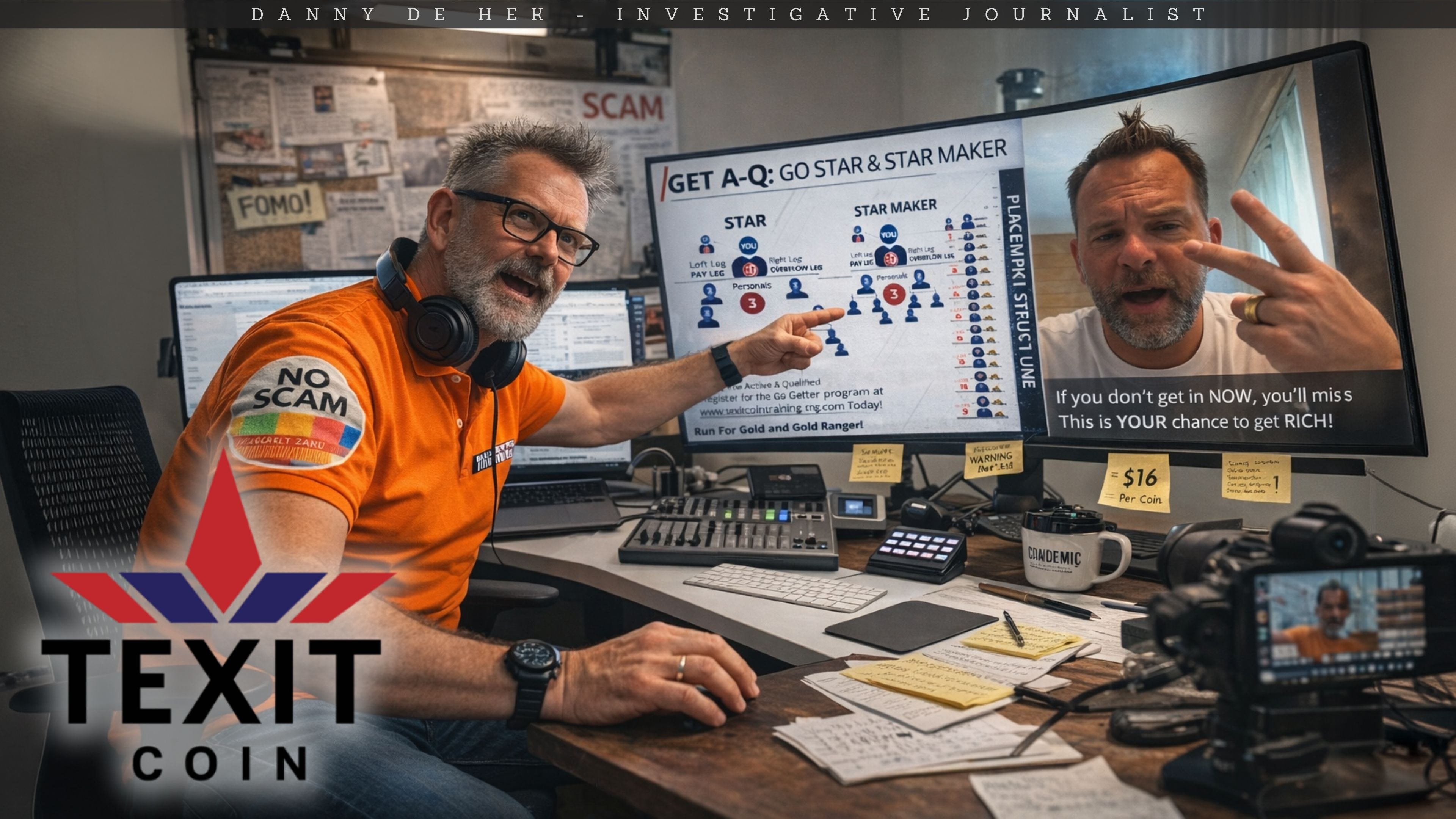
“TEXITcoin isn’t a financial revolution — it’s another crypto scheme hoping enough people believe the hype before reality catches up.”
Over the years I’ve investigated hundreds of cryptocurrency schemes claiming to revolutionise finance. Almost all of them promise the same things — decentralisation, financial freedom, and a community-driven alternative to traditional banking.
But when you look past the marketing, the same warning signs appear again and again.
Grand promises. Emotional narratives. Recruitment incentives. And a business model that depends on new investors bringing in more investors.
The latest project raising serious alarm bells is TEXITcoin (TXC) — a cryptocurrency marketed as a digital currency “for Texas by Texans.”
At first glance it’s packaged as a patriotic financial revolution tied to the idea of Texas independence. But once you start digging into the compensation structure, the mining “investment” packages, the blockchain data, and — most importantly — the official actions taken by financial regulators, the story begins to look very different.
In fact, the Texas State Securities Board has already issued an Emergency Cease and Desist Order, alleging that the project is offering unregistered securities through misleading investment schemes.
That alone should stop any sensible investor in their tracks.
Because when regulators warn that a project poses immediate and irreparable harm to the public, it’s not just a red flag.
It’s a flashing neon warning sign.
What’s being sold as a patriotic cryptocurrency movement may in reality be another recruitment-driven crypto scheme wrapped in political marketing and multi-level promotion tactics — the kind that has repeatedly left investors holding the bag when the hype collapses.
The Texas Independence Narrative
One of the oldest tricks used to sell questionable financial schemes is to create a crisis and then present the product as the solution.
TEXITcoin’s marketing leans heavily into exactly that playbook.
Promotional material repeatedly pushes the idea that the United States is in decline, that federal institutions cannot be trusted, and that Texas may one day need to stand on its own as an independent nation.
Once that fear is planted, the project conveniently positions its own cryptocurrency as the answer — a token supposedly designed to become the future currency of an independent Texas.
In other words, the problem they are selling is a collapsing system, and the solution they are offering just happens to be the token they want you to buy.
This tactic is nothing new. We’ve seen it before in gold schemes that claim the banking system is about to collapse, survivalist investments that warn of economic catastrophe, and crypto projects that insist traditional currencies are doomed.
The pattern is always the same: create fear first, then sell the miracle solution.
But here’s the reality.
There is no evidence whatsoever that any Texas government authority recognises, supports, or has any involvement with TEXITcoin.
It is not an official state project. It is not a government-backed initiative. And it is certainly not the approved future currency of Texas.
Even the project’s own FAQ acknowledges that the token has no official governmental backing at all.
Strip away the patriotic branding and political rhetoric and what remains is simply a private cryptocurrency project using fear and ideology as marketing tools to sell a speculative token.
A Cryptocurrency That Admits It Is “Not an Investment”
One of the most revealing details about TEXITcoin appears in its own material.
The project’s FAQ openly warns that purchasing TEXITcoin should not be considered an investment and may be comparable to gambling or buying a lottery ticket.
Think about that for a moment.
The people promoting the project are effectively telling participants up front that there is a real possibility they could lose everything.
While most cryptocurrency projects include risk warnings, very few go as far as comparing participation to buying a lottery ticket. That kind of language isn’t usually used by legitimate financial ventures — it’s typically the sort of disclaimer people use when they want to protect themselves from responsibility if things go wrong.
Which raises an obvious question.
If the token is supposedly just speculative and comparable to gambling, why is the project simultaneously promoting mining packages, recruitment rewards, and income opportunities tied to participation?
You can’t have it both ways.
You can’t market something as a community-driven financial opportunity, encourage people to spend thousands of dollars on “mining packages,” and then fall back on the defence that it was never meant to be an investment in the first place.
That contradiction alone should set off alarm bells for anyone considering getting involved.
The Multi-Level Marketing Structure
Another major red flag is the multi-level marketing compensation structure used to sell TEXITcoin mining packages.
Participants are encouraged to recruit others into the program and build referral networks beneath them. As new participants join and purchase packages, commissions are paid out through a structure that tracks activity across two organisational “legs.”
In simple terms, the system rewards people not for using the technology, but for bringing in more investors.
That distinction matters.
Legitimate blockchain projects do not rely on recruitment commissions to grow. Bitcoin does not pay people to recruit new buyers. Ethereum does not reward users for building referral networks.
Cryptocurrency adoption normally grows because people find the technology useful.
But when commissions are tied directly to recruitment, the incentive structure changes. The focus shifts away from building real-world utility and toward expanding the network by convincing more people to join.
This is why regulators pay close attention to programs structured this way.
When money flows primarily through recruitment rather than genuine product demand, the system begins to resemble the mechanics of multi-level marketing schemes — where early participants benefit most and success depends heavily on a constant stream of new investors entering the network.
Mining Packages Instead of Real Mining
Another major concern is the way TEXITcoin promotes so-called “Mining Packages.”
In legitimate cryptocurrency mining, participants typically operate their own hardware, secure the blockchain network, and receive block rewards directly from the protocol.
That is not how this system works.
Instead of encouraging people to run their own mining equipment, TEXITcoin sells packages that supposedly generate daily cryptocurrency rewards for the buyer.
According to the Texas State Securities Board, investors purchasing these packages do not receive mining hardware and have no control over mining equipment. They are simply paying to participate in mining operations that are entirely managed by the company.
This is a crucial distinction.
When participants are not actually mining anything themselves and must rely entirely on a company to generate returns on their behalf, the arrangement begins to look far less like cryptocurrency mining and far more like an investment scheme promising passive income.
That is precisely why regulators step in.
When people are encouraged to hand over money with the expectation that someone else’s efforts will generate profits for them, the offering may fall under the legal definition of a security — which brings it under financial regulation designed to protect investors.
What the TexitCoin Pitch Deck Actually Tells Investors
 The official TexitCoin Presentation Deck reveals how the opportunity is marketed to potential participants. Rather than focusing on technology or decentralised adoption, the slides frame the project as a mining-based income opportunity combined with referral rewards.
One slide even reassures potential participants:
“You don’t need to understand cryptocurrency to get involved & make money.”
The presentation goes on to make several key claims:
- Mining seats start at $995, with daily TXC rewards generated by company-run mining operations.
- Participants are told supercomputers handle all mining automatically, meaning no technical knowledge or hardware is required.
- Additional income can be earned through referral bonuses for recruiting new participants into the system.
- Promotional material even asks prospects if they wish they could “go back in time and buy Bitcoin in 2008.”
Taken together, the pitch deck frames TexitCoin less as a decentralised cryptocurrency project and more as a mining package program combined with recruitment incentives — a structure regulators often scrutinise when determining whether an operation is offering unregistered securities.
Texas Securities Regulators Step In
The concerns surrounding TEXITcoin are not just coming from independent investigators or critics. Texas regulators have already stepped in.
On February 11, 2026, the Texas State Securities Board issued an Emergency Cease and Desist Order against:
- TEXITcoin
- MineTXC
- Blockchain Mint
- founder Robert J. Gray
According to the regulator, the project was offering mining packages as passive investment opportunities.
Promotional material reportedly told investors that after purchasing a package they could simply “sit back and enjoy the ride.”
That kind of promise is exactly the sort of language regulators look for when determining whether an offering is being sold as an investment.
The order further states that the program used a multi-level marketing network of sales agents to recruit new participants and sell these mining packages.
After reviewing the structure of the program, the Texas State Securities Board concluded that the mining packages qualify as securities and were being offered without proper registration.
Even more concerning, the regulator determined that the respondents were engaging in misleading or deceptive practices and warned that the conduct posed a risk of immediate and irreparable public harm.
In other words, the regulator believed the situation was serious enough to justify an emergency order to stop the activity immediately.
And that order carries real consequences.
Violating a cease and desist issued under Texas securities law can result in criminal penalties, including substantial fines and potential imprisonment.
New Zealand Regulator Issues Warning
The concerns surrounding TEXITcoin are not limited to the United States. Regulators in New Zealand have also stepped in after noticing that a significant number of New Zealand residents were both investing in and promoting the scheme.
New Zealand’s Financial Markets Authority (FMA) issued a Public Warning after the Texas State Securities Board Emergency Cease and Desist Order was announced.
According to the FMA, a large number of New Zealanders have already invested in TEXITcoin and are actively promoting the project within New Zealand.
The regulator warned that the mining packages associated with the scheme may qualify as financial products under New Zealand law, and the services connected to them may fall under the definition of regulated financial services.
That creates a serious problem for anyone promoting the project locally.
The FMA confirmed that TEXITcoin is neither registered nor licensed in New Zealand, meaning the promotion or offering of these products could breach New Zealand financial regulations.
The warning specifically referenced the Texas regulatory order, which alleged that the mining packages were:
- offered in breach of U.S. securities legislation
- connected to fraud in the offer of the mining packages
- promoted using materially misleading and deceptive practices
Because of these concerns, the FMA issued a very clear message to promoters in New Zealand:
Stop promoting TEXITcoin.
The regulator strongly recommended that all promotional activity cease immediately, warning that the products are high-risk offerings from overseas entities that are not protected under New Zealand law.
For New Zealand investors, that means one thing: if something goes wrong, there may be little to no legal protection available locally.
The $16 Token Narrative
One of the most striking promises used to attract investors was the claim that TEXITcoin could reach $16 per token by February 2026.
This figure wasn’t presented as a distant dream decades into the future. It was promoted as a relatively near-term target, designed to give potential investors the impression that enormous returns were just around the corner.
The strategy behind this narrative was straightforward.
Grow the network.
More people joining the mining program meant more tokens being purchased, more promotion, and more demand — at least in theory.
Promoters framed this idea using Metcalfe’s Law, a concept suggesting that the value of a network increases as more participants join it.
But in practice, the model relied heavily on exactly what critics warn about in recruitment-driven schemes: a constant stream of new participants entering the system.
Once recruitment slowed, the economics quickly began to unravel.
The token price, which had reportedly traded above $0.75, fell dramatically — dropping to around $0.16 to $0.19 following regulatory intervention and a decline in new investor activity.
That’s a long way from the promised $16 target, and it illustrates a pattern that has played out repeatedly across the cryptocurrency industry.
When growth depends more on bringing in new participants than on real-world utility, the price can collapse just as quickly as it rose.
Recruitment Collapse and Narrative Shift
Investigative reporting from BehindMLM — a tip of the hat to Oz — indicates that recruitment activity for TEXITcoin was already beginning to decline before Texas regulators stepped in.
That detail matters, because it suggests the project was already struggling to attract new participants.
Once recruitment slowed, the messaging around the project began to change.
Instead of focusing on the earlier promises of returns tied to mining packages and network growth, promoters started shifting the narrative toward new themes such as:
- token “utility”
- payment systems and apps
- the idea of TEXITcoin as a “community currency”
This kind of pivot is something investigators have seen many times before in the crypto world.
Projects initially promoted as income opportunities or investment vehicles suddenly begin talking about “utility” once the flow of new investors starts to slow down.
The problem, of course, is that the thousands of people who bought into the scheme were not originally pitched a long-term technology experiment. They were sold on the idea of financial upside tied to the growth of the network.
Changing the story after recruitment begins to stall does not change how the project was originally marketed to investors.
Founder Remaining Outside the United States
Following the regulatory action in Texas, TEXITcoin founder Robert J. Gray made a revealing statement during one of the project’s update calls. When asked about returning to the United States, Gray said he would only consider coming back once he was “one hundred percent sure” the situation would not escalate into criminal charges.
That statement alone raises serious questions. If everything about the project were above board, there would be little reason to publicly discuss concerns about potential criminal charges.
At the time of reporting, Gray was believed to be located in Singapore, having travelled there from Turkey, with earlier reports placing him in Dubai.
Moving between jurisdictions while regulatory scrutiny intensifies is something investigators have seen before in several high-profile crypto and MLM cases.
Whether Gray eventually returns to the United States remains to be seen. But his own comments make one thing clear: the possibility of further legal action is being taken seriously.
Questions About the Founder’s History
The Texas regulatory order also references a previous bankruptcy connected to a company associated with Gray.
The order notes that Mulligan Mint Inc. filed for Chapter 11 bankruptcy in 2013, which was later converted to Chapter 7 liquidation.
According to regulators, this information was not disclosed while Gray’s experience was being promoted to potential investors.
When Crypto, Politics and Recruitment Collide
When you step back and look at the bigger picture, the pattern becomes difficult to ignore.
TEXITcoin brings together several ingredients that have appeared in many failed crypto schemes before it:
- political messaging designed to attract ideological supporters
- recruitment-driven compensation structures
- centrally managed mining operations sold as passive income
- promises of future price growth tied to network expansion
- regulatory warnings from multiple jurisdictions
Each of these elements on its own might raise questions.
But when they appear together in the same project, experienced investigators tend to pay very close attention.
History has shown that when cryptocurrency ventures rely heavily on recruitment incentives, emotional narratives, and passive income promises, the model often depends on a steady stream of new participants to sustain itself.
Once that flow slows down, the structure begins to struggle — and the people who joined later are usually the ones left holding the losses.
The involvement of financial regulators in both the United States and New Zealand should serve as a serious warning to anyone considering participation.
The Writing Is on the Wall
TEXITcoin markets itself as a revolutionary cryptocurrency tied to the future of Texas.
But once you strip away the marketing and political rhetoric, the reality looks very different.
What remains is a project built around token promotion, mining package sales, and recruitment-driven growth, rather than genuine technological adoption or real-world utility.
Regulators in both the United States and New Zealand have already issued warnings about the way this project is being promoted.
That alone should give any potential investor serious pause.
Because history has shown time and time again that when a financial opportunity relies more on recruiting new participants than creating real value, the outcome is rarely good for the people who join late.
By the time the hype fades and the recruitment slows down, the insiders and early promoters have usually moved on — and it’s the everyday investors who are left dealing with the losses.
The warning signs here are already visible.
The question now is whether people will pay attention before more money disappears into the next so-called crypto revolution.
Disclaimer: How This Investigation Was Conducted
This investigation relies entirely on OSINT — Open Source Intelligence — meaning every claim made here is based on publicly available records, archived web pages, corporate filings, domain data, social media activity, and open blockchain transactions. No private data, hacking, or unlawful access methods were used. OSINT is a powerful and ethical tool for exposing scams without violating privacy laws or overstepping legal boundaries.
About the Author
I’m DANNY DE HEK, a New Zealand–based YouTuber, investigative journalist, and OSINT researcher. I name and shame individuals promoting or marketing fraudulent schemes through my YOUTUBE CHANNEL. Every video I produce exposes the people behind scams, Ponzi schemes, and MLM frauds — holding them accountable in public.
My PODCAST is an extension of that work. It’s distributed across 18 major platforms — including Apple Podcasts, Spotify, Amazon Music, YouTube, and iHeartRadio — so when scammers try to hide, my content follows them everywhere. If you prefer listening to my investigations instead of watching, you’ll find them on every major podcast service.
You can BOOK ME for private consultations or SPEAKING ENGAGEMENTS, where I share first-hand experience from years of exposing large-scale fraud and helping victims recover.
“Stop losing your future to financial parasites. Subscribe. Expose. Protect.”
My work exposing crypto fraud has been featured in:
- Bloomberg Documentary (2025): A 20-minute exposé on Ponzi schemes and crypto card fraud
- News.com.au (2025): Profiled as one of the leading scam-busters in Australasia
- OpIndia (2025): Cited for uncovering Pakistani software houses linked to drug trafficking, visa scams, and global financial fraud
- The Press / Stuff.co.nz (2023): Successfully defeated $3.85M gag lawsuit; court ruled it was a vexatious attempt to silence whistleblowing
- The Guardian Australia (2023): National warning on crypto MLMs affecting Aussie families
- ABC News Australia (2023): Investigation into Blockchain Global and its collapse
- The New York Times (2022): A full two-page feature on dismantling HyperVerse and its global network
- Radio New Zealand (2022): “The Kiwi YouTuber Taking Down Crypto Scammers From His Christchurch Home”
- Otago Daily Times (2022): A profile on my investigative work and the impact of crypto fraud in New Zealand




Leave A Comment