


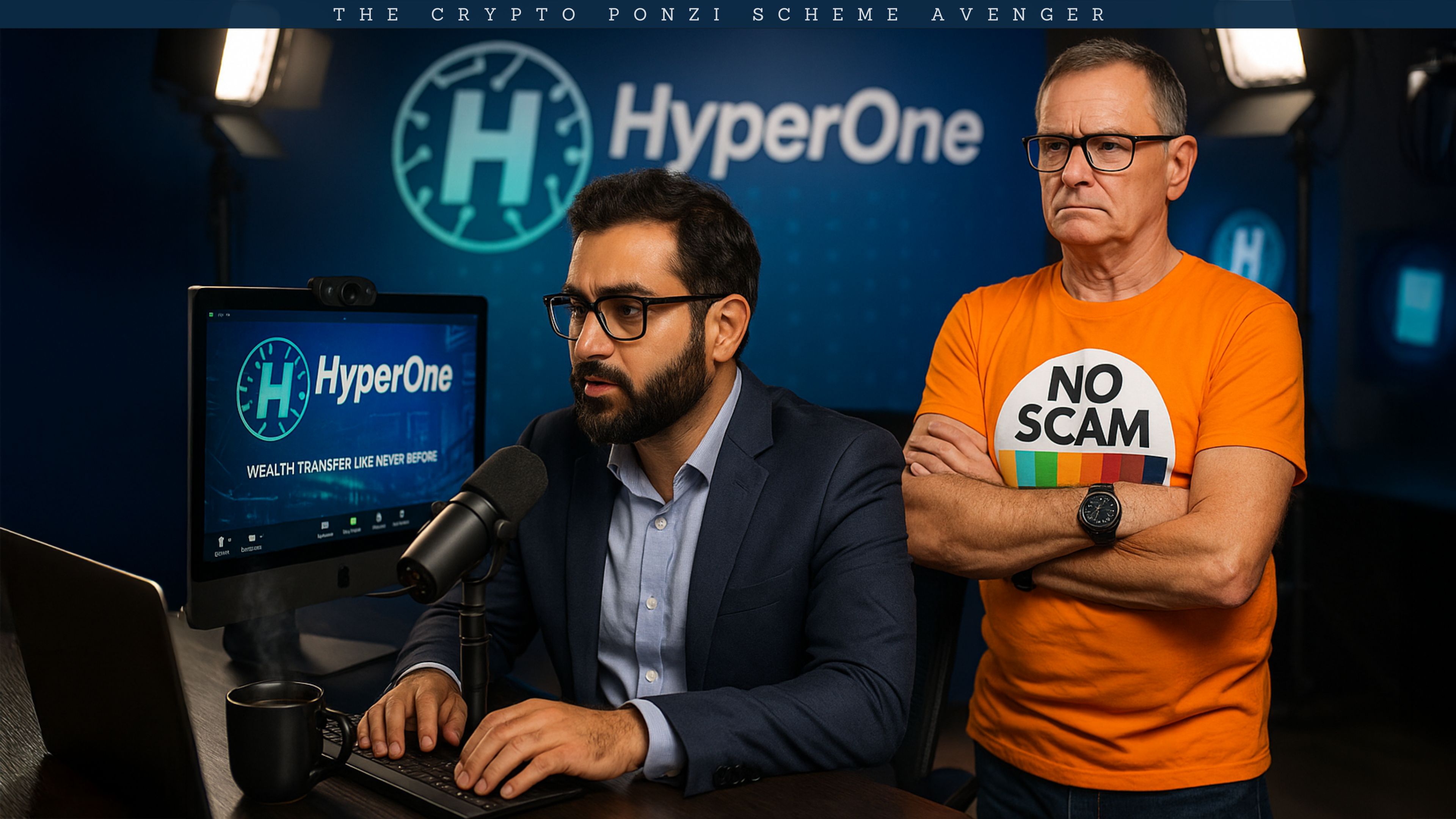
He called himself a blockchain innovator. He hosted webinars, smiled in pitch decks, and talked about cross-chain interoperability, quantum encryption, and decentralised governance.
But behind the marketing buzzwords and technical theatrics, Shavez Ahmed Siddiqui was helping launder credibility into a Ponzi scheme—and his boss was none other than Sam Lee, the man who fled to Dubai after stealing tens of millions from investors.
This is the truth behind HyperOne, the final rebrand of the HyperVerse collapse, and the critical role Shavez played in promoting it.
The Myth of HyperOne
 HyperOne was marketed as a groundbreaking blockchain project. Its developers claimed it would bridge traditional blockchains with DAG-based systems, protect user data through post-quantum cryptography, and enable borderless smart contract development through a hybrid PoW and PoS consensus mechanism. The website, hosted at hcash.one, promised privacy, decentralisation, and the ability to “redefine the blockchain” itself. The project was supposedly backed by research partnerships with prestigious universities in Shanghai and Hong Kong. Its Whitepaper and Yellow Paper were bloated with cryptographic terminology, code names like “RPPOM” and “HAILP,” and wildly optimistic claims about scalability and token economics.
But for all the talk, there was no working blockchain. No open-source code repository. No verifiable team of developers. No listed exchanges. No real community. Just a glossy website, some PDF documents, and a growing number of financially desperate investors funneled in through private webinars and affiliate links.
HyperOne was not a technological project. It was a marketing front for another Ponzi scheme, built off the back of trust siphoned from the ashes of HyperFund and HyperVerse.
Shavez’s Role: The Professional Promoter
Shavez didn’t just stumble into HyperOne. He was already a known figure within the HyperTech Group, the shady crypto conglomerate founded by Sam Lee and Ryan Xu. Shavez presented himself as a trusted insider, someone close to the leadership, someone with answers. In Zoom meetings and Telegram groups, he actively pitched HyperOne as the natural evolution of HyperFund. This wasn’t just a pivot—it was sold as a redemption arc. A reset button for everyone who lost money in the previous schemes. A fresh start.
But the truth is, HyperOne was designed to recycle victims, not empower them. And Shavez knew it.
He was no mere investor or enthusiastic community member. He was running damage control. When HyperVerse began collapsing and authorities started circling, Sam Lee needed a new product. A new name. A new hook. That’s when Shavez stepped forward. He helped lead the public-facing charge to prop up HyperOne as legitimate, while concealing the fact that his boss was the same man responsible for the millions in missing investor funds from the last scam.
Shavez called it innovation. He used phrases like “quantum-safe” and “next-gen interoperability.” But what he was actually doing was using high-concept jargon to mask the same old MLM structure—bring in new users, promise big gains, and pay old ones using fresh deposits.
A Blockchain Built on Lies
HyperOne’s whitepaper was technical by design, not to inform but to confuse. It referenced RingCT, lattice cryptography, zk-SNARKs, and a hybrid dual-chain model that, on paper, looked futuristic. But there was no functioning explorer. No open access to the supposed “HyperExchange” or “HyperCash” chain. The post-quantum claims were never peer-reviewed. The universities named in the documents have never publicly acknowledged any relationship.
Instead, what did exist were controlled dashboards, invitation-only webinars, and strict withdrawal rules. The same playbook HyperTech had used before.
At the center of it all stood Shavez—hosting Zooms, nodding along to hype sessions, collecting commissions, and building credibility for the next collapse.
The Same Boss, the Same Scam
It is essential that people understand this: Shavez was working for Sam Lee. This wasn’t a case of a well-meaning affiliate getting fooled. This was a deliberate campaign of rebranding and narrative control. Sam Lee, after fleeing from global scrutiny over HyperVerse, needed someone to step forward and continue the illusion of legitimacy. Shavez played that role without hesitation.
He knew exactly what happened to investors in HyperFund and HyperVerse. He had watched the exit scams, the fake leadership changes, the empty announcements. And yet, he stood on camera telling people that HyperOne was different. That it was safer. That this time, the technology was real.
But nothing had changed. Not the leadership. Not the structure. Not the lies. HyperOne was just HyperVerse wrapped in a lab coat—and Shavez was the salesman sent to dress it up.
Coming Up Next
In the follow-up to this exposé, I’ll show you exactly how the scheme was promoted, break down the timelines, and share excerpts from recorded calls where Shavez pitched the platform. We’ll walk through the anatomy of the whitepaper and show precisely where the deception begins and ends. You’ll see that the tech doesn’t hold up. The team doesn’t exist. And the story told by Shavez was designed to recruit—not protect.
If you’ve been scammed, it’s not your fault. You were misled by someone who was paid to sound like an expert. But now it’s time to tell the truth—and stop these people from doing it again under another name.
Disclaimer: How This Investigation Was Conducted
This investigation relies entirely on OSINT — Open Source Intelligence — meaning every claim made here is based on publicly available records, archived web pages, corporate filings, domain data, social media activity, and open blockchain transactions. No private data, hacking, or unlawful access methods were used. OSINT is a powerful and ethical tool for exposing scams without violating privacy laws or overstepping legal boundaries.
About the Author
I’m DANNY DE HEK, a New Zealand–based YouTuber, investigative journalist, and OSINT researcher. I name and shame individuals promoting or marketing fraudulent schemes through my YOUTUBE CHANNEL. Every video I produce exposes the people behind scams, Ponzi schemes, and MLM frauds — holding them accountable in public.
My PODCAST is an extension of that work. It’s distributed across 18 major platforms — including Apple Podcasts, Spotify, Amazon Music, YouTube, and iHeartRadio — so when scammers try to hide, my content follows them everywhere. If you prefer listening to my investigations instead of watching, you’ll find them on every major podcast service.
You can BOOK ME for private consultations or SPEAKING ENGAGEMENTS, where I share first-hand experience from years of exposing large-scale fraud and helping victims recover.
“Stop losing your future to financial parasites. Subscribe. Expose. Protect.”
My work exposing crypto fraud has been featured in:
- Bloomberg Documentary (2025): A 20-minute exposé on Ponzi schemes and crypto card fraud
- News.com.au (2025): Profiled as one of the leading scam-busters in Australasia
- OpIndia (2025): Cited for uncovering Pakistani software houses linked to drug trafficking, visa scams, and global financial fraud
- The Press / Stuff.co.nz (2023): Successfully defeated $3.85M gag lawsuit; court ruled it was a vexatious attempt to silence whistleblowing
- The Guardian Australia (2023): National warning on crypto MLMs affecting Aussie families
- ABC News Australia (2023): Investigation into Blockchain Global and its collapse
- The New York Times (2022): A full two-page feature on dismantling HyperVerse and its global network
- Radio New Zealand (2022): “The Kiwi YouTuber Taking Down Crypto Scammers From His Christchurch Home”
- Otago Daily Times (2022): A profile on my investigative work and the impact of crypto fraud in New Zealand



Leave A Comment