


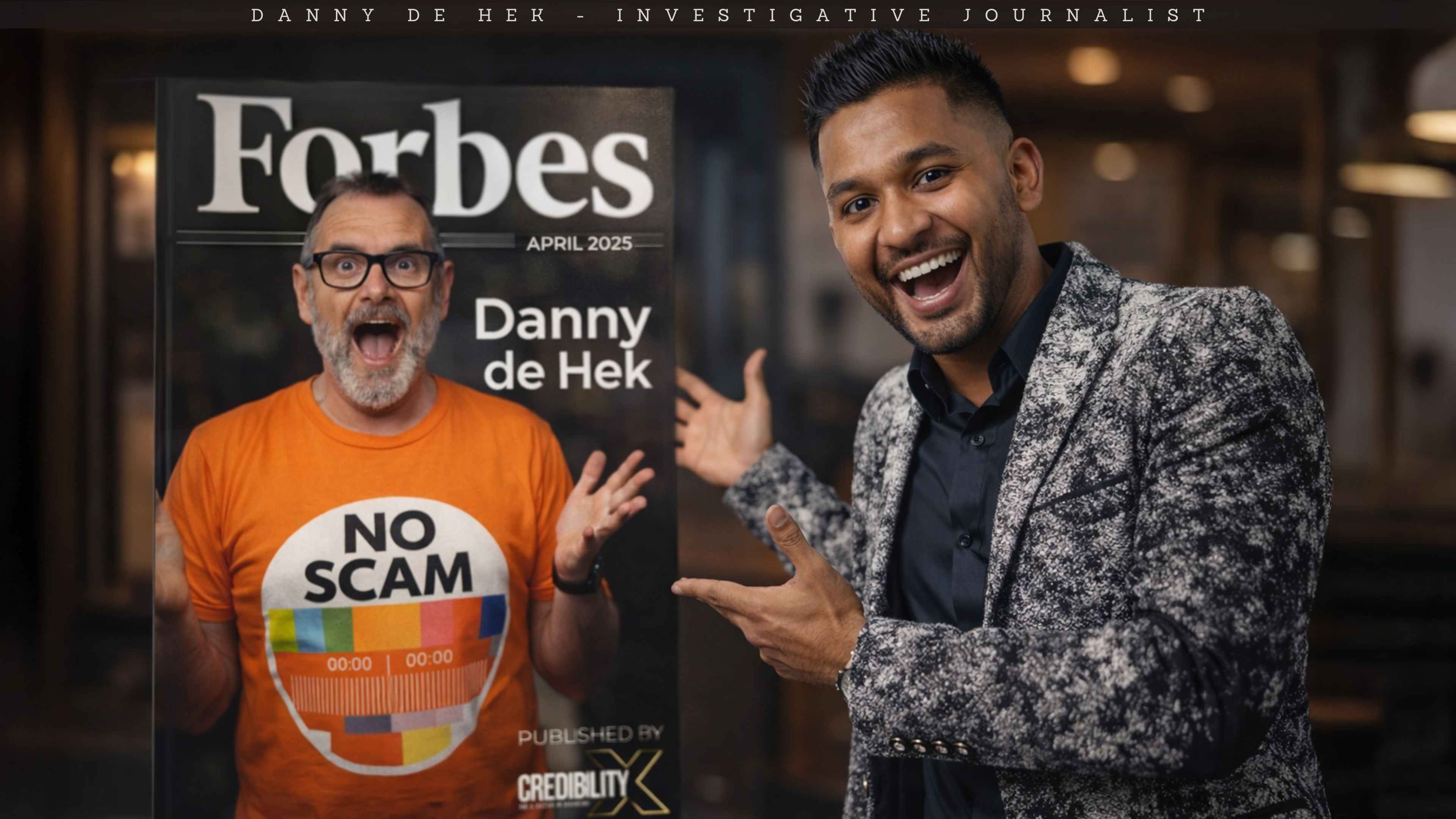
“If someone is selling you credibility, the first thing you should ask is whether they’ve earned it themselves.”
We get approached every day by people selling certainty.
Marketing services, PR placements, reputation management, authority-building systems — all promising to transform businesses, personal brands, or online profiles almost overnight. The language is always polished, the outcomes are always enormous, and the proof is usually just thin enough to sound impressive without being testable.
After years of investigating Ponzi schemes, crypto fraud, MLM deception, and financial manipulation, one thing becomes very clear: credibility has become one of the most abused currencies on the internet.
“My time is for fighting scams — not for being pitched miracle marketing by people who claim they can make me famous.”
I publicly position myself as an international Ponzi scheme and scam investigator. People can book time with me for a very specific purpose: discussing scams, fraud, exposure, and prevention. My Express Chat is designed for victims, journalists, whistleblowers, and agencies — not as a sales call, not as networking time, and not as an opportunity to pitch services.
That context matters.
So when Sashin Govender, the founder of CredibilityX, booked my time and used the session to present himself as someone capable of engineering credibility, shaping perception, and turning people into online superstars, it immediately raised concerns.
Once the call started, it became clear this wasn’t about supporting scam exposure. The discussion centred heavily on scale, influence, and authority. Sashin spoke confidently about billion-dollar businesses, stadium-sized speaking engagements, and media infrastructure designed to elevate clients into positions of power.
The implication was obvious: my platform could be dramatically amplified if I aligned with the right system.
Those aren’t claims you debate in real time.
They’re claims you verify.
That’s when the conversation stopped being a pitch — and became the starting point for due diligence.
Why Big Claims Trigger Investigation
When people start talking in extremes, the alarm bells don’t go off because of ego — they go off because of pattern recognition. Claims about billion-dollar outcomes, global influence, or elite access don’t exist in isolation. At that level, success leaves footprints. There are companies you can name, people you can identify, records you can check, and coverage you can verify.
What stood out here wasn’t confidence, it was how quickly the story skipped past detail. The narrative moved smoothly from one impressive claim to the next, but it never paused long enough for anything to be examined. Company names disappeared when revenue was mentioned. Roles were glossed over when achievements were claimed. Timelines shifted just enough to stay vague.
That doesn’t automatically make a claim false — but it does make it untestable. And once a claim can’t be tested, it stops being evidence and starts being marketing. When credibility is the product, that distinction matters.
The CredibilityX Timeline Problem
CredibilityX is presented as a company with 10–12 years of experience, global reach, and enterprise-level infrastructure. That claimed history is central to the authority being sold. But when you apply basic due diligence tools, the timeline starts to unravel.
Using archive.org (the Wayback Machine), the CredibilityX website shows no meaningful operational history prior to 2025. Between 20 March 2025 and 7 August 2025, archived versions of the site display a “Launching Soon” placeholder rather than an active business presence. A separate Who.is Lookup confirms the domain itself was registered on 20 March 2025.
When this discrepancy was raised, the explanation offered was that CredibilityX is a newer B2C-facing brand, built on top of older B2B operations under TMS Holdings and TMS Marketing. That explanation could be legitimate. Companies do rebrand. Structures do evolve.
The issue isn’t the explanation — it’s the absence of evidence.
No documentation was provided to demonstrate continuity between those earlier entities and the claims now being made under the CredibilityX name. There were no historical domains, archived websites, company filings, or client case studies tying a decade of experience to the brand currently being marketed. When credibility itself is the product, gaps like this don’t reassure — they raise red flags.
Celebrity Imagery and the Illusion of Authority
Another pillar of the branding relies heavily on celebrity imagery. Actors, musicians, athletes, and motivational speakers are presented visually as part of the ecosystem, creating an immediate impression of proximity to influence and elite access.
When questioned, Sashin explained that these individuals were podcast guests between 2019 and 2020, not endorsements or business partners. That explanation may be accurate. But accuracy alone doesn’t resolve the issue — because presentation matters when authority is being sold.
Historic interviews are being displayed as current credibility signals, without clear labelling, timestamps, or contextual explanation. There are no links to episodes, no audience metrics, and no viewership figures provided for independent verification. The imagery does the work the evidence should be doing.
This is a classic marketing technique. Credibility by association works precisely because most people don’t stop to question what they’re seeing. Familiar faces trigger trust, and trust lowers scrutiny — especially when paired with confident claims and polished branding.
For anyone doing their own investigation, this is a reminder: authority isn’t proven by who appears next to a brand, but by what can be independently verified behind it.
The Social Media and YouTube Contradiction
This is where the investigation becomes more complicated — and more important.
In a 13-minute Video published in April 2025, Sashin Govender lays out his credibility framework and personal backstory. In that recording, he makes a series of extraordinary, present-tense claims: contributing to a company he says reached $5 billion, speaking to tens of thousands of people in major stadiums, supplying over 1,000 media publications, employing 150 staff, working with billion- and even trillion-dollar clients, and building one of the largest independent media operations in the world.
These are not motivational anecdotes or legacy stories. They are foundational claims — the kind that underpin a business built on selling credibility, authority, and influence today.
And yet, the video itself was unlisted, and roughly nine months after publication had accumulated around 231 views. That contrast matters. Not because popularity determines truth, but because someone positioning themselves as an expert in visibility, perception, and media control would normally ensure that their flagship explanation of that system is highly visible, widely circulated, and easy to verify.
After receiving Sashin’s reply, I reviewed the broader social media presence he pointed me to. On the surface, the numbers are significant:
- YouTube: Joined in 2013, around 48.7K subscribers, 139 videos, and roughly 2.2 million total views, including long-form interviews with well-known figures dating back five to seven years
- Instagram: Around 953K followers, over 2,100 posts, with branding that heavily reinforces claims of founding 20+ companies and pioneering a $5 billion operation
- Facebook: Approximately 58K followers and 1K following, presented as a public figure page
Taken together, this confirms something important: he has a real, long-standing online footprint, and he has interviewed a wide range of recognisable figures over the years. That visibility is not fabricated.
But engagement tells a more nuanced story.
On Facebook, posts featuring high-profile figures such as Gary Vaynerchuk and Jason Derulo attracted only dozens of reaction emojis and two or three comments. For a page showing nearly 58,000 followers, that level of interaction appears inconsistent with the level of influence implied by the follower count. Similar patterns appear across platforms, where follower counts and branding language suggest scale, but engagement and verification lag behind the claims being made.
None of this proves misconduct. Algorithms fluctuate. Audiences age. Not every post performs well. But when extraordinary claims are made on camera, and the supporting visibility, engagement, and third-party verification don’t clearly align, it creates a tension that can’t be ignored.
This is the recurring theme throughout this investigation.
Visibility is not the same as verification.
Followers are not the same as influence.
Interviews are not the same as endorsements or operational scale.
The question at this stage isn’t whether Sashin has a platform — he does.
It’s whether the specific claims made in that 13-minute video are supported by evidence that matches their magnitude.
And that question remains open.
The Forbes Feature That Isn’t What Most People Think
One of the strongest credibility signals used throughout Sashin Govender’s branding is the claim of being “featured in Forbes.” On the surface, that sounds like independent recognition — the kind of validation that suggests a person or company has been vetted by a respected media institution.
But context matters.
The article in question appears under Forbes Australia BrandVoice, clearly labelled as a “BrandVoice – Special Feature,” and written by a “Brand Contributor,” not a Forbes journalist. That distinction is not cosmetic — it defines the entire nature of the content.
Forbes BrandVoice is part of Forbes’ commercial publishing model. It allows brands, agencies, or contributors to publish their own stories on the Forbes platform through paid access. These articles are not written by Forbes editorial staff, and Forbes does not independently verify or fact-check the claims made within them. That responsibility sits with the contributor.
This isn’t hidden or controversial — Forbes discloses it through the BrandVoice label itself. However, most readers don’t understand the difference between editorial journalism and partner-published content. To the average person, it all just looks like “Forbes.”
That’s where the problem arises.
When a BrandVoice article is presented prominently as proof of authority without explaining that it is paid partner content rather than independent journalism, it risks creating a misleading impression. The credibility of the Forbes name is effectively being borrowed, not earned through editorial scrutiny.
This doesn’t automatically mean the claims in the article are false. But it does mean they are unverified by Forbes, and they cannot be treated as independent validation of billion-dollar involvement, massive business success, or elite authority.
When someone is selling credibility itself — especially to people who may already be struggling for visibility — that distinction is not minor. It’s fundamental.
The Right of Reply — And Why It Didn’t Close the Gap
As an investigative organisation, we don’t publish without offering a right of reply. That isn’t optional. Sashin was given that opportunity, and to be fair, he responded politely and at length.
His reply focused primarily on providing explanations — not evidence. In it, he addressed:
- why LinkedIn wasn’t a priority
- why the CredibilityX website appeared new
- how impression figures were aggregated
- the intent behind the use of celebrity imagery
Those explanations added context, but they didn’t resolve the underlying issue.
What was missing was verification.
There were no documents substantiating revenue scale. No named companies behind billion-dollar statements. No contracts, invoices, or filings tying the claims to identifiable entities. And no independent verification beyond paid placements and self-description.
In the end, the reply clarified the narrative — but it didn’t substantiate it.
The story was explained.
It wasn’t proven.
And when credibility itself is the product, that distinction is everything.
Where This Approach Went Wrong
I’m not calling Sashin Govender a scammer. What I’ve documented is a credibility gap — the distance between what’s claimed and what can be independently verified.
That gap widened once I examined how CredibilityX presents itself. The website displays logos from major media brands such as Forbes, Bloomberg, Business Insider, Entrepreneur, Rolling Stone, Vogue, and GQ without clearly explaining what those logos represent. To an ordinary reader, this implies association or access, yet no context is provided to distinguish between paid placements, contributor content, indirect distribution, or simple name referencing. When credibility is the product, ambiguity matters.
That confusion is compounded by a lack of basic transparency. Despite claims of enterprise-scale operations and celebrity-level work, the site lists no physical office address, no phone number, no clear country of operation, and funnels contact almost entirely through WhatsApp. There is also no visible privacy or data-handling policy, an unusual omission for a business claiming to manage reputations and public figures.
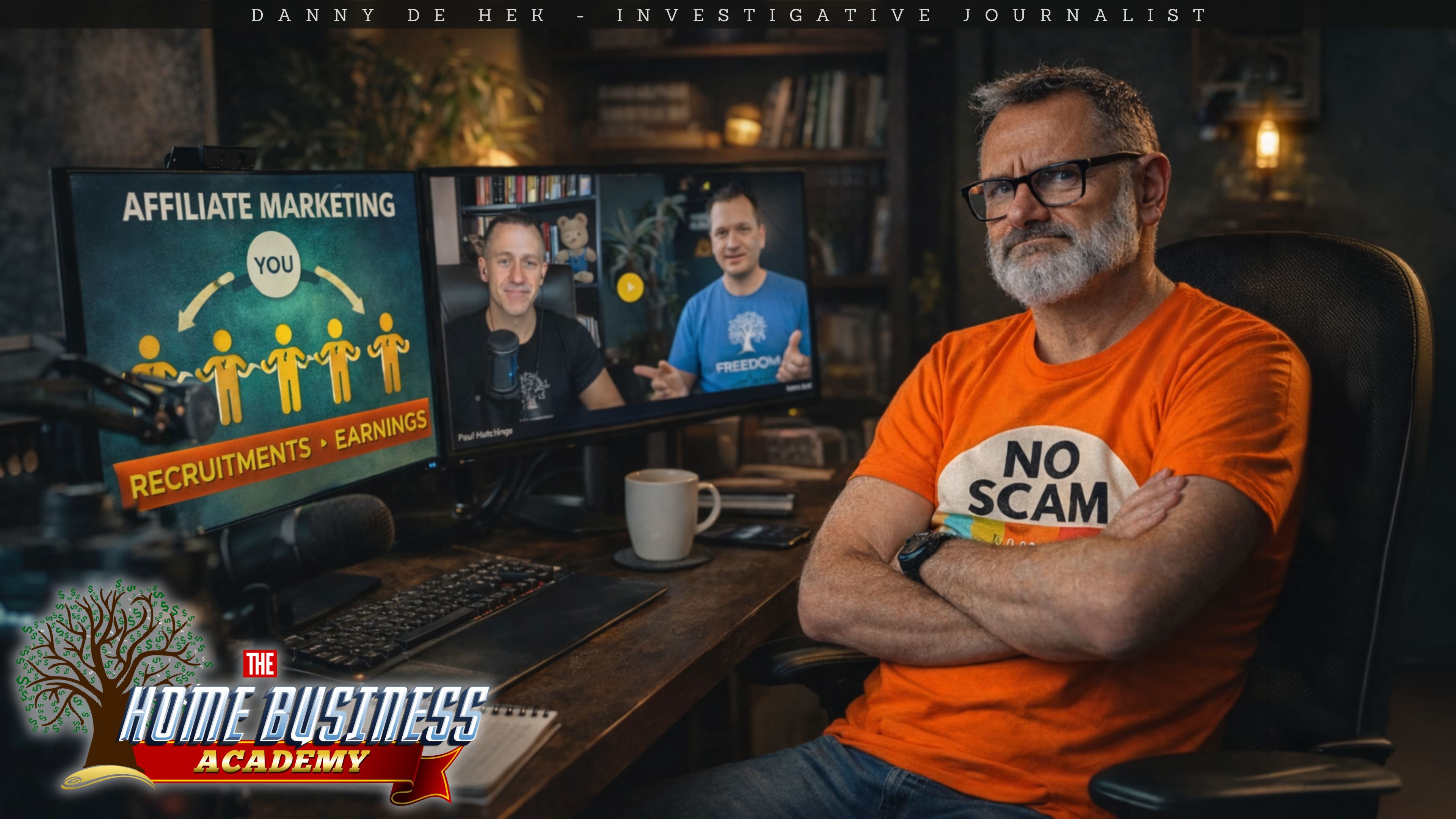
At the same time, the business promotes an affiliate referral model, encouraging others to sell CredibilityX services for commission. This reframes the operation from an elite media firm into a referral-driven sales funnel. Combined with heavy celebrity imagery and name-dropping, the brand leans more on implication than verification.
This matters because of how the approach unfolded. I’m very clear about who I am and what I do. My work focuses on investigating scams, Ponzi schemes, and financial misconduct. People who book my time are told exactly what that time is for. Had basic research been done, it would have been apparent that pitching credibility services — particularly ones reliant on narrative rather than independently verifiable proof — was poorly judged.
Extraordinary claims were made, a right of reply was provided, and while explanations were offered, the evidence required to independently verify those claims was not.
I remain open to further right of reply and to reviewing documentation that substantiates the claims made. But until that happens, the position remains simple:
“Extraordinary claims require extraordinary evidence.”
Until such evidence is produced, credibility remains asserted — not established.
Disclaimer: How This Investigation Was Conducted
This investigation relies entirely on OSINT — Open Source Intelligence — meaning every claim made here is based on publicly available records, archived web pages, corporate filings, domain data, social media activity, and open blockchain transactions. No private data, hacking, or unlawful access methods were used. OSINT is a powerful and ethical tool for exposing scams without violating privacy laws or overstepping legal boundaries.
About the Author
I’m DANNY DE HEK, a New Zealand–based YouTuber, investigative journalist, and OSINT researcher. I name and shame individuals promoting or marketing fraudulent schemes through my YOUTUBE CHANNEL. Every video I produce exposes the people behind scams, Ponzi schemes, and MLM frauds — holding them accountable in public.
My PODCAST is an extension of that work. It’s distributed across 18 major platforms — including Apple Podcasts, Spotify, Amazon Music, YouTube, and iHeartRadio — so when scammers try to hide, my content follows them everywhere. If you prefer listening to my investigations instead of watching, you’ll find them on every major podcast service.
You can BOOK ME for private consultations or SPEAKING ENGAGEMENTS, where I share first-hand experience from years of exposing large-scale fraud and helping victims recover.
“Stop losing your future to financial parasites. Subscribe. Expose. Protect.”
My work exposing crypto fraud has been featured in:
- Bloomberg Documentary (2025): A 20-minute exposé on Ponzi schemes and crypto card fraud
- News.com.au (2025): Profiled as one of the leading scam-busters in Australasia
- OpIndia (2025): Cited for uncovering Pakistani software houses linked to drug trafficking, visa scams, and global financial fraud
- The Press / Stuff.co.nz (2023): Successfully defeated $3.85M gag lawsuit; court ruled it was a vexatious attempt to silence whistleblowing
- The Guardian Australia (2023): National warning on crypto MLMs affecting Aussie families
- ABC News Australia (2023): Investigation into Blockchain Global and its collapse
- The New York Times (2022): A full two-page feature on dismantling HyperVerse and its global network
- Radio New Zealand (2022): “The Kiwi YouTuber Taking Down Crypto Scammers From His Christchurch Home”
- Otago Daily Times (2022): A profile on my investigative work and the impact of crypto fraud in New Zealand

Leave A Comment