


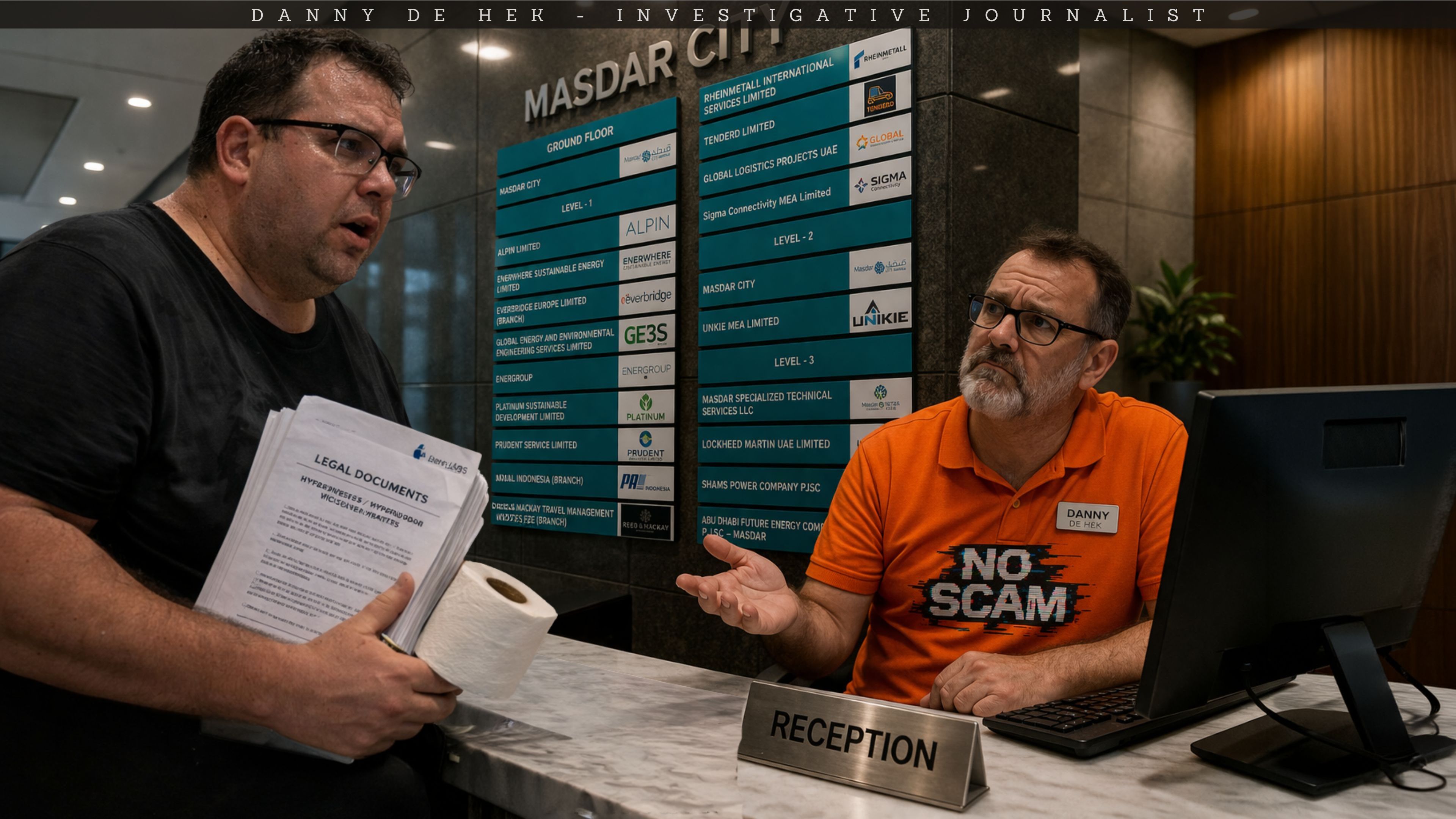
“You can’t have a lawsuit without a case number, a court filing, or a lawyer who can actually appear in court.”
Rory Conacher is back — and once again he’s presenting himself as the solution to a problem that has already cost people millions.
In recent YouTube Shorts, he’s been promoting what he describes as a recovery effort tied to HyperVerse, HyperFund and the wider network of schemes linked to Sam Lee.
On 18 March 2026, he sent out an email urging people to act immediately, claiming that lawyers had been appointed and that victims needed to join his groups to be part of the action.
At first glance, it sounds promising.
But when you slow down and actually examine what’s being presented, the story begins to unravel — quickly.
The Email That Sets the Tone
 The language used in Rory’s Email is not neutral. It is not measured. It is not what you would expect from a structured legal process.
It is built around pressure.
Phrases like “ACTION REQUIRED NOW” and warnings that recipients are already “two weeks behind” are designed to trigger urgency. The message pushes people into WhatsApp and Telegram groups and makes it clear that if they don’t onboard, they are effectively excluded.
That is not how legitimate legal proceedings operate.
Real legal action does not rely on fear of missing out. It relies on documentation, process, and verifiable facts.
Instead, what we are given is a funnel — one that directs vulnerable victims into controlled communication channels, away from independent verification.
What’s Missing Matters More Than What’s Said
Rory’s email makes bold claims. It names PSP Legal. It references a supposed appointment. It lists a long string of entities connected to the HyperVerse ecosystem.
But the fundamentals are missing.
There is no case number.
No court filing.
No signed legal mandate.
No named advocate with rights of audience in the UAE.
And without those elements, there is no actual proof that a legal action exists.
Instead, victims are told to trust the process — before the process has even been shown to exist.
“A real lawyer leaves a trail — not a blank page.”
We Tried to Verify the Lawyer
Because Rory provided the name and location of the solicitor, the next step was obvious: verify it.
A Formal Request was sent asking basic questions any legitimate legal firm should be able to answer. These were not aggressive or unusual. They were standard due diligence — the kind any client should feel comfortable asking before engaging legal representation.
The response we received was revealing.
Rather than providing the requested details, PSP Legal confirmed they had been appointed and insisted the matter was genuine, but declined to disclose specific registration information, lawyer details, or evidence of filed proceedings. The justification given was confidentiality.
In other words:
“We’re real — but we won’t prove it.”
That is not how trust is built in legal matters. It is how doubt is created.
But the questions didn’t stop there — so we looked at the firm itself.
The Website Raises More Questions Than Answers
As part of this investigation, we looked into PSP Legal itself — and what we found only adds to the concerns.
Using historical tools like the Wayback Machine, there is no meaningful track record of the website, suggesting it may be recently created or only recently made visible. For a firm claiming decades of experience and international work, that absence is difficult to ignore.
The website itself is polished, but the content is broad, generic, and lacking substance. It claims to cover everything from crypto and fintech to media, healthcare, and international litigation, yet provides no case studies, no client references, and no verifiable examples of legal work. Even its litigation section focuses on “strategic oversight” rather than clearly demonstrating court representation or filed proceedings.
It also describes itself as a “founder-led advisory practice”, with all mandates handled by a single individual. That raises a simple question — how is a supposedly large, multi-party international recovery effort being managed without any visible legal team, partners, or named advocates?
And here’s the part that’s hardest to ignore.
A lawyer claiming over 24 years of legal experience, recognition in major legal rankings, and senior roles in leading firms… should have a clear, verifiable professional footprint.
But that footprint is missing.
No strong independent listings.
No clear regulatory trail.
No publicly verifiable case involvement tied to this entity.
When you combine a new or unverified web presence, a lack of independent professional footprint, and no evidence of actual legal proceedings, it becomes very difficult to reconcile the claims being made with what can be proven.
A Phone Call That Raises More Questions
The concerns didn’t stop there.
 A contact in Abu Dhabi made a Direct Call, attempting to arrange a meeting as a potential paying client. That request was refused.
Think about that for a moment.
If this is a legitimate, large-scale recovery effort involving international victims, why refuse a client meeting?
Why operate through what appears to be a single mobile number, with no visible office structure, no reception, and no supporting staff?
It doesn’t align with what most people would expect from a firm handling international litigation.
The Address Check — And What Wasn’t There
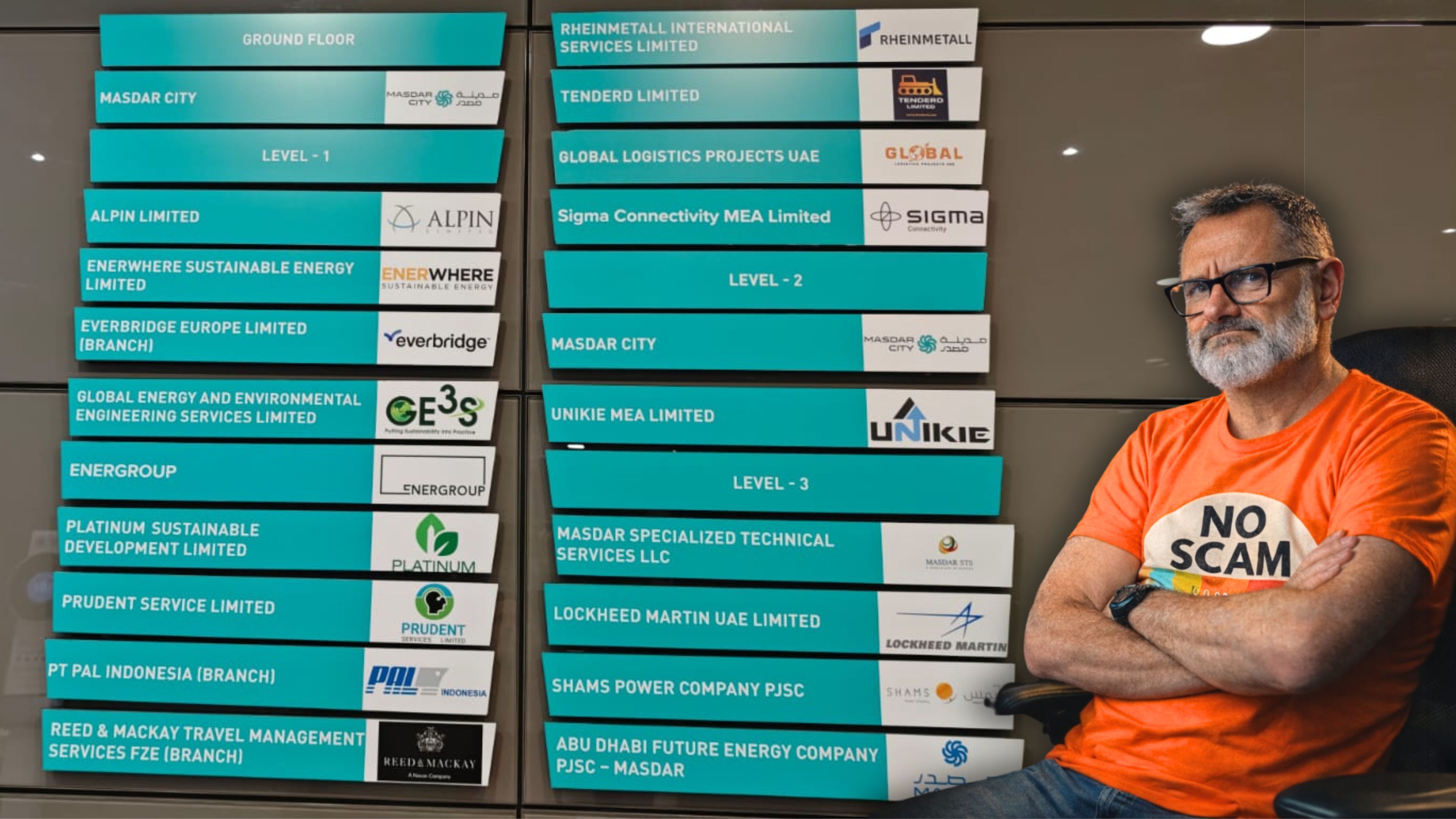
The address provided points to Masdar City.
A directory board at that location lists multiple companies operating within the building. Yet, based on the evidence collected, there is no visible listing for PSP Legal on that board.
No signage.
No identifiable office presence.
On its own, that might be explainable. But when you combine it with everything else — the lack of answers, the refusal to meet, the absence of documentation — it becomes part of a broader pattern.
And that pattern is difficult to ignore.
The Legal Reality Rory Doesn’t Explain
Here’s where the story really starts to break down.
Because even if we take everything at face value, the structure Rory is presenting does not align with how the UAE legal system actually works.
The UAE does not operate class action lawsuits in the way this is being described.
There is no mechanism where thousands of victims join a Telegram group, onboard through KYC, and are then collectively represented in court by a single process.
That simply isn’t how it works.
Legal action in the UAE is individualised, formal, and heavily documented. Each claimant must be identified. Each must sign a notarised Power of Attorney. And critically, the case must be handled by a licensed UAE advocate with rights of audience in the relevant court.
A consultancy operating out of a Free Zone does not have that authority.
So the obvious question becomes:
Who is the advocate actually taking this case to court?
Because no such person has been named.
And without one, there is no enforceable legal action.
The Timeline Doesn’t Make Sense
Another inconsistency lies in the order of events.
Rory is asking people to join, onboard, and prepare for legal action — yet there is no evidence that a case has even been filed.
That is backwards.
In real litigation, the process begins with a filed claim. The court assigns a reference. Legal representation is clearly documented. Only then do additional claimants become involved.
Here, we are seeing the opposite.
The crowd is being built first — and the legal structure is expected to follow.
That is not just unusual.
It is structurally inconsistent with how real legal proceedings operate.
A Familiar Pattern Emerging
When you step back and look at the bigger picture, the pattern becomes clear.
This is not about one missing document or one unanswered question.
It is about a structure built on:
- urgency
- limited transparency
- controlled communication
- and reliance on trust without proof
These are the same ingredients seen in recovery scams — where victims of one scheme are drawn into another, often under the promise of getting their money back.
Hope becomes the product.
And urgency becomes the sales tool.
Rory’s Own Credibility Problem
There is one final piece that cannot be ignored.
Rory Conacher’s own company, RJS Capital (Pty) Ltd, has been placed into Final Liquidation by the South African High Court.
That is not speculation. It is a matter of record.
So when the same individual is now asking victims to trust a new recovery narrative, it is entirely reasonable to question his credibility.
Is this a genuine legal effort — or another attempt to maintain influence over an already vulnerable audience?
The Questions That Still Remain
At this point, the burden of proof is not on the victims.
It is on Rory and the lawyer he claims is acting on their behalf.
Where is the case number?
Where is the filed claim?
Who is the licensed advocate?
What court is handling the matter?
What legal mandate has actually been signed?
Until those questions are answered with verifiable evidence, the claims being made should not be taken at face value.
There Is No Evidence Of A Lawsuit
Let’s cut through it.
This isn’t about opinions or speculation — it’s about what’s actually in front of us.
You’ve got an email pushing urgency and telling people to act now. You’ve got a lawyer who won’t answer the most basic verification questions. A potential client tries to book a meeting — refused. A physical address that doesn’t clearly show the firm exists where it says it does.
And when you step back and look at the legal side of it… the whole structure doesn’t even line up with how the UAE system works.
That’s not one red flag.
That’s a pattern.
And it’s a pattern I’ve seen before — over and over again — when people who’ve already been burned are offered a way to get their money back.
Here’s the reality.
If this was a genuine lawsuit, you wouldn’t have to go digging for proof. You wouldn’t be chasing answers. You wouldn’t be getting vague responses and being told to just trust the process.
The evidence would be there.
Clear. Verifiable. Easy to confirm.
But it’s not.
And let’s not ignore the context.
This is all coming from someone whose own company has already been liquidated by the South African courts.
So you have to ask yourself — why should anyone trust this process, when the person promoting it can’t even point to verifiable proof that it exists?
Because when the evidence is missing…
the questions start answering themselves.
Disclaimer: How This Investigation Was Conducted
This investigation relies entirely on OSINT — Open Source Intelligence — meaning every claim made here is based on publicly available records, archived web pages, corporate filings, domain data, social media activity, and open blockchain transactions. No private data, hacking, or unlawful access methods were used. OSINT is a powerful and ethical tool for exposing scams without violating privacy laws or overstepping legal boundaries.
About the Author
I’m DANNY DE HEK, a New Zealand–based YouTuber, investigative journalist, and OSINT researcher. I name and shame individuals promoting or marketing fraudulent schemes through my YOUTUBE CHANNEL. Every video I produce exposes the people behind scams, Ponzi schemes, and MLM frauds — holding them accountable in public.
My PODCAST is an extension of that work. It’s distributed across 18 major platforms — including Apple Podcasts, Spotify, Amazon Music, YouTube, and iHeartRadio — so when scammers try to hide, my content follows them everywhere. If you prefer listening to my investigations instead of watching, you’ll find them on every major podcast service.
You can BOOK ME for private consultations or SPEAKING ENGAGEMENTS, where I share first-hand experience from years of exposing large-scale fraud and helping victims recover.
“Stop losing your future to financial parasites. Subscribe. Expose. Protect.”
My work exposing crypto fraud has been featured in:
- Bloomberg Documentary (2025): A 20-minute exposé on Ponzi schemes and crypto card fraud
- News.com.au (2025): Profiled as one of the leading scam-busters in Australasia
- OpIndia (2025): Cited for uncovering Pakistani software houses linked to drug trafficking, visa scams, and global financial fraud
- The Press / Stuff.co.nz (2023): Successfully defeated $3.85M gag lawsuit; court ruled it was a vexatious attempt to silence whistleblowing
- The Guardian Australia (2023): National warning on crypto MLMs affecting Aussie families
- ABC News Australia (2023): Investigation into Blockchain Global and its collapse
- The New York Times (2022): A full two-page feature on dismantling HyperVerse and its global network
- Radio New Zealand (2022): “The Kiwi YouTuber Taking Down Crypto Scammers From His Christchurch Home”
- Otago Daily Times (2022): A profile on my investigative work and the impact of crypto fraud in New Zealand



Leave A Comment