


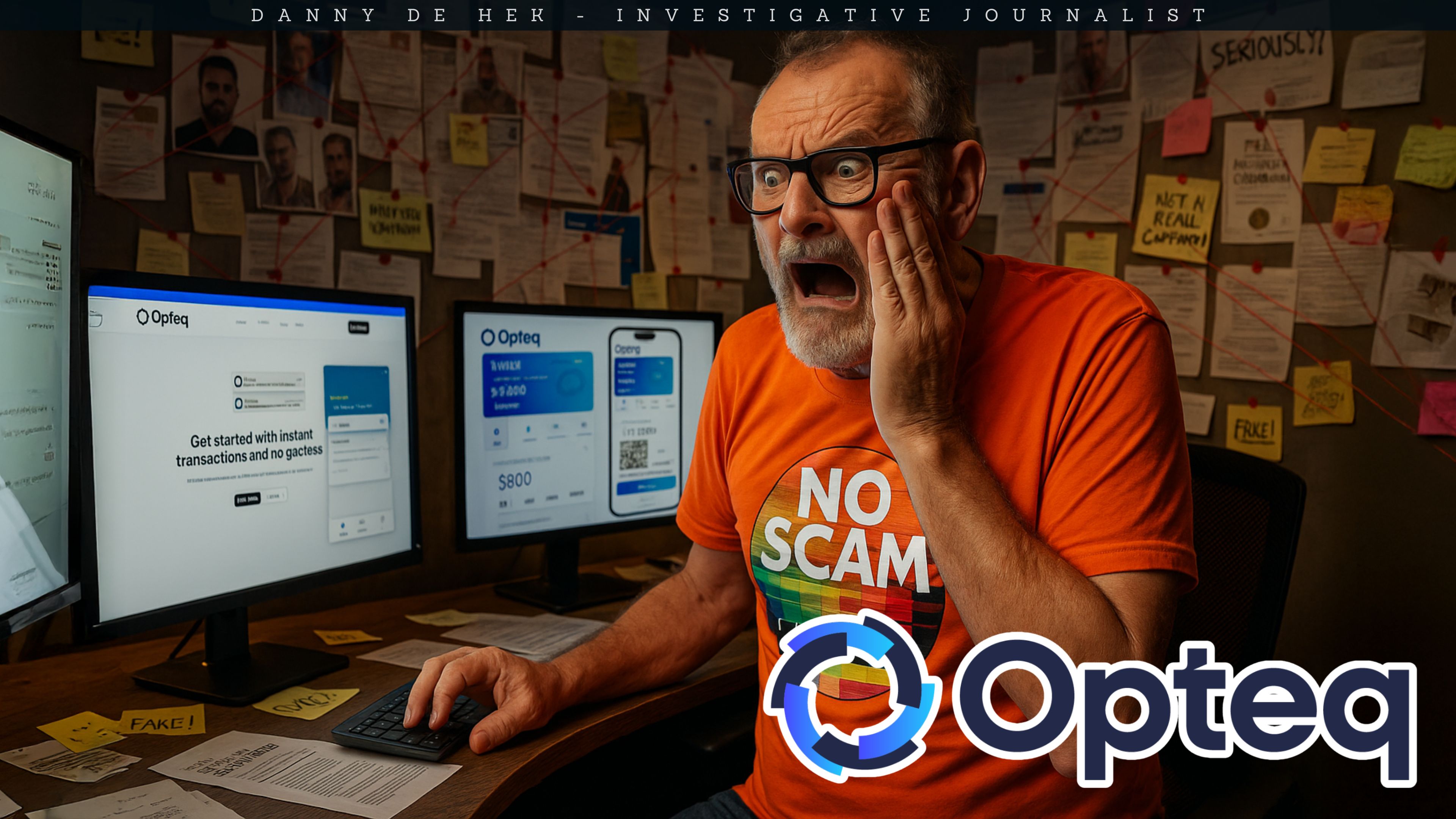
If you’re being told to migrate your Qoin into a new OPTEQ wallet, promised instant transactions, no gas fees, and a “future-ready” blockchain experience, you need to stop and think very carefully.
On the surface, OPTEQ presents itself as a modern, user-friendly gateway into blockchain ownership. But underneath the glossy branding sits a complex, fragmented, and deeply concerning structure that everyday users are expected to trust without question.
This is my OSINT-driven look into OPTEQ, the company behind it, the connection to Qoin, the terms you unknowingly agree to, and why I believe this entire setup is extremely high risk for mum-and-dad investors.
Why OPTEQ Exists in the First Place
OPTEQ is being pushed as the official migration tool for Qoin holders. If you’ve followed the Qoin story even loosely, you’ll know their old ecosystem was hit with serious regulatory trouble. Rather than fixing those issues transparently, the project has resurfaced with a new chain, new wallet, and new branding — and OPTEQ is at the centre of that transition.
This isn’t a standalone wallet app. OPTEQ is the front-end of a tightly controlled, custom-built Qoin pipeline. You’re not selecting a random wallet from the app store. You’re being funnelled into a proprietary system designed by the same ecosystem that regulators have already ruled against.
And that’s the first major red flag.
The Company Behind OPTEQ — An Offshore Shell
OPTEQ is operated by Operations Tech Limited, a company incorporated in the British Virgin Islands.
I’ve been around this industry long enough to know that companies don’t base themselves in the BVI because they enjoy the tropical weather. They choose the BVI because it offers near-total secrecy, minimal public disclosure, and hard-to-enforce legal recourse for customers. If something goes wrong, you’re effectively dealing with a corporate ghost.
For years I’ve exposed MLMs, crypto schemes and offshore operations. This structure is identical:
- The business is offshore.
- The services are global.
- The liability is buried.
- The users carry the risk.
And OPTEQ fits that mold perfectly.
The Crossmint Layer — Another Obstacle Between You and Accountability
OPTEQ doesn’t even run the wallet infrastructure. Instead, it “partners” with Crossmint — a large digital-asset infrastructure company operating under different laws, different regulators, and different jurisdictions depending on which feature you use.
When you sign up to OPTEQ, you automatically agree to both sets of terms, whether you realise it or not:
- OPTEQ (BVI law, BVI arbitration, offshore protections)
- Crossmint (New York arbitration, Spanish regulators, strict liability caps)
This means you’re entering a two-layered legal labyrinth where every single path leads you away from consumer protection and towards private arbitration under foreign law. The moment you click “I accept,” you give away every meaningful right you have.
Let me emphasise this clearly:
If your funds are lost, stolen, frozen, inaccessible, or mishandled — you will be fighting a BVI company and a U.S.-based company, through arbitration, with capped liability, and no class action rights.
That is not a user-first system.
That is a risk-offloading machine.
The Marketing vs The Reality
OPTEQ’s marketing is polished and comforting:
“Next-generation security.”
“No seed phrases.”
“Swipe between wallets.”
“Instant transactions.”
“Your assets, your control.”
But when you read the terms — which 99% of users won’t — it becomes clear that almost every line of marketing is contradicted by legal disclaimers.
The legal reality:
- They don’t store your private keys.
- They can’t recover your access.
- You bear 100% of credential security risk.
- Your wallet is “as-is” with no guarantees.
- Digital asset purchases are non-refundable, non-reversible.
- Lost credentials mean permanent loss of funds.
- They cap their maximum liability at around the price of a cheap dinner.
- They can repossess digital assets in certain circumstances.
In other words:
The simplicity is for them.
The risk is for you.
The Qoin Problem Doesn’t Disappear — It Migrates With You
Qoin’s regulatory history is not a footnote — it’s the entire context for why OPTEQ exists.
A major regulatory body found Qoin’s original system to be misleading and operating without the proper licensing. Their blockchain, their merchant claims, their wallet setup — all were heavily criticised.
Instead of addressing those issues transparently, the project launched a brand-new chain, a brand-new wallet system, and a brand-new migration pipeline.
The timing is not a coincidence.
It’s damage control.
OPTEQ becomes the “gateway” to the new system, complete with fresh branding and updated technical jargon, but none of the core consumer-protection issues solved.
This is not innovation — it’s repackaging.
The Migration Pressure Tells Its Own Story
Any time a company frames a migration as:
- urgent
- mandatory
- necessary to “avoid losing access”
- the only way forward
…you’re not being offered a service.
You’re being herded.
Users report issues like balances disappearing, confusion about wallet ownership, and being told the old chain is becoming unusable. This behaviour is familiar to anyone who has studied crypto collapses: when the foundation is cracking, a “migration” is the quickest way to consolidate control before users start asking too many questions.
OPTEQ is positioned as a solution, but the language around it is textbook pressure behaviour.
Who Really Benefits From This System?
Let’s break it down:
- Qoin needs a clean slate after regulatory trouble.
- OPTEQ provides a new, shiny wrapper for the migration.
- Crossmint provides the underlying wallet so the responsibility is shared — and diffused.
- You, the user, click “Agree” and instantly step into a multi-jurisdictional maze where you carry all the risk and they carry almost none.
This is not transparency.
This is not protection.
This is a cleverly engineered risk-shielding system.
My Independent Conclusion
I’m not claiming OPTEQ is a deliberate scam.
But based on everything I’ve investigated, here’s what I am comfortable saying:
OPTEQ is part of a high-risk ecosystem built to shield operators from liability, shift risk to users, and reboot a token that has already been ruled against by regulators.
If I personally held Qoin, I would not interpret the migration as “safety” or “progress.” I would see it as a final consolidation move — a way to lock users further inside a controlled system with no external liquidity, no consumer protections, and an offshore operator who never has to answer your questions.
If you choose to migrate, treat it as a temporary step toward exiting, not a vote of confidence.
Your financial safety depends on scepticism, not slogans.
Disclaimer: How This Investigation Was Conducted
This investigation relies entirely on OSINT — Open Source Intelligence — meaning every claim made here is based on publicly available records, archived web pages, corporate filings, domain data, social media activity, and open blockchain transactions. No private data, hacking, or unlawful access methods were used. OSINT is a powerful and ethical tool for exposing scams without violating privacy laws or overstepping legal boundaries.
About the Author
I’m DANNY DE HEK, a New Zealand–based YouTuber, investigative journalist, and OSINT researcher. I name and shame individuals promoting or marketing fraudulent schemes through my YOUTUBE CHANNEL. Every video I produce exposes the people behind scams, Ponzi schemes, and MLM frauds — holding them accountable in public.
My PODCAST is an extension of that work. It’s distributed across 18 major platforms — including Apple Podcasts, Spotify, Amazon Music, YouTube, and iHeartRadio — so when scammers try to hide, my content follows them everywhere. If you prefer listening to my investigations instead of watching, you’ll find them on every major podcast service.
You can BOOK ME for private consultations or SPEAKING ENGAGEMENTS, where I share first-hand experience from years of exposing large-scale fraud and helping victims recover.
“Stop losing your future to financial parasites. Subscribe. Expose. Protect.”
My work exposing crypto fraud has been featured in:
- Bloomberg Documentary (2025): A 20-minute exposé on Ponzi schemes and crypto card fraud
- News.com.au (2025): Profiled as one of the leading scam-busters in Australasia
- OpIndia (2025): Cited for uncovering Pakistani software houses linked to drug trafficking, visa scams, and global financial fraud
- The Press / Stuff.co.nz (2023): Successfully defeated $3.85M gag lawsuit; court ruled it was a vexatious attempt to silence whistleblowing
- The Guardian Australia (2023): National warning on crypto MLMs affecting Aussie families
- ABC News Australia (2023): Investigation into Blockchain Global and its collapse
- The New York Times (2022): A full two-page feature on dismantling HyperVerse and its global network
- Radio New Zealand (2022): “The Kiwi YouTuber Taking Down Crypto Scammers From His Christchurch Home”
- Otago Daily Times (2022): A profile on my investigative work and the impact of crypto fraud in New Zealand





Leave A Comment