


“Three things cannot be long hidden: the sun, the moon, and the truth.” — Buddha
For years, Rory Conacher positioned himself as a fighter, a fixer, a voice for the wronged. In reality, he was something far more familiar to anyone who has studied financial fraud long enough: a man who built an illusion of authority, wrapped himself in moral language, and blamed everyone else when the structure he created finally collapsed.
This blog exists for one reason: to strip away the narrative Rory is still trying to sell, using his own words, his own actions, and the final judgment of the court that shut his company down.
Because despite everything that has happened — despite a Final Liquidation Order, despite a court-appointed liquidator, despite creditors being recognised and assets now subject to investigation — Rory Conacher is still talking. Still posting. Still reframing himself as the victim. Still attempting to gather a new audience, a new “community,” and ultimately, a new pool of hope to exploit.
And that is exactly how scams survive longer than they should.
The Court Has Already Ruled

Before dissecting Rory Conacher’s videos, claims, and ongoing attempts to rewrite history, one fact must be stated clearly and unambiguously.
On 17 October 2025, the High Court of South Africa, KwaZulu-Natal Local Division (Durban) issued a Formal Court Order confirming the final winding-up of RJS Capital (Pty) Ltd. The order was electronically signed by the Registrar and filed on 27 November 2025.
The ruling did not arise from internet commentary or public pressure. It followed court proceedings initiated by Michelle Thora Alistoun and Sebastien George Maurice Mangeant, supported by sworn evidence and examined by the court.
The order confirms three critical points:
- The application for adjournment was dismissed
- The rule nisi was confirmed, resulting in final liquidation
- The costs of the liquidation application were ordered against the company
This means RJS Capital is legally dead. It cannot trade. It cannot fundraise. It cannot represent investors. And it certainly cannot position its former director as a legitimate advocate for justice.
Everything Rory has said since this ruling exists outside legal reality.
The Performance of Innocence
If you watch Rory Conacher’s recent videos closely, the pattern becomes impossible to ignore. Across two separate recordings — the hour-long video titled “Dubai Legal Claim: Final Community Call — Watch This & Act Now”, published shortly after his first court appearance, and a Shorter Update posted on January 29, 2026 — the same playbook unfolds in real time.
Each video opens with lengthy disclaimers, heavy on legal-sounding language and light on substance. Documents are selectively flashed on screen. Authority is implied rather than demonstrated. The word “community” is repeated like a shield. And beneath it all runs a single, consistent message: I am not the bad guy.
The timing matters.
Both videos were recorded before the court granted the Final Winding-Up Order, yet Rory has continued to circulate them after his company was legally shut down, as though the outcome of the case is still unresolved and hope remains justified.
In the longer video, Rory leans heavily on delay as a strategy. He frames the court process as incomplete, suggests patience will be rewarded, and implies that those pushing for accountability are acting prematurely or in bad faith. Spiritual language creeps in. So does moral pressure. The message is subtle but clear: wait longer, trust me, don’t act.
“It’s like he’s still performing for an audience that no longer exists.”
Then, on January 29, 2026, Rory posted a short follow-up video. Despite the company already being under final liquidation, he claimed progress was still being made. In that clip, he thanked supporters, referenced regulators in vague terms, and held up a document as supposed proof that a “Dubai legal process” was moving forward.
“Hi all, it’s Rory Conacher here and it’s 2026. For those people that thought that we weren’t going ahead with the Dubai legal process — here I’m attaching confirmation of the attorney that’s been appointed. It’s been a very, very long process to get to this point. Thank you for your support.”
This wasn’t accountability. It wasn’t transparency. And it certainly wasn’t closure.
It was a reassurance broadcast — designed to keep belief alive after the legal reality had already closed the door.
Not a call for justice, but a performance of it.
Blame as a Business Model
Throughout his appearances, Rory Conacher throws everyone under the bus — strategically, repeatedly, and without restraint. The liquidator becomes an obstacle. The lawyers become opportunists. His own creditors become unreasonable agitators. Anyone who challenges his narrative is recast as part of a shadowy agenda designed to undermine him.
He accuses people of acting out of revenge. He suggests whistleblowers are secretly aligned with Sam Lee. He implies regulators are either manipulated or incompetent. And in a particularly revealing moment, he turns his attention outward to critics, including me — dismissing investigative work as “click-driven,” reducing documented evidence and court outcomes to some kind of personal vendetta or content strategy.
What he never does — not once, not in a single sentence — is take responsibility.
There is no apology to investors. No acknowledgement of harm. No recognition of the financial and emotional devastation caused. Instead, Rory recasts himself as the true victim: misunderstood, maligned, persecuted for “trying to help,” and burdened with the impossible task of saving others from a mess he insists was never truly his fault.
This is textbook DARVO: Deny, Attack, Reverse Victim and Offender.
By framing accountability as persecution and scrutiny as harassment, Rory attempts to flip the moral equation — positioning those seeking answers as villains, and himself as a reluctant hero forced into battle. It’s a narrative designed not to withstand legal scrutiny, but to preserve loyalty among those still clinging to hope.
The court, however, was not confused. It was not distracted by rhetoric, motives, or imagined conspiracies.
It looked at the facts.
And it was not swayed.
The Court Wasn’t Confused
When Rory Conacher appeared before the court, he did submit an affidavit — but it contained no substantive defence to the liquidation itself. Instead, the affidavit focused on requesting an extension of time. The court considered that request and rejected it, noting that further delay would cause greater harm to creditors and the broader group of affected victims. The judge was not persuaded that Rory’s application justified postponing the inevitable, particularly given the ongoing risk his conduct posed.
The Judge paused to consider whether a delay would be prejudicial. But the law was clear. You can’t claim to be blindsided when you’ve known for months that liquidation proceedings are underway.
The court handed down a Final Winding-Up Order. RJS Capital (Pty) Ltd is no more.
A court-appointed liquidator now has full legal authority to investigate the company, seize records, trace funds, recover assets, and recognise victims as creditors. There is no more stalling. No more pretending.
This isn’t a YouTube debate. It’s legally binding justice.
The Human Cost of Deception
While Rory speaks in platitudes about “community,” real people like Michele Alistoun have been paying the price.
She’s a cousin. A whistleblower. And a victim.
Michele spent three years battling the shame, silence, and spiralling damage of a scam run by someone she once loved. She compiled a 100-page affidavit. Paid lawyers out of pocket. Took the case to court. And won — twice.
But what hurts more than the money is the gaslighting. Watching Rory continue to paint himself as a saviour while refusing to apologise to anyone.
She told me: *”I thought I’d hidden him under a rock. I’m really sad because I thought this was over.”
It isn’t just emotional. It’s physical. It’s financial. It’s exhausting.
And while she lives in Dubai, the legal fight has dragged her through South African courts, unpaid liquidators, and an avalanche of legal bills. She hasn’t given up. But she’s also running on fumes.
“Lawyers have bled me out. But it was worth it.”
That’s what courage looks like. That’s what the scam took.
If there’s one thing to take away from Michele’s story, it’s this: she kept going. When everyone else went silent, she stood her ground. When legal costs piled up, she paid what she could. When Rory resurfaced online, she didn’t flinch — she forwarded the videos straight to the liquidator.
Michele didn’t just help shut down a company. She lit a path.
For every whistleblower who wonders if speaking up is worth it. For every victim who’s too scared to come forward. For every investigator who’s ever felt alone in this fight.
Know this: justice doesn’t just happen. It takes relentless pressure, sustained truth, and people brave enough to say, “This ends with me.”
Michele is one of those people. She has stood alone in courtrooms, drained her finances to see justice through, and faced the darkest parts of family betrayal — and still found time to support others. She is a beacon in the aftermath of deception. A reminder that when systems fail and predators rise, there are still individuals willing to step forward, speak up, and push for truth.
She may be tired. But she is not finished. And she deserves our thanks.
A Pattern of Deception That Goes Back Years
This isn’t the first time Rory Conacher has misled people who trusted him. In fact, this blog follows an earlier exposé — The Betrayal of Trust: How Rory Conacher Deceived Family and Friends — that detailed how he personally solicited large sums from relatives and close associates under the guise of high-return crypto investments.
That first wave of victims weren’t strangers. They were family. They were lifelong friends. They were people who believed him when he said the funds were “secured in trust.” Many signed formal loan agreements. Some even handed over their children’s university savings.
The pattern was already visible then: overpromise, underdeliver, delay with spiritual jargon, and deflect with blame.
When things started falling apart in 2022, Rory disappeared. Then he resurfaced with excuses: black swan events, court delays, and sudden revelations. He gaslit creditors into waiting, warning them not to take legal action or they’d lose everything. And tragically, many did wait — right up until now.
The first blog laid bare how he manipulated even those closest to him. This one shows how the legal system has finally caught up.
Meanwhile, Rory Was Recruiting Again
While all of this was happening — while his company was being shut down by the court — Rory was back at it.
He spent six straight weeks promoting StepChain / StepClub, a rebranded crypto hustle peddling $500,000 rewards, lucky draws, and slick-looking business packages. He ran Zoom calls. Sent newsletters. Posted memes about community and resilience.
It was business as usual — except his business had already been placed under provisional liquidation.
So while Michele was in courtrooms and paying notaries, Rory was shopping for fresh believers.
That’s not redemption. That’s reoffending.
The Cult of Commenters
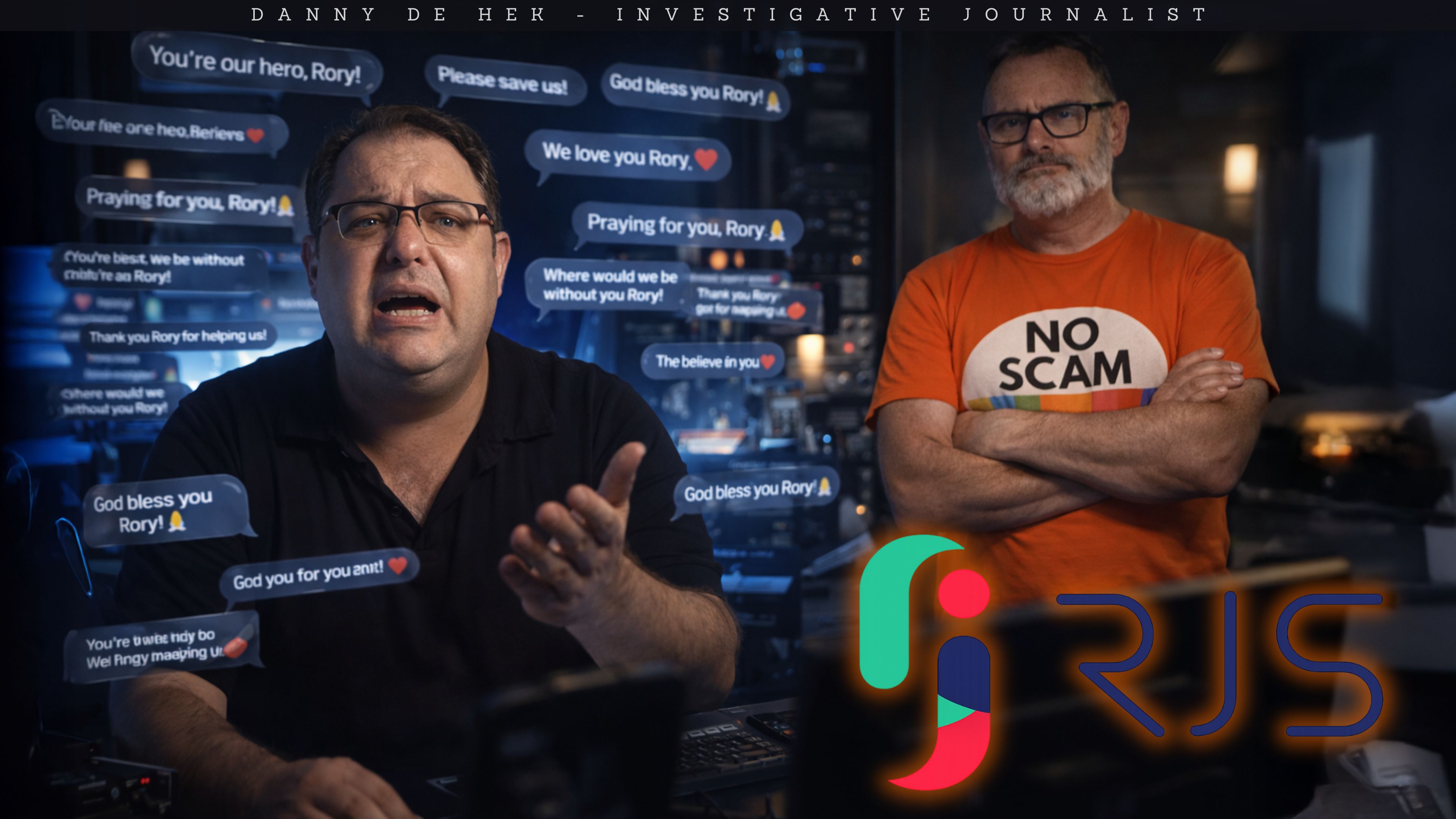
Perhaps most disturbing is the flood of comments under Rory’s videos — hundreds of people still clinging to the fantasy that he’s their saviour. Some call him “brave.” Others thank him “on behalf of the community.” One even offers to share champagne with him once the miracle payout arrives.
Many express their support with religious overtones: “God bless you,” “Sending healing hugs,” “You’re doing the Lord’s work.” They frame criticism of Rory as abuse, painting him as a martyr who has sacrificed everything to help them.
But buried among the flattery are the cracks.
A few commenters admit they’ve received no replies from any authority. Others say they followed every instruction and still got nothing. Some now openly question Rory’s credibility. One writes: “I understand why people think you scammed them. We waited two years for nothing.”
This isn’t just denial — it’s collective delusion. The cult of personality has replaced logic. And Rory is feeding it.
Because as long as people believe he’s “trying his best,” they won’t ask the harder question:
Where did the money go?
This Isn’t Over. But It Is Ending.
There is no “next payment.” There is no miracle investor. There is no global delay.
The company is dead. The scam has been exposed. The liquidator has begun.
Rory Conacher can talk all he wants. But the time for talking is over.
Because unlike Rory’s video scripts, court transcripts don’t lie.
“Never doubt that a small group of thoughtful, committed citizens can change the world; indeed, it is the only thing that ever has.” — Margaret Mead
Disclaimer: How This Investigation Was Conducted
This investigation relies entirely on OSINT — Open Source Intelligence — meaning every claim made here is based on publicly available records, archived web pages, corporate filings, domain data, social media activity, and open blockchain transactions. No private data, hacking, or unlawful access methods were used. OSINT is a powerful and ethical tool for exposing scams without violating privacy laws or overstepping legal boundaries.
About the Author
I’m DANNY DE HEK, a New Zealand–based YouTuber, investigative journalist, and OSINT researcher. I name and shame individuals promoting or marketing fraudulent schemes through my YOUTUBE CHANNEL. Every video I produce exposes the people behind scams, Ponzi schemes, and MLM frauds — holding them accountable in public.
My PODCAST is an extension of that work. It’s distributed across 18 major platforms — including Apple Podcasts, Spotify, Amazon Music, YouTube, and iHeartRadio — so when scammers try to hide, my content follows them everywhere. If you prefer listening to my investigations instead of watching, you’ll find them on every major podcast service.
You can BOOK ME for private consultations or SPEAKING ENGAGEMENTS, where I share first-hand experience from years of exposing large-scale fraud and helping victims recover.
“Stop losing your future to financial parasites. Subscribe. Expose. Protect.”
My work exposing crypto fraud has been featured in:
- Bloomberg Documentary (2025): A 20-minute exposé on Ponzi schemes and crypto card fraud
- News.com.au (2025): Profiled as one of the leading scam-busters in Australasia
- OpIndia (2025): Cited for uncovering Pakistani software houses linked to drug trafficking, visa scams, and global financial fraud
- The Press / Stuff.co.nz (2023): Successfully defeated $3.85M gag lawsuit; court ruled it was a vexatious attempt to silence whistleblowing
- The Guardian Australia (2023): National warning on crypto MLMs affecting Aussie families
- ABC News Australia (2023): Investigation into Blockchain Global and its collapse
- The New York Times (2022): A full two-page feature on dismantling HyperVerse and its global network
- Radio New Zealand (2022): “The Kiwi YouTuber Taking Down Crypto Scammers From His Christchurch Home”
- Otago Daily Times (2022): A profile on my investigative work and the impact of crypto fraud in New Zealand



Leave A Comment