


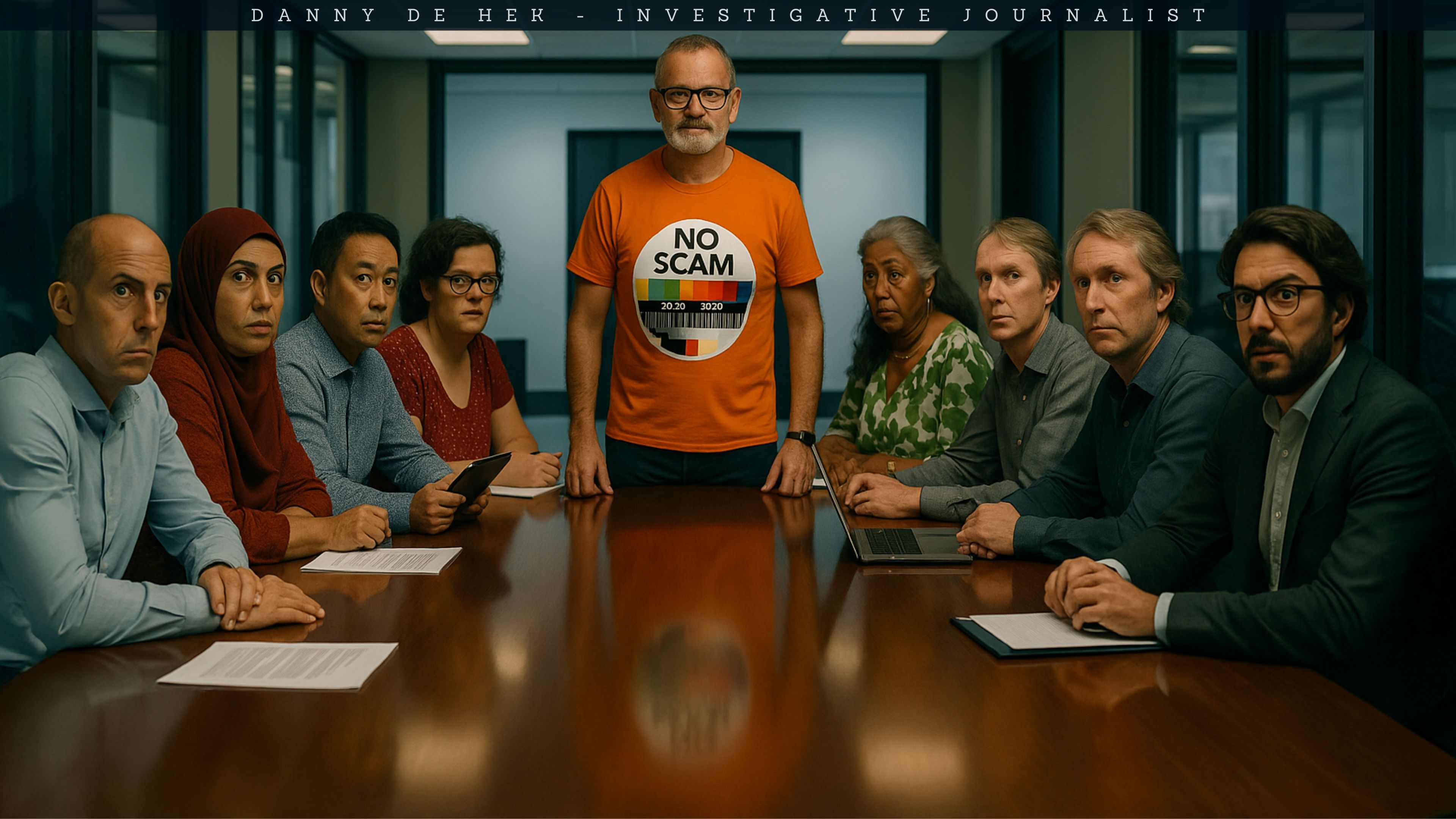
When an organisation controls the .nz domain space, manages millions in charitable funds, and positions itself as a guardian of New Zealand’s digital infrastructure, the public expects transparency, honesty, and proper governance.
Instead, InternetNZ (INZ) and its wholly owned subsidiary, the Domain Name Commission Ltd (DNC), have demonstrated a pattern of stonewalling, secrecy, unanswered questions, and escalating financial concerns.
Over the past several months, I have reviewed InternetNZ’s accounts, examined public documents, spoken with multiple parties, contacted MBIE, engaged with whistleblowers, and reached out directly to InternetNZ’s leadership. The more I uncovered, the clearer the picture became: something is seriously wrong inside InternetNZ.
This investigation lays out the evidence.
A pattern of silence from an organisation that claims transparency
InternetNZ repeatedly describes itself as transparent and accountable. However, members, journalists, registrars, and whistleblowers all report the same behaviour: legitimate questions ignored, disclosures dismissed, and accountability avoided.
At the 2025 AGM, attended by more than a thousand members, dozens of reasonable questions were submitted. Most were left unanswered, even when there were no other questions in the queue. These questions covered:
- public-good funding
- conflicts of interest
- who approves grant allocations
- DNC’s legal authority
- financial transparency
- governance concerns
- the 22 percent .nz price increase
InternetNZ did not answer them.
That silence reflects a broader pattern.
Millions flowing out without proper public disclosure
InternetNZ’s accounts reveal several red flags.
In 2025, InternetNZ transferred $11 million into an “endowment fund.” This fund now pays out around $1 million per year. On top of this, InternetNZ’s main accounts appear to distribute a further $4 million annually to external entities. None of this is properly itemised or publicly explained.
After InternetNZ increased .nz wholesale pricing by 22 percent in July 2025, it added roughly $3 million per year to its revenue.
A whistleblower summarised the scale succinctly:
“In 2025, the total amount flowing externally may have been as high as $5 million.
In 2026, once the price increase is included, it could be $8 million.”
Yet InternetNZ refuses to provide:
- who receives these funds
- why recipients were chosen
- who approves the allocations
- whether conflicts of interest exist
- what oversight is in place
- which board or staff are involved in decision-making
For a charity entrusted with public-interest funds, this level of opacity is unacceptable.
Potential Conflicts of Interest: Who Benefits From These Payments?
One of the most serious concerns raised by multiple whistleblowers is the possibility of conflicts of interest between InternetNZ’s board members and the organisations receiving funding. This isn’t an accusation — it’s an unanswered question. And the fact that InternetNZ refuses to disclose basic information makes that question even more important.
The public still has no transparency over:
- who sits on the committees or panels making funding decisions
- whether any board or staff member has direct or indirect ties to the beneficiaries
- whether any of the money flows back through relationships, associations, or aligned entities
- whether declarations of interest even exist — or if they’re enforced
No one is saying wrongdoing has occurred.
The issue is that InternetNZ has created an environment where the public cannot tell either way.
For a charitable organisation controlling millions in public-money-derived revenue, that is unacceptable.
DNC repeatedly calls itself a regulator. MBIE says it is not.
Throughout 2024–2025, DNC representatives repeatedly referred to themselves as “regulators,” both publicly and in written communications. At the 2025 AGM, DNC and INZ leadership used the term again.
However, MBIE has now formally confirmed:
- the Memorandum of Understanding (MOU) between MBIE and InternetNZ uses the word “regulate”
- this language does not confer any legal authority
- DNC is not a regulator in law
- the MOU is purely administrative
- InternetNZ may amend the MOU appendix at any time
InternetNZ and DNC appear to have built years of public-facing communication on an authority they do not possess. This raises obvious concerns under the Fair Trading Act.
The Memorandum of Understanding
 As part of this investigation, I reviewed the official Memorandum of Understanding between MBIE and InternetNZ (2016, amended 2025). This document is central because it is the only instrument InternetNZ and DNC rely on when claiming to “regulate” the .nz domain space. The MOU outlines administrative expectations but does not grant any statutory or legislative authority.
MBIE reinforced this when it confirmed that the MOU “does not provide any legislative authority for InternetNZ or the Domain Name Commission to perform any function.” The MOU is available publicly on InternetNZ’s own website and is an important document for anyone seeking to understand the limits of DNC’s actual legal standing.
Whistleblowing disclosures ignored or dismissed
In 2025, several whistleblowing disclosures were made involving allegations of:
- oppressive and discriminatory conduct
- failure to investigate legitimate complaints
- attempts to suppress allegations
- stonewalling by both INZ and DNC
- conflicts of interest and mismanagement
- breaches of obligations under the Protected Disclosures Act
Disclosures were sent to:
- the Chair of DNC
- the CEO of InternetNZ
- the Chair of InternetNZ
- the proper escalation channels
Months passed with no investigation.
Some disclosures were dismissed as “not serious,” without proper review.
International precedent: comparing INZ to Nominet (UK)
A relevant comparison exists in the United Kingdom.
In 2021, Nominet, the operator of the .uk namespace, faced a revolt triggered by:
- opaque financial decisions
- declining trust
- governance failures
- questionable allocations
- ignored complaints
The end result was extraordinary: the board was removed by its members.
The similarities between the Nominet situation and current issues at InternetNZ are notable.
Who oversees InternetNZ? The current board
Given the scale of financial authority, public responsibility, and decision-making power involved, it is important to understand who currently oversees InternetNZ and is accountable for its governance.
The following individuals sit on InternetNZ’s board. All details come directly from InternetNZ’s publicly available profiles.
- Stephen Judd – Chairperson
With over 30 years in IT and technology leadership, Judd was elected in 2023 and now chairs the organisation during a period of increasing scrutiny from members and the public. - Anjum Rahman – Deputy Chairperson
A chartered accountant with decades of governance experience in community and international organisations, Rahman brings strong financial and policy background to the board. - Anthony Bow – Appointed Board Member
Based in Auckland, Bow has extensive experience in investment management, finance, and taxation, including leadership roles in financial services entities. - Kate Pearce – Elected Board Member
Pearce is Head of Security at TradeMe and has a background in cybersecurity research, network protocol security, and diversity advocacy within the tech sector. - Potaua Biasiny-Tule – Elected Board Member
A long-standing advocate for digital empowerment within Māori communities, Biasiny-Tule co-founded Digital Natives Academy and works across technology, storytelling and education. - Richard Hulse – Elected Board Member
A former RNZ media manager with deep experience in governance, digital transformation, and internet culture, Hulse has served on the InternetNZ Council since 2015. - Whetū Fala – Appointed Board Member
A respected producer, director, and governance figure in Aotearoa’s creative sector, with more than 35 years’ experience across film, television and iwi-based media. - Daniel Spector – Elected Board Member
With 30 years in the tech industry and expertise in cross-border governance, trade policy, and digital infrastructure, Spector has contributed across Asia-Pacific markets. - Dylan Reeve – Elected Board Member
Reeve began in the early internet industry before moving into film and journalism, where he focused on online misinformation and wrote “Fake Believe: Conspiracy Theory in Aotearoa.” - Jonathan Ayling – Elected Board Member
A public-policy and governance leader with ministerial advisory experience, Ayling focuses on digital rights, civic infrastructure, and public-interest stewardship of the .nz namespace.
This group collectively holds responsibility for financial oversight, governance, transparency, and the ethical operation of the .nz domain name system. As questions continue to grow around InternetNZ’s decision-making and financial disbursements, public confidence depends on how this board responds.
For the sake of transparency and public accountability: the exact email I sent InternetNZ
As part of this investigation, I contacted InternetNZ’s Chairperson, Stephen Judd, directly on 30 October 2025, offering INZ a fair and reasonable opportunity to provide clarity before any publication. The organisation did not respond.
For transparency and accountability, here is the email exactly as it was sent:
Dear Stephen,
My name is Danny de Hek. I am a New York Times–featured investigative journalist, also profiled in Bloomberg and The Guardian, currently investigating a story concerning InternetNZ and the Domain Name Commission.
I have been reviewing InternetNZ’s published accounts and recent AGM transcripts, including several questions raised by members that remain unanswered. A number of these concern the organisation’s transparency and financial governance—specifically regarding the use of “public good” funding, transfers into endowment accounts, and the oversight of related entities.
I would appreciate clear answers to the following points before publication of my upcoming piece (scheduled for release within the next 7–15 days):
Financial Transparency:
Despite InternetNZ’s stated commitment to transparency, several members have expressed that it has been “impossible to identify from year to year where the money has gone and who has benefited from it.” Can you confirm:
- Who currently makes the decisions about where “public good” funding is allocated?
- What controls or oversight processes are in place to prevent conflicts of interest or favouritism?
- Why is there no detailed breakdown showing recipients of grants or “good cause” disbursements?
Potential Misallocation of Funds:
It has been suggested that certain board members may have directed funds toward personal or affiliated projects, which—if true—could amount to grounds for criminal investigation. How does InternetNZ ensure that no such conflicts occur?
Endowment and Revenue Increases:
The 2025 accounts reportedly show $11 million transferred into an “endowment” fund, while an additional $4 million annually appears to flow to entities unrelated to InternetNZ’s core business. At the same time, domain registration fees increased by 22% in July 2025, generating roughly $3 million extra revenue.
- What was the rationale for these changes, and how are these funds being applied in the public interest?
- Where is the independent audit or board resolution authorising these transfers publicly recorded?
Regulatory Status of the DNC:
During the AGM, both you and Ms Barbara Pearse appeared to refer to the Domain Name Commission Ltd (DNC) as a “regulator.” Yet there seems to be no statutory basis for such a claim beyond an MOU with MBIE, which does not itself confer regulatory authority.
- On what legal foundation does DNC describe itself as a regulator?
- Has InternetNZ obtained formal advice confirming that representation is lawful under the Fair Trading Act?
I understand from multiple sources that more than twenty written questions have been submitted to InternetNZ and DNC over the past year, most of which remain unanswered. I’m hoping to avoid adding to that list and would genuinely appreciate your cooperation in clarifying these matters.
I will be publishing a story on this investigation soon and would welcome a written reply, or if you prefer, a short interview. I’m also happy to provide any additional context or supporting material you may require.
Best Regards
Danny de Hek
Why their silence matters
InternetNZ operates the backbone of New Zealand’s digital identity. With that comes an obligation to maintain:
- trust
- transparency
- oversight
- financial integrity
- genuine engagement with stakeholders
When questions about funding, governance, authority, and conduct are ignored, that trust erodes rapidly. When whistleblowers are dismissed, that trust erodes further. When millions of dollars move without transparent reporting, the public is right to demand answers.
Until InternetNZ provides those answers, the concerns remain legitimate.
This investigation continues
The issues raised here are not going away.
More documents exist.
More voices are coming forward.
More scrutiny is needed.
In the coming weeks, I will continue reviewing:
- the MOU in full
- DNCL’s public claims
- oversight by Charities Services
- InternetNZ’s financial arrangements
- potential conflicts of interest
- governance behaviour
- international parallels
The .nz namespace is a public asset. The public deserves transparency and accountability from the organisation that manages it.
This is only the beginning.
Disclaimer: How This Investigation Was Conducted
This investigation relies entirely on OSINT — Open Source Intelligence — meaning every claim made here is based on publicly available records, archived web pages, corporate filings, domain data, social media activity, and open blockchain transactions. No private data, hacking, or unlawful access methods were used. OSINT is a powerful and ethical tool for exposing scams without violating privacy laws or overstepping legal boundaries.
About the Author
I’m DANNY DE HEK, a New Zealand–based YouTuber, investigative journalist, and OSINT researcher. I name and shame individuals promoting or marketing fraudulent schemes through my YOUTUBE CHANNEL. Every video I produce exposes the people behind scams, Ponzi schemes, and MLM frauds — holding them accountable in public.
My PODCAST is an extension of that work. It’s distributed across 18 major platforms — including Apple Podcasts, Spotify, Amazon Music, YouTube, and iHeartRadio — so when scammers try to hide, my content follows them everywhere. If you prefer listening to my investigations instead of watching, you’ll find them on every major podcast service.
You can BOOK ME for private consultations or SPEAKING ENGAGEMENTS, where I share first-hand experience from years of exposing large-scale fraud and helping victims recover.
“Stop losing your future to financial parasites. Subscribe. Expose. Protect.”
My work exposing crypto fraud has been featured in:
- Bloomberg Documentary (2025): A 20-minute exposé on Ponzi schemes and crypto card fraud
- News.com.au (2025): Profiled as one of the leading scam-busters in Australasia
- OpIndia (2025): Cited for uncovering Pakistani software houses linked to drug trafficking, visa scams, and global financial fraud
- The Press / Stuff.co.nz (2023): Successfully defeated $3.85M gag lawsuit; court ruled it was a vexatious attempt to silence whistleblowing
- The Guardian Australia (2023): National warning on crypto MLMs affecting Aussie families
- ABC News Australia (2023): Investigation into Blockchain Global and its collapse
- The New York Times (2022): A full two-page feature on dismantling HyperVerse and its global network
- Radio New Zealand (2022): “The Kiwi YouTuber Taking Down Crypto Scammers From His Christchurch Home”
- Otago Daily Times (2022): A profile on my investigative work and the impact of crypto fraud in New Zealand






Leave A Comment