


“Follow the money, and the truth stops hiding.”
Over the past few months, I’ve been documenting what I believe to be one of the most significant financial collapses tied to a modern Ponzi-style operation — Goliath Ventures Inc.
What started as whistleblower tips, victim statements, and fragmented financial trails has now escalated into something far more serious. We are no longer dealing with rumours, speculation, or online accusations. We are now looking at formal court-ordered examinations, subpoenas, and forced disclosure of financial records.
 Before going any further, I want to make something clear — this isn’t based on hearsay or second-hand commentary. The developments outlined here are supported by Court Filings, including a docket filed on March 31, 2026.
I strongly encourage people to look at these documents directly. Because once you see what’s being requested — and who is being examined — the narrative starts to shift very quickly.
I’ve seen this pattern before. It always begins the same way — a polished front, promises of consistent returns, a network built on trust and momentum, and individuals positioned as “leaders” who appear to be thriving. Then, slowly, the cracks begin to show. Withdrawals stall. Communication becomes controlled. Narratives shift. Blame is redirected. And eventually, the structure collapses under the weight of its own promises. What follows is where things get real — the forensic phase — where stories stop mattering and documents take over.
That’s exactly where we are now.
The latest filings out of the United States Bankruptcy Court confirm that the Receiver has moved into Rule 2004 examinations. This is not a routine administrative step. This is one of the most powerful tools available in bankruptcy proceedings, allowing investigators to compel third parties to produce documents, communications, and financial records under oath. In practical terms, it means anyone connected to the flow of money — directly or indirectly — can be required to cooperate.
The investigation shifts from narrative to evidence
What we are now witnessing is a clear transition from narrative-driven exposure to evidence-driven reconstruction. Up until this point, much of what we’ve uncovered has come from victims, insiders, and observable patterns — all of which pointed in the same direction. But patterns alone are not enough. They raise questions. They don’t always answer them.
Rule 2004 changes that.
Under these examinations, entities are being required to hand over Complete Financial and Operational Records — not curated versions, not selective disclosures, but full datasets covering years of activity. This includes bank account openings, transaction histories, wire transfers, crypto activity, internal communications, and compliance records, spanning back to January 1, 2019 through to present
That level of access allows investigators to reconstruct the operation from the ground up. It removes interpretation and replaces it with traceable, verifiable data. Where money entered, where it moved, how it was distributed, and who ultimately benefited from it.
And this is where most schemes begin to unravel. Because while marketing can be manipulated and testimonials can be staged, financial records tend to tell a far more consistent story.
Who is being pulled into the investigation — and why it matters
The scope of entities now being examined is one of the clearest indicators of how serious this has become. This is not limited to one sector. We are seeing involvement across traditional banking, cryptocurrency platforms, fintech infrastructure, and even charitable organisations.
That matters, because it tells us something important about the structure of the operation.
Money did not move through a single channel. It moved through multiple layers of financial infrastructure, both centralised and decentralised. That includes banks, exchanges, payment processors, and third-party service providers — all of which play a role in creating the appearance of legitimacy.
One of the subpoenas issued to Coinbase, for example, requires disclosure of:
- Full transaction histories
- Wallet addresses
- Linked bank accounts
- Login and IP data
- Internal fraud and compliance reviews
This is not surface-level information. This is Deep Operational Data that allows investigators to connect identities, trace movements, and identify relationships between accounts that would otherwise remain hidden.
From experience, this is where the illusion starts to fall apart. What appears to be independent activity often turns out to be coordinated behaviour operating behind the scenes.
The timeline is now public — and so is the process
One of the more significant developments here is that this process is no longer happening quietly. The court has scheduled formal hearings, and the timeline is now public and trackable.
The key date is April 22, 2026 at 2:30 PM (EDT), where the court will conduct a hearing via video conference . Anyone who wants to observe must register in advance. That level of transparency is important, because it allows the public — particularly victims — to see how the process unfolds.
Alongside this, examinations have already been scheduled and conducted for specific entities, with clear deadlines for document production. These are not informal requests. These are legally enforceable obligations backed by the court.
Another critical detail is the time scope. Investigators are not just looking at the collapse. They are examining the entire lifecycle of the operation, including its early stages. And in most cases, that’s where intent becomes visible — how the system was structured, how it scaled, and how it sustained itself.
What may have been missed — and why that matters
Despite the breadth of the current investigation, there are still noticeable gaps. And these gaps matter, because they point to areas where the financial trail may not yet be fully explored.
One observation raised internally questioned why certain organisations — such as the Indian American Chamber of Commerce and Orangewood Athletics — were not included in the initial list of examined entities. Both have now reportedly been contacted, which suggests the investigation is still evolving.
It’s important to be clear here. Being contacted does not imply wrongdoing. It simply means there may be a connection worth understanding — financial, operational, or otherwise.
Investigations like this do not begin with a complete map. They begin with known data points and expand outward as new information is uncovered. Every new document, every transaction, every communication has the potential to lead to additional entities.
What we are seeing now is that expansion happening in real time.
The co-conspirators hiding in plain sight
Up until now, much of the focus has been on Goliath Ventures Inc as an entity — the company, the court proceedings, and the institutions now being subpoenaed. But there is a critical layer that still isn’t being addressed with the depth it deserves — the individuals operating behind the scenes who drove the growth, handled the money, and benefited from it.
I’m not referring to passive investors. I’m referring to what I would describe as co-conspirators operating under the label of “partners”. Individuals who, based on their own public behaviour, were deeply embedded in the system — recruiting aggressively, moving funds, and living lifestyles that do not align with their legitimate business activities.
These individuals were not observers. They were participants at scale.
They were:
- Recruiting large networks of investors
- Handling funds through company structures
- Facilitating crypto transactions
- Displaying wealth through luxury vehicles, high-end properties, and lifestyle spending
And yet, when you examine the current scope of the Rule 2004 process, many of these individuals and their associated entities are not being scrutinised at the same level.
The companies that handled the money
Through ongoing research and whistleblower input, a number of companies have been identified that appear to be directly linked to the movement of funds within the Goliath ecosystem. These companies are tied to individuals who were actively promoting, recruiting, and in some cases handling large volumes of money.
These include:
- Habibi HQ LLC — Christopher Delgado
- Habibi Holdings — Christopher Delgado
- PrimeLedger Capital — Mike Chmielewski
- TOMO Capital — Tomo Marjanovic
- TWENTYWON Ventures LLC — Nicholas Petrillo and Jay Newton
- 2608640 Ontario Inc — Marty Birthelmer
- Holladay Ventures LLC — Casey Holladay
- Prime Chain Holdings LLC — Matt Burks
- LEGACY DESIGN & CONSTRUCTION GROUP LLC — Hunter Smallback
- LMT Financial LLC — Jonathan Mason
The existence of these entities on its own is not the issue. The concern is how they were used.
When company structures are used to receive funds, move capital, and facilitate transactions that align with recruitment-driven income, they become highly relevant to any investigation into potential financial misconduct.
The question that naturally follows is:
Why are these entities not being examined with the same level of scrutiny as the financial institutions processing the transactions?
Because following the money does not stop at the bank. It ends with the beneficiaries.
The individuals driving the machine
Alongside these entities is a network of individuals who were instrumental in scaling this operation. These are not unknown figures. Many were highly visible, actively promoting Goliath Ventures Inc, and building extensive downlines.
From the information available, the following individuals are connected through recruitment, promotion, or fund movement:
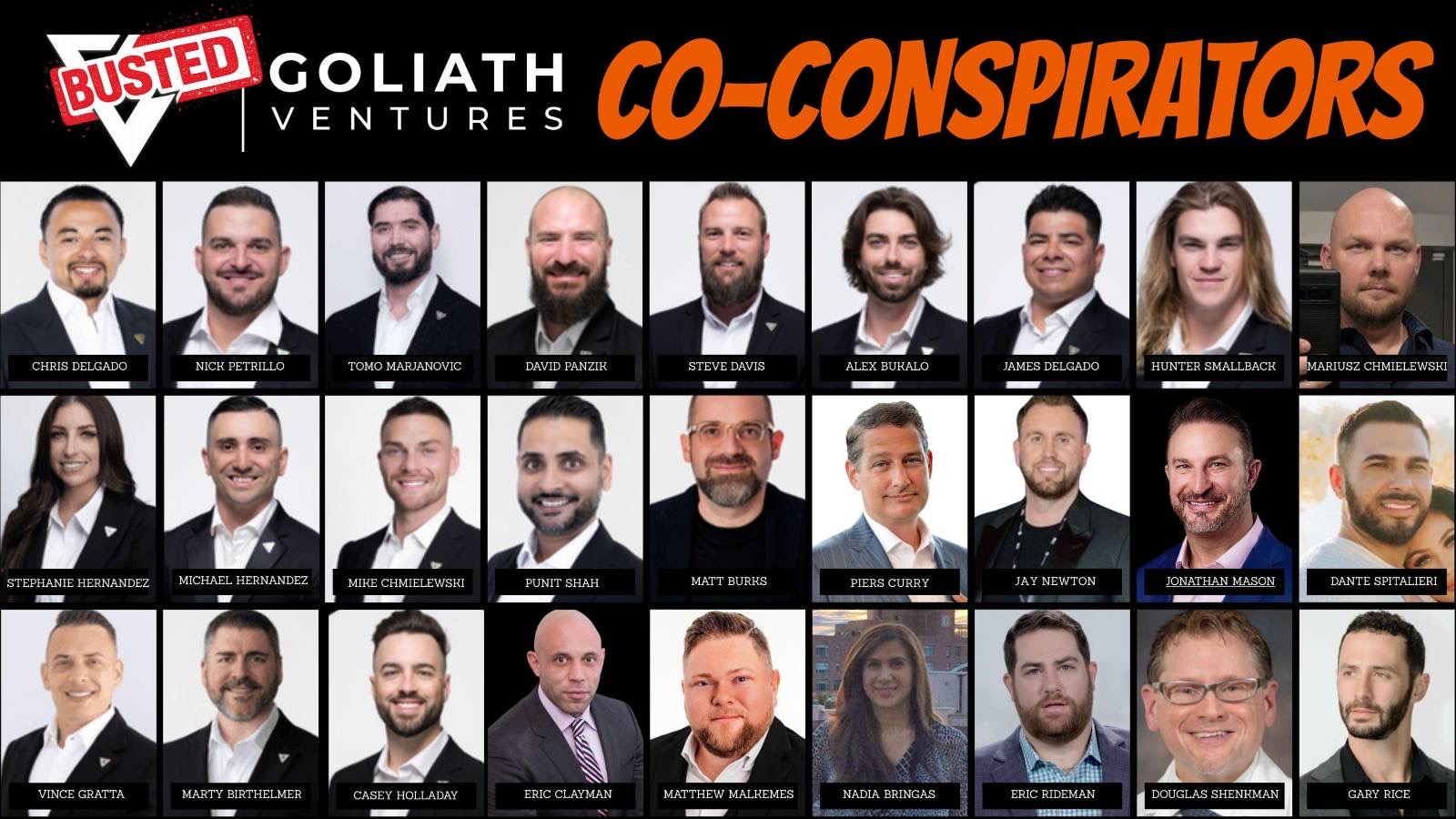
Chris Delgado, Nick Petrillo, Tomo Marjanovic, David Panzik, Steve Davis, Alex Buralo, James Delgado, Hunter Smallback, Mariusz Chmielewski, Stephanie Hernandez, Michael Hernandez, Mike Chmielewski, Punit Shah, Matt Burks, Piers Curry, Jay Newton, Jonathan Mason, Dante Spitalieri, Vince Gratta, Marty Birthelmer, Casey Holladay, Eric Clayman, Matthew Malkemes, Nadia Bringas, Eric Rideman, Douglas Shenkman, Gary Rice
This is not about speculation. It is about identifying consistent behavioural patterns:
- High-volume recruitment
- Promotion of fixed or consistent returns
- Participation in structured networks
- Evidence of funds being handled through personal or associated entities
For example, Punit Shah is believed to have recruited approximately 500 individuals, promoting what was described as a 7% monthly return model. That raises serious questions around unlicensed securities promotion.
Similarly, Nick Petrillo is reported to have recruited around 900 individuals, yet there is no clear indication of accountability at this stage. At the same time, records suggest Petrillo filed a claim seeking $40 million in unpaid rewards — effectively positioning himself as a creditor.
That creates a contradiction that cannot be ignored.
How does someone claim losses while simultaneously benefiting from the system they helped build?
The missing crypto trail and the Canadian gap
One of the most concerning gaps in the current documentation is the lack of visibility around crypto wallet activity linked to individuals within this network.
Based on multiple sources, funds were not only moved through traditional banking systems but also through cryptocurrency wallets controlled by individuals and their associated entities.
Yet:
- Many of these wallets are not listed
- There is limited reference to off-platform crypto transfers
- Canadian exchanges are notably absent
This is significant, because there is credible information suggesting that a substantial portion — potentially up to 40% — of investment flow originated from Canada.
If that is accurate, then the absence of Canadian exchange involvement in the current filings represents a major gap in the financial reconstruction.
Crypto introduces additional complexity:
- Funds can be moved across jurisdictions instantly
- Wallet ownership can be obscured
- Transactions can be layered through multiple addresses
Without addressing this layer properly, the full picture of the money flow remains incomplete.
The uncomfortable questions that remain
At this stage, there is no question that the investigation is active and progressing. But there are also questions that need to be asked — not emotionally, but logically, based on the evidence.
Why are independent investigators, who have been tracking this since September 1, 2025, not being formally engaged?
Why is there a stronger focus on institutions than on individuals and entities directly handling funds?
Why are high-level recruiters and promoters not being examined with the same intensity?
And perhaps most importantly:
Will those who drove the growth of this system be held accountable, or will they be allowed to reposition themselves as victims?
Because in many cases like this, the line between participant and beneficiary becomes blurred — unless it is properly examined.
The accountability gap
This is the phase where investigations either go deep enough to uncover the full structure, or stop just short of exposing the entire network.
The institutions matter. The platforms matter. But the real story often sits with the people who built the trust, drove the recruitment, moved the money, and benefited from it.
If those layers are not fully explored, what we are left with is a partial truth.
And in cases like this, a partial truth is not enough.
Because once the documents are fully analysed and the data is laid out, the narrative will change — not based on opinion, but on evidence.
And when that happens, the question will no longer be whether something went wrong.
It will be who knew, when they knew it, and what they did next.
Disclaimer: How This Investigation Was Conducted
This investigation relies entirely on OSINT — Open Source Intelligence — meaning every claim made here is based on publicly available records, archived web pages, corporate filings, domain data, social media activity, and open blockchain transactions. No private data, hacking, or unlawful access methods were used. OSINT is a powerful and ethical tool for exposing scams without violating privacy laws or overstepping legal boundaries.
About the Author
I’m DANNY DE HEK, a New Zealand–based YouTuber, investigative journalist, and OSINT researcher. I name and shame individuals promoting or marketing fraudulent schemes through my YOUTUBE CHANNEL. Every video I produce exposes the people behind scams, Ponzi schemes, and MLM frauds — holding them accountable in public.
My PODCAST is an extension of that work. It’s distributed across 18 major platforms — including Apple Podcasts, Spotify, Amazon Music, YouTube, and iHeartRadio — so when scammers try to hide, my content follows them everywhere. If you prefer listening to my investigations instead of watching, you’ll find them on every major podcast service.
You can BOOK ME for private consultations or SPEAKING ENGAGEMENTS, where I share first-hand experience from years of exposing large-scale fraud and helping victims recover.
“Stop losing your future to financial parasites. Subscribe. Expose. Protect.”
My work exposing crypto fraud has been featured in:
- Bloomberg Documentary (2025): A 20-minute exposé on Ponzi schemes and crypto card fraud
- News.com.au (2025): Profiled as one of the leading scam-busters in Australasia
- OpIndia (2025): Cited for uncovering Pakistani software houses linked to drug trafficking, visa scams, and global financial fraud
- The Press / Stuff.co.nz (2023): Successfully defeated $3.85M gag lawsuit; court ruled it was a vexatious attempt to silence whistleblowing
- The Guardian Australia (2023): National warning on crypto MLMs affecting Aussie families
- ABC News Australia (2023): Investigation into Blockchain Global and its collapse
- The New York Times (2022): A full two-page feature on dismantling HyperVerse and its global network
- Radio New Zealand (2022): “The Kiwi YouTuber Taking Down Crypto Scammers From His Christchurch Home”
- Otago Daily Times (2022): A profile on my investigative work and the impact of crypto fraud in New Zealand



Leave A Comment