





Every now and then a “crypto opportunity” comes along that is so brazen, so lazy, and so obviously engineered to separate people from their savings that it almost becomes useful as a training tool. Global Gold Coin and the website CryptoGold.Exchange fall squarely into that category.
One of the first giveaways is the embedded TradingView widget on their dashboard — not showing their own token, but Bitcoin on Binance — a cosmetic trick scammers use to mimic the appearance of a functioning exchange when nothing is actually trading.
This isn’t just another dodgy token. This is a live case study in how scammers weaponise hype, religion, family pressure, fake success stories, and multi-level marketing to hoover up deposits from people who are already under financial strain.
I’m not writing this for the die-hard “leaders” who know exactly what they’re doing. I’m writing it for the people who might stumble across one of these videos, feel that familiar knot of FOMO in their stomach, and start wondering whether they’re about to miss “the next Bitcoin.”
If that’s you — or your mum, your neighbour, your church friend, or someone at work — this blog is for you.
The first red flag: a website with almost no information
Let’s start with the front door.
When you type in CryptoGold.Exchange, you don’t get a serious financial platform. You get three lonely lines of text:
“Trade Crypto and Gold here.”
“The most secure and reliable platform…”
“Gold-backed security, instant trading, 24/7 support.”
That’s it. No explanation of how anything works. No company details. No legal page. No team. No whitepaper. No roadmap. No smart contract address. No mention of what chain they’re allegedly on. No risk disclosure. Nothing.
If you’ve ever visited a legitimate exchange or crypto project, you’ll know they drown you in documentation. They’re forced to. Lawyers insist on it. Regulators require it. Developers want to show their work.
Here, you get vague marketing fluff and a signup form.
It doesn’t read like the front end of a financial exchange. It reads like a landing page thrown together by someone who has seen crypto screenshots on Twitter and thought, “Close enough.”
And that’s the tone for everything that follows.
What they’re actually selling (spoiler: it isn’t crypto)
A lot of people struggle at this point. The scammers say “coin” so often that listeners assume there must be a coin. They hear numbers like 10 cents, 40 cents, 80 cents, $1.25 and think, “Well, something must be trading somewhere.”
There isn’t.
What Global Gold Coin is selling you is not a real cryptocurrency. There is:
- No blockchain contract you can inspect.
- No token address on any chain.
- No real exchange listing.
- No order book.
- No on-chain transaction history.
What they call a “coin” is just an entry in a private database they control. They can add a zero, remove a zero, change the “price,” multiply your “balance” — all with a few keystrokes.
If you can’t send the token to a wallet you control, if you can’t see it moving on a block explorer, and if you can’t sell it on a real exchange to an unrelated buyer, then you don’t own a coin. You own a number on someone else’s website.
So what are you really buying?
You’re buying a position in a recruitment structure. You’re buying hope. You’re buying the right to bring in the next batch of victims.
That is the real product.
Signing up: my test drive through their “exchange”
To see how seriously they treat security and compliance, I did what any good scam investigator does: I tried to break it with stupidity.
I signed up with:
- Password: 12345678
- Address: 10 Downing Street, London, New Zealand
No KYC. No identity checks. No “this password is too weak” warning. No “that’s not a real country”. Nothing. The system smiled, nodded, and let me walk right in.
Then a few interesting things happened:
- Despite them claiming that the referral code was “optional”, the form refused to submit until I entered one.
- Once I did, the dashboard proudly displayed my upline — complete with email: mrmilionmaker51@gmail.com.
- I was immediately given my own referral link, with my personal code baked in.
At no point did anyone ask who I was, whether I understood any risks, or whether I could afford to lose what I was being invited to “invest.”
But they were very keen to show me who I now “belonged” to, and how I could start recruiting under them.
That’s not how a crypto exchange behaves.
That’s how a multi-level marketing scheme behaves.
The promoters: recycled influencers with the same script
Before we get to the sales call, it’s worth looking at who is pushing this out into the world.
You’d expect, if this were a serious financial project, to see:
- Developers.
- Analysts.
- People with real track records in crypto.
- Maybe even a regulated entity.
Instead, we find:
- Kimberly Crawford, branding herself as “BossiAzzKim,” pumping referral links all over Facebook with the standard “new coin backed by gold, get your free 100 coins” spiel.
- Paul Saisal, a “make money online” operator in Phnom Penh, juggling various offers and funnel pages, with Global Gold Coin just being another slot in the carousel.
- Martin Chongo, based in Zambia, involved in other highly questionable crypto schemes like NdeipiCoin, suddenly very excited about yet another “life-changing” opportunity.
They all push the same talking points:
“New coin backed by gold.”
“Was 10 cents, now 60 cents.”
“Get 100 coins for free.”
If three different people in three different countries are using the same sentence structure, it’s not organic enthusiasm; it’s a copy-paste script from upline.
The only thing they are really selling is the next signup.
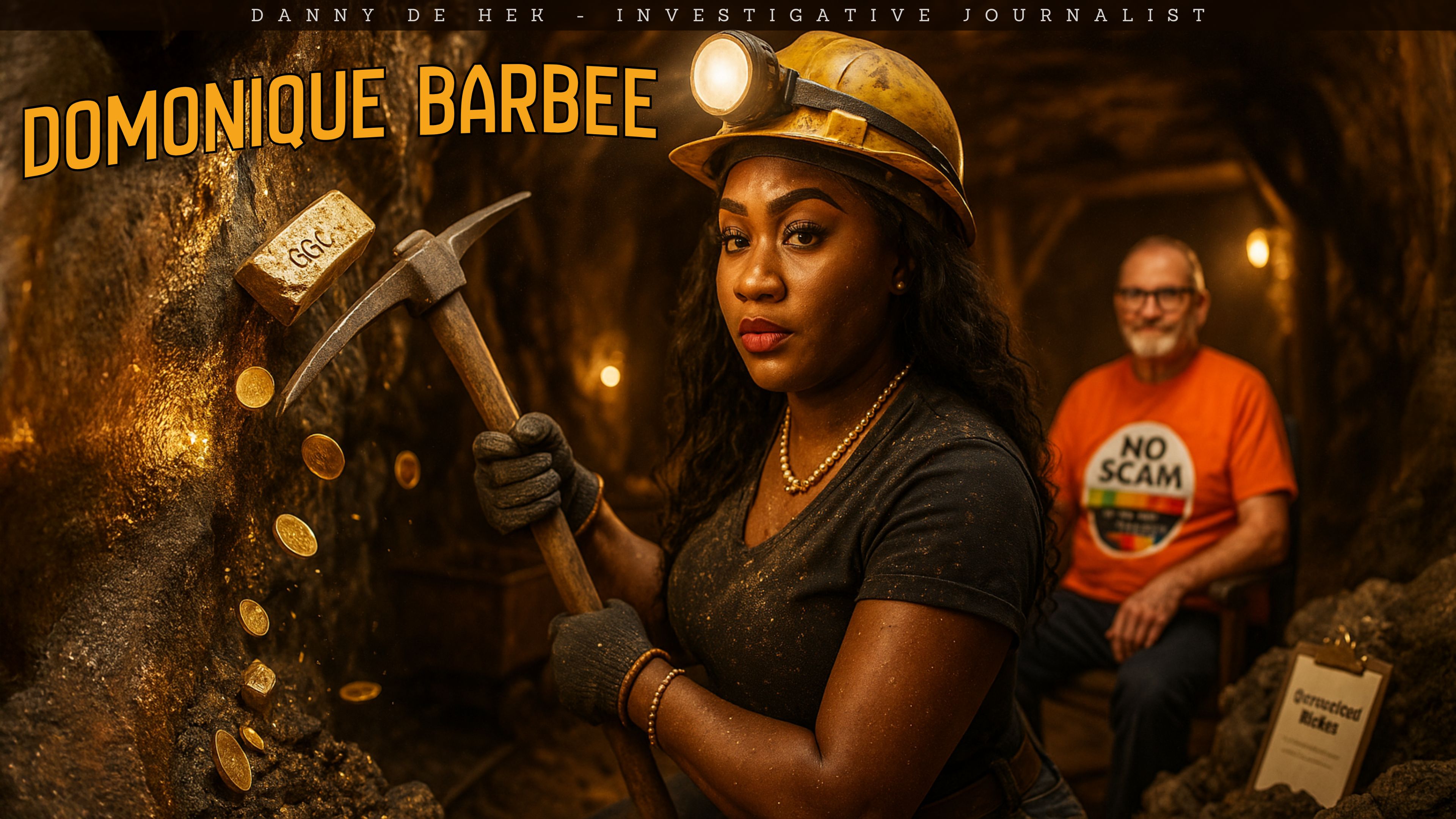
The MLM architect behind the curtain: Domonique Barbee
While the surface-level promoters push referral links and copy-paste scripts, the Zoom call reveals a much bigger player behind the scenes: Domonique Barbee.
Barbee is not a casual participant. She is a long-standing MLM recruiter whose entire online career is built on launching, promoting, and rapidly cycling through high-risk “opportunities.” She became widely known during the Tradera Forex MLM era — an operation that imploded under regulatory pressure — where leadership infighting escalated into lawsuits, including a high-profile civil action filed by fellow promoter Megan Lynch. The conflict wasn’t about trading or performance; it was about who controlled the downline, which says everything about her business model.
Since then, Barbee has flowed from scheme to scheme, attaching herself to whatever promises fast returns and faster recruitment. Her strategy never changes: host hype calls, rebrand herself as a “coach,” and present each new scheme as the next ground-floor miracle.
Her presence here is not a coincidence. It indicates that the people behind Global Gold Coin are plugged into the MLM supernetwork — the same ecosystem that moves from Forex to crypto to “AI bots” and back again, recycling victims and downlines with each collapse.
When Domonique Barbee shows up in a project, it doesn’t signal legitimacy.
It signals the beginning of a recruitment engine, not a financial product.
And that’s exactly what we’re seeing here.
The “Gold Mine Tour”: A Stage-Managed Prop for Their Sales Funnel
Just when you think you’ve seen every trick in the book, along comes a YouTube “tour” of the mine allegedly backing the coin—a carefully staged walk-through designed not to inform, but to impress the easily impressed.
On camera, promoters casually drop huge, unverifiable claims:
- The mine produced $12 billion in gold (no records support this).
- A mysterious “last living heir,” Patricia Thake/Thaki, supposedly born inside Shaft 13 in the 1930s, now living in an Arizona home “they bought for her.”
- The heaps of dirt outside the mine contain “millions, if not billions of dollars” in gold that nobody has ever bothered to extract since the 1800s.
It’s all delivered with a tone of warm insider storytelling, but not a single technical detail:
No geological reports.
No assay data.
No mining rights documentation.
No corporate registrations.
No visible evidence the mine is active.
No connection between the alleged asset and the actual token supply.
Instead, the “tour” exists for one purpose:
to make a crypto scam feel like a physical business.
This is a classic tactic. When a fraudulent scheme attaches itself to something tangible—a warehouse, a farm, a mine, a server room—they’re not proving legitimacy. They’re manufacturing confidence.
And their own words give it away.
The Sales Call Training: A Masterclass in Manipulation
The third video is outright shocking. It’s not about crypto, mining, gold, or technology.
It is a recruitment script workshop.
One promoter literally demonstrates a 60-second pitch designed to hit emotional triggers:
- Fake urgency (“It’s already gone from 10 cents to $1.50!”).
- Fear of missing out (“It will be $10 by Thanksgiving next year!”).
- Social pressure (“You’re on my top 10 list of people I love and care about.”).
- Artificial rush (“I’m really busy—call me back if you’re interested.”).
- Cult-style repetition (“Do that 80 times tomorrow.”)
He even tells the audience the quiet part out loud:
“If you only do it three or four times a week, you’ll make a little money.
I’m going to do it three or four times an hour.”
This is not investing.
This is cold-call MLM boiler-room training.
Then comes the psychological manipulation that every veteran scammer relies on:
“People make decisions faster based on fear of loss, not gain.”
They instruct promoters to weaponise FOMO and relational guilt:
- “What if I tell Larry no and he and his brother really do this?”
- “It’s not how much can I make, it’s how much am I going to lose if I don’t join.”
This kind of messaging doesn’t create informed participants.
It creates pressure-cooked victims.
And it confirms, beyond any doubt, what this whole operation really is:
A referral-driven, fear-driven recruitment machine disguised as a gold-backed cryptocurrency.
The Zoom call: an hour-long assault on your critical thinking
The heart of this operation is a Zoom call that, if you know what to look for, is almost painful to watch.
From the opening minute, you’re told this is:
- “a state-of-the-alarm type of call,”
- information “only the top top tier in the world know about,”
- a moment of “divine alignment,”
- your chance to be at the “right place at the right time.”
Notice something: they still haven’t told you what the product is. There is no coin name yet, no technical explanation, no breakdown of risk or mechanics. Just status language and spiritual language.
You aren’t being spoken to as a potential investor.
You’re being spoken to as a recruit who needs to be emotionally softened up.
They talk about being “blessed” to even hear this information, about how rare it is, about how only the inner circle gets access. They tell stories about being put on “private calls” with mysterious “huge leaders,” “super super leaders,” and quietly imply you are now part of that same circle.
If someone spoke to my mother this way — flattering her, telling her God organised a Zoom invite, suggesting that hesitation would mean ignoring a blessing — I’d be furious. Because none of this is about education. It’s about disarming scepticism before any facts appear.
The billionaire fairy tales and invisible experts
Whenever scammers want to skip over the awkward “proof” part of a pitch, they start name-dropping people they never quite identify.
On this call, we’re told:
- A “multi-multi-billionaire” in New York controls $80 billion in Bitcoin.
- Ten other billionaires are ready to “push the gold coin to $100.”
- They have someone they call the “Bitcoin queen” involved.
- One leader has 80,000 people.
- Another has 500,000 people in Europe.
- Someone else has two million crypto buyers ready to go.
- A multi-billionaire’s firm will “handle everything,” from the SEC to the IRS to exchange listings.
It sounds impressive until you realise not one full name, company, contract, or document is ever produced.
You aren’t given names you can google. You aren’t given firms you can check. You’re given vibes. They want you to feel small, late, and lucky just to be on the call.
Credibility in the real world is something you can verify.
Credibility in scam world is something you’re asked to feel.
The gold mine story: the shiny prop that doesn’t exist on paper
A big part of their pitch hangs on the claim that this token is “backed by gold.” Not just metaphorically, but literally backed by a real-world gold mine, supposedly worth billions.
“Professor Robert” claims:
- He owns 30% of a gold mine valued at “three or four or five billion dollars.”
- The mine is near Las Vegas, 110 acres, with a colourful history.
- Leaders will soon tour the mine that backs the token.
It sounds like the kind of story people want to believe. Gold has an emotional weight. It feels safer, older, more solid than digital coins.
But here’s what they never provide:
- No name of the mining company.
- No filings.
- No audited reserve reports.
- No production numbers.
- No independent valuation.
- No legal documentation showing Global Gold Coin has any secured claim over that alleged gold.
- No mechanism for token holders to ever redeem anything.
“Backed by gold” in this context means “we hope you don’t ask too many questions.”
If there really were billions of dollars’ worth of gold behind a token, the first thing a legitimate team would do is shove the documentation under your nose. Instead, the documentation is replaced with storytelling. That’s not an accident. It’s a strategy.
The Whitepaper That Promises Everything — And Proves Nothing
 A close review of the Global Gold Coin Whitepaper raises serious and unavoidable red flags. The document repeatedly claims that GGC is a “gold-backed” cryptocurrency tied to a 1,000-acre Nevada gold mine allegedly worth $15 billion, yet it provides no mine name, no claim numbers, no geological surveys, no reserve audits, no custody arrangements, and no redemption mechanism to substantiate those claims.
Instead of verifiable evidence, the whitepaper relies heavily on price predictions, guaranteed growth narratives, unnamed billionaire partners, and MLM-style recruitment networks. These are not characteristics of a legitimate asset-backed digital currency — they are classic markers of an unregistered securities-style investment pitch.
Despite grand statements about institutional-grade security, global partnerships, and reserve transparency, the document contains no regulatory disclosures, no third-party audits, no compliance statements, and no independently verifiable proof that any gold is currently mined, owned, stored, or redeemable by token holders.
In practical terms, the whitepaper functions less as a financial or technical disclosure and more as a belief-engineering marketing document, designed to manufacture confidence, urgency, and participation without meeting the most basic standards required of a genuine gold-backed or regulated crypto project.
For transparency, the full Global Gold Coin whitepaper is linked here so readers can review these claims and omissions for themselves.
The truth about “Krause Thacke Mining & Minerals LLC”
At first glance, the promoters make it sound like Global Gold Coin is backed by a vast, multi-billion-dollar gold empire. They even point to a Nevada company — Krause Thacke Mining & Minerals LLC, incorporated in 2005 — and a small mining claim in Clark County listed under the name Patricia Thacke, the supposed “last living heir.” On paper, that gives their story a faint whiff of legitimacy. But once you look closer, the entire narrative collapses.
The company is tiny, with an estimated revenue of around $180,000 a year and only a handful of staff. Public records categorize it under non-metallic mineral services, not major gold production. The single mining claim, PATSY #5, shows no evidence of large-scale extraction, no modern output, no audited reserves and no documentation connecting it to any cryptocurrency.
Most importantly, there is zero proof that this small local mining operation has anything whatsoever to do with the creation, supply, or value of Global Gold Coin. What the promoters have done is classic scam theatre: take a small, real-world company, stretch its existence into a grand myth, and hope nobody checks the paperwork. It’s a story built for trust — not truth — and it has no bearing on the fake “gold backing” behind this token.
The price promises: numbers plucked from thin air
Now we get to the numbers. This is where they really start to salivate.
They talk about the coin having been 10 cents, then 20 cents, then 35, then 40, then 80, then $1, now $1.25, on its way to $3–$4 by March and $150 shortly after that. They compare it to early Bitcoin. They say this is your chance to get in at “less than a dollar” and ride into millionaire territory.
But ask yourself: who is setting these prices?
A real token trades on real markets. Its price is set by buyers and sellers interacting on a public order book. Even dodgy coins listed on shady exchanges at least have some form of visible trading activity.
With Global Gold Coin, the “price” only exists inside their own website. There is no independent trading venue. You can’t verify volume. You can’t see order books. You can’t cross-check on CoinGecko or any serious aggregator.
The simplest explanation is the correct one:
The price is whatever they type into the admin panel.
When someone controls the database, they control the illusion of growth. They can show you a chart going up and up while you have no way of exiting at those numbers. It’s like a casino printing fake chips and telling you you’re up $100,000 — as long as you don’t try to cash out.
That’s not investment. That’s theatre.
The debt pressure: “Don’t leave Santa’s sack empty”
Scams don’t just invite you to put in money. They push you to put in more than you can afford.
On this call, they openly encourage people to:
- Put money on credit cards.
- Use a “credit card program” with 4% monthly repayments.
- Treat this as the way to “stabilise your family’s future forever.”
- Go as high as $25,000 in one hit.
They even wrap it in Christmas language:
“Don’t leave Santa’s sack empty this year.”
Think about that for a second. They’re explicitly tying your love for your family and your anxiety over Christmas spending to the decision to take on debt for a speculative “coin” that doesn’t even exist on a blockchain.
If someone said this to my mother, I wouldn’t just tell her to hang up — I’d sit her down and explain that anyone who brings up Christmas and credit cards in the same sentence while selling an “investment” is not on her side.
Legitimate financial advisers talk about diversification, risk management, timelines, and affordability. These people talk about maxing out cards and trusting God.
That’s not advice. That’s financial abuse.
The spiritual guilt trip
One of the ugliest tactics in the call is the religious framing.
They talk about:
- “Divine alignment.”
- “God blessing you with this opportunity.”
- “Being chosen to hear this information.”
- “Not wasting the blessing you’ve been given.”
The implication is clear:
To walk away is to ignore what God has arranged. To hesitate is to “block your blessing.” To question is to show a lack of faith.
This is not accidental language. It’s targeted at people for whom faith is deeply tied to identity and decision-making. When you can make someone feel like saying “no” to your scheme is the same as saying “no” to God, you can get them to override their own instincts.
It’s disgusting. And it works far too often.
If your faith is being used as leverage in a financial pitch, that pitch is rotten.
Why this isn’t “just another MLM”
At this point you might think, “Okay, so it’s MLM. Lots of big companies use MLM. What’s the big deal?”
The big deal is this: traditional MLM is already catastrophic for most people, and that’s with actual products. Study after study has shown that over 99% of MLM participants either lose money or barely break even.
Add in the emotional damage — friendships strained, family relationships reduced to prospect lists, people feeling like failures because they couldn’t “believe hard enough” — and MLM leaves a trail of human wreckage behind it.
Now take that same structure and strip away:
- The product.
- The physical inventory.
- The tangible service.
- The ability for an outside observer to see what’s really being sold.
Global Gold Coin doesn’t even have the pretence of selling something useful. The “product” is a fake coin inside a closed system. The only way anyone imagines making money is by getting in early and convincing others to join under them.
That’s not entrepreneurship. It’s structured exploitation.
The damage isn’t just financial. When people realise they’ve roped in friends and family into a scam, the shame can be crushing. Some never talk about it. Some double down and keep selling, because admitting the truth is too painful. Others walk away from relationships entirely.
Scammers like this know exactly what they’re doing to those relationships. They’ve seen it before. They just don’t care.
Inside the back office: a view of what really matters to them
Once you’re logged in, the mask slips a bit more.
On a real exchange dashboard, you’d expect to see:
- Account security options.
- Deposit and withdrawal tools.
- Market data.
- Trading pairs.
- Asset balances tied to on-chain addresses.
In CryptoGold.Exchange, what you actually see is the spine of a recruitment machine.
You’re shown your upline — the person who “brought you in”. You’re encouraged to share your personalised referral link. You can see your “team”, your “group”, your growing “downline” as people sign up under you. The entire layout revolves around people, not assets.
It’s like opening what you thought was a bank account and discovering the main feature is a family tree of who convinced whom to join.
There is no transparency about how tokens are created, where they’re stored, how the so-called price is calculated, or what happens if you try to withdraw. You’re not treated as an investor assessing risk; you’re treated as a node in a pyramid, tasked with dragging more bodies into the system.
The message of the back office is simple:
“You are not here to trade. You are here to recruit.”
Insider enrichment: how these schemes really make money
Let’s talk about the bit the promoters never want to explain clearly: who actually wins.
During the call, one of the men fronting the scheme boasts:
“My wallet has $1.2 billion on it right now.”
Later, he offers:
“Tonight only — $25,000 gets you one million coins.”
Take a step back and think about the implications.
For someone to be able to hand out a million coins at the drop of a hat, their personal allocation must be enormous. And if they can casually sprinkle out million-coin packages to whoever wires them enough money, it tells you that the supply is completely arbitrary.
These schemes work like this:
- Insiders award themselves gigantic token balances at effectively zero cost.
- They set an initial arbitrary price — say 10 cents — and start telling stories about how it will go to $1, $3, $10, $100.
- They sell these imaginary coins to recruits in exchange for real money — dollars, crypto, card payments.
- As more people buy in, they simply update the displayed price on the website, giving the illusion of growth.
- At some point, if they can get the token listed somewhere (even briefly), they dump as much as they can on the open market.
- When deposits slow or regulators sniff around, the system dies, and the insiders vanish with the lion’s share of the money.
It’s important to understand that from their point of view, the database is the treasure chest. They control who gets numbers, how many numbers, and what those numbers pretend to be worth.
You are not a partner in this. You are the exit liquidity.
The stories about helping a thousand people become millionaires are marketing. The reality is that these schemes are engineered so that the math guarantees almost everyone will lose — because the underlying value is fake, while the money flowing in from recruits is very real.
Why so many people fall for it
If you just read the mechanics, you might be tempted to think, “Who would fall for this?” But that’s the wrong question. It’s not about intelligence. It’s about pressure.
These calls are built to:
- Overwhelm you with numbers.
- Flood you with emotion.
- Wrap everything in spiritual and motivational language.
- Create urgency with fake deadlines, “tonight only” offers, and holiday themes.
- Make you feel like you’ll be left behind if you pause to think.
Most people don’t sit at a desk with a notepad and a calculator while watching. They’re on their phone after work, tired, worried about bills, worried about Christmas, hearing “this is your moment” from someone who sounds confident and successful.
Scammers know that. They build their pitch for that moment of vulnerability.
They also know shame will keep a lot of victims quiet. Once someone has told their family, “I’ve found something huge, we’re going to be okay,” it’s incredibly hard to later admit, “I was wrong, I was tricked, I’m sorry.”
The silence protects the scammers.
Why Global Gold Coin is so dangerous
Global Gold Coin combines several of the worst elements in one package:
- The illusion of a crypto token, with none of the transparency.
- The psychology of MLM, with none of the product.
- The emotional hooks of religious and motivational rhetoric.
- The financial recklessness of gambling with borrowed money.
- The shame and relationship damage that comes from turning your social circle into your prospect pipeline.
If this were just a bad investment, it would be one thing. But it’s not. It’s a system designed to exploit trust, hope, and desperation. It targets people in regions where regulation is weak, financial literacy is under attack from all directions, and where a few hundred dollars means the difference between getting by and going under.
The promoters aren’t innocent. They know what they’re doing. They may tell themselves stories about being “wealth mentors” or “kingdom builders,” but at the end of the day, they’re repeating scripts that funnel money upwards and leave a trail of wrecked lives behind them.
They know the statistics on MLM.
They’ve seen previous schemes disappear.
They carry on anyway.
If someone you love is being pulled into this
If your mother, your partner, your friend, or someone at your church is being drawn into Global Gold Coin — or anything like it — the worst thing you can do is mock them. Scammers are very good at what they do. They make smart, decent, caring people feel like they’ve finally found a way out — and then they weaponise that hope against them.
The best thing you can do is help them slow down.
Show them that:
- Real crypto can be checked on a public blockchain.
- Real exchanges don’t require you to join under a “sponsor.”
- Real investments don’t pressure you to use credit cards before midnight.
- Real business opportunities don’t rely on spiritual guilt or “God brought you to this Zoom” rhetoric.
- Real value doesn’t disappear the moment the website goes offline.
Ask them the simple questions the promoters hope nobody asks:
“Where is the contract address?”
“Where is the audited gold reserve?”
“Where are the real exchange listings?”
“What happens if you try to withdraw everything today?”
And most importantly:
“If this goes wrong, who can you actually hold accountable?”
If the honest answer is “no one,” then you already know what you’re dealing with.
The bottom line
Global Gold Coin and CryptoGold.Exchange are not the future of finance. They are the latest costume worn by a very old game.
The names change.
The logos change.
The buzzwords change.
The structure stays the same:
A handful of people at the top invent a story, invent a number, and convince everyone underneath that they’re early, chosen, blessed, and just one more deposit away from never worrying about money again.
If you’re reading this because someone sent you a referral link, or because you watched that Zoom and felt a twinge of FOMO, let me say this as plainly as I can:
This isn’t your way out. It’s their way in.
Walk away.
Warn others.
And don’t let these people — or anyone using the same tactics — anywhere near your wallet, your credit card, or your trust.
Disclaimer: How This Investigation Was Conducted
This investigation relies entirely on OSINT — Open Source Intelligence — meaning every claim made here is based on publicly available records, archived web pages, corporate filings, domain data, social media activity, and open blockchain transactions. No private data, hacking, or unlawful access methods were used. OSINT is a powerful and ethical tool for exposing scams without violating privacy laws or overstepping legal boundaries.
About the Author
I’m DANNY DE HEK, a New Zealand–based YouTuber, investigative journalist, and OSINT researcher. I name and shame individuals promoting or marketing fraudulent schemes through my YOUTUBE CHANNEL. Every video I produce exposes the people behind scams, Ponzi schemes, and MLM frauds — holding them accountable in public.
My PODCAST is an extension of that work. It’s distributed across 18 major platforms — including Apple Podcasts, Spotify, Amazon Music, YouTube, and iHeartRadio — so when scammers try to hide, my content follows them everywhere. If you prefer listening to my investigations instead of watching, you’ll find them on every major podcast service.
You can BOOK ME for private consultations or SPEAKING ENGAGEMENTS, where I share first-hand experience from years of exposing large-scale fraud and helping victims recover.
“Stop losing your future to financial parasites. Subscribe. Expose. Protect.”
My work exposing crypto fraud has been featured in:
- Bloomberg Documentary (2025): A 20-minute exposé on Ponzi schemes and crypto card fraud
- News.com.au (2025): Profiled as one of the leading scam-busters in Australasia
- OpIndia (2025): Cited for uncovering Pakistani software houses linked to drug trafficking, visa scams, and global financial fraud
- The Press / Stuff.co.nz (2023): Successfully defeated $3.85M gag lawsuit; court ruled it was a vexatious attempt to silence whistleblowing
- The Guardian Australia (2023): National warning on crypto MLMs affecting Aussie families
- ABC News Australia (2023): Investigation into Blockchain Global and its collapse
- The New York Times (2022): A full two-page feature on dismantling HyperVerse and its global network
- Radio New Zealand (2022): “The Kiwi YouTuber Taking Down Crypto Scammers From His Christchurch Home”
- Otago Daily Times (2022): A profile on my investigative work and the impact of crypto fraud in New Zealand





Leave A Comment