


This is your wake-up call. Literally.
I’m Danny de Hek, The Crypto Ponzi Scheme Avenger, and today I’m sharing a real-life encounter with a scammer who tried—unsuccessfully—to trick me into handing over the seed phrase to my crypto wallet. What unfolded was a psychological masterclass in manipulation that every crypto user needs to hear.
Let’s break this down and expose how these scammers operate, so you don’t become their next victim.
It Starts with a Text
I received this message out of the blue:
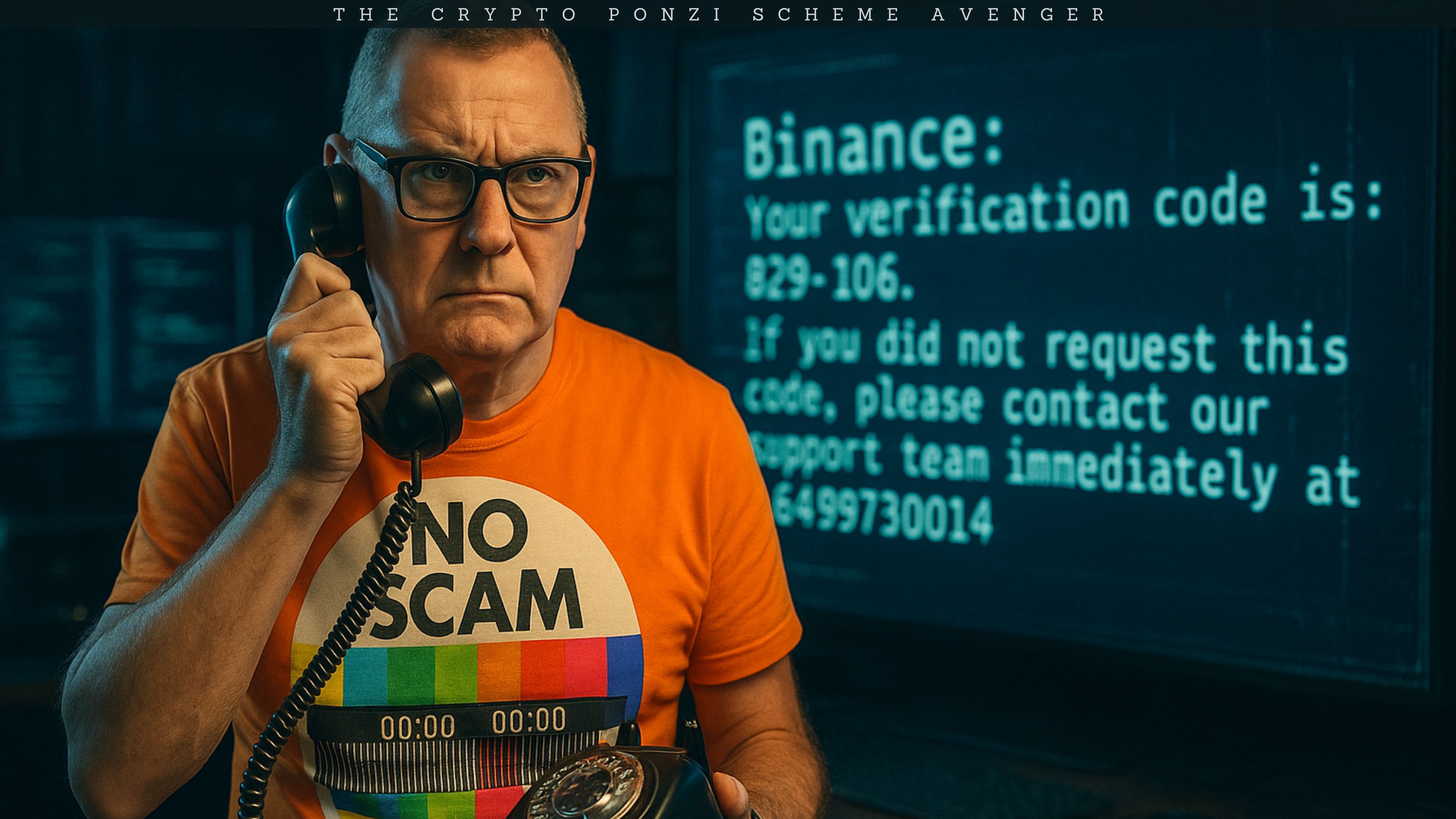
“Binance: Your verification code is: 829-106. If you did not request this code, please contact our support team immediately at +6499730014.”
Now, that’s a New Zealand number. I live in New Zealand. It looked official. Sound familiar?
This scam is known as a callback phishing attack. They trigger your fear of unauthorized access, then offer a fake lifeline: “Call us right now.”
So I did.
The Fake Support Call
Once connected, I was greeted by a robotic voice saying:
“Welcome to Binance. All of our calls are recorded for training and monitoring purposes…”
Legit-sounding. Calming. Then a “consultant” named Adam took over, asking harmless questions:
- “Have you logged into your Binance account recently?”
- “Did anyone else have access?”
- “What’s your name?”
- “What’s your balance?”
Harmless? No. Each answer I gave helped him build trust, collect information, and lower my guard.
Eventually, I was “transferred” to a supervisor named Brian. Spoiler: it was the same voice as before, just pretending to be someone higher up.
Then Came the Hook
The fake supervisor hit me with this:
“We noticed a login attempt from India. We’ve put a withdrawal block on your account. But to secure your funds, we need to upgrade your account to a Level 3 plan using Trust Wallet.”
Here’s the psychology at play:
- Urgency: “Your account’s under attack.”
- Authority: “I’m a senior Binance supervisor.”
- False security: “We’re protecting your funds with a one-device plan.”
- Distraction: “Let’s just set up a Trust Wallet together.”
The Trap: Trust Wallet and the Seed Phrase
He guided me to install Trust Wallet, told me I had an existing wallet (I didn’t), and walked me through restoring an “existing wallet.” Then he asked for the 12-word seed phrase.
The exact words were:
“Do you have a pen and paper handy? We’re only going to be able to read this out to you once.”
He insisted it was safe because:
- “Binance advisors are allowed to know it.”
- “I won’t remember the words.”
- “You’ve got a passcode, so it’s fine.”
- “This is how we secure your tokens.”
Let me be crystal clear:
No legitimate crypto company will ever ask for your seed phrase. Not Binance. Not MetaMask. Not Trust Wallet. Not anyone.
Giving away your seed phrase is like giving a stranger the keys to your house, the alarm code, and a signed permission slip to rob you.
The Moment They Slipped Up
I started asking questions:
- “What’s my last name?”
- “How did you find my Binance account just by my phone number?”
- “Why does the new voice sound like the first guy?”
- “Why does your website search come up blank?”
They got flustered. They couldn’t answer. They tried to guilt me:
“Your funds are at risk. If you hang up now, we can’t help you.”
Classic scam tactic. Make you feel like you’re the one causing the problem.
The Scam, Fully Exposed
Here’s how it works:
- They get you to call them using a fake text.
- They impersonate Binance support, sounding official.
- They tell you there’s suspicious activity on your account.
- They walk you through downloading a new wallet.
- They convince you to restore an existing wallet using a seed phrase that they control.
- You move your funds to what you believe is your secure wallet—but they now have full access.
Once you hand over your seed phrase, your funds are gone forever.
How to Protect Yourself
- NEVER share your seed phrase with anyone. Not support, not your mum, not your cat.
- Verify the number. Scammers spoof local numbers all the time.
- Don’t act out of fear. If something feels off, it probably is.
- Call Binance or your platform directly using their website—not numbers sent via text.
- Record suspicious calls and report them to local authorities or CERT NZ.
Final Thoughts from The Crypto Ponzi Scheme Avenger
This wasn’t just an inconvenience. It was a highly targeted attack using real-world psychology, fake tech support, and clever impersonation. These scammers almost sounded legit.
But almost isn’t enough.
And if I didn’t know better—if I hadn’t been trained by years of exposing MLM frauds and crypto cons—I could have lost everything.
Stay sharp. Stay skeptical. And if you ever get a call like this—hang up, report it, and spread the word.
Let’s keep the scammers out of crypto—one phone call at a time.
Got scammed? Spotted something shady?
Send it my way. Let’s keep the heat on.
— Danny de Hek, The Crypto Ponzi Scheme Avenger
About the Author
I’m DANNY DE HEK, a New Zealand–based YouTuber, investigative journalist, and OSINT researcher. I name and shame individuals promoting or marketing fraudulent schemes through my YOUTUBE CHANNEL. Every video I produce exposes the people behind scams, Ponzi schemes, and MLM frauds — holding them accountable in public.
My PODCAST is an extension of that work. It’s distributed across 18 major platforms — including Apple Podcasts, Spotify, Amazon Music, YouTube, and iHeartRadio — so when scammers try to hide, my content follows them everywhere. If you prefer listening to my investigations instead of watching, you’ll find them on every major podcast service.
You can BOOK ME for private consultations or SPEAKING ENGAGEMENTS, where I share first-hand experience from years of exposing large-scale fraud and helping victims recover.
“Stop losing your future to financial parasites. Subscribe. Expose. Protect.”
My work exposing crypto fraud has been featured in:
- Bloomberg Documentary (2025): A 20-minute exposé on Ponzi schemes and crypto card fraud
- News.com.au (2025): Profiled as one of the leading scam-busters in Australasia
- OpIndia (2025): Cited for uncovering Pakistani software houses linked to drug trafficking, visa scams, and global financial fraud
- The Press / Stuff.co.nz (2023): Successfully defeated $3.85M gag lawsuit; court ruled it was a vexatious attempt to silence whistleblowing
- The Guardian Australia (2023): National warning on crypto MLMs affecting Aussie families
- ABC News Australia (2023): Investigation into Blockchain Global and its collapse
- The New York Times (2022): A full two-page feature on dismantling HyperVerse and its global network
- Radio New Zealand (2022): “The Kiwi YouTuber Taking Down Crypto Scammers From His Christchurch Home”
- Otago Daily Times (2022): A profile on my investigative work and the impact of crypto fraud in New Zealand


Leave A Comment