


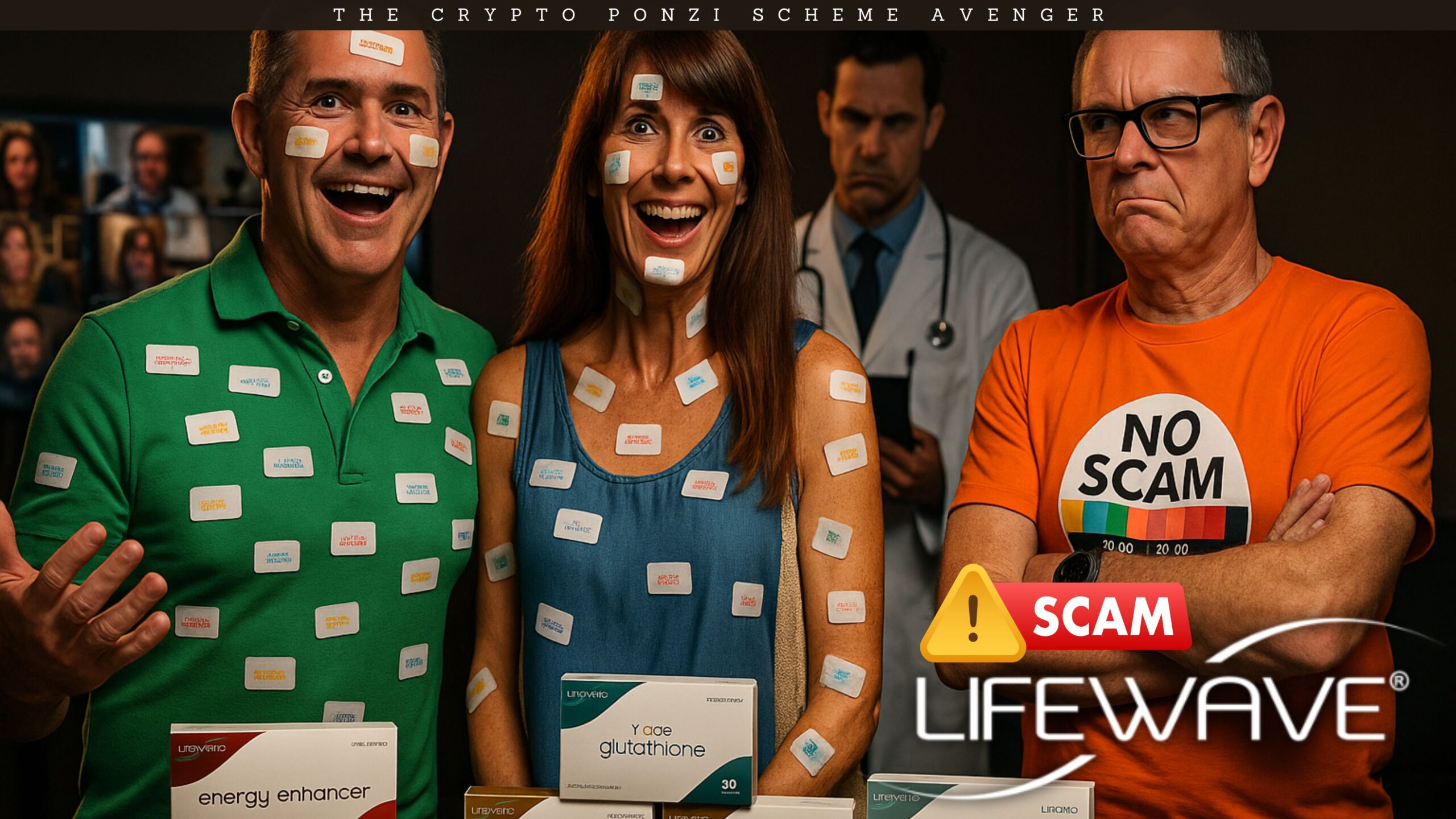
If you’ve heard of LifeWave patches, you’ve probably been told they can “activate your stem cells” or “boost your energy naturally”.
It sounds revolutionary — but what’s really going on behind the scenes? And more importantly: is there any medical proof these patches actually work?
Let’s break it all down.
The Science Claims Sound Fancy — But Where’s the Proof?
LifeWave markets its flagship patch, X39, as a form of phototherapy — claiming it reflects your body’s infrared heat to stimulate specific points on your skin. According to them, this leads to better sleep, increased stamina, and even rejuvenated stem cells.
But here’s the problem: there is no clinical evidence offered to support these claims.
Their official documents admit the products are not intended to diagnose, treat, cure, or prevent any disease. You won’t find peer-reviewed studies, FDA approval, or any scientific body endorsing the technology. What they do offer is a lot of testimonials, many of them emotional, vague, and anecdotal.
It’s Not Just About Patches — It’s About Recruitment
LifeWave isn’t just trying to sell you wellness — it wants you to sell it to others.
Once you become a Preferred Customer, you’re encouraged to subscribe monthly, refer others using a personal link, and eventually upgrade to a Brand Partner. That’s when the real agenda becomes clear: recruit others, build a team, and earn commission based on your group’s purchases.
This is where Multi-Level Marketing (MLM) kicks in. LifeWave’s compensation structure includes:
- Binary teams
- Volume thresholds
- Rank advancement based on downline activity
These aren’t signs of a health company — they’re the telltale mechanics of a recruitment-driven business model, where most people make little or no profit, while a few at the top reap the rewards.
Danny and Diane McDaniel Are Driving the Hype
If you’ve seen a LifeWave promo or webinar, chances are you’ve come across Danny and Diane McDaniel. They’re well-known MLM marketers, previously involved in other schemes, now helping build LifeWave’s downline with emotional storytelling and “freedom lifestyle” pitches.
They don’t lead with science. They lead with motivation, vision, and community. Their focus is more about building teams and less about proving the product.
The McDaniels’ involvement adds another layer of concern. These are experienced recruiters who know how to sell the dream — even if the product can’t deliver on it.
The “Wellness Movement” That Feels Like a Cult
LifeWave’s Welcome Center in Utah features things like:
- A “Time Travel Tunnel”
- A holographic speech from the founder
- Emotional testimonials about how “the patch found me”
It’s framed as a health innovation showcase, but it feels more like a recruitment indoctrination event. These immersive, spiritual experiences are classic MLM emotional manipulation tactics, designed to create loyalty and suppress critical thinking.
Their Own Policy Document Raises Serious Concerns
In LifeWave’s official April 2025 Policies & Procedures, it clearly states:
- Products are sold “as-is” with no guarantees
- Health claims are prohibited
- Brand Partners are banned from contacting medical professionals
- Ranks and bonuses are tied to recruiting and team volume — not retail sales
Even worse, there’s no income disclosure, no verified retail customer base, and no commitment to scientific transparency.
So… Do the Patches Actually Work?
From what we’ve reviewed — no. There is no medical evidence, no trials, no expert backing. Just a lot of emotionally charged marketing, celebrity endorsements, and a carefully structured funnel designed to pull in new recruits.
It’s not about whether you feel something. It’s about whether the product is proven, regulated, and honestly marketed. LifeWave falls short on every one of those fronts.
Final Thoughts: Hope Shouldn’t Be For Sale
LifeWave is selling hope disguised as health, and it’s doing so through a recruitment-first business model that mimics pyramid scheme structures.
If someone is pitching you LifeWave, ask them one question:
“Can you show me independent clinical evidence this product works?”
If the answer is no — walk away.
You deserve truth, not testimonials. You deserve proof, not patches.
New Zealand Public Warning: Active Local LifeWave Promoters
 New Zealand readers should be aware that LifeWave is currently being Promoted Locally by individuals with a documented history of pushing high-risk multi-level marketing (MLM) schemes to New Zealanders.
Individuals of concern include:
- Josh Burton-Chadwick (Josh B-C)
NZ: +64 27 432 6654
AU: +61 439 717 880
Email: sirjoshbc2@protonmail.com | sirjoshbc2@pm.me - Ryan Wall
NZ: +64 21 620 854 - Hohepa Patea
NZ: +64 21 490 676
Email: hpatea@gmail.com
These same individuals have previously promoted schemes such as BG Wealth Sharing and CR Group LLC (UICEX) before pivoting to LifeWave.
Due to serious concerns around health-related claims, income inducements, and recruitment-driven sales tactics, these individuals have now been formally reported to the New Zealand Financial Markets Authority (FMA). The risks of promoting MLM-style opportunities in New Zealand have been clearly outlined to the regulator.
If you are approached by any New Zealand-based promoters regarding LifeWave “stem cell patches,” unrecorded “doctor calls,” or income opportunities, extreme caution is advised. Always conduct independent due diligence and seek regulatory guidance before engaging.
If you have been approached by any of the individuals named above, or have already invested in LifeWave through a New Zealand promoter, you are welcome to Contact me confidentially. Any information shared will be treated with discretion and used solely for evidence and public awareness purposes.
Disclaimer: How This Investigation Was Conducted
This investigation relies entirely on OSINT — Open Source Intelligence — meaning every claim made here is based on publicly available records, archived web pages, corporate filings, domain data, social media activity, and open blockchain transactions. No private data, hacking, or unlawful access methods were used. OSINT is a powerful and ethical tool for exposing scams without violating privacy laws or overstepping legal boundaries.
About the Author
I’m DANNY DE HEK, a New Zealand–based YouTuber, investigative journalist, and OSINT researcher. I name and shame individuals promoting or marketing fraudulent schemes through my YOUTUBE CHANNEL. Every video I produce exposes the people behind scams, Ponzi schemes, and MLM frauds — holding them accountable in public.
My PODCAST is an extension of that work. It’s distributed across 18 major platforms — including Apple Podcasts, Spotify, Amazon Music, YouTube, and iHeartRadio — so when scammers try to hide, my content follows them everywhere. If you prefer listening to my investigations instead of watching, you’ll find them on every major podcast service.
You can BOOK ME for private consultations or SPEAKING ENGAGEMENTS, where I share first-hand experience from years of exposing large-scale fraud and helping victims recover.
“Stop losing your future to financial parasites. Subscribe. Expose. Protect.”
My work exposing crypto fraud has been featured in:
- Bloomberg Documentary (2025): A 20-minute exposé on Ponzi schemes and crypto card fraud
- News.com.au (2025): Profiled as one of the leading scam-busters in Australasia
- OpIndia (2025): Cited for uncovering Pakistani software houses linked to drug trafficking, visa scams, and global financial fraud
- The Press / Stuff.co.nz (2023): Successfully defeated $3.85M gag lawsuit; court ruled it was a vexatious attempt to silence whistleblowing
- The Guardian Australia (2023): National warning on crypto MLMs affecting Aussie families
- ABC News Australia (2023): Investigation into Blockchain Global and its collapse
- The New York Times (2022): A full two-page feature on dismantling HyperVerse and its global network
- Radio New Zealand (2022): “The Kiwi YouTuber Taking Down Crypto Scammers From His Christchurch Home”
- Otago Daily Times (2022): A profile on my investigative work and the impact of crypto fraud in New Zealand



Been using Lifewave patches since 2005. I was a good friend of David Schmidt, the inventor, at the time. I use them as a way to extend the effectiveness of needles in acupuncture. i have been keeping track of customer usage for over 25 years. They all seem to work. Literally, one sees improvement. There are university studies on each patch, testing and verifying its production of the intended target of each patch. I know because I read them before using the patches. I have carefully followed their research. I do not use them in an MLM setting. My tree is empty and most that join me as a customer quit because most people dislike MLM technology. I don’t even pay attention to the money aspect. I keep enough on hand to cover my patients who have critical needs. I use them in protocols I developed and used an MRI machine weekly on a patient at Rady Children’s Hospital to confirm they were doing what they said they would do … in that case it cleaned up the brain in a simple protocol in which the surgeon said he had never seen a brain clean up like that in his entire career as a surgeon. The eleven year old boy came out of brain surgery blind. Within months, the brain cleaned up and the vision returned. It kicked off a series of testing what works and what doesn’t work for many years now. I still dislike their MLM scheme … and ask myself why?
Thanks for sharing your personal experience—truly. It sounds like you’ve taken great care to use these patches ethically and outside of the MLM circus, which is rare. But anecdotal outcomes, even when well-documented, aren’t a substitute for **peer-reviewed, repeatable science**.
Many of the so-called “studies” on LifeWave products aren’t published in reputable journals, don’t pass independent scrutiny, and often come from biased sources or unreviewed PDFs. “Cleaning the brain” and restoring vision through stickers isn’t something we’ll find in **The Lancet** or **JAMA**—for good reason. Extraordinary claims require extraordinary evidence.
The bigger issue, as you’ve hinted yourself, is **why a legitimate health technology would wrap itself in an MLM model at all**. If the products truly worked at the level being claimed, hospitals—not home meetings—would be distributing them.
The LifeWave MLM scheme isn’t just annoying. It’s designed to exploit **hope, desperation, and financial vulnerability**—especially targeting the sick, the elderly, and the easily influenced. That’s where the real harm lies.
We’re not here to discredit your personal use. But when a company is using *miracle recovery stories* to sell overpriced patches to thousands of people under a recruitment-based model, **someone has to call it out**—even if a few people *feel* like it works.
If the patch works for you, great. But the system around it is **deeply unethical**, and that’s what this video exposes.