


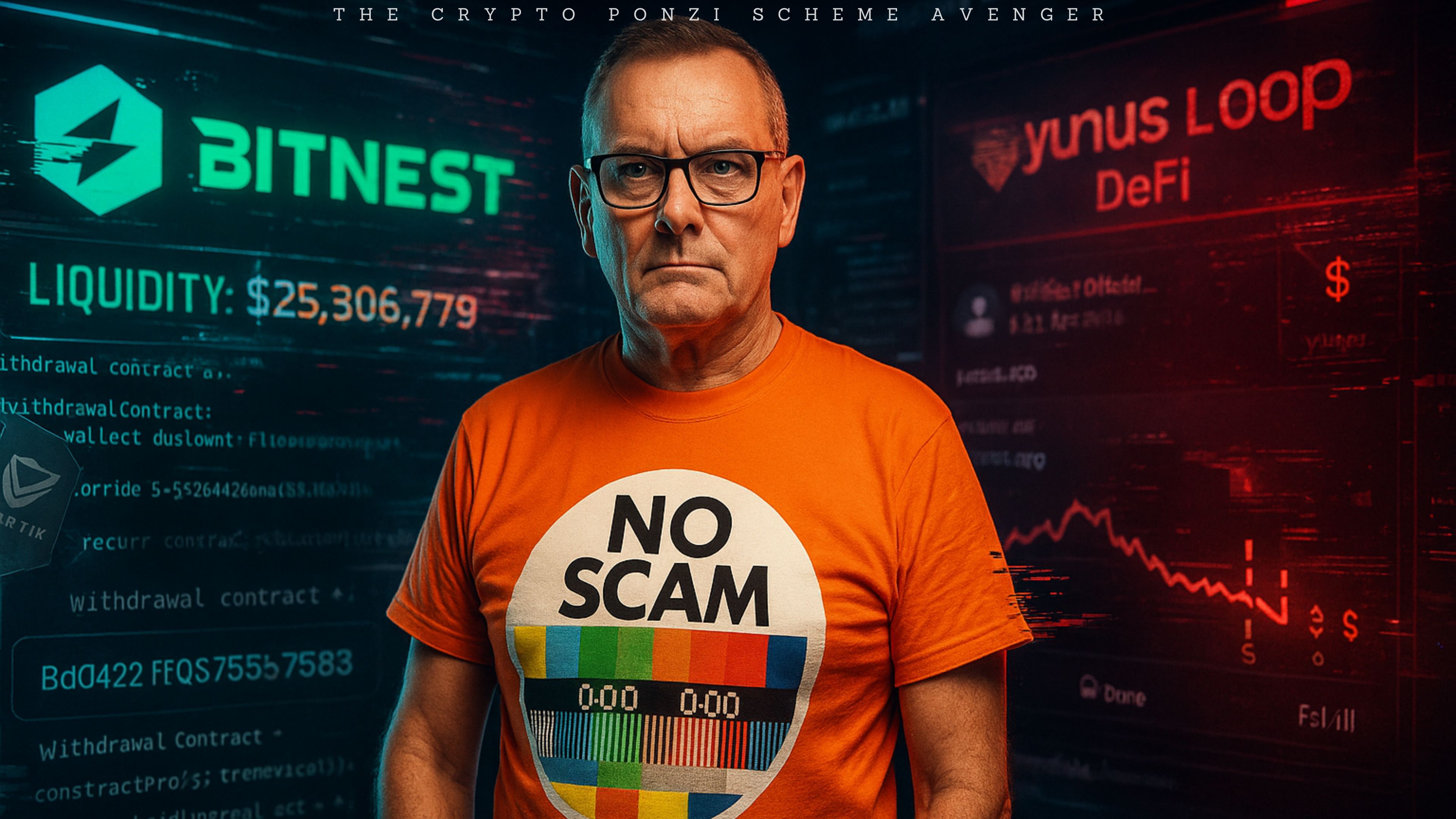
BitNest is not what it seems. Behind the slick marketing, flashy percentages, and promises of passive crypto income lies a repackaged fraud — and thanks to newly uncovered evidence, we now know exactly who is behind it.
This blog lays out the indisputable facts: BitNest is a near-identical clone of a previous Ponzi scam called Yunus Loop DeFi, run by the very same developers. We now have the receipts.
This is no longer speculation — it’s blockchain-verified truth.
The BitNest–Yunus Loop DeFi Connection
Yunus Loop DeFi was launched in 2022, ran through early 2024, and rugged its users twice — first in October 2023, then again in May 2024. The team behind it vanished… only to re-emerge as BitNest, using almost the exact same user interface, smart contract structures, Telegram channels, and language.
BitNest’s documentation is so close to Yunus Loop’s that many phrases were literally copy-pasted — and in some places, the scammers forgot to replace “Yunus” with “BitNest.”
In one message from the “BitNest Official Subscription Channel” (screenshot taken June 9, 2025), the admin wrote:
“…Yunus Loop has been an innovative platform for digital asset leasing…”
This wasn’t edited out in time — and the word “Yunus” betrays their copy-paste operation. The message was later edited to replace “Yunus” with “BitNest,” proving they rebranded the old Telegram group instead of creating a new one.
And why would they do this? Because they wanted a fake history — a way to point to a 2022 start date to make BitNest look older and more legitimate.
The Blockchain Says Otherwise
A new analytics dashboard from Dune (created by a former BitNest user) shows BitNest only began accepting deposits in May 2024. That’s not even a year ago.
Despite claims of a 3-year track record, the blockchain reveals that BitNest is less than 15 months old — and growing only because fresh money is covering older obligations.
Here are some numbers:
- BitNest liabilities to users: ~$37.6 million
- Dev-controlled funds remaining: ~$3.1 million
- Dev withdrawals (unannounced): ~$16.3 million
- Borrower income found: ZERO
- Conclusion: BitNest is paying old users with new user money.
This is textbook Ponzi.
Only One Smart Contract is Audited
 BitNest defenders often point to a CertiK Audit as proof of legitimacy.
What they don’t tell you is:
- Only the deposit contract (where you give them your money) was audited.
- The withdrawal contract (where they send it back) was NOT audited or renounced.
- That means BitNest devs can still stop, delay, or redirect your withdrawal at any time.
Even the audited code contained serious red flags:
- Centralized Admin Control
- Unlimited Token Approvals
- Ignored Return Values
- Third-Party Dependency Risks
“A smart contract doesn’t change a bad business model — it just automates the scam.”
A smart contract proves automation, not legitimacy.
Smart Contracts: What You’re Not Being Told
BitNest often boasts about their CertiK-audited smart contract. But here’s the catch:
There are two main contracts powering BitNest:
- Deposit Contract
0xFCc442275A2620E40F17598F9987F320fB57526e- Ownership renounced
- Audited by CertiK
- De.Fi Safety Score: 99%
- Withdrawal Contract (Proxy)
0xb25EcDaC023d7DD8bc24FA3Bf93afEfc9DFb24ae- NOT audited
- Ownership NOT renounced
- De.Fi Safety Score: 28%
That means BitNest devs still have full control over withdrawals, including Loops, SavingsBox, and referral payouts. So while deposits might be secure on paper, you’ll never see your money again if they choose to lock withdrawals — and they’ve done it before.
Additional wallets:
- Savings Box Deposit:
0x355b7cf7a9b1f32793c2b580c5e0a8a3585d95e2(unaudited) - Gas Wallet:
0x797A35f060Be968792922328F6D73aF37e6cF928
Misleading Liquidity Pool: At the top of the BitNest homepage, a bold “Liquidity: 25,306,779” is displayed. But that figure isn’t theirs — it links to a general PancakeSwap pool, not BitNest’s. The actual BitNest-controlled pool holds less than $3 million, barely enough to support even a week of withdrawals.
A Ponzi Scheme by Design
BitNest’s structure is built for deception:
- “Guaranteed” 0.4% Daily ROI (requires continuous inflow to sustain)
- 17-Level Referral Commission Plan (classic MLM trap)
- Token burning mechanics (to simulate scarcity)
- Claims of anonymous “borrowers” paying 350% APR (with zero proof)
Users asking tough questions in the Telegram group get banned. That’s not how legitimate DeFi operates — that’s how a scam silences its critics.
One user asked for “a contract address showing any borrower income” and was immediately banned. Another asked why millions were being withdrawn without announcement — also banned. This behavior is classic scam playbook.
They’ve Done It Before — And They’ll Do It Again
The BitNest devs rugged Yunus in Oct 2023, relaunched it in early 2024 with promises of refunds, then rugged users again in May 2024.
Weeks later, BitNest magically appeared.
Now, with over 34,000 wallets connected, BitNest is quickly heading toward the same fate.
The playbook is identical:
- Collect deposits
- Use new funds to pay out old users
- Market “decentralization” as a security feature
- Promote fake audit credibility
- Disappear when the liquidity dries up
Related Reading: Previous BitNest Exposés
This blog is the third in a growing series investigating BitNest’s operations and exposing its fraudulent structure. For more context and evidence, see:
- Munir Jannedy Exposed: The Dark Truth Behind BitNest, Mellion Coin, and Their Crypto Ponzi Empire
A deep dive into BitNest’s shady frontman, fake Zoom presentations, and the aggressive MLM-style recruitment tactics being used to lure investors. - BitNest’s Smart Contract Audit: Why a Clean Code Check Doesn’t Erase a Ponzi Business Model
An exposé on how BitNest’s CertiK audit fails to address the core fraud — showing how even well-coded smart contracts can automate a scam.
Together, these blogs uncover the full scope of BitNest’s operations — from deceptive marketing to technical manipulation to past scams.
Tip of the Hat to the Whistleblower
Special thanks to Andy, a former BitNest investor who saw through the deception and took action. His site — bitnest-truth.com – compiles the evidence linking BitNest’s devs to the collapsed Yunus Loop DeFi scam. Andy also built the Dune analytics dashboard, which tracks the on-chain data proving this is a classic Ponzi model in disguise. It’s grassroots investigators like Andy who help bring these crypto frauds into the light.
Final Warning
This is not financial advice — but it is a call to critical thinking.
The BitNest system has been proven to be controlled by serial scammers. They rebranded an old rug-pulled Ponzi, reused the same playbook, and continue to extract millions from unsuspecting investors.
Don’t be their next exit liquidity.
If it walks like a Ponzi, talks like a Ponzi, and hides its past like a Ponzi — it’s a Ponzi.
Stay alert. Stay skeptical. Stay scam-free.
This blog post is based on blockchain analysis, audit reports, Telegram forensics, and data from:
- bitnest-truth.com
- dune.com/bitsandbytes/bitnest
- web.archive.org/web/20230615000951/https://www.yunusloopdefi.com/
You’re welcome to share this post. Credit: Danny de Hek — The Crypto Ponzi Scheme Avenger.
Scam-fighting is a community sport. Stay alert, stay loud.
Recent Developments: BitNest Showing Clear Signs of Collapse
Since publishing this investigation, I have received new insider information from an active BitNest participant that strongly reinforces the conclusions already laid out in this blog. What is now unfolding inside BitNest follows a very familiar pattern seen in countless crypto Ponzi collapses.
According to multiple consistent reports, BitNest has largely stopped paying users, begun locking or disabling accounts, and muted its public Telegram channels to suppress growing panic. Those asking where their money is are being ignored or given scripted responses blaming vague USDT/USDC “system mismatches” or wallet compatibility issues. These explanations change regularly and are never backed by verifiable on-chain evidence.
At the same time, BitNest has quietly shifted communication into private, invite-only Telegram groups, limited to so-called “team leaders” — individuals with large downlines and commission exposure. While the broader community is told to “wait patiently,” these leaders are being reassured behind closed doors and encouraged to keep their networks calm, a classic containment tactic used during liquidity failure.
Rather than fixing withdrawals, BitNest is now aggressively pushing Mellion Coin (MEC), paid “nodes,” and new buy-in opportunities. Investors are being promised airdrops, expedited support, and future value — promises that, in multiple cases, are already not being honoured. This shift away from paying existing obligations toward selling new products is a major red flag and historically marks the late stage of Ponzi schemes.
Adding to these concerns, BitNest has changed its primary domain, another well-documented behaviour seen shortly before exits, rebrands, or shutdowns. When combined with payment delays, muted communities, selective communication, and token distractions, the picture becomes unmistakable.
It is also important to address the role of Munir Ali Kaid-Al Jannedy, a visible promoter of BitNest. During Zoom presentations that I personally attended and disrupted, Munir publicly stated that BitNest was not a scam and dismissed critics as uninformed. Those assurances were given despite structural flaws that made the current outcome inevitable. When promoters continue defending a system while withdrawals stall and communities are silenced, they are no longer offering opinions — they are misleading others.
None of what is happening now suggests a temporary technical issue. It reflects collapse management: slowing payouts, controlling information, introducing new products, protecting top recruiters, and asking ordinary investors to wait while fresh money is still being collected.
For anyone reading this because payments have stopped, accounts have been restricted, or answers no longer make sense — you are not alone, and you are not imagining things. This is exactly what the end of a crypto Ponzi looks like.
Disclaimer: How This Investigation Was Conducted
This investigation relies entirely on OSINT — Open Source Intelligence — meaning every claim made here is based on publicly available records, archived web pages, corporate filings, domain data, social media activity, and open blockchain transactions. No private data, hacking, or unlawful access methods were used. OSINT is a powerful and ethical tool for exposing scams without violating privacy laws or overstepping legal boundaries.
About the Author
I’m DANNY DE HEK, a New Zealand–based YouTuber, investigative journalist, and OSINT researcher. I name and shame individuals promoting or marketing fraudulent schemes through my YOUTUBE CHANNEL. Every video I produce exposes the people behind scams, Ponzi schemes, and MLM frauds — holding them accountable in public.
My PODCAST is an extension of that work. It’s distributed across 18 major platforms — including Apple Podcasts, Spotify, Amazon Music, YouTube, and iHeartRadio — so when scammers try to hide, my content follows them everywhere. If you prefer listening to my investigations instead of watching, you’ll find them on every major podcast service.
You can BOOK ME for private consultations or SPEAKING ENGAGEMENTS, where I share first-hand experience from years of exposing large-scale fraud and helping victims recover.
“Stop losing your future to financial parasites. Subscribe. Expose. Protect.”
My work exposing crypto fraud has been featured in:
- Bloomberg Documentary (2025): A 20-minute exposé on Ponzi schemes and crypto card fraud
- News.com.au (2025): Profiled as one of the leading scam-busters in Australasia
- OpIndia (2025): Cited for uncovering Pakistani software houses linked to drug trafficking, visa scams, and global financial fraud
- The Press / Stuff.co.nz (2023): Successfully defeated $3.85M gag lawsuit; court ruled it was a vexatious attempt to silence whistleblowing
- The Guardian Australia (2023): National warning on crypto MLMs affecting Aussie families
- ABC News Australia (2023): Investigation into Blockchain Global and its collapse
- The New York Times (2022): A full two-page feature on dismantling HyperVerse and its global network
- Radio New Zealand (2022): “The Kiwi YouTuber Taking Down Crypto Scammers From His Christchurch Home”
- Otago Daily Times (2022): A profile on my investigative work and the impact of crypto fraud in New Zealand






So why doesn’t the US Government shut them down?
That’s a great idea why don’t we submit a list of scams to the government and see them shut them down in minutes.