


“If you have to trust a CEO you can’t verify, a trading system you can’t audit, and returns that only grow when you recruit others… you’re not investing — you’re funding a system designed to collapse.”
Before we even get into the detail, you need to understand something very clearly. This is not just another questionable crypto opportunity.
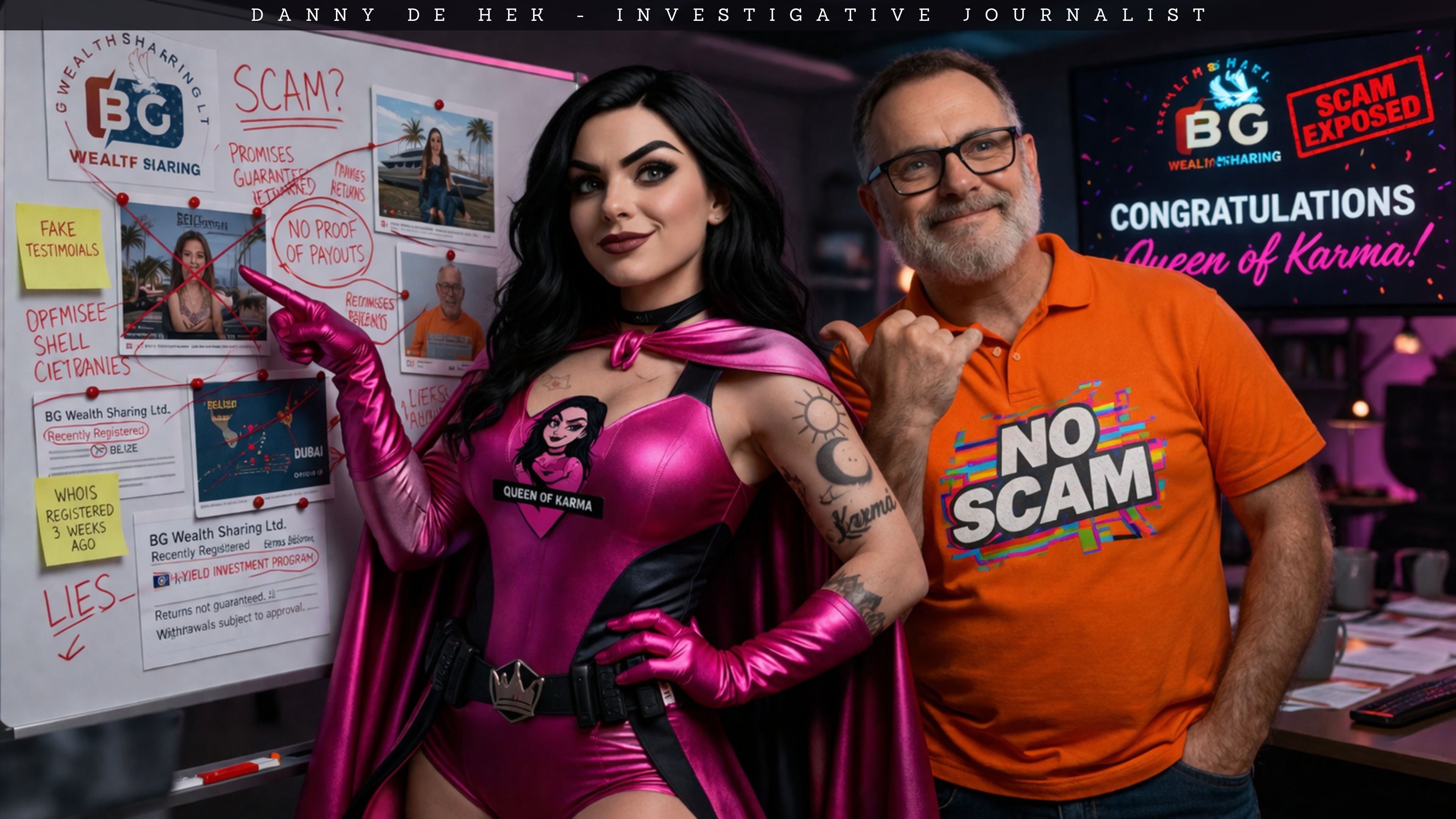
What you’re about to read is built off one of the most detailed investigations I’ve seen into BG Wealth Sharing — a deep dive by Queen of Karma that doesn’t just raise concerns, it systematically dismantles the entire story this company is built on.
And the reason this matters is because of how dangerous this particular operation actually is.
This isn’t some low-effort scam thrown together overnight. This is structured, polished, and psychologically engineered to feel legitimate. It has leadership. It has community. It has a narrative that pulls people in slowly — not with hype, but with confidence.
That’s what makes it effective.
People aren’t joining this thinking they’re taking a risk. They’re joining because they believe they’ve found something safe, stable, and proven.
But the deeper you go — the more you verify, the more you question, the more you step outside of the controlled environment they’ve created — the more that illusion starts to break.
Because behind the presentations, behind the testimonials, and behind the man they want you to trust…
There is a story that does not hold up to even the most basic level of scrutiny.
And once you see that, you realise something far more important:
This doesn’t just look like a scam.
It follows the exact pattern of one.
The Moment Everything Falls Apart
But here’s where the entire story begins to collapse.
Everything BG Wealth Sharing presents — the credibility, the authority, the confidence — rests on one simple assumption: that Stephen Beard is a real, verifiable person. The moment you step outside their controlled environment and try to confirm that for yourself, the illusion starts to break.
This is where Queen of Karma’s investigation becomes impossible to ignore. Because instead of uncovering a complex background or a hard-to-trace financial career, she uncovered something far more alarming — there is no trace of him at all. No academic record matching the qualifications he claims, no employment history that reflects the experience he presents, and no presence anywhere in the financial world outside of BG Wealth’s own ecosystem.
Even the university he supposedly attended confirmed they have no record of him ever studying there.
Let that sink in for a moment.
You are being asked to trust your money with someone who claims to hold advanced financial qualifications… yet cannot be verified at the most basic level.
At that point, the red flags stop being subtle. They become undeniable.
- No verified education
- No proven career history
- No independent identity outside the platform
And then there’s the part that should make anyone stop in their tracks — when questioned directly, instead of providing verifiable proof, the response is deflection, redirection, or pushing you toward someone else.
“Please contact my assistant… she will guide you.”
That’s not transparency.
That’s avoidance.
And this is the moment where the conversation changes completely. Because you are no longer evaluating a company with missing information — you are looking at a situation where the central figure appears to be entirely constructed for the purpose of gaining trust.
Once you understand that, everything else needs to be questioned.
The Trading That Makes No Sense — But Keeps People Hooked
Now let’s talk about the part that pulls people in — the piece that makes everything feel real.
The trading.
You’re told it’s simple. You don’t need experience, you don’t need to understand markets, and you certainly don’t need to think too hard about what’s actually happening behind the scenes. You just follow instructions. A signal appears, you copy it, paste it into the platform, wait a few minutes… and watch the profit come in.
It’s presented as a system that has been refined over years — powered by AI, driven by data, and capable of producing consistent results with near-perfect accuracy. In fact, they go as far as claiming a 99.6% success rate, which on the surface sounds impressive, but in reality should stop you dead in your tracks.
Because that number doesn’t just raise questions — it breaks the entire premise.
If a system like that actually existed, it wouldn’t be packaged up and handed out through chat groups or referral links. It wouldn’t rely on everyday people depositing a few hundred dollars and following copy-and-paste instructions. And it certainly wouldn’t need to be promoted through word-of-mouth and recruitment.
A system with that level of accuracy would be one of the most valuable financial tools in the world. It would sit behind institutional walls, generating enormous profits quietly and consistently — not being shared publicly with strangers on the internet.
And yet here, it’s being offered as something anyone can access.
That contradiction is where the logic starts to fall apart.
Because if the trading itself doesn’t make sense — if the claims don’t align with how real markets actually operate — then the obvious question becomes:
Why does it feel like it’s working?
Because The Money Isn’t Coming From Trading
This is the part most people either miss — or choose not to see.
If you step back and really listen to the success stories, not just the headlines but the details behind them, a pattern begins to emerge. People talk about their earnings growing, about their accounts increasing, about how things “started working” for them… but when you dig a little deeper, that growth rarely comes from better trades or some sudden improvement in strategy.
It comes after something else happens.
They bring people in.
They start building a team.
They begin earning bonuses, commissions, and rewards tied to other people depositing money into the system.
And that’s the moment where everything shifts.
Because what you’re looking at is no longer a trading platform in the traditional sense. It’s a structure where the flow of money is driven by new participants entering the system, not by any independently verifiable trading activity happening in the background.
The trading is what you’re shown.
The recruitment is what actually drives the income.
And once you see that, it becomes very difficult to unsee it.
The people promoting this aren’t necessarily doing it because they’ve carefully verified the business model or confirmed that the trading is legitimate. In many cases, they’re doing it because the system rewards them for bringing others in. The more people they introduce, the more they earn — and that creates a powerful incentive to focus on growth, not scrutiny.
At that point, the question isn’t whether the trading works.
It’s whether the system can keep going as long as new money continues to enter it.
The SEC Lie That Gives It False Credibility
One of the most effective tactics BG Wealth uses to build trust is the illusion of regulatory backing — particularly the suggestion that they are somehow connected to, recognised by, or operating under the oversight of the SEC.
You’ll see this repeated constantly in promotions. People point to filings, certificates, and registration numbers as if they are proof that the company has been vetted, approved, or endorsed. To the average person, that sounds official. It feels like due diligence has already been done.
But that’s not what’s actually happening.
The document they rely on is a Form D filing, and this is where the misunderstanding — or deliberate misrepresentation — comes in. A Form D is not approval, it’s not regulation, and it’s certainly not verification. It’s simply a notice that a company has claimed an exemption when offering securities. In other words, it’s paperwork that says, “we’re raising money under this exemption” — not proof that the business itself is legitimate, audited, or even operating as described.
That distinction is critical, because it means the very thing being used to reassure investors is being misunderstood or misused.
And while that narrative is being pushed to build confidence, something far more telling is happening in the background. Regulators in multiple countries — the very authorities that are supposed to protect investors — are not endorsing this operation.
They’re warning about it.
Which raises a far more important question than any certificate ever could:
Why would a legitimate company need to rely on misunderstood filings for credibility, while real regulators are actively raising concerns?
The Global Warnings People Ignore
By this point, it’s no longer a question of opinion — it’s a matter of record.
This isn’t one isolated warning from a single regulator. BG Wealth Sharing has been flagged across multiple jurisdictions, and when that starts happening, it’s usually because the same pattern is being recognised over and over again by different authorities looking at the same red flags.
In New Zealand, the Financial Markets Authority has already linked BG Wealth Sharing to a wider network of high-risk investment platforms. Across Canada, multiple provincial regulators have issued alerts, warning that the company is not registered to offer financial services. The Philippines Securities and Exchange Commission has also stepped in with a public advisory, cautioning people about the risks involved.
Different countries. Different regulators. Same conclusion.
This is not a licensed or properly regulated investment platform.
And that should be the moment where everything stops — where people pause, reassess, and ask themselves whether this is something they should be involved in at all.
But that’s not what happens.
Because here’s the uncomfortable reality.
As long as people are still seeing money come in — whether through withdrawals, bonuses, or commissions — those warnings are often dismissed as noise. They’re brushed off as misunderstandings, or even framed as attacks from outsiders who “don’t understand the system.”
And that’s how these operations continue to grow, even when the evidence is sitting right in front of everyone.
Because in the short term, belief is often stronger than logic.
And as long as the money appears to be flowing…
People convince themselves that it must be working.
Why People Still Promote It (Even When It Doesn’t Make Sense)
This is the part that needs to be said clearly — because it’s often misunderstood.
People are not promoting BG Wealth Sharing because they’ve carefully verified the business, analysed the trading, or confirmed that everything stacks up. In most cases, they’re promoting it because the system is designed to reward them for doing exactly that.
The incentives are built in from the start. When someone joins, there’s a commission. When they deposit more money, that commission increases. And when they bring other people in, the earnings grow again. It creates a structure where income is directly tied to how many people you introduce and how much money flows in beneath you.
And that changes behaviour.
Because even when doubts start to creep in — when something doesn’t quite add up, when questions go unanswered, or when warnings begin to surface — there is a very real financial reason to push those concerns aside. Acknowledging the problem doesn’t just mean admitting something might be wrong; it can also mean cutting off your own income.
So instead, the focus stays on growth.
The conversations shift toward opportunity.
The risks get downplayed.
The warnings get dismissed.
Not necessarily out of malice, but because the system encourages it.
And that’s what keeps something like this moving forward. Not transparency, not verified performance, but a continuous cycle of people being incentivised to bring in the next wave.
Because as long as that cycle continues…
the system stays alive.
The Pattern That Tells You Everything
If you’ve seen this before, there’s a reason it feels familiar.
Because it is.
What you’re looking at with BG Wealth Sharing isn’t new, innovative, or unique. It follows a structure that has already played out time and time again under different names, different brands, and slightly different stories — but always with the same underlying mechanics.
It starts by building trust. A strong narrative is introduced, leadership is established, and early participants begin to see results. That initial success creates belief, and that belief spreads quickly as more people join and share their experiences.
From there, it accelerates.
The community grows.
The momentum builds.
The opportunity starts to feel real.
And for a period of time, everything appears to be working exactly as promised.
But underneath that growth, the same dependency always exists — a reliance on new money continuously entering the system. As long as that flow continues, the structure holds. As soon as it slows, the pressure begins to show.
That’s when things change.
Withdrawals become delayed or restricted.
Conditions are introduced.
Explanations start to shift.
And eventually, the system reaches a point where it can no longer sustain itself.
At that stage, the outcome is almost always the same. The people at the top — the ones who benefited most from the growth — move on, often quietly, sometimes reappearing in the next opportunity. Meanwhile, the majority are left behind trying to understand what happened, often realising too late that the warning signs were there all along.
And that’s why recognising the pattern matters.
Because once you see it clearly, you realise this isn’t about one company.
It’s about a system that keeps repeating itself… until people stop falling for it.
The One Question That Matters
If you’ve made it this far, you’re probably not here for hype — you’re here because something doesn’t quite sit right, and you’re trying to figure out whether BG Wealth Sharing is legitimate or not.
So forget the marketing, forget the testimonials, and forget the promises for a moment, and ask yourself one simple question:
Why would you trust a company where the person in charge cannot be independently verified, where the trading performance cannot be proven, where the earnings increase through recruitment, and where regulators are already raising concerns?
That’s not a complicated question, but it’s an important one — because it cuts through everything else.
You don’t need to understand every technical detail. You don’t need to analyse every claim. You just need to look at the fundamentals and decide whether they make sense.
And when you do that honestly, without the influence of hype or pressure from others, the answer becomes very clear.
Because legitimate opportunities don’t rely on missing identities, unproven systems, and recruitment-driven income to function.
Once you see that…
you already know the truth.
Final Warning: This Only Works Until It Doesn’t — And Then It’s Too Late
If you’ve read everything above and you’re still unsure, then this is the part you need to pay the most attention to.
Because once you strip away the branding, the presentations, and the promises, what you’re left with is brutally simple.
BG Wealth Sharing only works as long as people keep believing in it. It grows because new money continues to enter the system, and it survives because the people inside it are financially incentivised to keep promoting it — whether they fully understand it or not.
That is not investing.
That is not trading.
That is a system where the appearance of success depends entirely on constant inflow and continued belief.
And history has already shown how these systems end.
Not gradually. Not fairly.
They stop.
Withdrawals get restricted. Excuses begin. Conditions change. And by the time people realise what’s happening, the money is already gone or locked beyond reach.
The people at the top move on.
The people at the bottom are left behind.
And the only thing that remains is the same question we see every time:
“How did we not see this sooner?”
Because the truth is, the warning signs are already here.
A CEO that cannot be verified.
A business model that depends on recruitment.
A trading system that cannot be proven.
And regulators around the world raising concerns.
You are not looking at a misunderstood opportunity.
You are looking at a system that is following a well-known pattern — one that always ends the same way.
The only difference is when it happens… and who is still inside when it does.
Disclaimer: How This Investigation Was Conducted
This investigation relies entirely on OSINT — Open Source Intelligence — meaning every claim made here is based on publicly available records, archived web pages, corporate filings, domain data, social media activity, and open blockchain transactions. No private data, hacking, or unlawful access methods were used. OSINT is a powerful and ethical tool for exposing scams without violating privacy laws or overstepping legal boundaries.
About the Author
I’m DANNY DE HEK, a New Zealand–based YouTuber, investigative journalist, and OSINT researcher. I name and shame individuals promoting or marketing fraudulent schemes through my YOUTUBE CHANNEL. Every video I produce exposes the people behind scams, Ponzi schemes, and MLM frauds — holding them accountable in public.
My PODCAST is an extension of that work. It’s distributed across 18 major platforms — including Apple Podcasts, Spotify, Amazon Music, YouTube, and iHeartRadio — so when scammers try to hide, my content follows them everywhere. If you prefer listening to my investigations instead of watching, you’ll find them on every major podcast service.
You can BOOK ME for private consultations or SPEAKING ENGAGEMENTS, where I share first-hand experience from years of exposing large-scale fraud and helping victims recover.
“Stop losing your future to financial parasites. Subscribe. Expose. Protect.”
My work exposing crypto fraud has been featured in:
- Bloomberg Documentary (2025): A 20-minute exposé on Ponzi schemes and crypto card fraud
- News.com.au (2025): Profiled as one of the leading scam-busters in Australasia
- OpIndia (2025): Cited for uncovering Pakistani software houses linked to drug trafficking, visa scams, and global financial fraud
- The Press / Stuff.co.nz (2023): Successfully defeated $3.85M gag lawsuit; court ruled it was a vexatious attempt to silence whistleblowing
- The Guardian Australia (2023): National warning on crypto MLMs affecting Aussie families
- ABC News Australia (2023): Investigation into Blockchain Global and its collapse
- The New York Times (2022): A full two-page feature on dismantling HyperVerse and its global network
- Radio New Zealand (2022): “The Kiwi YouTuber Taking Down Crypto Scammers From His Christchurch Home”
- Otago Daily Times (2022): A profile on my investigative work and the impact of crypto fraud in New Zealand

Leave A Comment