


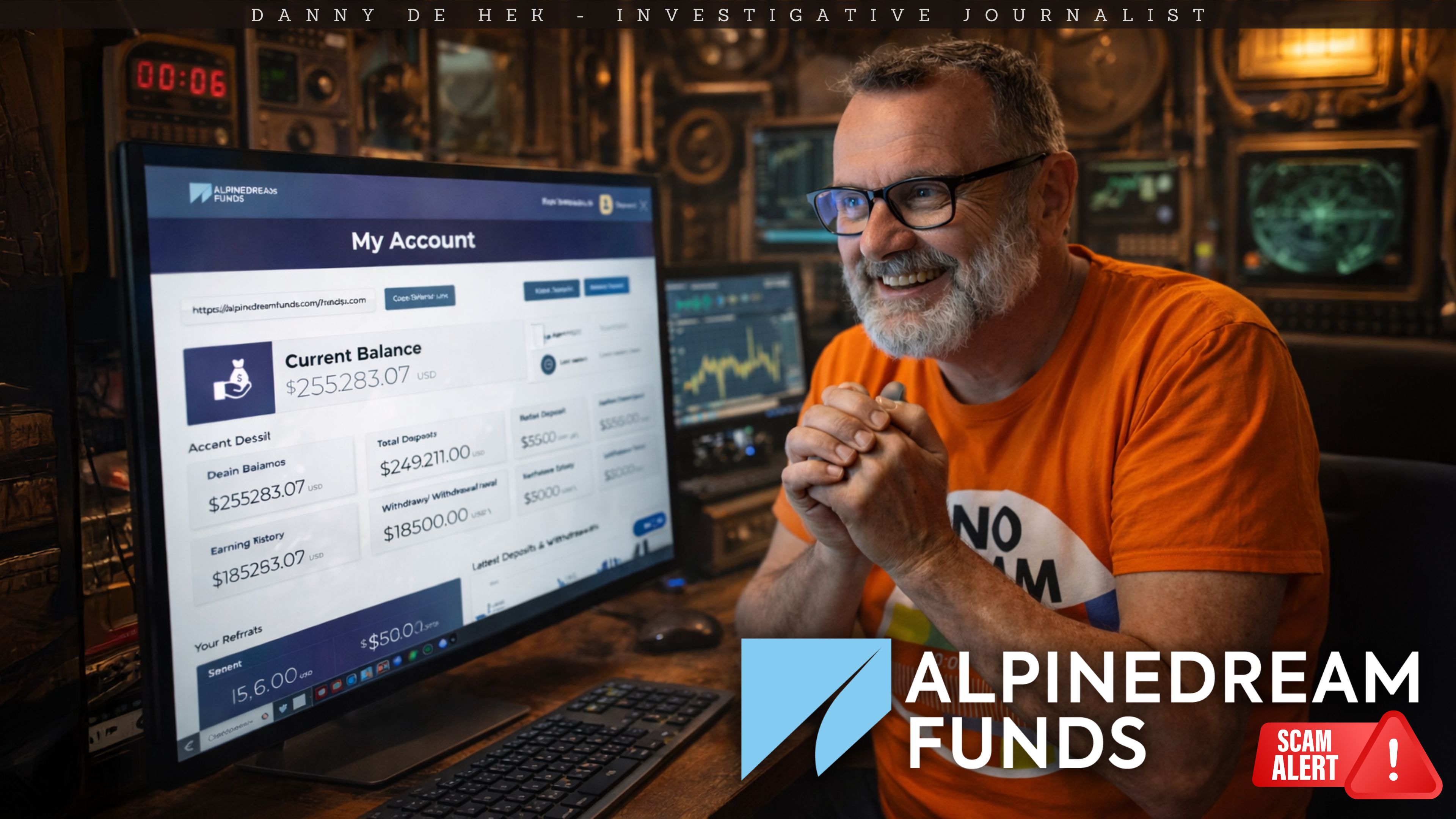
“The money wasn’t delayed — it was never real in the first place.”
When people think about investment scams, they often imagine reckless decisions or obvious warning signs. What they don’t see is how platforms like ALPINEDREAMFUNDS operate after someone is already inside. This follow-up investigation documents what happened to a U.S.-based woman who invested more than $23,000, refinanced her vehicle, maxed out credit cards, and borrowed money — all while believing she was on the verge of withdrawing funds that only existed on a screen. Her story matters because it mirrors exactly what thousands of others are experiencing right now.
This article is based on direct backend access, screenshots, live chat conversations, WhatsApp correspondence with promoters, and transaction records. It is written so that anyone currently staring at a “pending withdrawal” message can recognise the pattern before losing more.
The Illusion Begins: A Dashboard That Looks Like Success
The AlpineDreamFunds dashboard is not an investment account. It is a behavioural control interface designed to replace reality with reassurance. In this case, the account displayed a six-figure balance, repeated “bonus” credits, and a large pending withdrawal that suggested progress rather than failure. The key persuasive trick is that the platform never says “you cannot withdraw” — it says “you are almost there.”
Key signals visible in the backend include:
- Balances that increase without explanation
- Bonuses added internally with no transaction proof
- Withdrawals permanently stuck in “pending”
- No evidence of real trading, custody, or blockchain linkage
Live chat reinforces this illusion by framing delays as technical, procedural, or administrative. Once a victim starts trusting the dashboard, bank statements and logic lose authority.
The $50 Lie: How Trust Was Manufactured
The most effective manipulation came in the form of a $50 “verification” withdrawal sent to the victim’s Uphold account. This was deliberately framed as proof that withdrawals worked and that larger payouts were imminent. In reality, it was conditioning.
This single transaction achieved several things at once:
- It neutralised doubt
- It validated the platform
- It reframed every future delay as temporary
Live chat repeatedly referenced this test payment as evidence that “everything is working normally.” This is a well-documented scam tactic: allow a tiny withdrawal early, then block all meaningful ones forever.
She never received another cent.
The Fees That Never End: Pay More, Get Less
Once withdrawals were requested in earnest, the system shifted into extraction mode. Every attempt triggered a new requirement, always framed as standard procedure and always urgent.
Over time, the victim was charged:
- Withdrawal fees
- VIP or eligibility fees
- Anniversary fees
- Processing and “stamp” fees
- Account closure fees
Each payment was presented as the final step. Each one was followed by another obstacle. Live chat and promoters reinforced the message that compliance equals progress, even as the financial damage escalated.
By this stage, the victim was no longer chasing profit. She was trying to escape loss — the exact psychological state these platforms are designed to exploit.
The Rules Change: When Withdrawals Become Recruitment
The moment withdrawals were tied to recruitment, the scam’s structure became undeniable. After months of payments, support informed her that funds could only be released if she recruited new participants.
First, it was five people.
Then, after protest, two people — each required to deposit at least $1,000.
This condition:
- Did not exist at signup
- Was not disclosed in advance
- Appeared only once funds were trapped
This is the point where an “investment platform” becomes a containment system. When payouts depend on bringing in new money, liquidity has already failed.
Promoters in the Middle: Helen Franklin and Tia
Throughout the process, two individuals — referred to as Helen Franklin and Tia — maintained constant contact via WhatsApp only. No calls. No emails. No verifiable identities. Their messages were consistently reassuring, positive, and dismissive of concern. Delays were reframed as growth. Doubt was reframed as negativity.
Key behaviours included:
- Exclusive off-platform communication
- Emotional reassurance instead of evidence
- Discouraging outside advice
- Changing phone numbers over time
Whether knowingly complicit or not, their role was critical. They humanised the scam, making it easier to trust people rather than question the platform. This is how these schemes spread — through personal relationships, not advertisements.
The Human Cost: What the Dashboard Never Shows
Behind the polished interface was a person under severe psychological strain. The victim experienced weight loss, persistent anxiety, and an increase in antidepressant medication. She lived with constant stress, believing that each new payment would finally unlock the funds needed to repay debts and stabilise her life.
The dashboard never reflected this cost. It showed:
- Progress instead of pressure
- Numbers instead of consequences
- Hope instead of harm
This is why these platforms are dangerous. They isolate victims emotionally while maintaining constant digital contact, making the scam itself the primary source of reassurance.
What AlpineDreamFunds Really Is
AlpineDreamFunds presents itself as a Swiss-based financial operation, complete with an address and corporate language designed to imply legitimacy. There is no evidence of regulation, licensing, or real-world financial operations consistent with such claims.
It is important to be precise. There is no confirmed public evidence identifying the physical location of AlpineDreamFunds’ operators. What can be said is that its structure — scripted live chat, fake dashboards, rotating identities, fee escalation, and recruitment pressure — closely matches organised crypto scam operations documented globally, many of which are run offshore using compartmentalised teams rather than a traditional company.
Victims are led to believe there is a large organisation behind the platform. In reality, there doesn’t need to be one.
Final Word: If This Feels Familiar, Stop Now
If you recognise any of the following:
- Money stuck in “pending withdrawal”
- Requests for one more fee
- Pressure to recruit others
- Reassurance without evidence
- Support limited to live chat or WhatsApp
Then understand this clearly: the system is working exactly as intended.
Stop paying. Stop trusting the dashboard. Stop believing promises that are always one step away. This investigation exists so people who are inside these platforms right now can see the mechanism clearly — and get out before the damage becomes irreversible.
Disclaimer: How This Investigation Was Conducted
This investigation relies entirely on OSINT — Open Source Intelligence — meaning every claim made here is based on publicly available records, archived web pages, corporate filings, domain data, social media activity, and open blockchain transactions. No private data, hacking, or unlawful access methods were used. OSINT is a powerful and ethical tool for exposing scams without violating privacy laws or overstepping legal boundaries.
About the Author
I’m DANNY DE HEK, a New Zealand–based YouTuber, investigative journalist, and OSINT researcher. I name and shame individuals promoting or marketing fraudulent schemes through my YOUTUBE CHANNEL. Every video I produce exposes the people behind scams, Ponzi schemes, and MLM frauds — holding them accountable in public.
My PODCAST is an extension of that work. It’s distributed across 18 major platforms — including Apple Podcasts, Spotify, Amazon Music, YouTube, and iHeartRadio — so when scammers try to hide, my content follows them everywhere. If you prefer listening to my investigations instead of watching, you’ll find them on every major podcast service.
You can BOOK ME for private consultations or SPEAKING ENGAGEMENTS, where I share first-hand experience from years of exposing large-scale fraud and helping victims recover.
“Stop losing your future to financial parasites. Subscribe. Expose. Protect.”
My work exposing crypto fraud has been featured in:
- Bloomberg Documentary (2025): A 20-minute exposé on Ponzi schemes and crypto card fraud
- News.com.au (2025): Profiled as one of the leading scam-busters in Australasia
- OpIndia (2025): Cited for uncovering Pakistani software houses linked to drug trafficking, visa scams, and global financial fraud
- The Press / Stuff.co.nz (2023): Successfully defeated $3.85M gag lawsuit; court ruled it was a vexatious attempt to silence whistleblowing
- The Guardian Australia (2023): National warning on crypto MLMs affecting Aussie families
- ABC News Australia (2023): Investigation into Blockchain Global and its collapse
- The New York Times (2022): A full two-page feature on dismantling HyperVerse and its global network
- Radio New Zealand (2022): “The Kiwi YouTuber Taking Down Crypto Scammers From His Christchurch Home”
- Otago Daily Times (2022): A profile on my investigative work and the impact of crypto fraud in New Zealand





Leave A Comment