


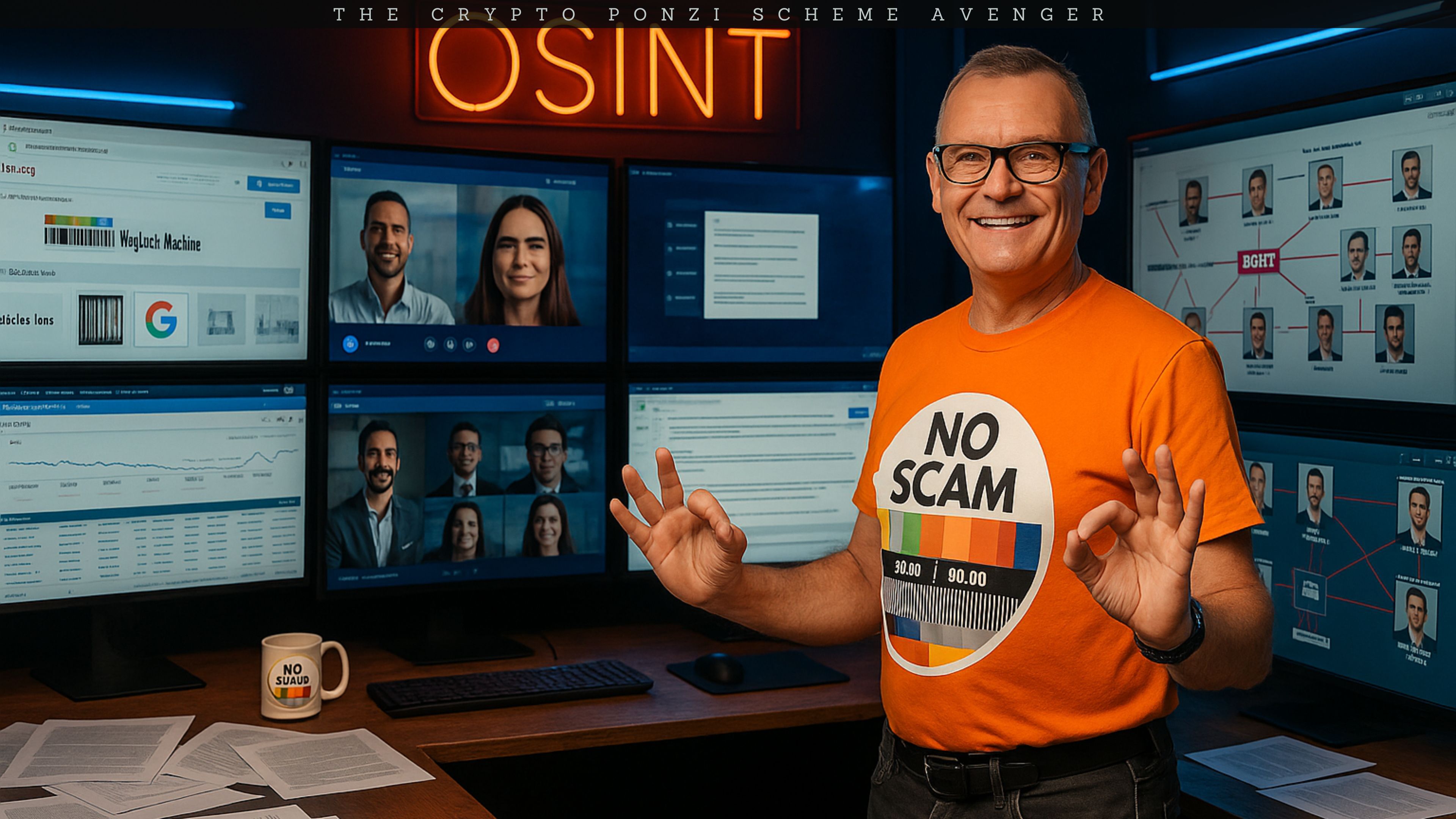
If you’ve ever Googled a scammer, dug through LinkedIn, or followed a paper trail through public records — congratulations, you’ve used OSINT.
Open Source Intelligence (OSINT) is the backbone of modern investigative work, and it’s one of the most powerful tools we have to expose scams, corruption, and digital deception.
But what exactly is OSINT? And why should everyday people — not just intelligence agencies — understand how it works?
Let’s break it down.
What Does OSINT Actually Mean?
OSINT stands for Open Source Intelligence.
It refers to the collection and analysis of publicly available data — information that’s free to access and legally obtained. This includes:
- Social media profiles
- Blogs, forums, and websites
- Government and corporate databases
- News articles and public records
- WHOIS data and DNS records
- Leaked documents (if legally accessible)
- Images, videos, metadata — even satellite imagery
In other words, OSINT is not hacking. It’s not breaking into private systems. It’s simply the art of finding clues in the digital noise we all leave behind.
Why OSINT Matters in Scam Exposure
Scammers rely on secrecy, confusion, and fake personas. OSINT tears all of that apart.
When you use OSINT techniques to investigate a suspected Ponzi scheme or a shady online figure, you start to piece together the truth. You can:
- Unmask fake identities by cross-referencing profile pictures, usernames, and aliases
- Follow the money using blockchain explorers and payment gateway trails
- Expose networks of promoters by connecting LinkedIn data, domain registrations, and Zoom events
- Verify or debunk claims using archive tools, timestamp data, and online history
This is exactly what I do as The Crypto Ponzi Scheme Avenger. I’m not waiting around for regulators to catch up — I’m using OSINT to educate and expose, one scam at a time.
Common OSINT Tools and Tactics
You don’t need to be a cybersecurity expert to start using OSINT. Some of the best tools are free and accessible to anyone:
- Google Dorking: Using advanced search operators to uncover hidden pages and files
- WHOIS Lookup: See who owns a domain, when it was registered, and where
- Wayback Machine: Browse archived versions of websites to expose deleted content
- Social Search Engines: Tools like Rocketreach or Social Searcher to find aliases across platforms
- Image Reverse Search: Use Google Lens or Yandex to trace where else an image appears
- Blockchain Explorers: Track crypto wallet transactions on Bitcoin, Ethereum, and more
- DNS Analysis Tools: Tools like urlscan.io and whatsmydns.net help scan, monitor, and verify domain activity and DNS propagation.
The real power comes from knowing how to connect the dots. Scams don’t operate in a vacuum — they leave footprints. OSINT helps you follow them.
How I Use OSINT to Expose Real Scams
Here’s how I personally gather intel — often in real time — to expose MLM scams, Ponzi schemes, and fake crypto platforms.
Archive.org (Wayback Machine):
This is one of my favourites. I use it to verify the true age of a scam’s website. One scam, HEALTHCODE, claimed it had been in business for 35 years, but the domain was only a few months old. Archive snapshots prove when a website actually went live and how its content evolved — often showing rebrands or scrubs of outrageous income claims.
Domain tools and WHOIS data:
Scammers love to say “we’ve been around forever,” but their domain registrations tell a different story. A fresh registration date is a dead giveaway.
Social media (even without a personal account):
Even though I lost access to Facebook, I still use Google to uncover embedded posts, event promos, and trails of recruitment activity. Often, scammers post in groups, tag others, or use the same pitch language that can be traced across platforms.
Zoom Meetings:
These are goldmines. I regularly join public Zoom calls being used to pitch scams — and sometimes disrupt them. One of my tricks is to search for Zoom Meeting IDs across Facebook, Eventbrite, and Telegram. That’s how I find the actual promoters and track their past events.
Google Lens and Image Search:
Fake CEOs are everywhere — especially since AI headshots have become common. If someone claims to be a CEO but no image of them exists anywhere else online, that’s a red flag. I once investigated Gerhardt Guido, who claimed to be the CEO of Aqua Marine Club. After running his images through Google Lens, I found out he was a B-grade German actor living in Nigeria under a fake name and a wig. His “LinkedIn” was hijacked from a real account that hadn’t posted in over six months — and was eventually taken down.
LinkedIn Cross-Verification:
Real people leave a trail — endorsements, interactions, activity. Fake LinkedIn accounts are often shell profiles with no history. I cross-check connections, employment dates, and endorsements to verify if someone’s background is legit or completely fabricated.
Each scammer leaves breadcrumbs — my job is following them, connecting the dots, and publishing the truth so others don’t fall victim.
OSINT and Me – Why I See Patterns Others Miss
I’m Dyslexic.
I don’t read the world the way most people do. I see patterns, not words. I visualise connections in my mind — names, dates, faces, domains, conversations — and I don’t need to write them down to map them out. For me, OSINT isn’t just a tool… it’s a language I was born to speak.
I’ve turned what others might see as a learning difficulty into a serious investigative advantage. I think differently, and that means I use tools like Archive.org, Google Lens, LinkedIn, Zoom, and now ChatGPT in ways many wouldn’t think to. I see through the clutter. I connect the dots. I don’t stop until I’ve built the full picture.
Building databases is my superpower.
You can throw a name at me and I’ll show you their network — who they’re tied to, what scams they’ve touched, and how the pattern repeats. Every time a new scam pops up, I can almost immediately trace where it came from and who’s running it. Because I’ve seen the pattern before.
Years ago, I ran a business networking company in Christchurch, New Zealand. Over four years, I tracked 1,500 local businesses through face-to-face meetings. That taught me the value of human connection — and it gave me the instinct to log everything, even back then.
In 2024, I was invited to the Global Financial Crime Summit hosted by Ken Gamble. That event was a turning point. I met 150 delegates from around the world — from law enforcement, private investigation firms, and global watchdog groups. It cemented my role in this space. I’m not just some guy on YouTube — I’m part of an international anti-scam network. My OSINT work has supported investigations by the IRS, Homeland Security, and the Department of Justice.
Right now, my database is accessed by six different government agencies across six countries.
And I do it all from my home office.
This is what open source intelligence can do — especially when used by someone who sees the world differently.
Final Thoughts: Knowledge Is Power
OSINT levels the playing field.
You don’t need millions of dollars or badges to fight back — you need curiosity, ethics, and the willingness to learn.
If you’ve ever found yourself wondering, “Is this legit?”, don’t just trust your gut. Learn how to investigate. Learn how to document. Learn how to expose.
Because the truth is out there — and it’s open source.
About the Author
I’m DANNY DE HEK, a New Zealand–based YouTuber, investigative journalist, and OSINT researcher. I name and shame individuals promoting or marketing fraudulent schemes through my YOUTUBE CHANNEL. Every video I produce exposes the people behind scams, Ponzi schemes, and MLM frauds — holding them accountable in public.
My PODCAST is an extension of that work. It’s distributed across 18 major platforms — including Apple Podcasts, Spotify, Amazon Music, YouTube, and iHeartRadio — so when scammers try to hide, my content follows them everywhere. If you prefer listening to my investigations instead of watching, you’ll find them on every major podcast service.
You can BOOK ME for private consultations or SPEAKING ENGAGEMENTS, where I share first-hand experience from years of exposing large-scale fraud and helping victims recover.
“Stop losing your future to financial parasites. Subscribe. Expose. Protect.”
My work exposing crypto fraud has been featured in:
- Bloomberg Documentary (2025): A 20-minute exposé on Ponzi schemes and crypto card fraud
- News.com.au (2025): Profiled as one of the leading scam-busters in Australasia
- OpIndia (2025): Cited for uncovering Pakistani software houses linked to drug trafficking, visa scams, and global financial fraud
- The Press / Stuff.co.nz (2023): Successfully defeated $3.85M gag lawsuit; court ruled it was a vexatious attempt to silence whistleblowing
- The Guardian Australia (2023): National warning on crypto MLMs affecting Aussie families
- ABC News Australia (2023): Investigation into Blockchain Global and its collapse
- The New York Times (2022): A full two-page feature on dismantling HyperVerse and its global network
- Radio New Zealand (2022): “The Kiwi YouTuber Taking Down Crypto Scammers From His Christchurch Home”
- Otago Daily Times (2022): A profile on my investigative work and the impact of crypto fraud in New Zealand


Leave A Comment