


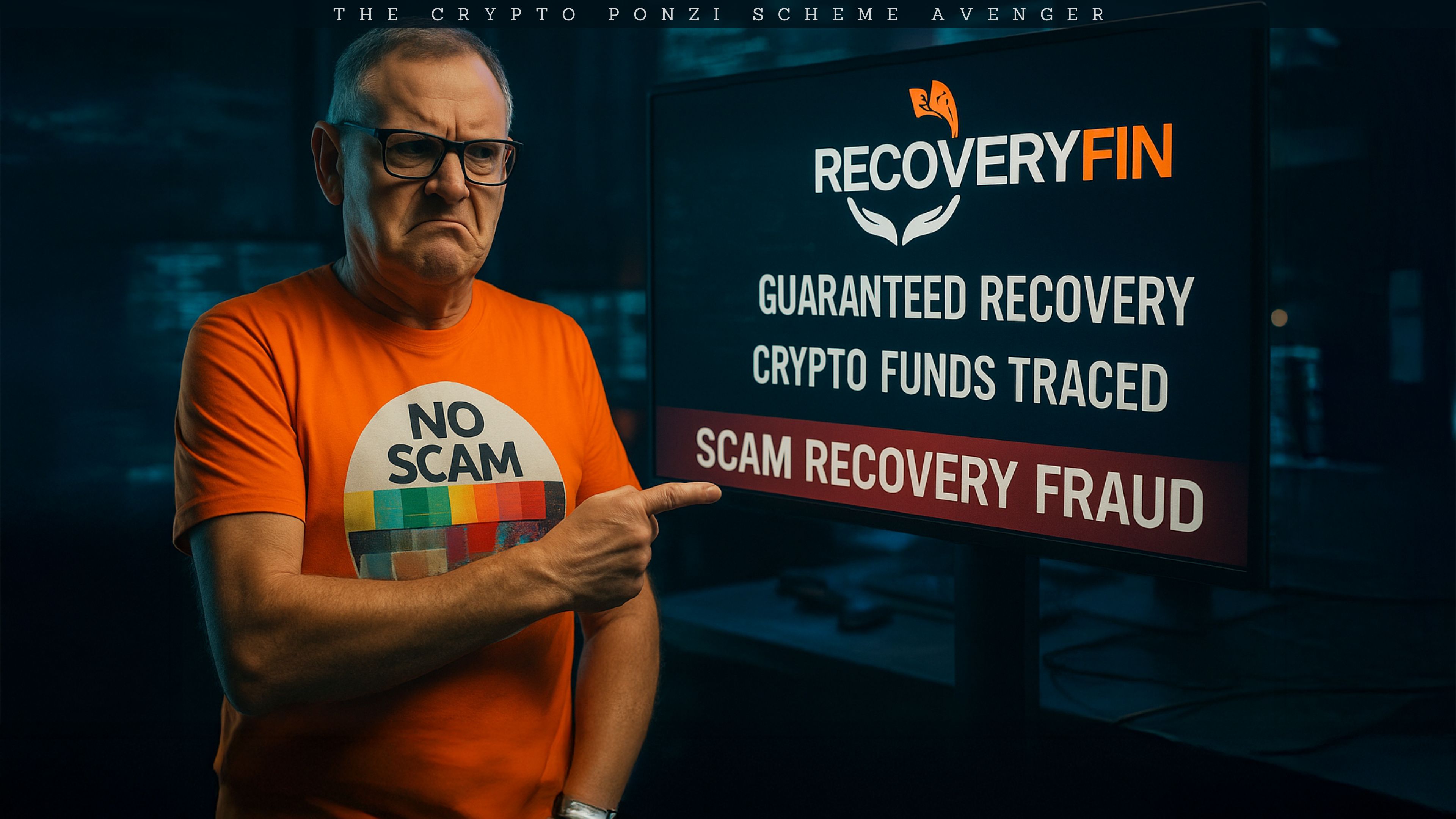
If you’ve lost money to a crypto scam, this blog is for you. Not to give you false hope — but to give you the truth. Because once your crypto is gone, the hard reality is this: you’re probably never getting it back.
And that’s exactly what scammers like RecoveryFin.com are counting on — that you’ll be desperate enough to believe anyone who says they can recover it for you. They’re not just scammers. They’re the scammers who scam scam victims.
RecoveryFin is just one of hundreds of fake recovery websites designed to exploit your vulnerability. They use slick websites, fake testimonials, AI-generated support reps, and emotional bait to convince you to hand over even more money. In this exposé, we break down exactly how RecoveryFin operates, the fake services they claim to offer, and why it’s time to stop chasing lost funds and start protecting what’s left.
Because here’s the truth most victims never hear: if someone tells you they can recover your crypto for a fee, they’re lying.
A Real Example: Tracy’s Question That Sparked This Investigation
We didn’t write this blog out of theory — we wrote it because of a real message from a real person. Tracy Sellers was almost tricked into transferring $138,000 to a Ponzi scheme called SmartLab. Thankfully, her bank blocked the transaction. We interviewed her, Exposed the Scam on Video, and wrote an in-depth blog about it.
Despite all of that, Tracy later sent this message:
“Dear Danny, I found this website that helps people recover their lost funds due to scams. I got scammed out of a lot of money with the forex trading in the past. I do not want to get scammed again. I am wondering what this Recoveryfin is all about. Is it a scam recovery business trying to scam people who have already been scammed?”
Thank you kindly,
Tracy Sellers
This blog is the answer to Tracy’s question — and the same one we want every potential victim to read before they send another cent.
How the RecoveryFin Scam Process Works — In Detail
 RecoveryFin’s approach is carefully staged to appear professional and urgent, but every step is designed to exploit desperation and extract money from victims. Here’s the breakdown:
- Initial Contact – They reach out via email, WhatsApp, or Telegram, often following an inquiry made by a victim. A so-called “Financial Recovery Expert” like “David Wilkins” introduces themselves and claims they have already investigated your case.
- Fake Forensic Report – They send a long, detailed message full of technical jargon, naming specific websites, companies, and fabricated scam networks allegedly tied to your case. This report is designed to overwhelm you with detail and create the illusion of expertise.
- Emotional Hook – The narrative confirms you’ve been the victim of an elaborate, coordinated fraud, repeating back parts of your story to build trust. They describe the scam’s recruitment tactics, impersonated individuals, and withdrawal traps in a way that feels personal.
- Urgency & Limited Window – They claim there’s a short timeframe to act before your funds are “laundered” or “digital trails are lost.” This urgency is meant to pressure you into paying quickly without due diligence.
- The Service Agreement – You’re sent a legal-looking contract on RecoveryFin letterhead. It lists a “refundable” security deposit — in this example, $2,298 — and a 15% success fee payable after supposed recovery. Refund terms are vague and full of loopholes.
- Upfront Payment Demand – Before any action, they insist the deposit must be paid via irreversible methods: wire transfer, Western Union, MoneyGram, cryptocurrency, or other non-recoverable channels.
- Conditional Refund Loopholes – The agreement lists scenarios where the refund won’t apply, such as “external interference” or “undisclosed facts” — terms they can interpret however they wish to deny repayment.
- Ongoing Communication – Once paid, they provide regular updates to maintain the illusion of progress: tracing cycles, forensic monitoring, server scans. In reality, no recovery work is being done.
- Second Payment Requests – Later, they may invent new fees — taxes, compliance charges, unlocking costs — each framed as the “final step” before your funds are released.
- Disappearance – Eventually, they stop responding. You’re left without your original lost funds and out of pocket for the “deposit” and any subsequent payments.
Every stage is designed to mimic legitimate investigative work while steering you toward one goal: sending them money you will never see again.
Important Warning for Victims of Crypto Scams
Anyone asking you for upfront money to recover lost crypto is almost certainly trying to scam you again.
There are a few legitimate firms that can trace blockchain activity — but their job is to track, not to retrieve. They work with law enforcement during real criminal investigations, and they never guarantee recovery. Even if stolen funds are located, getting them back requires court orders, legal enforcement, and cooperation from exchanges — and even then, it’s extremely rare.
Getting stolen crypto back is like finding a needle in a haystack that’s constantly moving.
And let’s address the biggest lie of all:
“We have software that can hack into wallets and retrieve your funds.”
That’s nonsense. If it were possible to hack into blockchain wallets and reverse transactions, then no one’s crypto would be safe. The entire point of blockchain is that it’s immutable and resistant to tampering. If scammers could actually “unlock wallets,” then criminals wouldn’t be scamming victims — they’d just drain random wallets for billions.
The very fact that these recovery scammers claim they can do what even the FBI can’t should tell you everything you need to know.
Stop chasing hope. Start protecting your future. And please — don’t give these crooks another cent.
What To Do If You’ve Been Scammed
- Do not pay any recovery company upfront. Legitimate investigators never ask for money to get your money back.
- Report the scam to your country’s financial regulator or cybercrime unit. (In NZ: FMA and CERT NZ. In the US: FTC or IC3.gov)
- Warn others by leaving public reviews on platforms like Trustpilot or Reddit.
- Talk to a cybercrime support group like IDCARE (AU/NZ) or Netsafe.
- Stop all communication with the recovery scammer. Block them immediately.
Your chances of recovery are slim, but your chances of being re-scammed are guaranteed if you continue down this path.
Spot the Red Flags: Crypto Recovery Scam Checklist
- Anyone who asks for upfront fees
- Promises of “guaranteed” recovery
- Claims they can hack wallets or bypass blockchain
- Contact via WhatsApp or Telegram only
- No legal entity, no registration, no team transparency
- Testimonials with AI-generated faces or generic names
If it sounds too good to be true — it is.
Wire Fraud Recovery
What They Claim: RecoveryFin says it has a global team of “wire fraud recovery experts” who will trace lost money, liaise with banks and law enforcement, and recover your funds quickly and securely.
The Reality: There’s no company registration, no named staff, and no proof they work with any banks or regulators. The language is vague, the process is fake, and the contact form simply asks for your WhatsApp and Telegram handles so they can take the conversation off-grid and untraceable. There’s zero evidence they’ve recovered a single cent.
Red Flags:
- No company info, address, or licensing
- SEO-stuffed language repeated endlessly
- No timeline, no success data, just fake promises
Investment Fraud Recovery
What They Claim: They say they can help you recover money from Ponzi schemes, crypto scams, and bad investments, working with regulators and financial institutions to deliver “financial justice.”
The Reality: There’s no evidence this company has ever recovered money from an investment scam. The domain is barely a year old — yet they claim “15+ years of expertise.” They offer no real success stories, no partnerships, and their fake testimonials come from AI-generated faces with robotic voices.
Red Flags:
- Repeated use of “legitimate recovery” to mask the scam
- No credentials or regulatory affiliation
- Same fake testimonials used across all service pages
Romance Scam Recovery
What They Claim: That they help victims of romance scams by identifying the scammer, tracing the money, and recovering funds, all while providing emotional support.
The Reality: They’re targeting one of the most vulnerable demographics with a rehashed template of emotional buzzwords and vague promises. There are no investigators, no psychologists, and certainly no recoveries. It’s a second-wave scam designed to exploit people already emotionally manipulated.
Red Flags:
- Heavy use of emotional bait: “You deserve justice,” “Don’t be ashamed”
- Zero transparency on who actually provides this service
- Requests personal data with no privacy policy in sight
Crypto Recovery
What They Claim: They offer recovery services for stolen or lost crypto — especially Bitcoin and USDT — using “advanced blockchain tools” and a “global recovery network.”
The Reality: They name no tools, no staff, no partners, and no legal authority. There’s no Chainalysis, no TRM Labs, no law enforcement partnerships — just SEO-loaded spam. Real crypto recovery firms can’t make promises, and they certainly don’t contact you via WhatsApp.
Red Flags:
- No technical explanation of how funds are traced
- No legal disclosures
- Scam-style pressure language like “Act Fast to Recover”
Final Word: RecoveryFin Is the Scam After the Scam
If you’ve already lost money to wire fraud, crypto schemes, or a romance scam, the last thing you need is to fall for another trap. RecoveryFin is not a legitimate business — it’s a digital ambulance chaser built to prey on trauma and desperation. They offer nothing real, nothing regulated, and nothing recoverable.
Avoid at all costs. And warn others.
Disclaimer: How This Investigation Was Conducted
This investigation relies entirely on OSINT — Open Source Intelligence — meaning every claim made here is based on publicly available records, archived web pages, corporate filings, domain data, social media activity, and open blockchain transactions. No private data, hacking, or unlawful access methods were used. OSINT is a powerful and ethical tool for exposing scams without violating privacy laws or overstepping legal boundaries.
About the Author
I’m DANNY DE HEK, a New Zealand–based YouTuber, investigative journalist, and OSINT researcher. I name and shame individuals promoting or marketing fraudulent schemes through my YOUTUBE CHANNEL. Every video I produce exposes the people behind scams, Ponzi schemes, and MLM frauds — holding them accountable in public.
My PODCAST is an extension of that work. It’s distributed across 18 major platforms — including Apple Podcasts, Spotify, Amazon Music, YouTube, and iHeartRadio — so when scammers try to hide, my content follows them everywhere. If you prefer listening to my investigations instead of watching, you’ll find them on every major podcast service.
You can BOOK ME for private consultations or SPEAKING ENGAGEMENTS, where I share first-hand experience from years of exposing large-scale fraud and helping victims recover.
“Stop losing your future to financial parasites. Subscribe. Expose. Protect.”
My work exposing crypto fraud has been featured in:
- Bloomberg Documentary (2025): A 20-minute exposé on Ponzi schemes and crypto card fraud
- News.com.au (2025): Profiled as one of the leading scam-busters in Australasia
- OpIndia (2025): Cited for uncovering Pakistani software houses linked to drug trafficking, visa scams, and global financial fraud
- The Press / Stuff.co.nz (2023): Successfully defeated $3.85M gag lawsuit; court ruled it was a vexatious attempt to silence whistleblowing
- The Guardian Australia (2023): National warning on crypto MLMs affecting Aussie families
- ABC News Australia (2023): Investigation into Blockchain Global and its collapse
- The New York Times (2022): A full two-page feature on dismantling HyperVerse and its global network
- Radio New Zealand (2022): “The Kiwi YouTuber Taking Down Crypto Scammers From His Christchurch Home”
- Otago Daily Times (2022): A profile on my investigative work and the impact of crypto fraud in New Zealand





Leave A Comment