


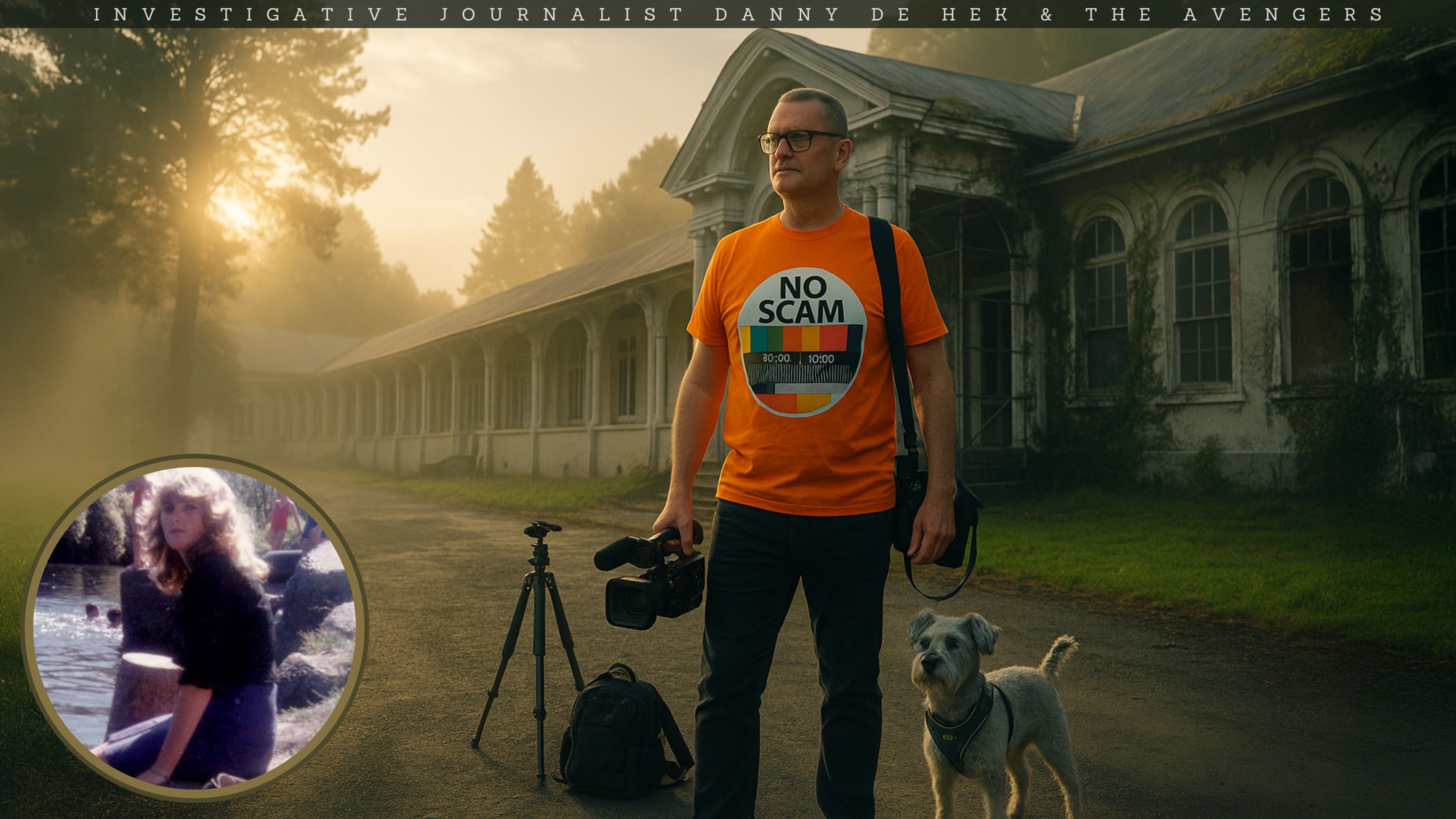
It started as a spontaneous trip — I jumped in my car, drove north from Christchurch, and headed for Hanmer Springs.
I wasn’t planning a holiday; I was retracing steps that my sister once took in her fight against mental illness.
She spent part of her life at Queen Mary Hospital, a place I had only heard about through family stories filled with sadness, confusion, and unanswered questions.
As I pulled up to the historic gates, surrounded by autumn trees and mountain air, I realised this visit wasn’t just about exploring an abandoned hospital. It was about confronting the past — my family’s past — and finally seeing where my sister Linda Warfield had once searched for help, healing, and peace.
The Queen Mary Hospital complex is hauntingly beautiful. Behind the ivy-covered walls lies a history that mirrors the pain and hope of thousands of New Zealanders who passed through its wards. What was once a proud mental-health institution now stands partly restored, partly in ruin — a relic of how we used to treat people struggling with depression, addiction, and trauma.
Exploring Queen Mary Hospital’s Haunted Legacy
In this blog, I explore the tragic history of Queen Mary Hospital in Hanmer Springs, New Zealand — and how this historic asylum connects to my own family’s story of trauma, survival, and loss.
The Hidden History Behind Queen Mary Hospital
Originally opened in 1916 as the Queen Mary Hospital for Sick and Wounded Soldiers, the facility was built for men returning from the horrors of World War I. These soldiers carried invisible wounds — shell-shock, trauma, and psychological scars few could understand at the time. Over the next century, Queen Mary evolved from a convalescent home into one of New Zealand’s most important mental-health and addiction-treatment centres.
By 1922, it came under civilian control and began treating patients with depression, anxiety, and other nervous conditions. Its design reflected the belief that sunlight, open space, and the alpine air could heal the mind — a philosophy that shaped generations of care in New Zealand’s mental-health system.
From Refuge to Relic
The hospital’s role changed throughout the decades. By the 1970s, it was New Zealand’s national centre for alcoholism and drug-dependency treatment, pioneering approaches like Taha Māori, which reconnected patients with their whānau and ancestors. But while the therapies improved, stigma persisted, and funding cuts in the late 1980s eventually led to its closure in 2003.
Today, Queen Mary stands as both a monument to progress and a reminder of neglect — its peeling paint and broken windows echoing the silence of those who once lived and died within its walls.
My Family’s Connection to Mental Health and Queen Mary Hospital
While documenting this hospital’s story, I can’t help but think of my sister, Linda Warfield, and my stepfather, Robert de Hek — two people I loved dearly, both lost to suicide. Their lives tell the story of how fragile hope can be when institutions and belief systems fail to support those in pain.
Robert de Hek — My Stepfather
Robert immigrated from Holland in the 1970s with his brother Bert. He was witty, charming, and the life of every party — yet beneath his humour, he battled depression. He and my mother, Trish Kidd, were Jehovah’s Witnesses, a religion that discouraged seeking professional help for mental-health struggles.
After the 1979 Mount Erebus disaster, Robert’s mental health spiralled. He took his life shortly afterward — gassing himself in his car at our family camping ground. I was nine years old. The congregation elders came that evening to tell my sister Linda and me that our stepfather was gone. My mother was devastated, consumed with guilt and shame.
For years, she cried herself to sleep, clinging even tighter to the religion that had failed us. We were told suicide was a sin — that it showed “disrespect for life.” The emotional damage of that doctrine shaped everything that followed.
Linda Warfield — My Sister
Linda was only eleven when Robert died. By her teens, she was rebellious, angry, and searching for freedom. As adults, we saw her life descend into a storm of addiction, mental illness, and trauma.
She struggled with postnatal depression after her daughter Samantha was born and later required treatment at Princess Margaret Hospital, Sunnyside Hospital, and Queen Mary Hospital in Hanmer Springs — the very same place I’ve explored in this video.
Linda battled with drug dependency and suicidal ideation for most of her life. There were countless emergency calls, late-night rescues, and near-death experiences. I remember one morning arriving at her home to find Pink Floyd’s The Wall blaring through open windows as she cut herself — I had to drag her to the car and rush her to hospital.
She was placed on suicide watch, but even in a controlled ward, she managed to take her own life on 3 December 1999, the same date and age as our stepfather — 36.
Faith, Silence, and Survival
The Jehovah’s Witnesses forbade us from holding a memorial for Robert, and years later, they refused one for Linda too. My mother, still a devout Witness, believes the organisation more than her own son. The pain of that continues to this day.
At Linda’s funeral, I stood before people who wouldn’t speak to me because I was disfellowshipped. I said:
“This is a sad day for us, but a peaceful day for Linda.”
I wanted them to see her humanity — not the “sin” they had been conditioned to see.
Reflections
Queen Mary Hospital is more than a crumbling relic; it symbolises the failures and hopes of mental-health care in New Zealand. My sister and stepfather’s stories live on in those walls — a reminder of what happens when stigma, religion, and silence replace compassion and science.
Their deaths fuel my determination to speak up about the human cost of cults, religious isolation, and untreated mental illness. This journey through Queen Mary is not just about abandoned buildings — it’s about acknowledging the forgotten, the broken, and the brave who lived their final chapters behind locked doors.
If you or someone you know struggles with depression or suicidal thoughts, please reach out for help — in New Zealand, contact Lifeline (0800 543 354) or 1737 Need to Talk. You’re not alone.
About the Author
I’m DANNY DE HEK, a New Zealand–based YouTuber, investigative journalist, and OSINT researcher. I name and shame individuals promoting or marketing fraudulent schemes through my YOUTUBE CHANNEL. Every video I produce exposes the people behind scams, Ponzi schemes, and MLM frauds — holding them accountable in public.
My PODCAST is an extension of that work. It’s distributed across 18 major platforms — including Apple Podcasts, Spotify, Amazon Music, YouTube, and iHeartRadio — so when scammers try to hide, my content follows them everywhere. If you prefer listening to my investigations instead of watching, you’ll find them on every major podcast service.
You can BOOK ME for private consultations or SPEAKING ENGAGEMENTS, where I share first-hand experience from years of exposing large-scale fraud and helping victims recover.
“Stop losing your future to financial parasites. Subscribe. Expose. Protect.”
My work exposing crypto fraud has been featured in:
- Bloomberg Documentary (2025): A 20-minute exposé on Ponzi schemes and crypto card fraud
- News.com.au (2025): Profiled as one of the leading scam-busters in Australasia
- OpIndia (2025): Cited for uncovering Pakistani software houses linked to drug trafficking, visa scams, and global financial fraud
- The Press / Stuff.co.nz (2023): Successfully defeated $3.85M gag lawsuit; court ruled it was a vexatious attempt to silence whistleblowing
- The Guardian Australia (2023): National warning on crypto MLMs affecting Aussie families
- ABC News Australia (2023): Investigation into Blockchain Global and its collapse
- The New York Times (2022): A full two-page feature on dismantling HyperVerse and its global network
- Radio New Zealand (2022): “The Kiwi YouTuber Taking Down Crypto Scammers From His Christchurch Home”
- Otago Daily Times (2022): A profile on my investigative work and the impact of crypto fraud in New Zealand



I am so sorry you went through this.
But I am so proud of you for finding the words to write this and I hope you continue to find closure through your writing and work on here.
This is what you are here to do, Danny! You save people from scams but you are here to help people in NZ understand these topics and this was the perfect way to do that, using all your skills and your whole heart.
I know how hard this was for you to do. Keep up the good work. This is the final stage of healing, finding your voice and using your story to help others.
Much love to you, always
xo