


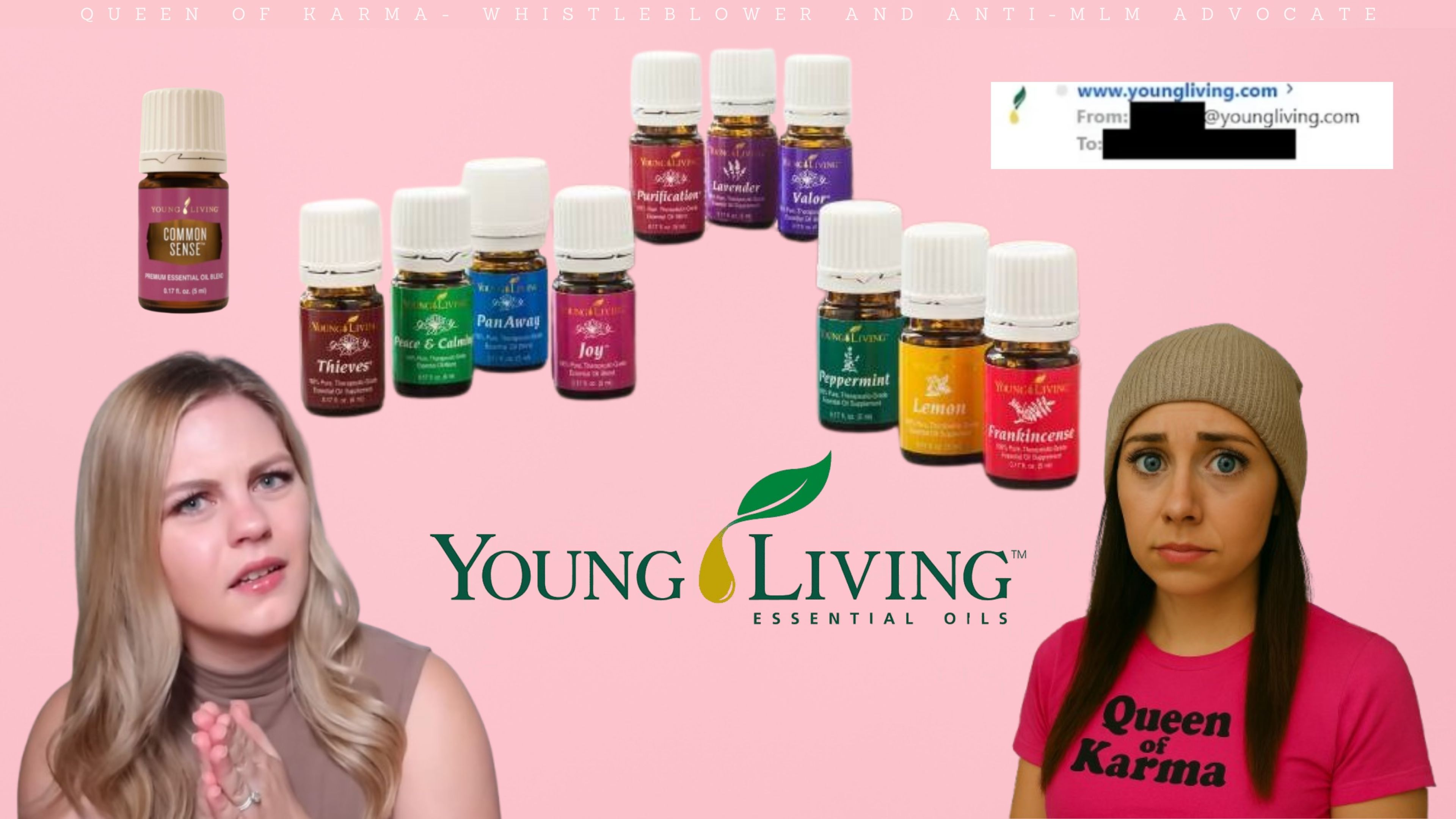
Young Living Essential Oils is one of the most recognizable names in the essential-oil MLM world. With millions of distributors worldwide and a reputation built on “therapeutic grade” marketing, the company has spent decades positioning itself as a natural-wellness leader. But behind the branding lies a long history of legal issues, pseudoscientific claims, and troubling behavior from its founder, D. Gary Young.
Now, in 2026, Young Living is facing a new PR disaster — one sparked not by regulators, but by a single content creator in the AntiMLM movement: Hannah Alonzo.
What Is Young Living?
Founded in 1993, Young Living is a Utah-based multi-level marketing company that sells essential oils, supplements, and wellness products. The company markets its oils as “therapeutic,” “healing,” and “life changing,” despite repeated legal findings that these claims lack scientific evidence.
Young Living operates globally and has built a massive distributor network, largely targeting women, stay-at-home parents, and people seeking alternative health solutions.
Young Living uses a standard MLM compensation plan:
- Distributors buy starter kits and monthly products
- They earn commissions by recruiting others
- Higher ranks require maintaining monthly purchases
- Income is tied to downline size, not product sales
The structure has been criticized for prioritizing recruitment over retail sales — a hallmark of MLM instability.
Young Living has also faced lawsuits alleging that its income claims and product claims are misleading. In 2021 and again in 2024, the company agreed to settle class-action lawsuits accusing it of promoting essential oils as treatments for anxiety, sleep issues, and other health conditions without scientific evidence.
Who Was Gary Young?
D. Gary Young (1949-2018) was the co-founder and CEO of Young Living. His background is riddled with controversy:
- He Pleaded Guilty to the unlicensed practice of medicine early in his career
- He promoted pseudoscientific healing methods
- He made unsupported medical claims about essential oils
- His companies were repeatedly investigated by regulators
Young Living’s entire brand was built on Young’s self-styled image as a healer — an image that has not held up under scrutiny.
One of the most troubling and widely documented incidents involves the death of Young’s infant son in the 1980s.
Multiple investigative sources — including the Deadly Faith podcast — detail allegations of infanticide, medical malpractice, and dangerous pseudoscientific practices connected to Young’s early “healing” experiments.
These allegations have circulated for decades and remain one of the darkest shadows over Young Living’s origins.
Major Controversies
Young Living has faced a long list of legal and ethical issues:
- Federal Raids and Investigations
The company has been investigated multiple times for illegal medical claims and improper business practices. - Class-Action Lawsuits
Young Living has paid millions to Settle Lawsuits alleging false advertising and unsupported health claims. - Aggressive Recruitment Tactics
Distributors are encouraged to recruit constantly, often using emotional manipulation and pseudoscience to sell products. - Misleading “Therapeutic Grade” Claims
The term “therapeutic grade” is a marketing invention — not a regulated or scientific standard.
A Corporate Misstep
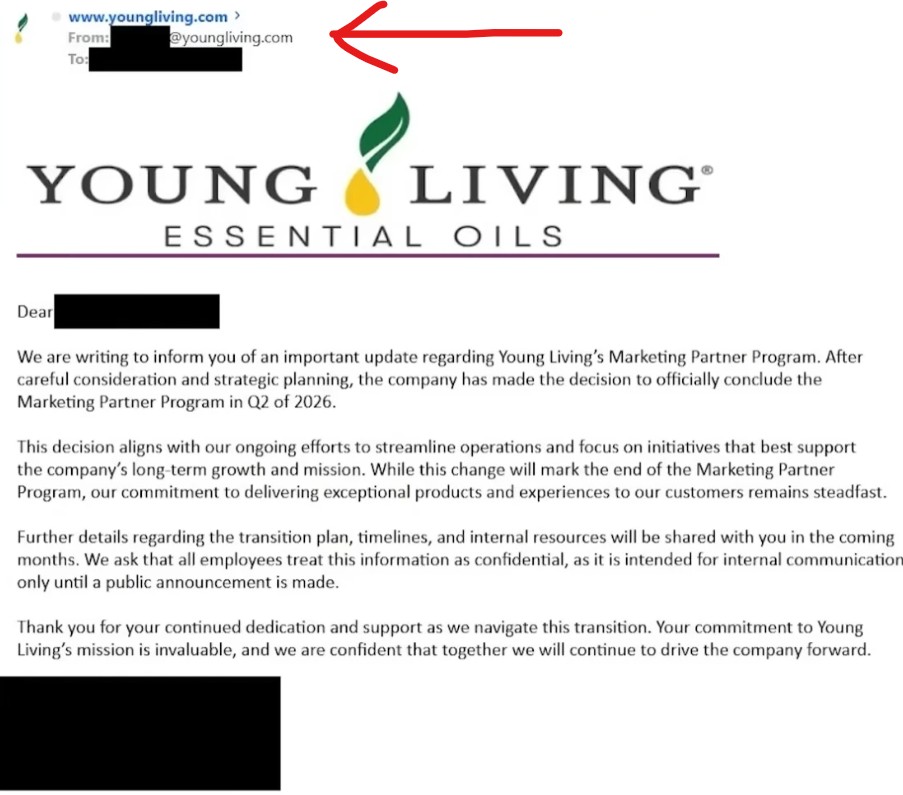
On January 7, 2026, content creator Hannah Alonzo posted a video exposing an email she received from a @youngliving.com address. Hannah makes Anti-multi-level marketing content and has over 800K followers on the YouTube platform alone. Shortly after her upload, she received a Cease and Desist from Young Living and put her video to private, stating she would be speaking with a lawyer.
The email was received by Hannah on December 15 and clearly stated that the company was planning to conclude its Marketing Partner Program in Q2 of 2026. That’s not just a rebrand or a tweak — that’s a full-scale dismantling of their MLM structure.
The language in the email confirms it was an internal corporate communication, not a rumor or a spoof. It talks about “strategic planning,” “streamlining operations,” and “confidential transition timelines.” That’s corporate speak for: we’re shutting this down and we don’t want the reps to panic yet.
So when Young Living and its defenders started claiming Hannah “faked” the email or that it “wasn’t official,” they weren’t just wrong — they were gaslighting. The domain proves it came from inside the company. And the content proves it was about ending the MLM model.
A screenshot of the email taken from a re-uploaded version of Hannah’s video is below:
The Company Responds
Young Living responded on their Instagram story on January 10 (pictured to the right).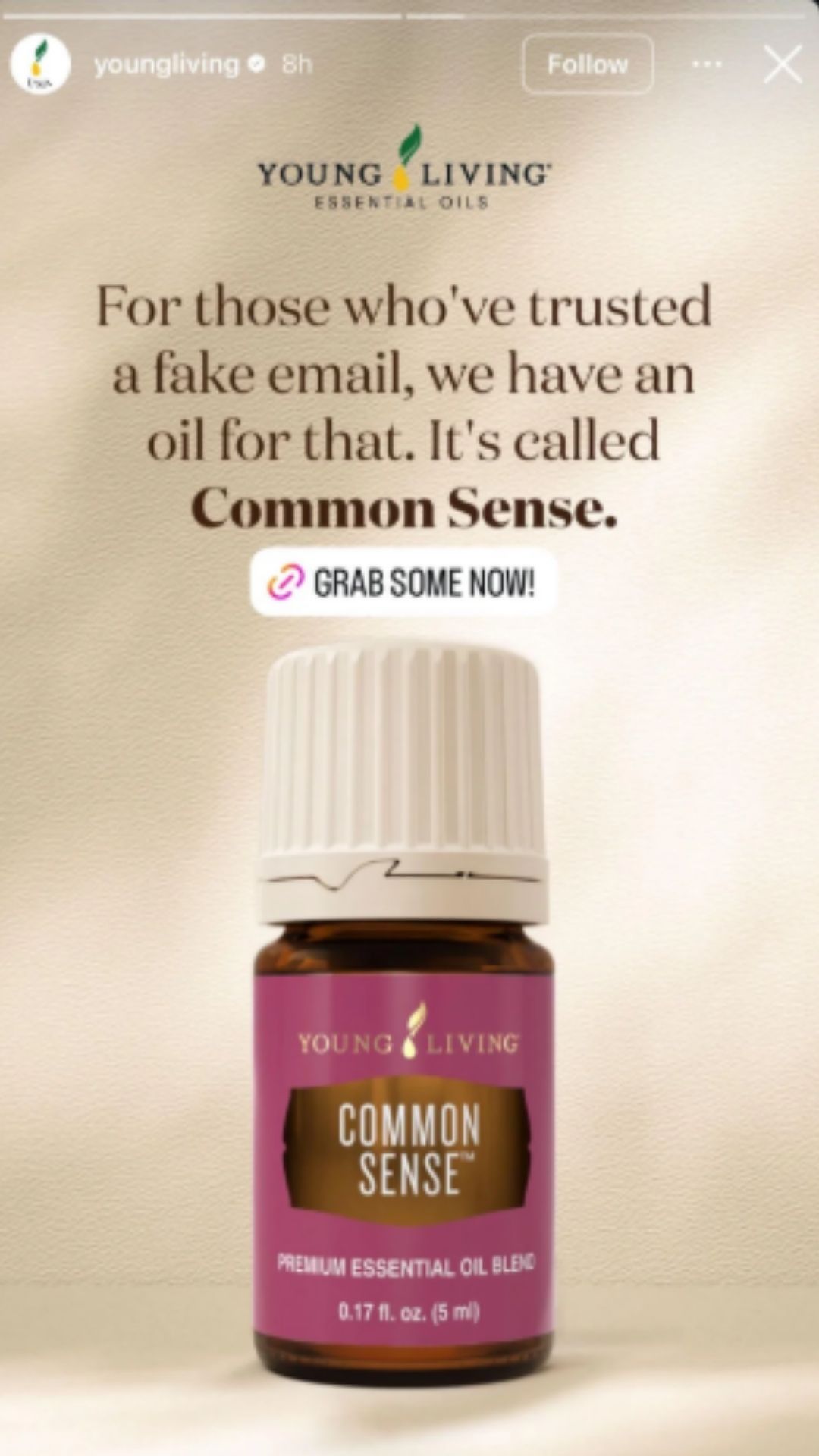
The only ones who seem to be lacking common sense are those working in corporate at Young Living.
By denying the email’s authenticity, Young Living created a bigger problem:
- They undermined their own credibility
- They confused their distributor base
- They gave critics even more proof that the company operates in secrecy and spin
And the distributors parroting the “it’s fake” narrative? They’re unknowingly helping corporate walk back a decision that may have already been in motion.
If anything, Hannah’s exposure of the email forced Young Living to pause, reconsider, and possibly reverse course — which means distributors should be thanking her. She may have saved their commissions, their structure, and their ability to keep earning under the current system.
But instead, the company chose denial. And in doing so, they confirmed what critics have said for years: Young Living doesn’t just sell oils — it sells illusion.
When MLMs Silence Critics
When an MLM moves to silence a critic, it’s never just about the critic — it’s about protecting the machinery that keeps the company alive. These organizations rely on tightly controlled narratives: empowerment, community, financial freedom, wellness, transformation. Anything that threatens that narrative becomes a threat to the entire recruitment pipeline. And because recruitment is the lifeblood of an MLM, criticism isn’t just inconvenient — it’s dangerous.
That’s why MLMs often respond to critics with intimidation rather than transparency. Cease and desist letters, takedown demands, vague legal threats, and coordinated distributor pile-ons are all part of the same playbook. The goal isn’t to correct misinformation. The goal is to stop the conversation before people start asking questions the company doesn’t want to answer.
When a company chooses silence-through-force instead of clarity-through-communication, it tells you everything you need to know:
- They fear scrutiny
- They fear documentation
- They fear their own internal decisions becoming public
- They fear distributors realizing how fragile the business model really is
The AntiMLM Community’s Role
The AntiMLM community’s role in these moments is crucial. When MLMs try to silence critics, we can respond by:
- Amplifying the truth so it can’t be buried
- Supporting the people who speak up, especially when they face backlash
- Educating distributors who may not understand why the company is panicking
- Preserving evidence so the company can’t rewrite the narrative later
- Standing together, because MLMs rely on isolating critics to weaken them
Silencing critics is not a sign of strength. It’s a sign of structural instability.
And every time a critic refuses to disappear, the MLM loses a little more control over the story.
What Young Living V Hannah Alonzo Reveals
Young Living’s recent behavior — from internal secrecy to legal intimidation to public denial — is not an isolated incident. It’s the culmination of decades of questionable leadership, pseudoscientific claims, and a business model that depends on belief rather than transparency. The company’s founder, Gary Young, built an empire on unverified healing claims and a carefully curated mythos. That legacy continues to shape how Young Living operates today.
The internal email announcing the end of the Marketing Partner Program was a rare, unfiltered glimpse behind the curtain. It showed a company preparing for a major structural shift — one that would fundamentally change how distributors earn money. And instead of addressing the situation honestly, Young Living chose to deny, deflect, and silence. They sent legal threats. They pressured a critic into making her video private. They tried to control the narrative rather than confront the truth.
But the truth has a way of resurfacing anyway.
This moment should be a wake-up call for distributors. If a company is willing to hide internal decisions, deny verifiable communications, and threaten critics, what else are they willing to hide? What other decisions might be made behind closed doors, only revealed when it’s too late for the field to react?
And ironically, the person many distributors attacked — Hannah Alonzo — may have been the one who protected them. By exposing the email, she forced Young Living to pause, rethink, and possibly reverse a plan that would have blindsided the entire field. She didn’t harm their business. She revealed the truth about it.
Young Living can deny, distract, and send as many cease and desist letters as they want. But the pattern is clear:
MLMs don’t silence critics because the critics are wrong. They silence critics because the critics are right.
As long as people continue to speak up, document, and refuse to be intimidated, the truth will keep breaking through — no matter how hard the company tries to bury it. Or rub it in essential oils.
By Beth Gibbons (Queen of Karma)
Beth Gibbons, known publicly as Queen of Karma, is a whistleblower and anti-MLM advocate who shares her personal experiences of being manipulated and financially harmed by multi-level marketing schemes. She writes and speaks candidly about the emotional and psychological toll these so-called “business opportunities” take on vulnerable individuals, especially women. Beth positions herself as a survivor-turned-activist, exposing MLMs as commercial cults and highlighting the cult-like tactics used to recruit, control, and silence members.
She has contributed blogs and participated in video interviews under the name Queen of Karma, often blending personal storytelling with direct confrontation of scammy business models. Her work aligns closely with scam awareness efforts, and she’s part of a growing community of voices pushing back against MLM exploitation, gaslighting, and financial abuse.

Leave A Comment