



When we last covered VYB on December 2, 2025, the company had just relaunched for the second time that year. Leadership — primarily Megan and Ragan Lynch — promised stability, momentum, and a “new era” for the brand.
But after that December relaunch, nothing happened. No growth. No traction. No meaningful updates. And then, in mid-January, the first sign of another pivot quietly appeared.
A Strange Website Appears
Before any official announcement, before any leadership call, before any hype, a website quietly appeared online: wearemerging.com
It wasn’t vague, mysterious, or coded the way MLM funnels usually are. There was no “big news coming,” no countdown clock, no cryptic branding meant to stir curiosity. Instead, the site was bluntly titled “THE MERGE | Build Your Future” — and it said the quiet part out loud.
The language on the site didn’t dance around possibilities or tease potential partnerships. It explicitly named iGenius and David Imonitie, framing the transition as a coordinated, structured merge between VYB, iGenius, and Imonitie’s leadership ecosystem. The branding tied the three together as though the deal had already been finalized, the paperwork already signed, and the integration already underway.
The site includes a live call link that leads to their Zoom webinars, a sponsor field, and a distributor-capture form — the kind of infrastructure you only build when a transition is not just planned, but already in motion. And the way Imonitie was positioned on the site made it clear he wasn’t a guest speaker or an outside collaborator. He was central to the narrative, woven directly into the identity of the merge itself. The page even featured what I can only describe as a David Imonitie promotional video…as in, he was hyping up himself!
This wasn’t rumor. This wasn’t speculation. This wasn’t a “maybe.” The website itself confirmed the merge before VYB leadership ever addressed it publicly. In other words, this website revealed that the merge was already planned, structured, and branded — long before VYB distributors were told anything. The website was the first breadcrumb that made this undeniable.
The Webinar That Confirmed Everything
On January 25, VYB finally broke its silence. After weeks of speculation and the sudden appearance of the website, the company held a webinar to explain what “The Merge” actually meant. Megan and Ragan Lynch appeared on screen, poised and upbeat, ready to walk their field through what was being framed as a major new chapter for the company.
Joining them was David Imonitie, a name that carries weight in MLM circles. His presence alone signaled that this wasn’t a casual collaboration. Imonitie is known for his prosperity-gospel tone, his polished stage presence, and his ability to sell vision with the confidence of someone who has spent years headlining convention stages. His career has taken him through many MLM companies and a string of personal development ventures — always with the same high-energy, motivational cadence that has become synonymous with MLM leadership culture. On this Zoom call, he played that role effortlessly.
One person notably absent from the panel was Andray Russell, who had already shifted his focus to promoting Akashx. His absence in VYB has never been addressed and on this night, the call moved forward as though he had never been there.
Throughout the webinar, Megan and Imonitie spoke with a unified voice. They described the transition as a partnership — two companies “coming together,” combining strengths, merging ecosystems, and building something bigger than either could accomplish alone. The tone was warm (minus a couple of Megan’s facial expressions). It was collaborative and confident. The message was unified, and the overall impression was that this merge represented stability, growth, and a shared future.
For distributors watching, the call framed iGenius as a natural partner — a company with tools, systems, and global reach that VYB could now access through this new collaboration. It set the stage for understanding who iGenius was and why this partnership was being positioned as a step forward.
Who iGenius Is
To understand why the January 25 webinar framed the merge as a strategic partnership, it helps to understand what iGenius actually is. iGenius is a financial-education MLM owned by Investview, a publicly traded company that has built its brand around trading tools, market analysis, and subscription-based access to financial content. Instead of selling physical products, iGenius sells access — monthly memberships that promise education, alerts, and tools related to crypto, forex, and market trends.
The pricing structure is tiered, with memberships ranging from entry-level packages to high-ticket subscriptions that can cost hundreds of dollars per month. The higher the tier, the more tools a distributor can access, and the more volume they generate for the compensation plan. This model has made iGenius distinct from wellness-based MLMs, but it has also drawn scrutiny. Critics have long questioned whether the value of education matches the cost, and whether the real incentive lies in recruiting others into the subscription system rather than in the tools themselves.
iGenius has also faced controversy over the years. Its parent company, Investview, has been the subject of regulatory attention, and the trading-education space itself has been criticized for encouraging high-risk speculation among beginners. The company has absorbed multiple teams from other MLMs, often during periods of collapse or restructuring, which has contributed to its reputation as a landing place for displaced leaders looking for a new home for their downlines.
iGenius Rebrands to Connectiv
In late 2023, iGenius underwent a full Corporate Rebrand and emerged under a new name: Connectiv. The shift wasn’t just cosmetic. The company updated its visual identity, refreshed its messaging, and repositioned itself as a broader “financial empowerment” platform rather than a trading-education MLM. The rebrand emphasized community, technology, and global reach — themes that had been part of iGenius’s marketing for years, but now packaged under a more modern, tech-forward identity.
Despite the new name, the core structure remained the same. Connectiv continued offering tiered subscription packages for financial education, market alerts, and crypto-related tools, with pricing that ranged from entry-level memberships to high-ticket monthly plans. The compensation model also stayed intact, relying on recruitment-driven volume and subscription renewals rather than retail product sales. For distributors, the rebrand functioned less as a transformation and more as a continuation of the same business model under a new banner.
The rebrand also highlighted the company’s leadership ecosystem, including figures like David Imonitie, who had long been involved in guiding teams and shaping the motivational culture around the opportunity. His presence during the VYB transition aligned naturally with Connectiv’s updated branding — positioning him as a familiar, influential voice within the new named organization. Even if on the wearemerging.com website, the company is still referred to as “iGenius.”

Who David Imonitie Truly Is
When David Imonitie appears on a webinar, it’s never just a cameo. His name comes with a long trail of companies, collapses, lawsuits, and rebrands that matter deeply to anyone trying to understand what this “merge” really represents.
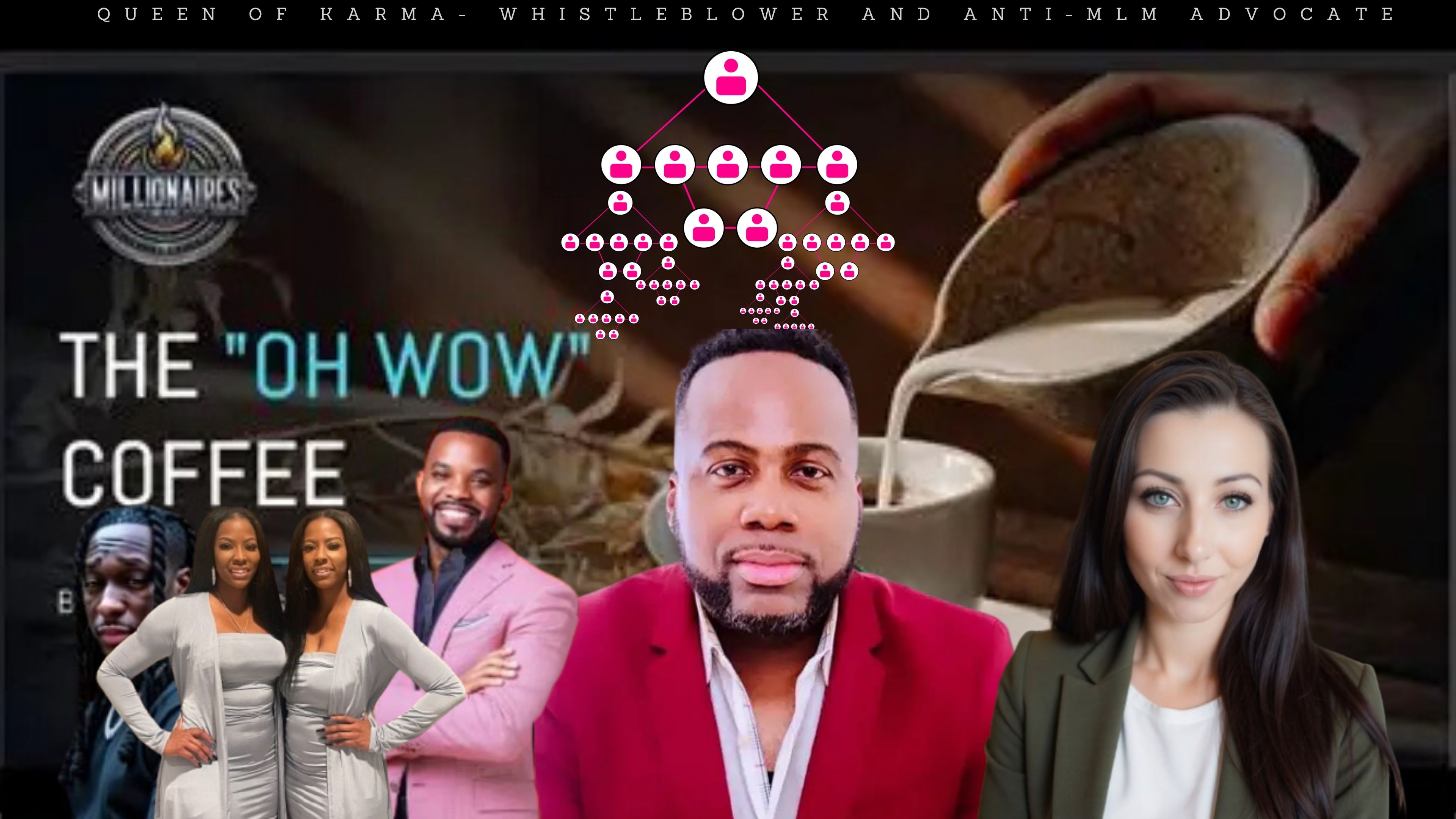
Imonitie first became widely known through Organo Gold, a mushroom-based coffee MLM that leaned heavily on lifestyle marketing and prosperity messaging. It was also one of the first MLM companies I spoke out about back in 2019. There, he built a reputation as a charismatic recruiter and motivational figure, someone who could fill hotel ballrooms and sell the dream of financial freedom. That early success set the template for what would follow: big stages, big promises, and big downlines.
He later emerged as one of the top earners and promoters inside iMarketsLive, which rebranded as IM Mastery Academy and, more recently, Iyovia. This was a forex and crypto “education” MLM that the FTC would eventually sue for over a billion dollars in alleged fraud, accusing the company and its leadership of deceiving consumers about trading results and income potential. Imonitie was part of the ecosystem that helped build that machine, particularly targeting Black communities with wealth-building rhetoric and trading education that, according to Multiple Investigations, did not live up to the hype.
When his time with IM Mastery Academy ended, he didn’t disappear. Instead, he resurfaced as the co-founder of Nvisionu, a company widely described as a spinoff created by top IM Mastery Academy earners. Nvisionu launched in 2022 with a familiar model: digital education, trading-style positioning, and later, supplements and travel bolted on to keep the opportunity fresh. IM Mastery Academy sued Imonitie and others, alleging they had resigned or been terminated and then conspired to recruit its distributors into Nvisionu and directly compete in the same space.
By late 2025, Nvisionu itself had collapsed. Reporting at the time documented that Imonitie had effectively sold out his Nvisionu field to iGenius, appearing in promotions welcoming him as a new leader and suggesting he was now aligned with iGenius promoter Anthony Napolitano to pitch the company to former Nvisionu promoters. In other words, yet another team migration: one company implodes, and the downline is steered into the next vehicle.
Layered on top of this are legal and contractual disputes, including a Business Lawsuit filed against Imonitie in Navada in 2022, tied to International Markets Inc., which further illustrates how often his name appears at the center of high-stakes, high-dollar conflicts in this space.
The Sudden Coffee Pivot
When Bass Grant took the screen on February 4 to introduce “My Alive” coffee, the presentation marked a sharp turn from everything VYB and iGenius had been positioning themselves as. The Presentation was drenched in hype. This coffee, they said, was going to be huge. It was the next wave. It was the opportunity distributors have been waiting for. After months of branding centered around financial literacy, crypto tools, and market education, the new flagship product was suddenly a consumable — a peptide-infused bold, black coffee with a price tag that immediately set it apart from anything you’d find on a store shelf.
A single bag of My Alive coffee was listed at $69.99 USD, a price point that would be unthinkable in any retail environment outside of an MLM compensation structure. But the real numbers came from the packages. The “starter” option pushed the cost well into triple digits, and the larger “builder” or “promoter” packs — the ones positioned as the best choice for anyone who wanted to “launch their business” — climbed even higher. These weren’t curated wellness kits or multi-product bundles. They were simple multiple bags of the same coffee, stacked into increasingly expensive tiers.
The pricing alone raised questions. Coffee is one of the most commoditized products in the world, and even premium specialty roasts rarely approach the cost of a single bag of My Alive. The justification, of course, was the peptides. It was being positioned as the next major revenue stream for distributors who had spent the past year selling financial education.
The pivot was abrupt. One week, VYB was a trading-focused opportunity preparing to merge with a financial-education company. The next, its field was being introduced to a high-priced consumable with wellness branding and a compensation-friendly price structure. For many distributors, it was the first tangible product they had seen in months — something physical to hold, sample, and sell. And for a moment, that was enough. The field buzzed with excitement, posting screenshots of their orders and speculating about the product’s potential.
Now, the merge really appeared legitimate. The coffee appeared to be a part of the new ecosystem. And the field believed they were stepping into a larger, more stable opportunity.
The real reveal was still two days away.
Peptides in Coffee: What the Science Actually Says
The central selling point of “My Alive” coffee is its peptide infusion — marketed as a wellness booster, an energy enhancer, and a performance aid. But the scientific literature does not support the claims being made in MLM marketing.
A 2024 Review published in the International Journal of Molecular Sciences examined the stability, absorption, and bioavailability of orally consumed peptides and found that most peptides are broken down during digestion, losing their structure long before they could exert any targeted biological effect. The authors note that peptides face “significant enzymatic degradation in the gastrointestinal tract,” and only a very small subset — typically those specifically engineered for pharmaceutical delivery — show any meaningful absorption at all. In other words, the vast majority of peptides do not survive the digestive process intact, and certainly not in a hot beverage like coffee. The study concludes that oral peptide products marketed for general wellness lack evidence for real-world efficacy, especially when consumed casually rather than in controlled clinical formulations.
This means the peptide claims surrounding “My Alive” coffee are not grounded in credible science. They are marketing language — not medical fact — and they mirror a long pattern in MLMs of attaching trendy biochemical buzzwords to everyday products to justify inflated pricing and recurring auto-ships.
The Rank-Up That Exposed the Truth
Two days after the peptide coffee webinar, the entire narrative surrounding “The Merge” cracked open — not because of an official announcement, not because of a leadership call, but because of a single graphic quietly circulating through group chats and Telegram channels.
It was a celebration post: Megan Lynch — Diamond Executive, iGenius.

For anyone outside the MLM world, that might sound like just another title. But inside iGenius, “Diamond Executive” isn’t a starter rank. It isn’t something you stumble into. It represents a massive amount of team volume — the kind of volume that normally takes months or years to build, even for seasoned recruiters.
Except Megan hadn’t been in iGenius for months.
She had been there for days.
That’s when everything snapped into focus. Because Megan didn’t join iGenius as a new distributor. She didn’t start from zero. She didn’t build a team inside the new company. She didn’t climb the ranks through the system she was now promoting. She brought an entire company with her.
VYB — the team she had spent over a year building, relaunching, rebranding, and rallying — had been quietly funneled into iGenius beneath her position. Every recruit, every leg, every leader, every volume-producing promoter she had accumulated through VYB was now sitting under her in a completely different company.
And that’s how you hit Diamond Executive in a weekend.
The “merge” suddenly made sense — not as a partnership, not as a collaboration, not as two companies joining forces, but as a migration. A transfer. A downline relocation. A structural shift designed to position Megan at the top of a new compensation plan with instant rank, instant authority, and instant credibility she could leverage to recruit even more people.
This wasn’t a merge. It was a takeover. And the rank-up was the receipt.
What made the moment even more revealing was something Megan herself said earlier that week on a training call: that the VYB business ecosystem — the systems, the funnels, the training, the culture — would now be used to train her iGenius team. At the time, it sounded like integration. After the rank-up graphic, it read like confirmation.
VYB wasn’t merging into iGenius. VYB was being absorbed into iGenius. And Megan was the one benefiting from this absorption.
What This Means for VYB Members
For the average distributor, the implications were stark. They hadn’t joined iGenius. They hadn’t agreed to switch companies. They hadn’t chosen a new compensation plan. They hadn’t signed up to be a part of a financial-education MLM with a history of absorbing collapsing teams…and legal scrutiny.
They were moved — quietly, strategically, and without transparency — to inflate the rank of the person at the top. This is the part of MLMs that rarely gets said out loud: leadership migrations are not about opportunity. They’re about leverage. A leader with a downline is a commodity. A leader with a downline in motion is a bargaining chip. And a leader who can move hundreds of people at once is someone companies will reward instantly, because they’re not rewarding the leader — they’re rewarding the volume.
The February 6 rank-up wasn’t an achievement. It was a transaction.
It exposed the truth that had been hidden behind the merge narrative, the webinars, the hype, and the peptide coffee distraction: VYB didn’t merge with iGenius. VYB was used to help rebuild iGenius — and Megan’s rank — overnight.
A Consumer Protection Warning
Once the truth of the February 6 rank-up settled in, the entire timeline snapped into place with a clarity that was impossible to ignore. What had been presented as a partnership was, in reality, a migration. What had been framed as a merge was, in practice, a transfer of bodies — a downline relocation that benefited one person at the top while everyone beneath her was left to navigate a new company, a new compensation plan, and a new identity they never signed up for.
This part of MLM culture exposes the machinery behind the motivational speeches and the glossy branding. Companies don’t merge because of synergy. They merge because of volume. Leaders don’t migrate because of opportunity. They migrate because of leverage. And distributors don’t follow because they believe in the vision. They follow because they’re told the alternative is failure.
In the case of VYB, the pattern is unmistakable. A company that relaunched twice in a year suddenly “merged” into a financial-education MLM with a history of absorbing collapsing teams. A new product — peptide coffee — appeared just long enough to distract the field. And then, within forty-eight hours, the person orchestrating the transition appeared at the top of a new compensation plan with a rank that would take the average distributor months or years to achieve, if they ever achieved it at all.
This is not empowerment. This is not leadership. This is not entrepreneurship. It is a structural maneuver designed to preserve the power of the person at the top while the people beneath absorb her risk.
As a consumer protection advocate, I cannot stress this enough: if a company cannot maintain stability for more than a few months at a time, if its leadership repeatedly pivots into new opportunities, and if its compensation structure rewards migration over merit, it is not a sustainable business model. It is a revolving door of hype cycles, each one shorter than the last, each one more desperate then the one before it.
If you are someone considering joining VYB, iGenius, or anything connected to “The Merge,” you deserve transparency. You deserve honesty. You deserve to know that the person recruiting you may already be positioned at the top of a structure you will spend years trying to climb. You deserve to know that the product being sold to you — whether it’s trading education or peptide-infused coffee — is not the real commodity. You are.
The truth is simple: This is not a stable opportunity. This is not a transparent organization. This is not a path to financial freedom. It is a collapsing MLM ecosystem held together by hype, pivots, and leadership decisions that benefit the few at the top while everyone else is told to “trust the process.”
And remember — no matter how many times they say it, no matter how many Zoom webinars they host, no matter how many graphics they post — vybing with peptide coffee won’t fix your finances, your future, or your life.
By Beth Gibbons (Queen of Karma)
Beth Gibbons, known publicly as Queen of Karma, is a whistleblower and anti-MLM advocate who shares her personal experiences of being manipulated and financially harmed by multi-level marketing schemes. She writes and speaks candidly about the emotional and psychological toll these so-called “business opportunities” take on vulnerable individuals, especially women. Beth positions herself as a survivor-turned-activist, exposing MLMs as commercial cults and highlighting the cult-like tactics used to recruit, control, and silence members.
She has contributed blogs and participated in video interviews under the name Queen of Karma, often blending personal storytelling with direct confrontation of scammy business models. Her work aligns closely with scam awareness efforts, and she’s part of a growing community of voices pushing back against MLM exploitation, gaslighting, and financial abuse.


Leave A Comment