


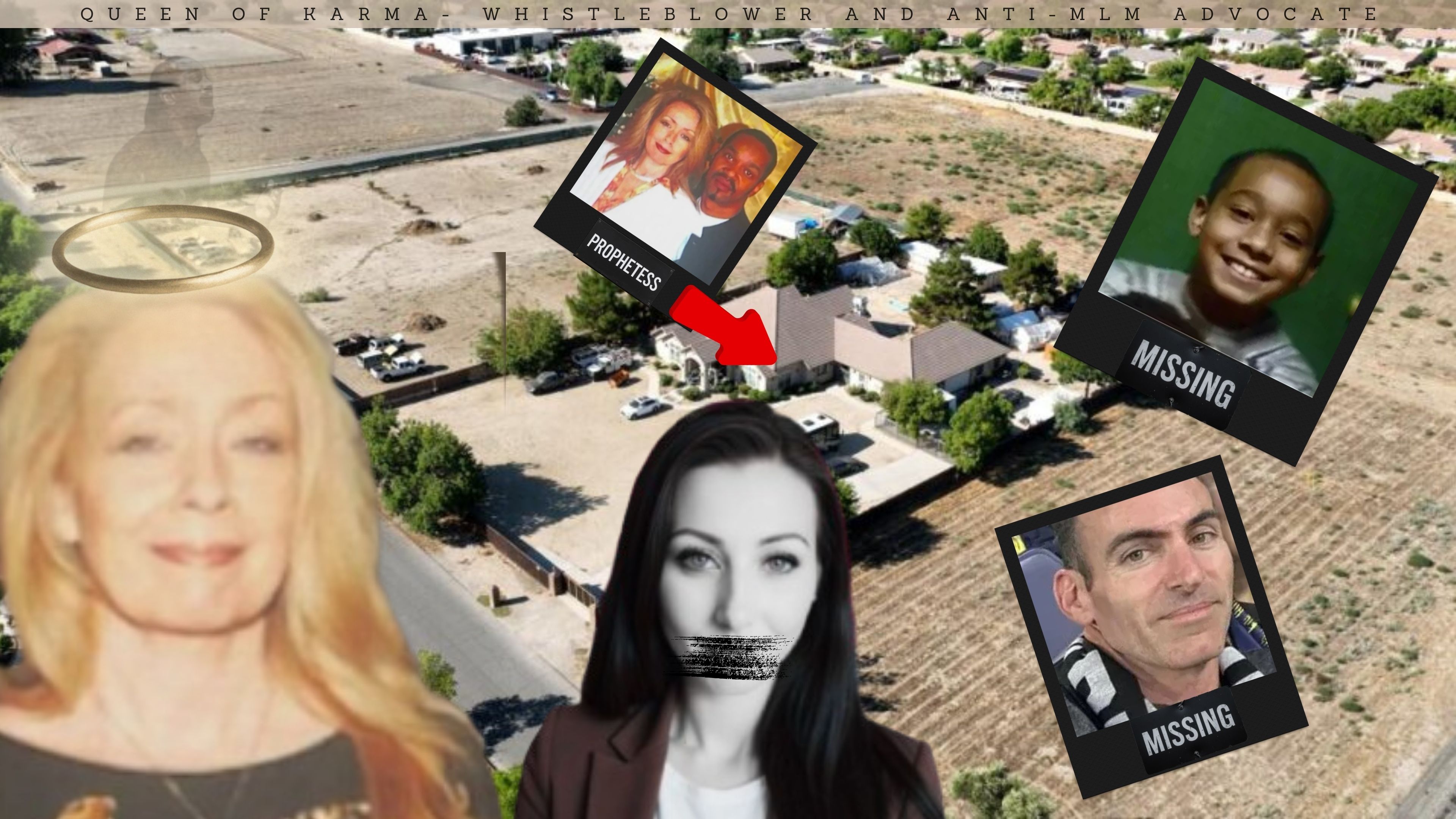
The courtroom was heavy with the kind of silence that only follows years of unspoken suffering. Shelly Baily “Kat” Martin, once the unquestioned spiritual authority of His Way Spirit Led Assemblies, sat shackled at the defense table. Her posture was rigid, her expression unreadable, but the aura of divine certainty she once projected had evaporated. The woman who claimed God spoke through her now faced charges of murder, torture, and conspiracy.
Behind her, the gallery was filled with former followers, family members, and observers trying to understand how a small religious group could transform into a closed world of violence and fear. Some of the people seated behind Martin had once believed she was a prophetess. Others had escaped her control and were now prepared to testify about the years they spent living under her authority.
One survivor described being struck in the head with a microphone during a service, a punishment delivered publicly to reinforce Martin’s dominance. Another recounted being locked in a room for days, starved, and beaten until she could barely stand. Others spoke of children being disciplined harshly, sometimes violently, for minor infractions. Several described Martin entering trances, speaking in a different voice, and claiming that God had taken over her body to deliver messages.
For decades, these stories existed only within the group’s walls. Now, in a courtroom illuminated by fluorescent lights and legal scrutiny, the truth was finally being spoken aloud.
A Child’s Death and a Missing Man
The charges against Martin and several of her followers stem from two central tragedies: the death of a four-year-old boy and the disappearance of an adult member who has never been found. According to prosecutors, both cases are tied directly to the group’s internal system of discipline and control.
The Child’s Death was the catalyst that finally forced authorities to look closely at the group. Survivors testified that the boy was subjected to harsh physical punishment under the guise of spiritual correction. His death, they said, was not an accident but the result of a culture where obedience was enforced through violence.
The Missing Adult Member, a man who had been part of the group for years, vanished under circumstances that raised immediate suspicion. Former members reported that he had been subjected to severe discipline shortly before he disappeared. His body has never been recovered, but prosecutors believe he died as a result of the group’s practices.
These two cases opened the door to a Broader Investigation, revealing a pattern of abuse that had gone unchecked for years.
The Prophetess and the Illusion of Divine Authority
To understand how His Way Spirit Led Assemblies operated, it is essential to understand the woman at its center. Shelley Bailey “Kat” Martin did not present herself as a typical religious leader. She claimed to be a prophetess — a vessel through whom God communicated directly. According to survivors, she described herself as spiritually “perfected,” someone who had transcended the limitations of the physical world.
Former members testified that Martin often entered trances, speaking in a different voice and claiming that God was using her body to deliver messages. She told followers that she alone could interpret divine will and that obedience to her was equivalent to obedience to God.
This kind of charismatic authority is a hallmark of many high-control groups. When a leader claims divine access, followers are conditioned to surrender their own judgment. Dissent becomes sin. Questioning becomes rebellion. And obedience becomes the highest spiritual virtue.
Under Martin’s leadership, this dynamic became the foundation of the group’s internal structure.
The Making of The Prophetess
Shelley Bailey “Kat” Martin did not emerge suddenly as a prophetess; she constructed her identity over years, layering personal history, spiritual ambition, and psychological need into a persona that eventually commanded absolute obedience.
Although publicly available records reveal little about Martin’s early life, survivors consistently describe a woman who framed her past as a journey marked by hardship, revelation, and divine calling. According to former members, Martin often spoke about her childhood as if it were a crucible — a period of suffering that she believed had prepared her for spiritual leadership. She portrayed herself as someone who had been misunderstood, underestimated, or spiritually oppressed in her youth, a narrative that positioned her later authority as both destiny and vindication.
Survivors recall that Martin frequently emphasized her intelligence and spiritual sensitivity, suggesting that she had always been “different” or “set apart.” She implied that her insights were innate rather than learned, and she rarely referenced formal education or theological training. Instead, she framed her knowledge as divinely bestowed, claiming that God had awakened her to truths that ordinary people could not perceive. This framing is common among leaders of high-control groups, who often rely on personal revelation rather than institutional legitimacy to establish authority.
Martin’s spiritual journey appears to have intensified in adulthood, particularly during the years leading up to the formation of His Way Spirit Led Assemblies. Survivors describe her as someone who moved fluidly between charismatic Christian traditions, prophetic movements, and independent ministries. She drew from each of these environments, adopting language, rituals, and practices that reinforced her emerging identity as a chosen vessel. Over time, she began to speak more openly about receiving direct messages from God, entering trances, and experiencing spiritual visions.
By the time she founded His Way Spirit Led assemblies, Martin had fully embraced the role of prophetess. She presented herself not merely as pastor or teacher but as someone spiritually perfected — a person who had transcended ordinary human limitations. Survivors testified that she compared herself to Neo from The Matrix, claiming she had “awoken from this realm” and could see spiritual realities hidden from others. This comparison was not accidental; it reinforced the idea that she possessed extraordinary insight and that her followers needed her guidance to navigate a world they could not fully understand.
The Role of Darryl “Muzic” Martin
While much of the public attention has focused on Shelly “Kat” Martin, reporting makes it clear that Darryl Muzic Martin played an equally central — and in some ways more operational — role in His Way Spirit Led Assemblies.
According to KTLA, Darryl Muzic Martin, 57, was arrested on illegal weapons charges during the initial sweep connected to the disappearance of former member Emilio Ghanem. Police identified him as one of the two primary leaders of the group, alongside Shelly “Kat” Martin.
Later reporting from The Independent states that Darryl was ultimately arrested for murder, accused of killing Emilio Salem Ghanem after the former member left the group in 2023. He was denied bail, underscoring the severity of the charges and the level of concern from investigators.
The LA Times further reported that Darryl appeared in court alongside Shelly during preliminary hearings tied to two separate murder cases, including the death of a 4-year-old boy years earlier.
But Darryl wasn’t just a behind-the-scenes figure. His online presence paints a picture of a man who blended religious authority with performance and branding. Under the name “Muzic Martin,” he released Christian rap tracks, appeared in promotional videos, and positioned himself as a charismatic spiritual performer. The group’s YouTube Channel features sermons, music videos, and promotional clips with Darryl front and center — a reminder that His Way Spirit Led Assemblies wasn’t just a church, but a tightly controlled ecosystem built around its leaders’ personas.
Taken together, the reporting shows a leader who was not only spiritually influential but deeply embedded in the group’s daily operations, public image, and — according to prosecutors — its most violent acts. His arrest marks a turning point in the investigation, revealing that the alleged harm within the group was not the work of a single “prophetess,” but a leadership structure that operated in tandem.
Inside the Belief System
Understanding the harm caused by His Way Spirit Led Assemblies requires understanding the belief system that held the group together. Survivors consistently describe a theology that blended charismatic Christianity, prophetic mysticism, and authoritarian control into a worldview where obedience was sacred, suffering was purification, and Shelly Bailey “Kat” Martin’s voice was indistinguishable from the voice of God.
Although the group presented itself as a Christian ministry, its internal doctrine diverged sharply from mainstream Christianity. Instead of emphasizing grace, community, or personal relationship with God, the group’s teachings revolved around hierarchy, spiritual warfare, and the idea that Martin had been chosen to lead a remnant of spiritually superior believers. This belief system created a closed world where Martin’s authority was absolute and her interpretations of scripture were treated as divine revelation.
Survivors describe a belief system centered on the idea that the world was filled with spiritual danger. Demons, curses, and unseen forces were said to be constantly at work, and only Martin possessed the spiritual maturity to recognize and defeat them. This framing made followers dependent on her guidance and fearful of questioning her decisions. Disobedience was not simply a mistake — it was a spiritual threat.
Within this worldview, suffering was reframed as purification. Physical punishment, starvation, and isolation were presented as tools God used to break pride, correct sin, and strengthen the spirit. Members were taught that resisting discipline meant resisting God’s will, and that accepting punishment without complaint was a sign of spiritual growth.
The group’s rituals were designed to reinforce Martin’s authority and maintain emotional dependency. Survivors describe intense prayer sessions, prophetic declarations, and moments where Martin entered trances and delivered messages she claimed were directly from God. These trances were treated as sacred events, and members were expected to accept her words without hesitation.
Confession was another central ritual. Members were required to confess doubts, sins, or perceived disobedience, often in front of others. These confessions were used to justify punishment, reinforce shame, and deepen loyalty to Martin. Over time, this practice eroded members’ sense of privacy and autonomy.
Discipline itself became ritualized. Punishments were not random acts of anger but structured events framed as spiritual correction. Whether it was isolation, starvation, or physical force, each act was presented as a necessary step toward holiness.
Members were encouraged to monitor one another and report any signs of rebellion, doubt, or “spiritual contamination.” This created a culture where trust was replaced with fear and where loyalty to Martin superseded loyalty to family. Even children were taught to report on adults, reinforcing the idea that Martin’s authority was absolute.
This internal surveillance system ensured that Martin’s teachings were not merely believed but enforced. It also prevented members from forming alliances or questioning the group’s practices, since any expression of doubt could lead to punishment.
One of the most powerful elements of the group’s belief system was Martin’s claim that she had reached a state of spiritual perfection. Survivors say she taught that she was incapable of error because she had been fully transformed by God. This doctrine placed her beyond accountability and allowed her to reinterpret any challenge as spiritual attack.
If Martin was perfect, then any harm she caused was justified. Any punishment she ordered was righteous. Any suffering she inflicted was necessary. This belief made it nearly impossible for members to recognize abuse, because the theology itself insisted that the prophetess could not be wrong.
The belief system of His Way Spirit Led Assemblies functioned as a self-contained universe. Every teaching reinforced Martin’s authority. Every ritual deepened dependency. Every punishment was framed as divine love. Over time, members lost the ability to distinguish between faith and fear, devotion and coercion, spirituality and survival.
In this closed world, abuse did not look like abuse — it looked like salvation. And that is what made the system so powerful, and so dangerous.
A Closed World: How The Cult Operated
His Way Spirit Led Assemblies began in Tennessee before relocating to California, a move survivors say was intended to avoid scrutiny. Over time, the group became increasingly isolated, both physically and socially. Members lived together, worshipped together, and were discouraged from maintaining relationships outside the group.
Inside this closed environment, Martin established a rigid hierarchy. She sat at the top, surrounded by loyal followers who acted as enforcers. These individuals carried out punishments, monitored members’ behavior, and ensured that Martin’s authority remained unquestioned.
Survivors describe a system where:
- adults were starved as punishment
- children were beaten for minor infractions
- members were locked in isolation rooms
- forced confessions were routine
- public humiliation was used to maintain control
- obedience was demanded at all times
One survivor said she was so starved she could see her bones. Another described being beaten until she collapsed. Others spoke of watching children being disciplined violently, sometimes for simply speaking out of turn.
This was not a spiritual community. It was a coercive-control environment designed to break autonomy and replace it with fear.
The Human Cost of Obedience
The most compelling evidence against the group comes from the people who lived inside it. Their testimonies reveal a pattern of abuse that was both systematic and deeply personal.
One former member described being locked in a room for days, given little food, and beaten repeatedly. She said she believed she deserved the punishment because Martin told her it was God’s will. Another survivor recounted being struck in the head with a microphone during a service, a public act meant to shame her into obedience.
Several survivors described watching children being disciplined harshly. One said she saw a child forced to stand for hours as punishment. Another said she witnessed a child being hit repeatedly for crying.
These testimonies paint a picture of a group where violence was not incidental but institutionalized. It was woven into the theology, the culture, and the daily life of the community.
How Faith Becomes a Weapon
To understand how a group like this can operate for years without intervention, it is important to examine the psychological mechanisms that make coercive control so effective.
Charismatic Authority
Martin positioned herself as the only person who could interpret God’s will. This created a dependency that made followers vulnerable to manipulation.
Isolation
By cutting members off from outside influences, the group removed alternative perspectives. This made it easier to control information and shape beliefs.
Fear and Punishment
The use of starvation, beatings, and public humiliation created a climate where obedience became a survival strategy.
Cognitive Dissonance
When people invest years into a belief system, they will endure suffering rather than admit they were deceived. This psychological phenomenon helps explain why members stayed even when the abuse became severe.
Trauma Bonding
Intermittent reinforcement — cycles of affection followed by punishment — creates emotional bonds that are difficult to break.
Spiritual Manipulation
By framing violence as “God’s will,” Martin turned abuse into righteousness. This is one of the most powerful forms of psychological control because it targets a person’s deepest beliefs.
The Sociology of a Closed Religious System
Sociologically, His Way Spirit Led Assemblies functioned like many high-control groups. It has a charismatic leader, a rigid hierarchy, a closed information environment, and a culture of surveillance. Members were encouraged to report on one another, creating an atmosphere of mistrust and fear.
The group’s belief system justified harm by framing it as spiritual correction. This allowed violence to become normalized. Over time, members internalized the idea that suffering was a form of purification and that obedience was the path to spiritual growth.
This is not religion. This is authoritarianism disguised as faith.
The Philosophy That Justified the Abuse
The groups philosophy rested on three core ideas:
- Divine Perfection
Martin claimed she was spiritually perfected and therefore incapable of error. This eliminated any possibility of accountability. - Divine Punishment
Punishment was framed as a necessary part of spiritual growth. Violence became a sacrament. - Divine Hierarchy
Members were taught that God had ordained their roles. This turned obedience into destiny and made dissent unthinkable.
When philosophy is weaponized, it becomes ideology.
When ideology is enforced through violence, it becomes tyranny.
Why People Stayed — and Why They Left
Survivors describe a slow erosion of autonomy. At first, they trusted Martin. Then they obeyed her. Eventually, they feared her. Over time, they forgot how to leave.
People stayed because they believed Martin spoke for God. They stayed because they feared punishment. They stayed because they were isolated, trauma-bonded, and spiritually manipulated. They stayed because they were told the outside world was dangerous.
People left because the violence escalated. They left because someone died. They left because someone disappeared. They left because the cognitive dissonance finally cracked and the spell broke.
Leaving a cult is not an act of rebellion.
It is an act of survival.
Justice, Accountability, and the Survivors
This case is not an isolated incident. It is part of a larger pattern. Across the country, small, decentralized groups are forming around charismatic leaders who claim divine authority. These leaders exploit vulnerability, manipulate faith, and use coercive control to maintain power.
His Way Spirit Led Assemblies is not unique.
It is a symptom of a broader cultural problem: unchecked spiritual power in isolated communities.
As the trial continues, one truth remains clear: this was not a church. It was not a spiritual awakening. It was a system of coercive control that cost lives.
The survivors who testified broke a silence that lasted decades. Their courage is the reason this case is finally being seen for what it is. Justice will play out in the courtroom, but the real victory is that the world is finally looking.
And once you see coercive control clearly, you cannot unsee it.
New Reporting Reveals the Group’s Defiance and Denial
A recent Yahoo News Report added another disturbing layer to the story. When reporters approached members of His Way Spirit Led Assemblies outside the Hemet property, they refused to acknowledge the arrests or the murder charges facing their leaders. Instead, they insisted the group was being “attacked” and framed the criminal investigation as a spiritual battle rather than a legal one.
Even as law enforcement described the organization as a cult and linked its leadership to two deaths, members continued to defend the group’s practices, deny wrongdoing, and dismiss the allegations as persecution. their reactions mirror classic high-control group behavior: isolation, denial, and unwavering loyalty to leadership — even in the face of overwhelming evidence.
This public response underscores the depth of influence the group’s leaders held and highlights how coercive control can shape not only private behavior but pubic perception.
What This Story Really Shows Us
The His Way Spirit Led Assemblies case isn’t just about a fringe religious group or a shocking set of criminal charges. It’s a window into how coercive control operates in real time — how it shapes belief, overrides instinct, and binds people to leaders who harm them.
The arrests, the FBI raid, the deaths linked to the group, and the unwavering loyalty of its members all point to a system built on fear, obedience, and spiritual manipulation. These dynamics don’t emerge overnight. They are cultivated slowly, through isolation, dependency, and the erosion of personal agency.
What makes this case so important is not just what happened inside the group, but what it reveals about the broader landscape of modern high-control movements. They don’t always look like the cults of the past. They can be small, decentralized, or hidden in plain sight. They can use scripture, prophecy, or “spirit-led” language to justify domination. And they can thrive for years before anyone on the outside realizes the danger.
As more survivors come forward and more investigations unfold, one truth becomes impossible to ignore: coercive control is not rare, and it is not confined to any one ideology. It is a pattern — predictable, recognizable, and devastating — and understanding that pattern is the first step toward preventing the next tragedy.
By Beth Gibbons (Queen of Karma)
Beth Gibbons, known publicly as Queen of Karma, is a whistleblower and anti-MLM advocate who shares her personal experiences of being manipulated and financially harmed by multi-level marketing schemes. She writes and speaks candidly about the emotional and psychological toll these so-called “business opportunities” take on vulnerable individuals, especially women. Beth positions herself as a survivor-turned-activist, exposing MLMs as commercial cults and highlighting the cult-like tactics used to recruit, control, and silence members.
She has contributed blogs and participated in video interviews under the name Queen of Karma, often blending personal storytelling with direct confrontation of scammy business models. Her work aligns closely with scam awareness efforts, and she’s part of a growing community of voices pushing back against MLM exploitation, gaslighting, and financial abuse.



Leave A Comment