


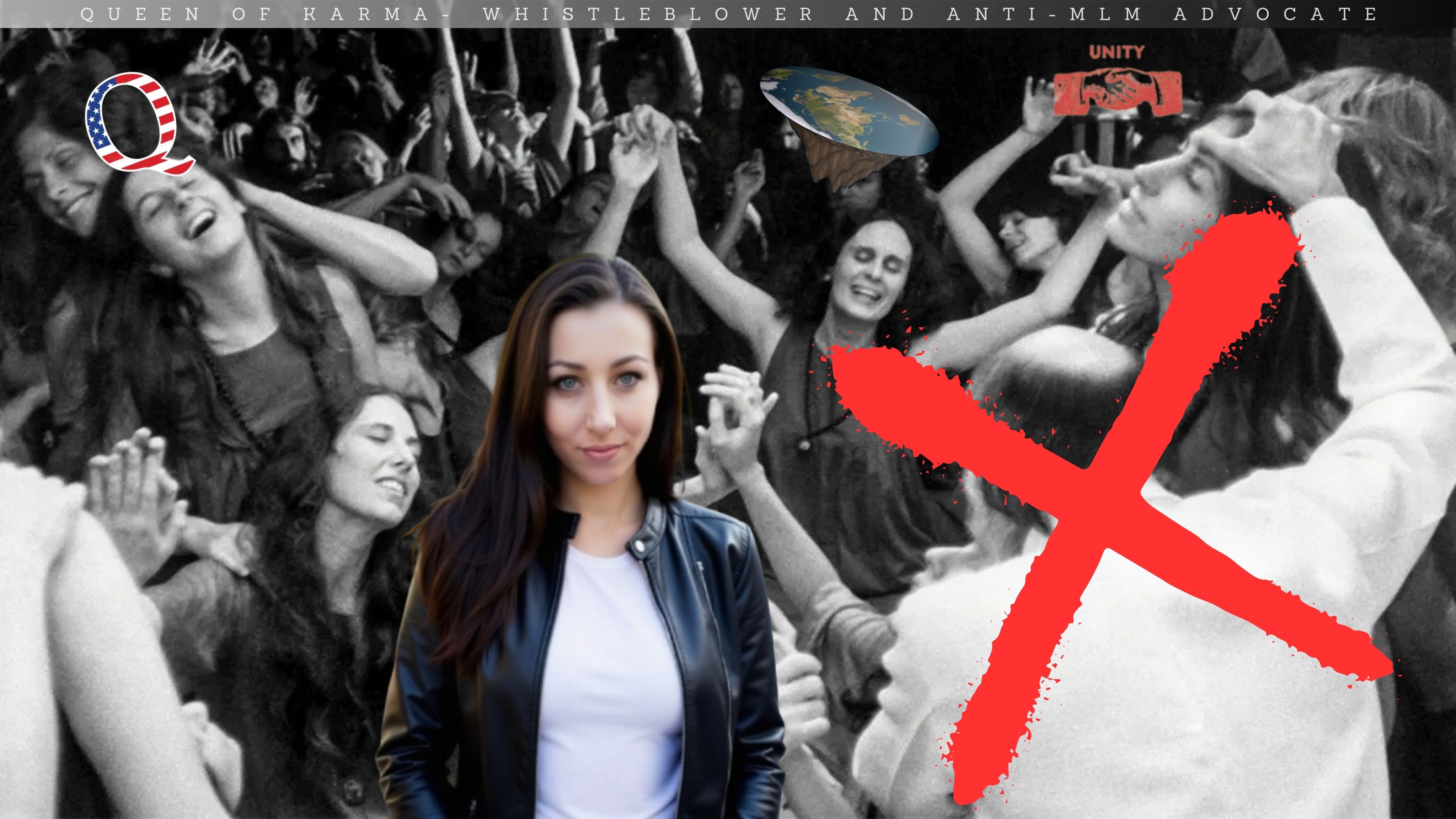
The first time I covered sovereign citizens on my channel, the comments section lit up like a fuse. Not because the information was wrong, or because the examples were exaggerated, but because I had used one word people still don’t understand: cult. The same thing happened when I covered flat earthers. And QAnon. And the pseudo-legal “freeman on the land” mythology that has ruined more lives than it has “liberated.”
Every time, someone would show up insisting I “just cover cults,” as if the term were a branding choice rather than a clinical descriptor. As if calling something a cult were a dramatic flourish instead of a scientifically grounded classification. As if the word only applied to robed followers chanting in a compound under the watchful eye of a charismatic leader.
But here’s the truth: the most dangerous cults today don’t have leaders at all. And that’s exactly why people fail to recognize them.
We are living in an era where belief systems — not individuals — are the ones exerting control. Where online communities enforce doctrine more aggressively than any guru ever could. Where algorithms act as high priests, feeding people the next revelation, the next prophecy, the next hit of certainty.
What about the leaderless cult? The ideological movement that doesn’t need a figurehead because the belief system itself has become the authority. These movements have quietly reshaped the psychological landscape of the digital age and we can no longer ignore it.
From Gurus to Algorithms
For decades, cults were easy to identify. They had leaders — charismatic, magnetic, often narcissistic men who positioned themselves as prophets, saviors, or enlightened guides. Jim Jones, Marshall Applewhite, David Koresh, are all perfect examples. Their faces were the brand. Their voices were the doctrine. Their authority was absolute.
But the internet changed everything.
As communication technologies evolved, influence became decentralized. Social media platforms created ecosystems where ideas spread faster than individuals, and where authority could be crowdsourced. The charismatic leader became optional. The doctrine became the star.
Psychologist Robert Jay Lifton‘s work in 1961 laid the foundation for understanding how belief systems can override autonomy. Lifton studied Chinese re-education camps and identified eight mechanisms of Thought Reform, including “milieu control” (controlling the environment and information), “sacred science” (treating doctrine as unquestionable truth), and “loading the language” (using jargon to shut down critical thinking). His research showed that you don’t need a leader to control people — you need a system that controls meaning.
Margaret Singer later expanded this research, documenting how coercive groups isolate members, overload them with doctrine, and punish doubt. Her interviews with former cult members revealed a pattern: the belief system becomes the authority, and the group becomes the enforcer.
The internet provided the perfect delivery system.
Today, the architecture of a cult can be built by a subreddit, a YouTube pipeline, a Telegram channel, a Facebook group, or an algorithm that learns what keeps you watching. The result is a new kind of cult — one where the belief system itself becomes the shepherd, and the community becomes the enforcer.
When the Doctrine Becomes the Dictator
Flat Earth is the perfect example. There is no prophet, no central figure, no official doctrine. Yet the movement behaves with the same rigidity, defensiveness, and hostility to evidence as any high-control religious group. The belief system has become the authority. The community has become the enforcement arm. And the algorithm has become the evangelist.
Sovereign citizens operate the same way. There is no leader issuing commands. Instead, there is a shared mythology about “secret laws” and “magic words” that promises power to the powerless. The doctrine spreads through YouTube videos, forums, and word-of-mouth, creating a decentralized but cohesive belief system that shapes behavior and identity.
QAnon takes this to an even more extreme level. It is a decentralized prophecy machine, constantly updating itself through collective interpretation. There is no leader — only a narrative that evolves through group participation. It is a cult without a cult leader, a religion without a prophet, a conspiracy without a single author.
This is the new face of coercive control: distributed, crowdsourced, and self-sustaining.
Why People Fall Into Leaderless Cults
People don’t join these movements because they’re unintelligent. They join because the movement meets a psychological need.
Conspiracy psychology research shows that these belief systems offer:
- certainty in a chaotic world
- identity when someone feels unmoored
- community when someone feels isolated
- superiority when someone feels powerless
- meaning when life feels random
Karen Douglas and her team demonstrated that conspiracy beliefs thrive when people feel powerless, uncertain, or disconnected. Conspiracies offer simple explanations for complex realities, a sense of superiority (“I know the truth”), and a community of like-minded believers. If Conspiracy Beliefs thrive in environments of uncertainty and fear, those are the conditions the modern world provides in abundance.
William Swan’s Identity Fusion Research showed that when people fuse their personal identity with a group identity, they will defend the group as if defending themselves. In experiments, fused individuals were more willing to take risks, endure pain, or sacrifice for the group. Their sense of “I” and “we” becomes indistinguishable.
This explains why challenging a belief in these communities feels like a personal attack. The belief isn’t just something they hold — it’s who they are.
Cognitive Dissonance Theory explains why members double down when confronted with contradictory evidence. Leon Festinger infiltrated a UFO doomsday cult that believed the world would end on a specific date. When the prophecy failed, the group didn’t disband. They doubled down. They claimed their faith had “saved the world.” Festinger documented this movement and coined cognitive dissonance — the mental discomfort we feel when reality contradicts our beliefs. Instead of changing the belief, people often change the interpretation of reality.
This is exactly what happens in leaderless cults: evidence becomes the enemy, not the belief.
Leaderless cults weaponize these psychological needs. They offer identity, belonging, and meaning — all wrapped in a worldview that feels empowering.
And here’s the twist: the absence of the leader strengthens the illusion of autonomy.
People believe they are “doing their own research,” even as the ideology dictates their interpretations of reality. They feel empowered while being controlled. Enlightened while being misled. Independent while being deeply dependent on the group for validation and identity.
This is not stupidity.
This is psychology.
How Leaderless Cults Enforce Reality
Again, leaderless cults don’t need a guru to enforce doctrine. The community does it for them. And the science behind that is chillingly clear.
Solomon Asch brought participants into a room with actors pretending to be other participants. They were shown lines on a card and asked which lines matched in length. The actors intentionally gave wrong answers. Shockingly, 75% of real participants conformed at least once, denying their own senses to avoid standing out.
This experiment showed that social pressure can override perception — a foundational mechanism of leaderless cults.
Serge Moscovinci gathered groups of people and had them discuss topics. After discussion, the group’s opinions became more extreme than the individuals’ original views. This is Group Polarization — the tendency for groups to drift toward more radical positions over time.
Online communities amplify this effect exponentially. Every comment, every meme, every video pushes the group further into extremity.
Rebecca MacKinnon coined the term “Networked Authoritarianism” to describe systems where control is distributed across networks rather than centralized in a leader. In these systems, the ideology polices itself. The community becomes the surveillance mechanism.
This is exactly how leaderless cults operate. No leader required. The belief system is the authority. The group is the enforcer.
When Ideas Become Tyrants
Philosophers like Hannah Arendt warned that ideas can become authoritarian when they claim exclusive access to truth, reject falsifiability, and frame dissent as betrayal. In The Origins of Totalitarianism (1951), Arendt described how ideology can become a self-contained universe, immune to evidence and hostile to doubt.
Flat Earth, sovereign citizens, QAnon all exhibit these traits. They do not need a leader because the idea itself becomes the tyrant.
The belief system becomes the judge, the prophet, the moral authority, the identity, the punishment, and the reward. This is the philosophical danger of ideological cults: they create a moral hierarchy where insiders are enlightened and outsiders are deceived. They create a worldview where questioning is betrayal and doubt is weakness. They create a system where the belief is more important than reality.
This is not just a psychological phenomenon. It is a philosophical one.
The Final Experiment: The Perfect Example
If you want to understand how leaderless cults maintain control, look at what happened when the Flat Earth community conducted its Final Experiment — the one that was supposed to be the movement’s triumphant “gotcha” moment. Instead, it became something far more revealing, far more human.
The Final Experiment was a 2023-2024 independent expedition designed specifically to test flat-earth claims using the exact evidence flat earthers themselves said would “prove” or “disprove” their model. It was not a debunking project created by outsiders — it was built around flat earthers’ own criteria, their own demands, and their own definitions of what would count as proof.
According to the expedition’s documentation and Reporting, the project:
- traveled to locations flat earthers claimed would reveal inconsistencies in the globe model
- conducted tests flat earthers said would “settle it once and for all”
- included flat earthers in the process
- livestreamed key portions of the expedition
- focused heavily on the 24-hour sun, because flat earthers insisted that if it existed, their model was impossible.
During the expedition, there was a livestreamed segment where participants — including flat earthers — observed and discussed the 24-hour sun phenomenon. In the Arctic and Antarctic Circles, the sun stays above the horizon for a full 24 hours. On a flat Earth, this is physically impossible. Unlike lasers or gyroscopes or horizon measurements, the 24-hour sun is not something you can hand-wave with “perspective” or “atmospheric lensing.” It is a direct, observable, repeatable phenomenon.
So when the expedition captured the 24-hour sun on camera — clearly, cleanly, undeniably — something extraordinary happened. Several flat earthers admitted, on camera, that the footage disproved their worldview.
Some of the statements included things like:
“I can’t explain this on a flat Earth.”
“This looks like the globe model.”
“This is the one thing I always said would change my mind.”
It was a moment of rare intellectual honesty — the kind of moment that should have been celebrated. A moment where evidence broke through identity. A moment where truth won.
These weren’t outsiders mocking them. These were flat earthers themselves, reacting honestly to evidence they had demanded. This moment was huge — not because it “owned” anyone, but because it showed something incredibly rare: real-time belief in revision in a high-control ideological environment.
But the moment didn’t stay pure for long. The flat earth community didn’t celebrate their honesty. They punished it.
As soon as the livestream circulated, the flat-earth community reacted with rage. Not debate. Not curiosity. Not “let’s look at this together.” Instead, they attacked the people who had changed their minds. They were called:
- traitors
- shills
- government agents
- “controlled opposition”
- “paid actors”
- “sellouts”
Some had their personal information shared publicly maliciously, what the internet refers to as “doxing.” Some were harassed. Some were pushed out of the community entirely and shunned. This wasn’t random cruelty — it was ideological enforcement.
Flat-earthers didn’t need to step in. The community policed itself. This is exactly what sociologists describe as group-enforced reality maintenance — a defining feature of cultic systems, even when there is no leader.
The message in the flat earth cult was unmistakable: You are allowed to question anything — except the belief that defines us.
The flat earthers who changed their minds weren’t weak. They were strong enough to face the truth. But the community they belonged to couldn’t tolerate the strength.
And that is the hallmark of a cult — leaderless or otherwise.
The Cults of Today Don’t Need Leaders, Only Believers
We are living in an era where cults no longer need gurus. They only need believers — people willing to surrender their critical thinking to a worldview that promises certainty, identity, and belonging. And that’s the part people still don’t understand when they tell me I “just cover cults.” They don’t see the machinery behind these movements. They don’t see the psychological hooks, the sociological enforcement, or the philosophical traps that turn ordinary people into defenders of an ideology that doesn’t even have a leader.
But I see it.
I see it every time I leave a community and get backlash.
I see it every time I publish a video or article and the backlash rolls in like a tide.
The anger.
The defensiveness.
The accusations.
The attempts to discredit me, silence me, or twist my motives.
What they don’t realize is that their backlash is the proof.
It’s the ideology defending itself.
It’s the group enforcing its reality.
It’s the belief system lashing out because it cannot tolerate scrutiny.
And that is exactly why I won’t stop covering this.
Leaderless cults thrive in the spaces where people assume “it’s just a conspiracy theory,” or “it’s just a fringe group,” or “it’s just people asking questions.” But there is nothing “just” about systems that override autonomy, punish doubt, and fuse identity with ideology. There is nothing harmless about movements that weaponize uncertainty, exploit vulnerability, and turn community into a tool of coercion. There is nothing trivial about belief systems that fracture families, destabilize communities, and erode trust in institutions.
The psychology we’ve discussed — cognitive dissonance, identity fusion, and the emotional appeal of conspiracy thinking — shows us how easily people can be pulled into these systems. The sociology we’ve explored — conformity pressure, group polarization, and networked authoritarianism — shows us how these systems sustain themselves. And the philosophy we’ve examined — the way ideas can become tyrants — shows us why these systems are so dangerous. All of this points to one truth: we need to start paying closer attention to these movements before they gather more believers.
Leaderless cults are harder to spot, harder to challenge, and harder to dismantle because there is no figurehead to expose, no prophet to debunk, no leader to remove. The power is in the ideology itself and in the community that protects it.
That’s why education and awareness matters. That’s why naming these systems matters. That’s why refusing to soften the language matters. That’s why I keep doing this work, even when the backlash is loud, relentless, and personal.
Silence is how these systems grow. Silence is how they gather believers. Silence is how they become normalized. Silence is how they spread. And I refuse to be silent.
I will keep covering ideological cults — leaderless or otherwise — because the world doesn’t need fewer people calling out cults. It needs more people who understand what a cult actually is. It needs more people willing to confront the systems that manipulate, isolate, and control. It needs more people who can see past the personalities and into the ideology. It needs more people who recognize that the absence of a leader doesn’t make a movement less dangerous — it makes it harder to see.
So yes, I will keep speaking. I will keep exposing. I will keep educating. I will keep shining a light on the systems that thrive in the dark. Because the danger isn’t that these movements have leaders.
The danger is that they don’t need one.
By Beth Gibbons (Queen of Karma)
Beth Gibbons, known publicly as Queen of Karma, is a whistleblower and anti-MLM advocate who shares her personal experiences of being manipulated and financially harmed by multi-level marketing schemes. She writes and speaks candidly about the emotional and psychological toll these so-called “business opportunities” take on vulnerable individuals, especially women. Beth positions herself as a survivor-turned-activist, exposing MLMs as commercial cults and highlighting the cult-like tactics used to recruit, control, and silence members.
She has contributed blogs and participated in video interviews under the name Queen of Karma, often blending personal storytelling with direct confrontation of scammy business models. Her work aligns closely with scam awareness efforts, and she’s part of a growing community of voices pushing back against MLM exploitation, gaslighting, and financial abuse.



Leave A Comment