


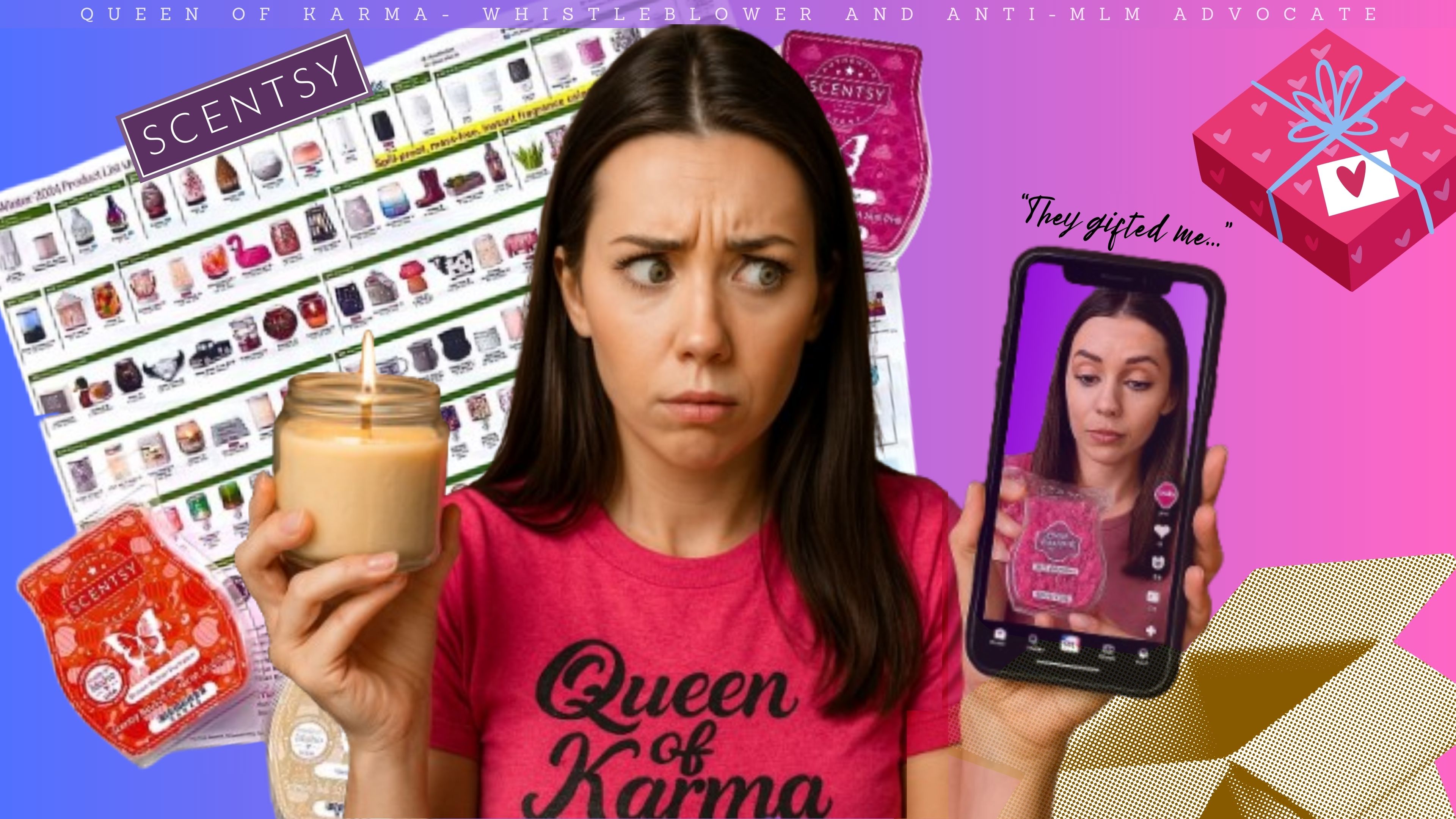
When you’ve lived inside a multilevel marketing (MLM) company, you develop a sixth sense for when something is off. This weekend, that instinct kicked in hard — thanks to DeeCee, an antiMLM creator on YouTube. Her Saturday night livestream broke open a conversation that Scentsy consultants, customers, and ex-consultants like me needed to have: Scentsy is shifting its entire strategy, and they’re doing it in ways that raise serious ethical and regulatory questions.
This is a deep dive from my perspective as an Ex-Scentsy Consultant who recognizes the patterns behind the rebrand, the restructuring, and the sudden influencer push.
How DeeCee Put This on the Radar
DeeCee’s Livestream highlighted a growing trend: Scentsy products appearing in TikTok unboxing videos from influencers who are not consultants, yet are receiving boxes of Scentsy products and promoting them without a clear disclosure that the content is sponsored or gifted. This is not a small issue. This is an FTC compliance problem.
This is also happening at the exact same time Scentsy is restructuring its compensation plan, laying off staff, and tightening consultant requirements — a pattern that often signals instability inside an MLM.
Her coverage was the catalyst for this investigation, and she deserves full credit for bringing the community’s attention to it.
Scentsy’s Shifting Strategy
Scentsy has been quietly reshaping its entire business model over the last year, and the pattern is becoming impossible to ignore. Between restructuring, regulatory pressure, and a sudden pivot in product strategy, the company is signaling instability. Several major shifts have already taken place:
Layoffs at Distribution Centers
On January 3, 2025, Scentsy filed a WARN notice in Texas documenting 94 layoffs at their Coppell, Texas distribution center. This coincided with broader staffing cuts and internal restructuring.
Compensation Plan Changes
Two weeks later, Scentsy announced adjustments to their compensation plan that effectively raise the barrier to entry for new consultants and made it harder for new consultants to stay active or even earn bonuses. The changes included higher PRV requirements, stricter GWV/TWV thresholds, increased active frontline requirements, and tighter enforcement of rank maintenance. This wasn’t a full rewrite — it was a tightening of expectations, which is exactly what MLMs do when recruitment slows and consultant churn rises. YouTube creators have been covering the fallout, including reactions to Scentsy’s leadership addressing the Compensation Plan Changes.
Product Rebranding
Scentsy is consolidating its “pod” products under a new unified label: Scentsy Air. This is a classic MLM move when sales stagnate — rebrand, rename, and relaunch.
A Surprising Pivot: Candles
After years of branding themselves as the “safe alternative to candles,” Scentsy reversed course and launched their Own Candle Line. This shift signals market pressure, brand identity confusion, and a need to expand into mass-market products as core warmer and wax sales decline. It also conveniently aligns with their new influencer strategy — candles are easier to promote in short-form content than warmers and wax systems.
Regulatory Scrutiny: DSSRC Action
On January 15, 2026, The Direct Selling Self-Regulatory Council issued a Formal Recommendation that Scentsy correct misleading earnings claims made by consultants. Twelve separate claims were flagged for failing to clearly disclose how atypical those incomes were. This shows regulators are watching Scentsy more closely — and that consultant behaviour is still a compliance problem.
As an ex-consultant, none of this surprises me. When an MLM starts tightening consultant requirements while simultaneously expanding external marketing, it usually means one thing: the consultant base is shrinking, and the company is trying to compensate.
The Rules: What TikTok & the FTC Require
Before looking at who’s doing disclosures right (and who isn’t), it’s important to understand what the rules actually are. TikTok’s policies and the FTC’s advertising laws overlap, and both are very clear: if you have a relationship with a brand, you must disclose it — visibly, immediately, and in plain language. This isn’t optional. It isn’t “only if you’re paid.” It isn’t “only if you’re an influencer.” It isn’t “only if you feel like it.” If you receive anything of value from a brand and then post about that brand, you are legally required to disclose that relationship.
When You Must Disclose:
A disclosure is required any time there is a material connection between the creator and the brand. A material connection inludes:
- Being paid to post
- Receiving free products (PR boxes)
- Receiving discounted products
- Using an affiliate code or link
- Earning commission from sales
- Being an employee, ambassador, or independent consultant
- Having family or personal relationship with someone at the brand
The FTC is explicit:
If a brand gives you anything of value and you post about them, you must disclose the relationship — even if they didn’t ask you to post.
TikTok enforces the same standard.
How You Must Disclose:
Disclosures must be:
- Clear — plain language like “Ad,” “Sponsored,” “Paid Partnership,” or “Gifted by Scentsy.”
- Unavoidable — viewers must see it without clicking “more.”
- Upfront — at the beginning of the caption or on-screen.
- Easily understandable — not coded, not implied, not hidden.
- Consistent — every time you post about the brand, not just once.
TikTok even provides a Paid Partnership toggle to make this easy.
TikTok creator @themeparkmom provides a clear example of how Scentsy-related content should be disclosed. In her Unboxing Disney’s Scentsy Surprise: Cinderella Collection video, she uses TikTok’s Paid Partnership label and openly states that the item was part of a PR box. The disclosure is visible at the bottom of the video, easy to understand, and impossible for viewers to miss. This is exactly what TikTok and the FTC require: a clear, upfront acknowledgement of the creator’s relationship with the brand.
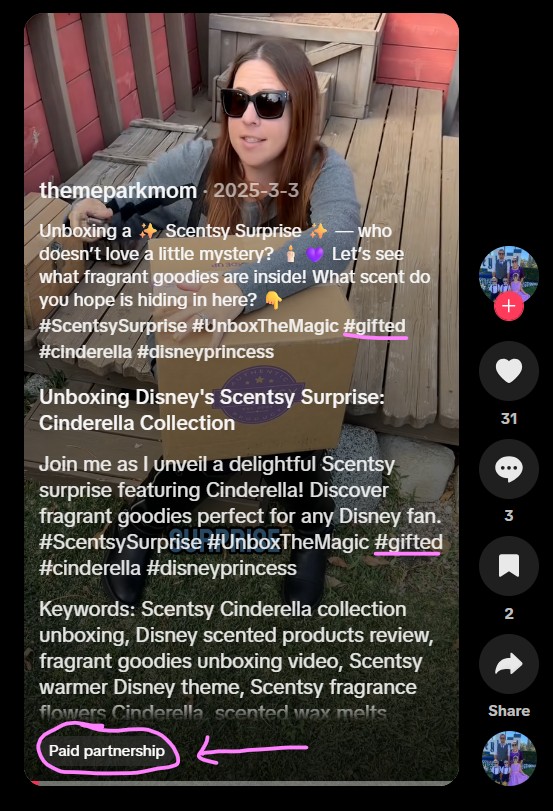
Her video stands out because it demonstrates transparent, compliant advertising — something many other Scentsy-related creators fail to do.
These rules exist for a reason.
Viewers deserve to know when they are being advertised to. Undisclosed ads:
- Mislead consumers
- Create false impressions of popularity
- Hide financial incentives
- Blur the line between genuine enthusiasm and paid promotion
- Give brands free advertising without accountability
- Undermine consultants who follow the rules
In Scentsy’s case, undisclosed UGC and consultant content create a false sense or organic demand at a time when the company is tightening consultant requirements and quietly shifting toward influencer-style marketing.
Scentsy Consultants Still Breaking the Rules
Independent Scentsy Consultants are legally required to disclose when their TikTok content is promotional because they have a material connection to the brand. That connection includes earning commission, receiving perks, getting discounted products, or benefiting financially from any sales generated by their videos. Under both TikTok’s policies and FTC law, that financial relationship means that their posts count as advertising, even if they frame it as attraction marketing or “just showing what I’m warming today.”
TikTok creator @scentswithemily has a page which openly identifies as a Scentsy consultant, yet she uploads product demos, restocks, warm-with-me videos, and lifestyle content that clearly promotes the Scentsy products and brand — all without any disclosure that the posts function as advertising for her business. A great example is her December Whiff Box video.
Without a clear disclosure like “Ad” or TikTok’s Paid Partnership label, viewers can’t tell that the content is tied to a business relationship. That lack of transparency turns the video into an undisclosed advertisement, even if the creator believes she is simply sharing her daily routine.
Another recent Scentsy Unboxing Video shows another common issue: the creator adds #gifted at the very end of the caption, with no on-screen disclosure and no indication in the video itself that the products were provided by Scentsy. She puts a small disclaimer at the end of her caption stating, “Note: I am not a seller of Scentsy but I am a loyal brand shopper and brand partner!” This does not meet TikTok or FTC requirements. Disclosures must be clear, upfront, and impossible to miss — not hidden at the end in a hashtag cloud. When “#gifted” is buried at the bottom, viewers are left thinking they’re watching an organic unboxing, when in reality, it’s still an advertisement tied to a brand relationship.
The Influencer Push: A Quiet Pivot to UGC Creators
While consultants are being squeezed, Scentsy appears to be sending PR packages to influencers and User-Generated Content (UGC) creators — people who are not Scentsy Independent Consultants — and encouraging them to post unboxing videos on TikTok.
“I am not a consultant but…”
One of the clearest examples comes from TikTok creator ScentsyObsessedAU, who openly states:
“I am not a consultant but I can point you in the direction of my consultant.”
Despite claiming she is not a consultant personally, she posts multiple Scentsy unboxing videos, including “LOVE Scentsy delivery days!” and “Love love LOVEEEDDDD this unboxing!” — all tagged with #Scentsy, #unboxing, and #scentsyaustralia, but no disclosure of whether the products were gifted or sponsored.
This is textbook UGC behavior: repeated product promotion, no consultant status, and no transparency about the creator’s relationship to the brand.
“Thank you again to #Scentsy for gifting me items…”
Another example of non-compliant UGC promotion comes from TikTok creator @krystaleverdeen, who posted a Video showcasing Scentsy’s Valentine’s Day and Spring collection. In the caption, she thanks Scentsy for gifting her the items and includes a $10 off affiliate code (“KRYSTAL10”). Despite this clear material connection, the video contains no visible disclosure such as “Ad,” “Sponsored,” “Gifted by Scentsy,” or TikTok’s “Paid Partnership” label.
Under TikTok and FTC rules, both gifted products and affiliate codes require an upfront, unavoidable disclosure. Without it, the video functions as an undisclosed advertisement.
“I got a HUGE package in the mail from Scentsy…”
TikTok creator @jordynsleek, a Disney-focused lifestyle account, posted an Unboxing Of A Scentsy PR Package and mentions in the caption that the box was “gifted.” However, the video contains no clear disclosure that the post is promotional — no “Ad,” no “Sponsored,” no “Paid Partnership,” and no on-screen indication that she received the products through a brand relationship.
A single “gifted” buried in the caption does not meet TikTok’s disclosure requirements. Viewers must be able to immediately understand that the content is tied to a brand relationship, and that standard is not met here.
This pattern makes one thing unmistakably clear: while consultants are held to strict rules and increasingly harsh requirements, Scentsy is simultaneously cultivating a parallel ecosystem of undisclosed UGC promotion. These creators aren’t bound by consultant compliance, they aren’t trained on disclosure rules, and many aren’t following TikTok or FTC guidelines at all — yet their content is being amplified, gifted, and rewarded. And that raises the question Scentsy has avoided answering: why are non-consultants being used to generate hype while consultants are being pushed to the margins?
The Valentine’s Day Sellout
As Valentine’s Day approached, consultants and customers were told the seasonal collection had sold out. Many assumed it was simply high demand — until they opened TikTok and saw creator after creator unboxing full Valentine’s Day PR packages. These weren’t consultants. These weren’t long-time customers. These were influencers and UGC creators who had never sold a single Scentsy bar in their lives.
Consultants in the comments were stunned. Some didn’t even know these products existed. Others had customers waiting on items they could no longer order and then they watched non-consultants gleefully unbox the very products they were told were gone.
One consultant summed it up perfectly:
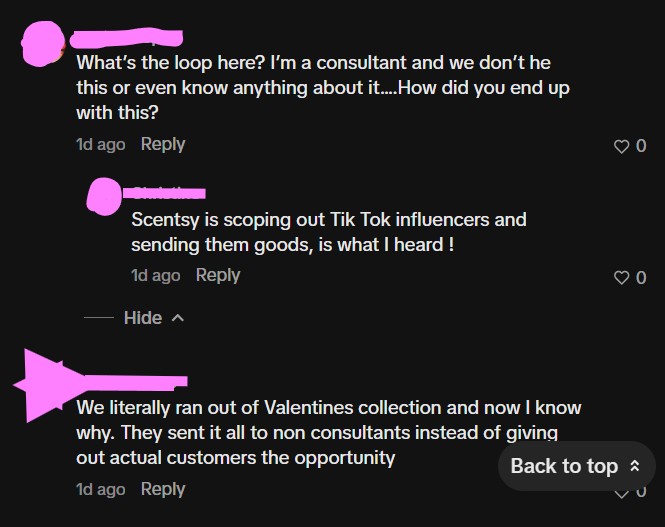
It’s hard to blame them for feeling betrayed. Consultants pay for starter kits, meet monthly minimums, and are expected to be the face of the brand — yet they were shut out of inventory while TikTok creators were stocked up for aesthetic unboxings.
So much for “Scentsy Family,” huh?
The optics are terrible: consultants scrambling to explain shortages to customers while the company’s funnels product to influencers who don’t even disclose their ads properly. It’s a recipe for resentment and Scentsy cooked it themselves.
Why Scentsy Is Doing This — And Why It’s a Problem
Scentsy’s sudden reliance on UGC creators and non-consultant influencers isn’t random. It’s a strategic pivot — one that reveals a lot about the company’s current state and the pressures it’s facing behind the scenes.
Several motivators are driving this shift:
- UGC looks more “authentic” than consultant content.
Consultants are immediately recognized as salespeople. A Disney creator or lifestyle TikToker unboxing Scentsy feels more organic, even when it isn’t. - UGC reaches audiences who avoid MLMs.
Many viewers won’t follow MLM consultants, but they will follow creators in niches like Disney, home decor, cleaning, or cozy lifestyle content. - UGC is cheaper than influencer marketing.
Scentsy doesn’t have to pay these creators. Sending a PR box is far cheaper than paying consultants commission or hiring real influencers. - UGC bypasses the MLM stigma.
Scentsy gets the benefit of influencer-style advertising without the baggage of being an MLM because the creators aren’t tied to the business model. - UGC creates the illusion of mainstream popularity.
When non-consultants post excited unboxings, it makes Scentsy look like a trendy, in-demand brand rather than a struggling MLM tightening consultant requirements.
This pivot creates several major issues:
- Undisclosed advertising misleads consumers.
Viewers can’t tell what’s an ad, what’s gifted, or who is financially connected to Scentsy. - Scentsy is benefiting from non-compliant content.
Many UGC creators are breaking TikTok and FTC rules — and Scentsy is gaining from that lack of transparency. - Consultants are being undercut by outsiders.
Consultants must buy inventory, meet minimums, follow compliance rules, and disclose their financial ties. UGC creators get free products, no rules, and more visibility. - It contradicts Scentsy’s “consultant-first” branding.
If consultants are the heart of the company, why is Scentsy giving free product and hype opportunities to people who aren’t even in the business? - It signals a deeper instability.
When MLMs start relying on non-consultants to generate buzz, it often means consultant engagement — and sales — are declining.
Scentsy is using UGC creators to manufacture the appearance of organic excitement at a time when consultants are struggling and the company is tightening requirements. It’s a marketing shortcut that relies heavily on undisclosed ads, inconsistent compliance, and creators who aren’t bound by the rules consultants must follow.
And it leaves consultants — the people who actually keep the company afloat — watching outsiders receive free product, brand attention, and algorithmic reach while they themselves are expected to pay for the privilege of selling. They have already shown some Pushback when it comes to the recent changes.
How Heidi and Orville Handled the Changes — and the Mixed Reactions
Heidi and Orville Thompson are the husband-and-wife founders of Scentsy, the company’s longtime public faces and executive leaders, known for shaping the brand’s culture, messaging, and consultant-focused identity. They have tried to frame Scentsy’s recent changes as necessary evolution: new product lines, new marketing strategies, new consultant requirements, and a “fresh direction” for the brand. Their messaging has leaned heavily on nostalgia, community, and the idea that Scentsy is still a family-run company adapting to a changing market.
But reactions have been mixed — and that’s putting it lightly.
Among consultants, the response ranges from cautious optimism to outright frustration. Some believe the Thompsons are doing what they must to keep the company afloat. Others feel blindsided by sudden policy changes, reduced earning potential, and the sense that consultants are being deprioritized in favor of influencers and UGC creators.
In the antiMLM community, the reaction has been sharper. Many see these changes as classic MLM behaviour: shifting blame downward, tightening consultant requirements, and using outside creators to mask declining consultant engagement. The candle launch missteps, the DSSRC warning, and the sudden pivot to influencer-style marketing have only fueled skepticism.
The Thompsons’ tone has remained calm and reassuring — but the consultant base is anything but.
A Company in Decline Making Desperate Moves
From my perspective, Scentsy is making a series of reactive, poorly timed decisions that are hurting the very people who keep the company alive. The candle launch was a mess — and I’ve already covered that in detail, you can read that article Here. This new influencer push feels like an extra slap in the face to consultants who are already dealing with shrinking commissions and stricter requirements.
Sending PR boxes to non-consultants while consultants can’t access inventory? Letting UGC creators post undisclosed ads while consultants are held to compliance rules? Tightening consultant agreements while giving free product to people outside the business? It’s not just tone-deaf, it’s disrespectful.
From a consumer protection standpoint, the undisclosed advertising alone is a problem. TikTok and FTC rules exist for a reason: people deserve to know when they’re being marketed to. Scentsy is benefiting from non-compliant content while pretending everything is above board.
From a consultant standpoint, it’s even worse. They’re being asked to do more, earn less, and follow stricter rules — all while watching outsiders get free product, brand attention, and algorithmic reach while they themselves are expected to pay for the privilege of selling.
It paints a picture of a company trying to manufacture hype instead of addressing deeper issues. And if Scentsy doesn’t course-correct, this influencer pivot may end up being remembered not as a bold new direction, but as the moment consultants realized the “Scentsy Family” was more slogan than truth.
At some point, a company has to decide whether it values hype or honesty. Scentsy has made its choice — and consultants are living with consequences. Scentsy can call itself a family all it wants, but families don’t treat their own like this.
By Beth Gibbons (Queen of Karma)
Beth Gibbons, known publicly as Queen of Karma, is a whistleblower and anti-MLM advocate who shares her personal experiences of being manipulated and financially harmed by multi-level marketing schemes. She writes and speaks candidly about the emotional and psychological toll these so-called “business opportunities” take on vulnerable individuals, especially women. Beth positions herself as a survivor-turned-activist, exposing MLMs as commercial cults and highlighting the cult-like tactics used to recruit, control, and silence members.
She has contributed blogs and participated in video interviews under the name Queen of Karma, often blending personal storytelling with direct confrontation of scammy business models. Her work aligns closely with scam awareness efforts, and she’s part of a growing community of voices pushing back against MLM exploitation, gaslighting, and financial abuse.

Leave A Comment