


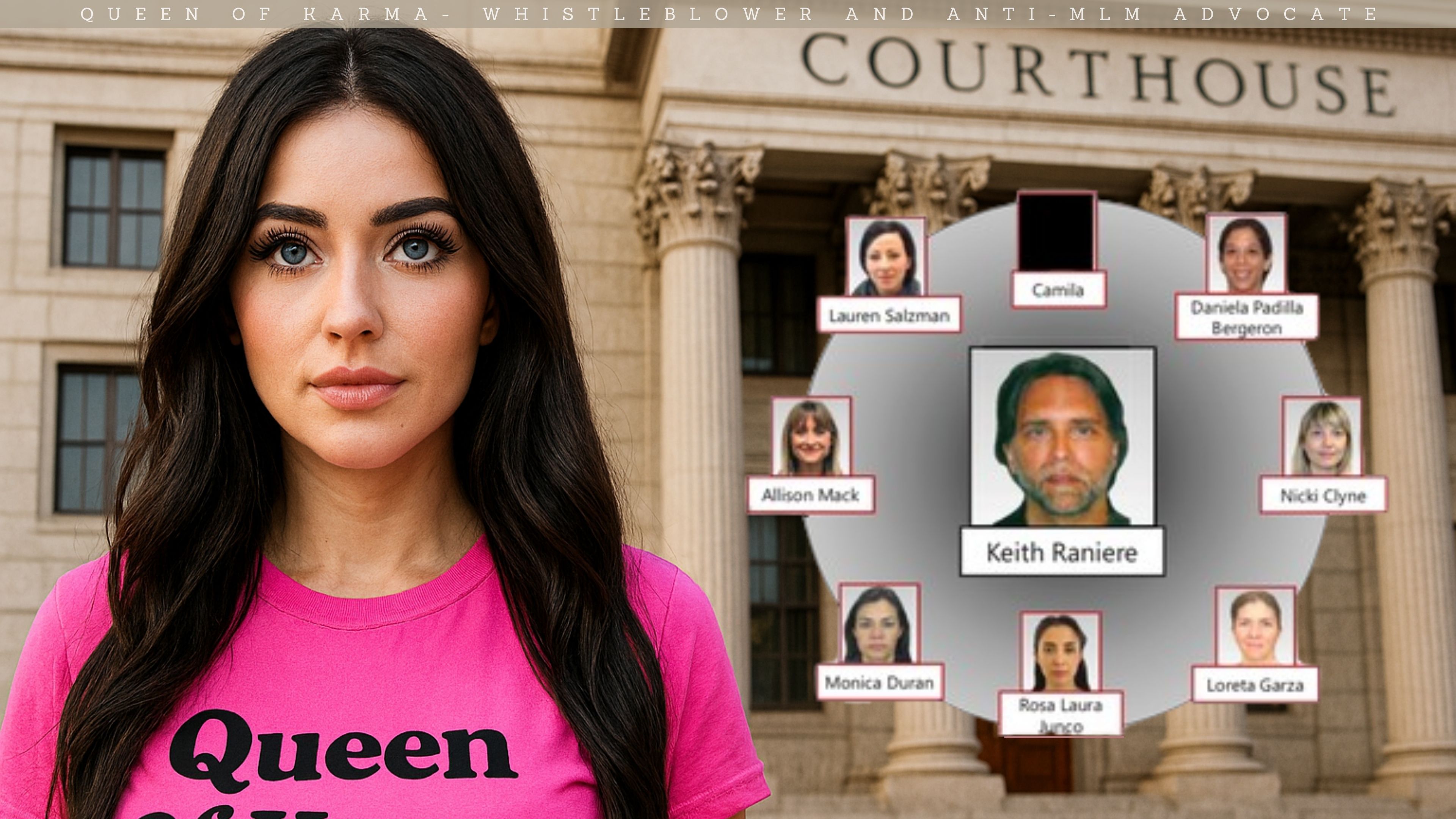
When NXIVM first emerged in the late 1990s, it marketed itself as a self-improvement company offering leadership seminars, personal growth workshops, and “Executive Success Programs.”
The organization used a multi-level marketing (MLM) model to recruit members — promising that those who completed courses could rise in rank, recruit others, and build influence within the group.
On the surface, NXIVM looked like just another high-priced coaching network. But behind the glossy branding and corporate language, it was something far darker: a coercive, high-control cult that used the MLM structure not just to make money, but to entrap, exploit, and abuse.
The Making of “Vanguard”
Keith Allen Raniere was born on August 26, 1960 in Brooklyn, New York, the only child of James Raniere, an advertising executive, and Vera Oschypko, a ballroom dance instructor. When he was five, the family moved to Suffern, New York. His parents separated when he was eight, and his mother died when he was sixteen.
Raniere attended Rensselear Polytechnic Institute (RPI), graduating in 1982 with a degree in physics. Even before NXIVM, he was already experimenting with multi-level marketing. In the early 1990s, he founded Consumers’ Buyline Inc. (CBI), a discount buying club that was shut down in 1996 after being investigated for operating as a pyramid scheme.
This early venture foreshadowed the MLM-style recruitment and hierarchical control that would later define NXIVM. By the time he co-founded NXIVM, Raniere had already honed the skills of charisma, manipulation, and network-driven profit that would become the backbone of his empire.
Raniere adopted the name “Vanguard” when he started NXIVM. According to former members and investigative reporting, the name came from a video game Raniere admired in which the protagonist defeats his enemies by destroying them completely so they can’t rise again. Within NXIVM, this title was framed as a symbol of Raniere’s role as the leader at the forefront of the movement.
This wasn’t just a quirky nickname, it was a psychological tool. In cult dynamics, such titles can help cement the leader’s mystique, discourage dissent, and make followers feel they’re part of something rare and elite.
The Promise of Transformation
NXIVM launched in the late 1998, founded by Raniere (“Vanguard“) with Nancy Salzman (“Prefect“) as his chief lieutenant. The public face was Executive Success Programs (ESP) — a labyrinth of workshops, colored sashes, and rank-based advancement. It looked corporate: seminars, jargon, and “modules.” It was structured like an MLM: pay to enter, recruit to rise, and watch your status hinge on your downline and your obedience. The system used financial buy-in, ritualized ranks, and constant evaluations to create dependency and compliance.
Inside the structure, Raniere cultivated an image of genius, ethicist, and philosopher, while the organization framed itself as a community of the most ethical people in the world. From the outside, it was just another coaching network; from the inside, it was a closed ecosystem with a single center of gravity.
The Pivot to Control
By 2015-2017, a secret subgroup — DOS which stood for “Dominus Obsequious Sororium” (Latin shorthand presented as “Master Over Slave Women“) — took shape. Women were recruited by female “masters” who promised elite mentorship and discipline, but entry required “collateral:” nude images, confessions, damaging secrets that could be used to ensure silence. The alleged sisterhood was in fact a chain of command with Raniere at the apex. Women were branded — physically burned — with a monogram that, when rotated, traced Raniere’s and Allison Mack’s initials. The line between consent and coercion was obliterated by blackmail, sleep deprivation, starvation diets, and the threat of public ruin via their collateral.
When the system finally cracked under scrutiny, what spilled out was not miscommunication but design: the collateral was mechanism, the branding was ritual, and the obedience was the point.
From Recruiter to Enforcer
Allison Mack, a television actress best known for her role on Smallville, joined NXIVM in 2006. Initially drawn in by the promise of personal growth, she rose quickly through the ranks and became one of Raniere’s most trusted inner-circle members.
Mack played a central role in DOS. She acted as a “master,” by recruiting women into DOS under the guise of mentorship. She would manipulate the women into joining DOS and provided their collateral to Raniere.
The women who were recruited into DOS trusted Mack. She was like a female mentor to them and she convinced them to do “acts of care” for their masters and with Raniere, at his request. He would decide what woman he wanted to spend the night with and even if they were married, they were expected to appear, and they did. Mack threatened the women that she would release their collateral if they disobeyed.
The Courtroom Reckoning
In 2018, Keith Raniere was arrested and charged in the Easter District of New York. In 2019, a jury found him guilty on counts that included racketeering, sex trafficking, and forced labor, among other crimes. In 2020, the court sentenced him to 120 years in prison. We “celebrated” his sentencing on my YouTube channel.
The federal case framed NXIVM as a racketeering enterprise that used fraud, extortion, and sex trafficking in service of its leader’s power.
Allison Mack, arrested alongside other senior members, initially pleaded not guilty but later admitted to racketeering and racketeering conspiracy. She acknowledged manipulating women into joining DOS and providing collateral, and cooperated with prosecutors by handing over key evidence. In 2021, she was sentenced to three years in federal prison.
The Public Docket, filings, and Transcripts provide a granular record of how the machine worked and who it harmed.
Voices from the Stand
What follows is not voyeurism; it’s necessary accounting of how a “leadership” brand used coercion and control to break people down. These snapshots come from witnesses whose testimony mapped the mechanics of harm.
- Sarah Edmondson, a Canadian actress was in NXIVM for 12 years, and became one of the biggest whistleblowers in the case. She was recruited into DOS by Laura Salzman in 2017 and subjected to the branding ritual. She later went public — first with law enforcement, then in the CBC podcast Uncover: Excaping NXIVM and her memoir Scarred — providing investigators and the media with critical insight into DOS’s structure, recruitment tactics, and the use of collateral. Her decision to speak out helped trigger the chain of events that led to Raniere’s arrest.
- Mark Vicente, a filmmaker and senior insider, explained the indoctrination architecture and loyalty tests.
- “Sylvie” (pseudonym) described her experience as a DOS “slave,” detailing collateral demands, obedience drills, and the fear that kept her silent.
- Lauren Salzman, daughter of co-founder Nancy Salzman, admitted to recruiting and controlling DOS members and described her own coercive bond with Raniere.
- Daniela testified about immigration and leverage, surveillance, and confinement.
- “Nicole” (pseudonym) recounted being blindfolded, driven to an unknown location, and forced into sexual contact with Raniere.
Mack’s name surfaced repeatedly in testimony, not only as a recruiter but as an enforcer who carried out Raniere’s directives and reinforced the chain of command. Edmondson’s public disclosures, while outside the courtroom, were also instrumental in corroborating these accounts and exposing the pattern of coercion that defined NXIVM.
How They Control
While NXIVM’s crimes were extreme, the psychological architecture it used is not unique. Many multi-level marketing (MLM) companies — even those selling legitimate products — employ coercive control tactics and cult dynamics. NXIVM simply pushed these tactics to their most abusive limits.
Here’s how the process typically unfolds:
- Love-Bombing and Idealism
New recruits are met with overwhelming positivity, promises of transformation, and stories of “ordinary people” achieving extraordinary success. In NXIVM, this came through ESP intensives, glowing testimonials, and the aura of being part of an elite ethical community. - Isolation from Outside Influence
Members are subtly encouraged to distance themselves from “negative” voices — friends, family, or media that question the group. In MLMs, this is often framed as “protecting your mindset.” In NXIVM, critics were labeled “suppressives” or “parasites.” - Financial and Emotional Buy-In
Courses, products, or “training” require significant upfront investment. The more you spend, the more you’re told you’ve proven your commitment. This sunk-cost fallacy makes leaving harder. - Rank and Recognition as Control
Colored sashes in NXIVM, pins and titles in MLMs — these symbols tie self-worth to status within the system. Advancement depends on recruitment and obedience, not independent achievement. - Redefining Consent and Reality
Language is weaponized. In NXIVM, coercion was reframed as “growth” or “commitment.” In MLMs, financial losses are reframed as “investing in yourself” or “paying your dues.” - Collateral and Leverage
NXIVM’s DOS subgroup took this to an extreme with blackmail material. While most MLMs don’t demand nudes or confessions, they often collect personal stories, financial details, and vulnerabilities that can be used to shame or pressure members. - Blame-Shifting
When the system fails, the individual is blamed — for not working hard enough, not believing enough, or not following the system. This keeps the structure blameless and the member striving.
By the time the member realizes they are being manipulated, it’s too late — they’ve already replaced their core values with that of the group and made the MLM their entire identity.
Why We NEED Legal Reform
Current laws in Canada, the U.S., and many other countries focus on financial fraud when regulating MLMs — specifically whether they are “pyramid schemes” under existing statues. But NXIVM shows that the harm can go far beyond money.
The gaps in the law:
- Coercive control is not universally criminalized — While the UK and some jurisdictions have laws against “controlling or coercive behavior,” many countries do not.
- MLM exemptions — In the U.S., the 1979 Amway decision carved out protections for MLMs that sell products, even if recruitment is the real profit driver.
- No oversight of psychological harm — Regulators focus on product legitimacy and income claims, not on isolation, indoctrination, or emotional exploitation.
- Weak disclosure requirements — Most MLMs are not required to provide realistic income statistics, attrition rates, or the percentage of members who lose money.
What reform should look like:
- Criminalize coercive control in commercial as well as domestic contexts, recognizing patterns of manipulation, isolation, and dependency as prosecutable harm.
- Expand pyramid scheme laws to include recruitment-driven models regardless of whether a product exists.
- Mandate transparency — Require MLMs to publish audited income disclosures, dropout rates, and the percentage of members earning net profit.
- Independent oversight— Create regulatory bodies with the power to investigate and shut down organizations showing cult-like control patterns before abuse escalates.
- Ban collateral-based loyalty mechanisms — Any system that collects personal, reputational, or intimate material as a condition of membership should be illegal.
Protecting the Public
In order to protect yourself from these systems, what can you do? Here are some ways to ensure you are not joining a high-control group:
- Vet the structure — If advancement depends more on recruitment than on selling a product people genuinely want, walk away.
- Demand transparency — Ask for audited income disclosures and attrition rates. If they won’t provide them, that’s your answer.
- Beware of love-bombing — Over-the-top praise and promises early on are a manipulation tactic.
- Keep outside connections strong — Isolation is a red flag. Maintain relationships with people outside the group.
- Watch for language shifts — If criticism is reframed as “negativity” or “lack of belief,” you’re in a controlling environment.
- Never give collateral — Whether it’s intimate photos, secrets, or financial details, anything that could be used against you is a tool of control.
- Trust your discomfort — If something feels off, it probably is. High-control groups train you to ignore your instincts — don’t.
Closing Thought
MLMs sell the dream of freedom, but in their most extreme forms — as NXIVM proved — they can deliver captivity instead. The same recruitment ladders and rank systems that promise empowerment can be twisted into chains.
When a business model depends on your loyalty over your liberty, on your obedience over your autonomy, it stops being an opportunity and becomes a trap.
Until our laws catch up, the best defense is awareness — because the most dangerous MLM isn’t just the one that takes your money. It’s the one that takes your voice, your choices, and your sense of self.
And the truth is, that’s the blueprint, not the outlier.
By Beth Gibbons (Queen of Karma)
Beth Gibbons, known publicly as Queen of Karma, is a whistleblower and anti-MLM advocate who shares her personal experiences of being manipulated and financially harmed by multi-level marketing schemes. She writes and speaks candidly about the emotional and psychological toll these so-called “business opportunities” take on vulnerable individuals, especially women. Beth positions herself as a survivor-turned-activist, exposing MLMs as commercial cults and highlighting the cult-like tactics used to recruit, control, and silence members.
She has contributed blogs and participated in video interviews under the name Queen of Karma, often blending personal storytelling with direct confrontation of scammy business models. Her work aligns closely with scam awareness efforts, and she’s part of a growing community of voices pushing back against MLM exploitation, gaslighting, and financial abuse.





Leave A Comment