


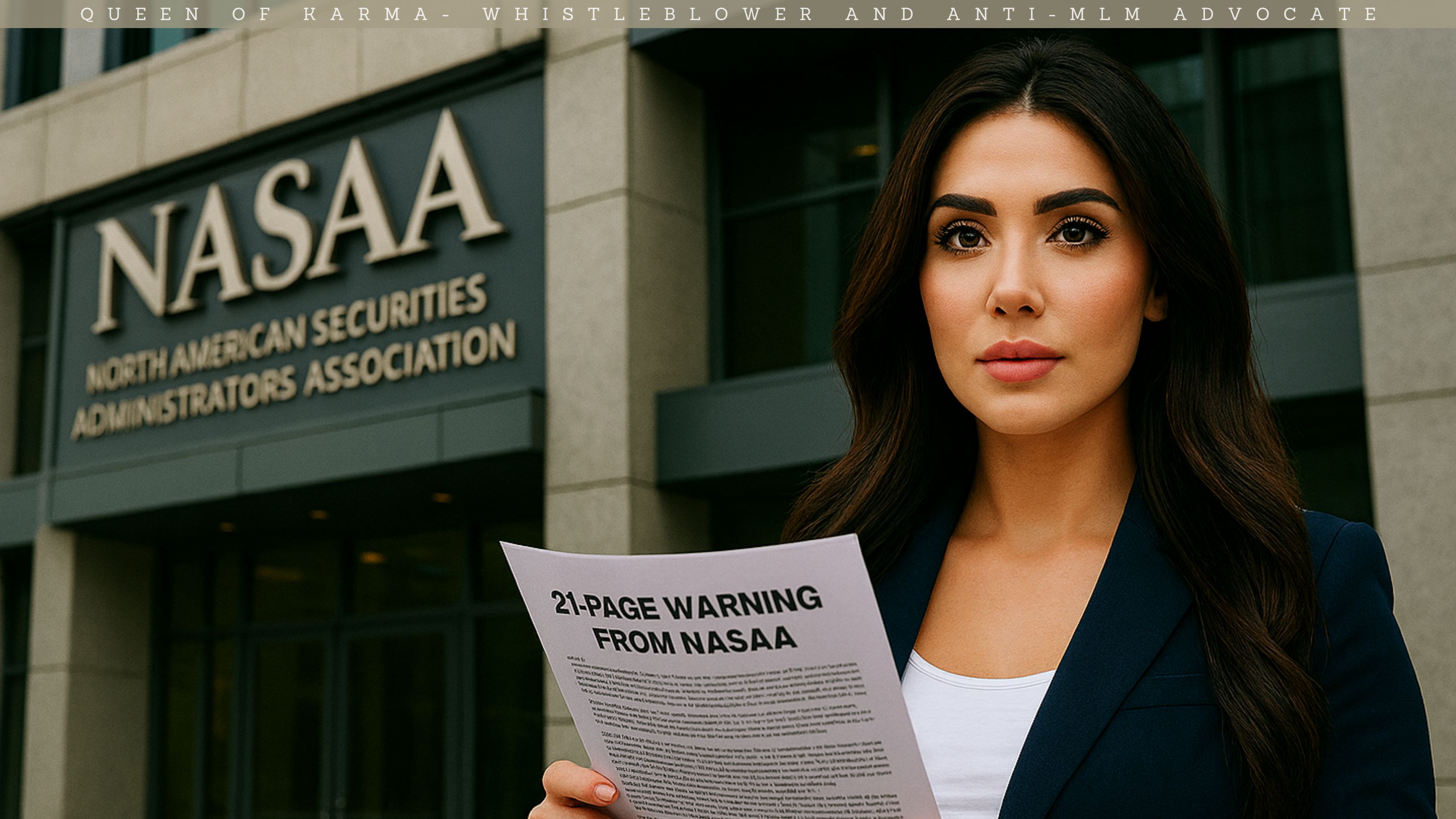
If Congress weakens the state securities regulators, it won’t just be a policy shift — it will be an open invitation for MLM kingpins, crypto con artists, and AI-powered scammers to run wild.
A new 21-Page Warning from the North American Securities Administrators Association (NASAA) lays out exactly how fraudsters exploit legal loopholes, why state-level enforcement is our first and fastest line of defense, and what’s at stake if those powers are stripped away.
From Ponzi-style MLM recruitment networks to unregistered crypto offerings and deepfake-driven investment pitches, the evidence is clear: without strong state action, these schemes grow faster, hit harder, and leave victims with nothing. This isn’t just a regulatory debate — it’s a fight for the financial safety of millions.
Why NASAA
The North American Securities Administrators Association (NASAA) is the umbrella for state and provincial securities regulators in the US, Canada, and Mexico. In the US, these “Blue Sky” regulators are the first responders for investment fraud. They work in administrative, civil, and criminal arenas; coordinate multistate actions; and partner with the SEC, CFTC, FTC, DOJ, and state AGs.
State regulators are closest to the ground, fielding complains first, acting faster, and shutting down local and cross-border schemes before they metastasize. Congress is examining fraud and new technologies. NASAA’s letter urges lawmakers to preserve and expand state authority, not preempt it with federal carve-outs or one-size-fits-all rules that scammers will exploit.
NASAA’s Core Message
NASAA’s thesis is unambiguous: Do not weaken state securities regulators. Preserve their jurisdiction, fund them properly, and modernize the legal toolkit to match today’s fraud — especially MLM-driven crypto schemes, unregistered offerings, and AI-powered deception.
NASAA’s Core Message is:
- Protect state enforcement powers from federal preemption securities and crypto.
- Close exemption loopholes that bad actors exploit (e.g. private placement exemptions misused to sell unregistered, high-risk junk).
- Expand resources and interagency coordination so early warnings become rapid enforcement.
- Update laws for AI-era fraud, deceptive digital marketing, and “influencer” schemes.
- Hold gatekeepers accountable — promoters, attorneys, auditors, exchanges, and payment intermediaries that enable fraud at scale.
The Fraud Landscape NASAA Sees
NASAA’s letter synthesizes years of cases across the states. The pattern is depressingly consistent: MLM structures + crypto hype + online marketing = exponential harm. NASAA highlights a typology that keep repeating, with variations:
- Offering frauds: Unregistered “tokens,” NFTs, or tokenized business pitched as ground-floor chances with “guaranteed” returns.
- Fake trading platforms: Slick dashboards showing unreal gains; withdrawals are stalled, “taxes” or “unlock fees” are demanded, then funds vanish.
- Fraudulent advisory services: Social media “mentors” and telemarketing “signals,” often paired with affiliate layers and referral bounties.
- Ponzi and pyramid schemes: Cash-flow dependence on recruitment, not real revenue, masked by “stalking,” “nodes,” or “mining contracts.”
- Mining and node scams: Contracts for hashpower or nodes that don’t exist or are wildly misrepresented.
- Recovery scams: Secondary schemes targeting prior victims with promises to “unlock” or “recover” funds.
- Commodity and hybrid frauds: Schemes dressed as “precious metals + crypto,” “forex + AI,” or “real estate tokens,” all relying on unregistered solicitations.
Across these categories, the constant accelerant is MLM-style recruitment, which turns personal trust networks into distribution channels for fraud.
The State Authority at Risk
NASAA warns that certain federal proposals — often framed as “streamlining” or “promotional innovation” — would preempt or chill state action. That would be a gift to serial promoters who thrive in regulatory gaps.
- Preemption concerns: Broad federal definitions of “digital assets,” overly permissive safe harbors, or uniform national exemptions could strip states of the ability to halt local offerings and freeze assets quickly.
- Exemption abuse: Loosely policed private offering exemptions (e.g. some forms of Regulation D offerings) are repeatedly abused to raise money from unsophisticated investors, especially when paired with online funnels and affiliate commissions.
- Crowdfunding and marketing frictions: Relaxed advertising rules without tight guardrails on influencer promotions, yield claims, and testimonials open the floodgates to deceptive mass solicitation.
When Congress ties states’ hands, fraud runs longer and digs deeper before federal agencies can mobilize.
Enforcement Track Record and Tools that Work
NASAA underscores that states deliver concrete results: emergency orders, asset freezes, restitution, and criminal referrals that land promoters behind bars. These outcomes hinge on tools the states already have — and could lose if preemption expands.
What gets results:
- Quick injunctive authority: Stop-the-bleed orders that halt sales and preserve assets.
- Licensing and registration oversight: Catching unregistered brokers, advisors, and offerings.
- Advertising scrutiny: Policing deceptive earnings claims, testimonials, and “passive income” hooks.
- Multistate coordination: Simultaneous actions that prevent “jurisdiction shopping.”
What states need more of:
- Budget and headcount for cyber forensics, crypto tracing, and undercover work.
- Data-sharing pipelines with platforms, payment processors, and telecom providers.
- Specialized training for prosecutors and judges on digital asset mechanics and MLM structures.
The message is not “start from scratch.” It’s fund and protect what’s already working.
AI Supercharges Fraud
NASAA flags AI as a force multiplier for every classic scam mechanic:
- Hyper-personalized lures: AI-generated scripts and voice clones that mimic trusted figures.
- Fabricated social proof: Deepfake videos, fake news clips, and synthetic testimonials that pass casual inspection.
- Automated funnel ops: Chatbots that “nurture” leads, drip-feed fake profits, and escalate to “VIP-tiers.”
- Scale and speed: One bad actor can now run thousands of bespoke cons in parallel.
Without AI-aware laws and state-level capacity to investigate fast, we will see more victims, faster losses, and colder trails.
Strengthening the Fight
NASAA’s letter gives consumer advocates something we need: policy ammunition. It formalizes what victims and watchdogs have been saying for years and translates it into legislative asks:
- MLM dynamics are integral to modern investment fraud. Recruitment-driven compensation structures supercharge reach and blur liability. When investment offers ride on those networks, the result is systemic harm, not isolated bad apples.
- State regulators are indispensable. They’re early movers who can issue emergency orders, coordinate multistate actions, and stop the promotion machine before it scales nationally.
- Exemption loopholes are a vector. Many MLM-crypto offerings hide behind private offering exemptions or “utility token” rhetoric. NASAA is telling Congress: tighten the gates, don’t widen them.
- Gatekeepers must face consequences. Influencers, attorneys, accountants, exchanges, OTC desks, payment processors, and “compliance-in-a-box” vendors can’t be allowed to profit from distributing fraud with no accountability.
For consumer advocates, that means our advocacy can be sharper: this isn’t just moral outrage — it’s aligned with the front-line regulators’ blueprint.
Concrete Policy Recommendations
To move from diagnosis to cure, let’s discuss the specific steps consistent with NASAA’s letter.
For Congress:
- Preserve state authority: Reject broad federal preemption in securities and digital assets. States must retain power to investigate, enjoin, and prosecute.
- Narrow exemptions: Tighten private offering rules and add heightened obligations for offerings that pay referral or affiliate compensation.
- Regulate promotions: Mandate clear, prominent disclosures for earnings claims, testimonials, and influencer-paid promotions; ban “guaranteed returns.”
- AI transparency: Require auditable records for AI-generated ads, voice/video, and chat funnel content used in solicitations.
- Gatekeeper liability: Create consequences for repeat enablers — promoters, attorneys, or deceptive offerings.
For federal agencies (SEC, FTC, DOJ):
- Joint task forces with states: Shared intel hubs focused on MLM-crypto hybrids, recovery scams, and social media funnels.
- Advertising sweeps: Coordinated actions against influencers and paid testimonial networks pushing unregistered securities.
- Expedited asset freezes: Faster paths to obtain and honor multijurisdictional freezes with crypto tracing support.
For state regulators:
- MLM-specific guidance: Clarify when recruitment-driven comp turns an “opportunity” into a securities offering.
- Platform MOUs: Direct data-sharing with exchanges, wallets, and payment processors for rapid freeze/trace actions.
- AI forensics investment: Tooling and training to detect deepfakes, synthetic personas, and automated funnel farms.
For platforms and payment intermediaries:
- KYB for promoters: Know-your-business checks for accounts that advertise “returns,” “staking,” or “nodes,” plus affiliate payout monitoring.
- Ad policy upgrades: Ban unregistered investment promotions; require proof-of-registration before campaign approval.
For consumers and communities:
- Trust your skepticism: If it leans on recruitment, promises passive income, or discourages independent verification, it’s a red flag.
- Document everything: Screenshots, URLs, chats, wallet addresses — this evidence accelerates enforcement.
- Report early, report local: Your state securities regulator is the fastest path to action.
Why MLMs and Investment-Style Promotions Should be Illegal
Let’s be precise. The case for prohibition isn’t abstract; it emerges from NASAA’s evidence and the states’ lived experience:
- Built-in asymmetry: MLM structures concentrate gains at the top and distribute losses downward. When wedded to investments, this becomes an engineered wealth transfer.
- Opacity by design: Layered affiliates, tokens, nodes, and “educational packages” obscure the actual product and evade registration.
- Enforcement whack-a-mole: Without upfront bans and strict liability on earnings claims, bad actors simply rebrand and relaunch.
- Externalities on the public: Families, churches, diaspora communities, and seniors pay the cost — financially and socially — while promoters externalize risk.
Policy translation: ban MLM compensation structures for any offering tied to financial returns, and impose strict liability on deceptive earnings or passive-income claims in any consumer context. If it looks like an investment, it must be registered, verified, and policed — or it should not be sold, period.
Bottom Line
NASAA’s letter is a rare, comprehensive signal from the people who actually fight fraud on the ground. It tells Congress to champion the states, close loopholes, modernize for AI, and hold enablers to account. For those of us battling MLMs and crypto schemes, it’s validation and a playbook: protect state power, criminalize investment-style MLMs, regulate the ad funnel, and starve the enablers.
We need to watch for any federal bills that would preempt state actions, expand exemptions without guardrails, or create “innovation” safe harbors for digital assets. We need to demand funding for state regulators, AI-aware ad rules, liability for promoters and gatekeepers, and a clear statutory line banning recruitment-drive compensation in anything resembling an investment.
If we want fewer victims and faster justice, we don’t need to reinvent the system. We need to back the states, tighten the rules, and outlaw the business models that are built to exploit. Let’s keep it up!
By Beth Gibbons (Queen of Karma)
Beth Gibbons, known publicly as Queen of Karma, is a whistleblower and anti-MLM advocate who shares her personal experiences of being manipulated and financially harmed by multi-level marketing schemes. She writes and speaks candidly about the emotional and psychological toll these so-called “business opportunities” take on vulnerable individuals, especially women. Beth positions herself as a survivor-turned-activist, exposing MLMs as commercial cults and highlighting the cult-like tactics used to recruit, control, and silence members.
She has contributed blogs and participated in video interviews under the name Queen of Karma, often blending personal storytelling with direct confrontation of scammy business models. Her work aligns closely with scam awareness efforts, and she’s part of a growing community of voices pushing back against MLM exploitation, gaslighting, and financial abuse.





Leave A Comment