


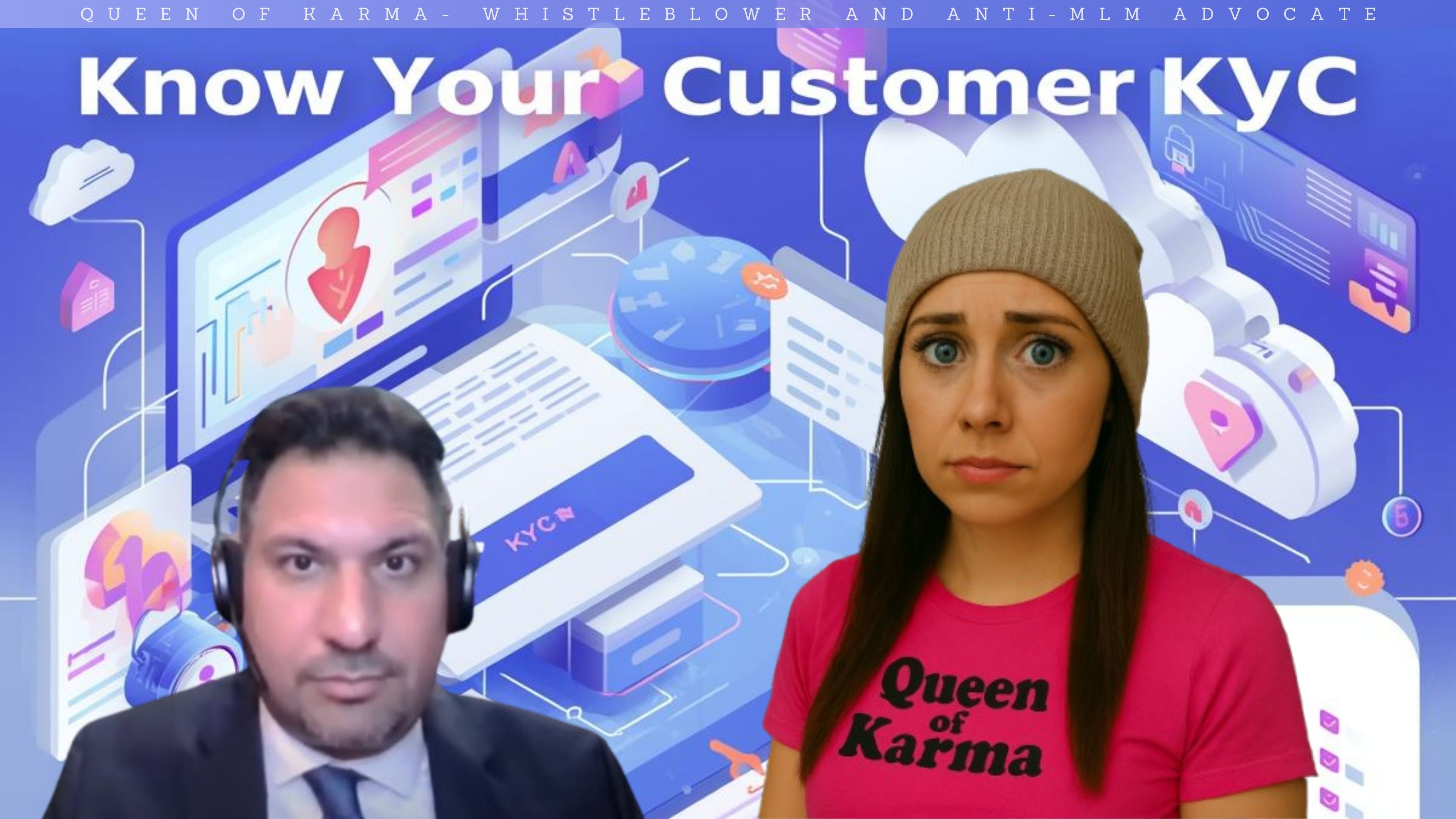
In late 2025, Victory With Ash (formerly known as OnPassive) began aggressively pushing a new requirement: every member must recruit ten people within 100 days, and all ten must complete KYC (Know Your Customer) verification. On the surface, this is framed as a “compliance measure” and a step toward “global legitimacy.” But when you look closer, the demand raises more questions than answers — and none of them are comforting.
KYC is a serious process. It involves handing over government-issued ID, personal details, selfies, addresses, and sometimes even financial information. Legitimate companies only require KYC when they are legally obligated to do so — typically banks, crypto exchanges, brokerages, and regulated financial institutions. OnPassive/Victory With Ash is none of these. So why the sudden push for mass identity collection? Let’s break down the concerns.
What KYC Is — and Why This Doesn’t Fit
KYC exists to prevent money laundering, fraud, and financial crime. It is required when a company:
- handles customer funds
- facilitates financial transactions
- operates as a regulated exchange
- is licensed under financial authorities
OnPassive/Victory With Ash does not operate in any of these categories. It has no verified financial licenses, no regulatory oversight, and no legitimate reason to collect thousands of government IDs.
When a company with no financial product demands KYC, it’s not compliance — it’s a red flag.
The “10 People in 100 Days” Rule Is Not Normal
No legitimate business ties identity verification to recruitment quotas.
This is not how compliance works.
This is not how regulation works.
This is not how KYC works.
The structure looks far more like:
- urgency
- pressure
- coercive control
- pyramid-style expansion
- rapid data harvesting
If the goal were truly identity verification, there would be no need to tie it to recruitment, deadlines, or team-building.
This is the part that raises the most concern.
Possible Motives Behind Unnecessary KYC Collection
There are several reasons a non-regulated company might want to gather large amounts of identity data — and none of them are legitimate.
- Identity Harvesting For Resale
Full KYC packets (“fullz”) are extremely valuable on the dark market. They can be used for:
• opening fraudulent bank accounts
• crypto exchange accounts
• loan fraud
• synthetic identity creation
• SIM swaps
• passport/visa fraud
• money laundering
If a company is collecting thousands of IDs without regulatory need, this is a real risk. - Creating Fake Verified Accounts
Some scam networks use harvested KYC to inflate user numbers, create fake “verified” profiles, bypass exchange restrictions, run bot farms, and manipulate crypto token launches. A massive pool of verified identities is a powerful tool for future fraud. - Psychological Control
Requiring KYC can also be used to:
• make members feel “locked in”
• discourage chargebacks
• create a false sense of legitimacy
• increase compliance
• deepen sunk-cost fallacy
It’s a coercive tactic disguised as “security.”
Ash Mufareh’s History Makes This Even More Concerning
OnPassive has a long track record of opaque operations, unverifiable claims, repeated “launches” that never materialize, and a charismatic-leader-centric structure that encourages compliance over transparency. But there’s an additional factor that raises the stakes even higher:
Ash Mufareh is currently under an eight-year director’s bar issued by the SEC.
A director’s bar means he is prohibited from serving as an officer or director of certain types of companies for the duration of the ban. While the specifics of he bar relate to securities-related conduct, the practical outcome is this:
He cannot legally operate or oversee a business that requires regulated financial compliance — including KYC — until that bar expires.
This makes Victory With Ash’s sudden push for mass identity verification even more suspicious. If the company were truly operating as a regulated financial entity, Ash would be legally barred from running it. Yet he remains the central figure, the public face, and the decision-maker. The company is even named after him!
So we’re left with a troubling contradiction:
- They are demanding KYC as if they are a regulated financial service
- But the person running the operation is barred from running a regulated financial service
- And he company has no licenses, no filings, and no regulatory oversight
This mismatch is not just a red flag — it’s a siren.
Why Would a Company Like This Need Your ID?
If there is no financial product…
If there is no regulatory requirement…
If there is no licensed exchange…
If there is no legitimate reason…
Then the question becomes unavoidable:
What is Victory With Ash planning to do with thousands of KYC documents?
Until the company provides a clear, verifiable, legally grounded explanation, the safest assumption is that the data is being collected for purposes unrelated to compliance — and potentially harmful to the people providing it.
Consumer Warning
If a company:
- cannot explain why it needs your ID
- is not licensed as a financial institution
- ties KYC to recruitment
- pressures you to complete it quickly
- has no transparent leadership
- has a history of unfulfilled promises
You should not hand over your personal documents.
Identity theft is not hypothetical.
It is not rare.
It is not something you can undo once your information is out there.
My Final Thoughts
Victory With Ash’s sudden push for mass KYC collection — tied to recruitment quotas, urgency, and opaque explanations — raises serious concerns about potential identity harvesting and coercive control. Combined with Ash Mufareh’s SEC director’s bar, the contradictions become impossible to ignore.
KYC is not a marketing tool.
It is not a recruitment tactic.
And it should never be used by a company that cannot legally operate a regulated financial service.
Until Victory With Ash provides verifiable regulatory justification, consumers should treat this requirement as a major red flag.
By Beth Gibbons (Queen of Karma)
Beth Gibbons, known publicly as Queen of Karma, is a whistleblower and anti-MLM advocate who shares her personal experiences of being manipulated and financially harmed by multi-level marketing schemes. She writes and speaks candidly about the emotional and psychological toll these so-called “business opportunities” take on vulnerable individuals, especially women. Beth positions herself as a survivor-turned-activist, exposing MLMs as commercial cults and highlighting the cult-like tactics used to recruit, control, and silence members.
She has contributed blogs and participated in video interviews under the name Queen of Karma, often blending personal storytelling with direct confrontation of scammy business models. Her work aligns closely with scam awareness efforts, and she’s part of a growing community of voices pushing back against MLM exploitation, gaslighting, and financial abuse.






Leave A Comment