


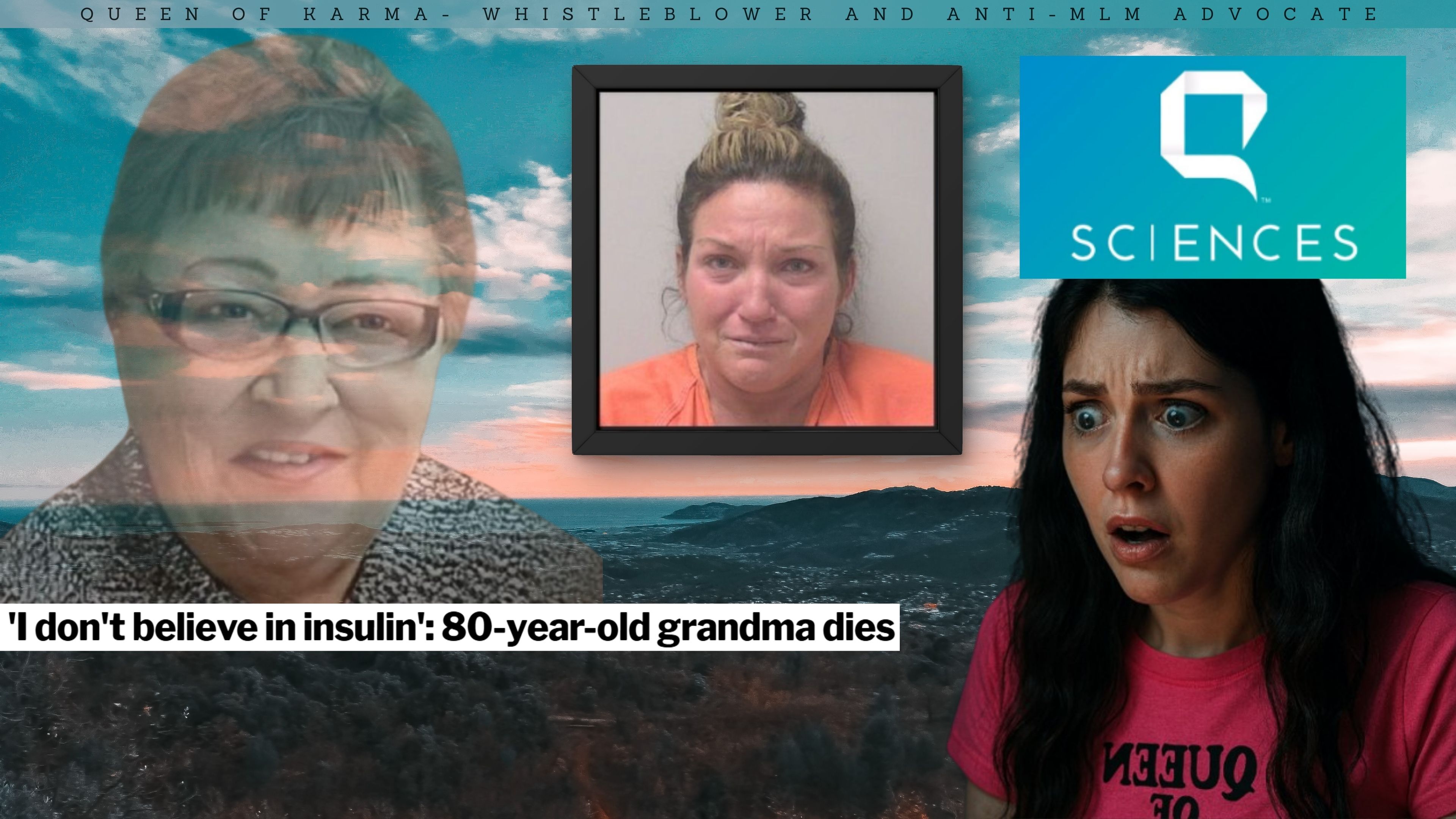
When 80-year-old Alene V. “Tudi” Schrader died in Wisconsin, the tragedy was not a medical mystery. It was the foreseeable outcome of a belief system that has been spreading quietly through supplement culture, MLM wellness communities, and social media “natural healing” spaces for years. Her 38-year-old granddaughter, Kandise L. Sheahen, a licensed nurse who sold Q Sciences products, made the deliberate choice to replace evidence-based diabetes care with supplements and prayer routines she promoted on social media. The result was fatal.
This case is not simply about one caregiver’s poor judgement. It is about the collision of MLM wellness ideology, anti-medical sentiment, and unregulated supplement marketing — a collision investigators recognized immediately.
A Fatal Belief System and A Facebook Post
According to Investigators and Reporting, Kandise openly stated she “didn’t believe in insulin.” Despite her medical training, she withdrew her grandmother, Alene Schrader, from proper diabetes management. Alene was found passed away in her home on January 8, 2022 after police responded to an emergency call. Police alleged Alene’s diabetic condition was mismanaged by her granddaughter, Kandise Sheahen.
In the weeks leading up to her death, Alene experienced prolonged hyperglycemia and paramedics, who were called to the home numerous times, were prevented from checking her vitals when they arrived to help. Kandise was a registered nurse but she replaced her grandmother’s prescribed pain medications — including insulin, blood pressure, and pain medications — with non-FDA-approved supplements she was selling online.
The autopsy revealed that Alene passed away from diabetic ketoacidosis, worsened by an existing COVID-19 infection and underlying cardiovascular disease. Investigators also found social media posts by Kandise suggesting she had reduced her grandmother’s insulin while promoting her supplements, which raised suspicions and led to a police investigation.
The deeper story lies in the ideology behind her choices — and the marketing machine that shaped them.
During the investigation, police uncovered a Facebook post that became a turning point in the case. In it, Kandise publicly promoted Q Core, a supplement bundle sold by the MLM company Q Sciences, writing:
“12 days on Q Core and my 81-year-old Grandma is down on her insulin and off her Tylenol.”
This was not a private message. It was a public advertisement.
When confronted in the interrogation room, she did not deny making the post. Instead, she attempted to reframe it, saying:
“What that post was was an advertising thing.”
This admission is critical. It confirms she was actively promoting Q Core, using her grandmother’s health as marketing content, and making medical-adjacent claims to sell supplements. It also shows she understood the post was promotional — not a factual medical update — even as her grandmother’s health deteriorated.
The Interrogation: Q Core and Q Sciences Take Center Stage
In an Interrogation Video posted on YouTube on February 5, detectives directly confronted her about Q Core. One investigator said:
“I believe it’s Q Sciences, right?”
Police do not name specific MLM companies unless they have evidence — whether from product labels, social media activity, or witness statements. The fact that Q Sciences was mentioned at all shows investigators recognized the role of MLM wellness ideology in this case.
The detective then pressed her about the Facebook post, explaining:
“In your post…you said grandma’s been on [Q Core] for 12 days and that we’ve dramatically seen her levels decrease.”
He then pointed out that her grandmother’s blood sugar readings were dangerously high, contradicting the narrative she presented online. He said:
“The numbers that are in her meter…the medial establishment would say that those numbers are extremely high.”
Kandise pushed back, insisting:
“Two to three hundred is where she did the best.”
This directly contradicts medial standards. It also reflects a mindset shaped by supplement-driven ideology — one that reframes symptoms to fit the narrative rather than adjusting the narrative to match reality.
When the detective asked why she never mentioned Q Core earlier in the interview, she responded:
“The vitamins — they’re over the counter.”
But the issue was never whether Q Core was over the counter. The issue was that she publicly claimed her grandmother’s insulin use had decreased because of it, and she admitted the post was promotional.
What Is Q Core and What Is Q Sciences
Q Core is a daily supplement bundle marketed by Q Sciences as a foundational wellness system. It typically includes a multivitamin, gut-health capsules, and anti-inflammatory or “stress support” supplements. Like most MLM wellness products, Q Core is not approved to treat or manage medical conditions, yet distributors frequently make medical-adjacent claims in their marketing.
Q Sciences presents itself as a wellness and lifestyle company, but its business model is built on the classic multi-level marketing structure. Instead of relying on traditional retail, the company recruits distributors who are expected to purchase products, promote them online, and recruit others beneath them. Income is tied not only to personal sales but to the size and productivity of the downline, creating a system where recruitment is often more profitable than product sales.
Q Sciences relies heavily on emotional testimonials, before-and-after stories, and personal health claims. Distributors are encouraged to frame supplements as transformative, often using language that blurs the line between marketing and medical advice. This is why Kandise’s Facebook post fit the MLM pattern so precisely. She wasn’t just sharing a personal update — she was selling a worldview.
These narratives, that products such as Q Core have life-changing results, are not created by medical professionals or backed by clinical evidence; they are generated by distributors who are financially incentivized to present the products as transformative. This creates an environment where exaggerated claims, medical-adjacent language, and “natural healing” rhetoric become normalized. Distributors are encouraged to frame themselves as wellness guides, even when they lack the training to do so.
Despite the controversy surrounding its products and the role Q Core played in this case, Q Sciences is still an active MLM company. In fact, the company recently underwent a major ownership shift. Industry reporting shows that Q Sciences was purchased by Awakened founder Rodney James, and Awakened’s products are now being sold through Q Science’s platform. The company continues to market Q Core as a flagship wellness product.
This means the same testimonial-driven marketing system that influenced Kandise’s decisions is still active today. The same supplement bundle she advertised is still being sold. The same ideological framework — distrust of medicine, glorification of “natural healing,” and reliance on personal testimonials — continues to shape the company’s culture.
MLM Wellness Culture as a High-Control Belief System
MLM wellness companies often promote a belief system that includes distrust of doctors, glorification of “natural” solutions, and the idea that pharmaceuticals are harmful. Distributors are encouraged to act as health coaches, even when they lack the training to do so. They are rewarded socially and financially for promoting supplements as superior to evidence-based treatment.
The culture surrounding Q Sciences mirrors that of many wellness-focused MLMs: distrust of conventional medicine, glorification of supplements, and the belief that “natural” solutions are superior to clinical treatment. This ideology is reinforced through team calls, private Facebook groups, and distributor training materials that emphasize mindset, belief, and personal transformation. This ideology can override medical training, objective data, and even the visible decline of a loved one. In the interrogation, Kandise repeatedly minimized her grandmother’s dangerously high blood sugar levels, insisting they were normal for her. She reframed medical danger as stability, a hallmark of belief systems that prioritize ideology over evidence. Over time, this creates a high-control environment where members feel validated for rejecting medical advice and encouraged to view themselves as part of a healing movement.
This is the context in which Kandise’s Facebook post was created. It was not an isolated moment of poor judgement. It was part of a larger marketing culture that encourages distributors to present supplements as solutions to serious health issues, often blurring the line between wellness promotion and medical advice. Understanding Q Sciences as an MLM is essential to understanding how a trained nurse could come to believe that a supplement bundle was a viable alternative to insulin — and why that belief had such devastating consequences.
This case is not isolated. Across North America, similar tragedies have occurred when caregivers replace medical treatment with supplements, essential oils, detox regimes, prayer routines, or MLM wellness products. The supplement industry is largely unregulated, and MLM companies rely on distributors to make claims the company itself cannot legally publish. Vulnerable people — children, the elderly, the chronically ill — become test subjects in someone else’s belief system.
A Sentence That Ignores the Bigger Problem
A jury in Wausau, Wisconsin found 38-year-old Kandise Sheahen guilty of neglect causing the death of her grandmother, Alene Schrader, in May of 2025. When the case reached sentencing late that August, the outcome felt painfully small compared to the harm that had been done. Prosecutors argued that the choices leading to Alene’s death warranted six years in prison, yet the judge handed down just nine months in jail and six years of probation. For a preventable death caused by deliberate medical neglect, the punishment felt disconnected from the reality of what happened.
What makes the outcome even harder to reconcile is that the larger system influencing those decisions faced no accountability at all. Q Sciences — the MLM company behind the Q Core supplements she promoted — continues to operate without interruption. The company has undergone ownership changes, expanded its product line and still markets Q Core as a foundational wellness system. The same testimonial-driven culture that shaped her beliefs remains intact, untouched, and unexamined.
The legal system treated this tragedy as the isolated actions of one caregiver, rather than the predictable result of a belief system aggressively marketed through MLM wellness culture. Kandise was held responsible for her role, but the corporate structure that encourages distributors to distrust medicine, glorify “natural healing,” and make medical-adjacent claims to sell supplements faced no scrutiny. The sentencing punished the individual while ignoring the industry that helped create the conditions for her death.
Until MLM wellness companies are held accountable for the belief systems they promote, cases like this will continue to be framed as personal failures instead of symptoms of a much larger, deeply harmful system.
A Preventable Death — and a Warning
Alene Schrader’s death was preventable. It happened because a caregiver, influenced by supplement marketing, MLM ideology, and anti-medical belief, chose ideology over evidence. The interrogation video, the Facebook post, and the investigators’ direct reference to Q Sciences all point to the same conclusion: MLM wellness culture played a significant role in this tragedy.
This case should spark national conversation about regulating supplement claims, holding MLM companies accountable, protecting vulnerable adults from ideological harm, and educating the public about medical misinformation. Until we confront the systems that enable this kind of neglect, more families will face tragedies just like this one.
At least Kandise is never allowed to act as a nurse or promote another MLM product again.
By Beth Gibbons (Queen of Karma)
Beth Gibbons, known publicly as Queen of Karma, is a whistleblower and anti-MLM advocate who shares her personal experiences of being manipulated and financially harmed by multi-level marketing schemes. She writes and speaks candidly about the emotional and psychological toll these so-called “business opportunities” take on vulnerable individuals, especially women. Beth positions herself as a survivor-turned-activist, exposing MLMs as commercial cults and highlighting the cult-like tactics used to recruit, control, and silence members.
She has contributed blogs and participated in video interviews under the name Queen of Karma, often blending personal storytelling with direct confrontation of scammy business models. Her work aligns closely with scam awareness efforts, and she’s part of a growing community of voices pushing back against MLM exploitation, gaslighting, and financial abuse.

Leave A Comment