



Imagine a system that claims to decode your soul’s blueprint using a mix of astrology, quantum physics, and ancient wisdom. Human Design promises clarity, purpose, and transformation—but beneath its mystical allure lies a story of radical beliefs, charismatic leadership, and growing controversy.
Before you dive in, ask yourself: is this spiritual awakening or something far more complex?
The Human Design System, a contemporary esoteric framework for personality analysis, claims to synthesize the wisdom of ancient disciplines such as astrology, the I Ching, Kabbalah, and the chakra system, with concepts from quantum physics and genetics. Emerging in the late 1980s, it was channeled by Ra Uru Hu (born Robert Allan Krakower) following a period of purported mystical revelation. Through its intricate charts, unique typologies, rituals, and apocalyptic prophecies, Human Design has cultivated a robust global following as well as a legion of critics. This report offers a comprehensive analysis of Human Design, spanning its belief structure, philosophical syncretism, founder’s biography, contemporary leadership, and the system’s cult-like dimensions. The discussion contextualizes Human Design alongside both supportive and critical perspectives, drawing on an extensive array of sources to scrutinize its claims, appeal, controversies, and broader social impact.
Core Principles and Belief Structure of the Human Design System
At its core, Human Design is presented as a sophisticated amalgam of multiple systems of thought. Its tenets claim to integrate astrology’s planetary archetypes, the binary and holistic philosophy of the I Ching, Kabbalah’s Tree of Life energy flows, the chakra system’s mapping of the subtle body, and the conjectural role of quantum physics and genetics. The guiding proposition is that each individual’s birth data—date, time, and location—unlocks a unique energetic imprint (“Design”) that determines one’s optimal life path, personality traits, and decision strategies.
Human Design asserts that every person is a microcosm of the cosmos, imprinted by universal energies at birth, and that understanding your chart (the BodyGraph) empowers you to live a life of authenticity, ease, and effectiveness. Proponents claim that following your chart’s prescription is akin to “deconditioning”, a process of removing societal and familial influences in order to fulfill one’s true potential.
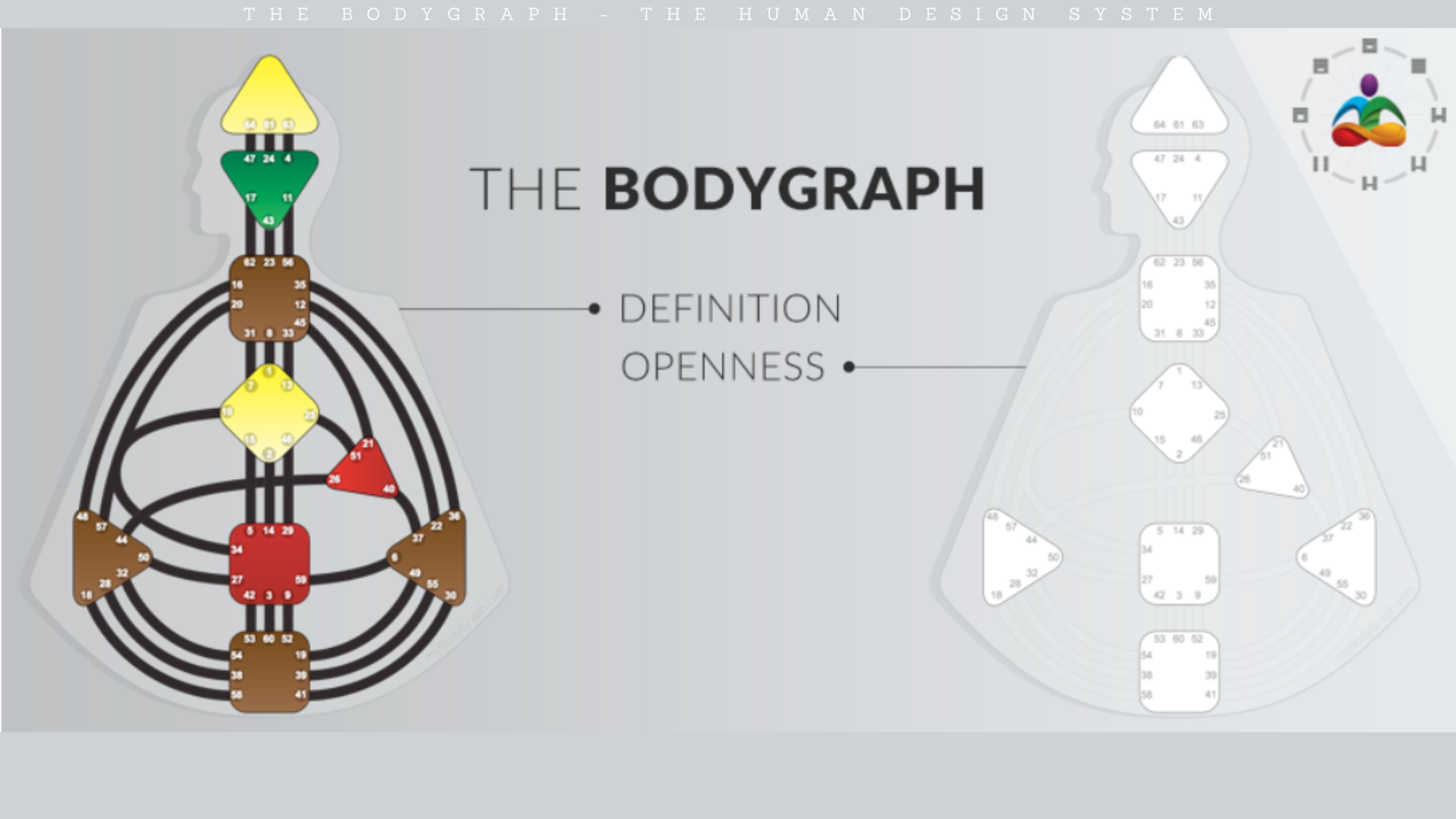
The central artifact of Human Design is the BodyGraph, a chart inscribed with nine Centers (analogous to chakras), 64 Gates (referencing the I Ching’s hexagrams and the 64 codons of DNA), and 36 Channels (paths between Centers). The Mandala, a wheel surrounding the BodyGraph, fuses the astrological zodiac and the I Ching’s archetypes, visually mapping planetary positions to energetic imprints.
This synthesis is not merely metaphoric; Human Design posits an actual correspondence between the 64 I Ching hexagrams and the 64 codons in human DNA. This purported parallel is core to its claim that the chart expresses something akin to a “genetic code for consciousness”, though critics dismiss this analogy as unscientific and selectively interpretive.
Human Design categorizes humanity into five main “Types”, each with an associated strategy for engaging with the world and a unique energy dynamic:
• Generators (and the sub-type Manifesting Generators): The majority, said to harbor sustained energy for work, creativity, and mastery, with a strategy to “respond” to life rather than initiate action.
• Manifestors: The initiators and leaders, tasked with informing others before acting to avoid resistance.
• Projectors: Guides and leaders adept at optimizing systems and people, who must “wait for recognition or invitation” before their influence is effective.
• Reflectors: The rarest type, mirrors of the community’s energy, whose strategy is to wait a full lunar cycle for clarity in decision-making.
Each chart also specifies an internal “Authority” (e.g., Emotional, Sacral, Splenic, Ego, Self-Projected, Mental, Lunar), dictating how one should make decisions based on their energetic configuration rather than mental analysis.
The BodyGraph’s nine Centers (Crown/Head, Ajna, Throat, G Center, Ego/Heart, Solar Plexus, Sacral, Spleen, Root) are the loci of different life themes: thought, identity, expression, willpower, emotions, life-force, survival, and pressure, respectively. Centers can be “defined” (consistent energy) or “undefined/open” (variable energy), and this configuration is said to account for an individual’s strengths, vulnerabilities, and how they relate to others.
Within each Center are “Gates”, each corresponding to an I Ching hexagram and mapped to an astrological position at birth. Gates represent specific energetic qualities and traits. When two Gates on either end of a “Channel” are both activated, this forms a fixed pathway conferring greater definition to the Centers involved, shaping core personality dynamics and roles.
Adding a veneer of scientific credibility, Human Design invokes quantum physics—notably, the neutrino, a subatomic particle with minuscule mass, discovered to pass through all matter in vast quantities. Ra Uru Hu claimed that neutrinos “imprint” individuals at the time of birth with information filtered through planetary positions, thus forming the basis of the Human Design chart. Neutrino streams are described as the “breath of the stars”, carrying “universal data” that constructs the unique personality and life path.
These claims, while imaginative, are highly speculative. No scientific evidence exists that neutrinos function in such a capacity; their invocation is metaphorical rather than empirically validated, and physicists reject the suggestion that neutrino flow encodes personality or identity.
Alongside Type and Center configurations, each Human Design chart includes:
• Profile: A combination of two numbers (drawn from the lines of the Sun and Earth gates) signifying an individual’s life theme, learning style, and social role.
• Incarnation Cross: Derived from key cosmic positions at birth, this is the ostensible “life purpose” or spiritual motif.
• Authority: As described, one’s unique mechanism for making aligned decisions—ranging from emotional waves to splenic intuition to ego-drive.
These elements combine to provide a “roadmap” for how one is supposed to navigate life, make choices, and relate to others, all in accordance with their cosmic imprint as determined by the time and place of their birth.
Human Design proponents frame the system as a “science of differentiation”, promising a liberating self-knowledge that renders obsolete the “one-size-fits-all” guidance of traditional psychology and self-help. By following one’s chart—living one’s Strategy and Authority—one reportedly sheds social or familial “conditioning” and lives more authentically, harmoniously, and successfully. Practitioners apply Human Design in career coaching, leadership, parenting, and even medical and therapeutic domains.
The Syncretic Fabric: Integration of Astrology, I Ching, Kabbalah, Chakras, and Modern Science
Astrological calculation forms the temporal scaffold of every Human Design chart. The precise positions of the planets at the moments of birth (and about three months prior, to account for Design and Personality aspects) determine which Gates are activated and provide the timing for the mandala’s overlay. Yet, Human Design’s astrological reading departs from Western astrology’s focus on zodiac signs and houses. Instead, planets are recast as “teachers,” dispensing particular lessons in different Centers; for example, Mercury “teaches communication,” Venus “teaches about values and society,” Mars about “energy dynamics,” and so forth.
The calculation of the BodyGraph thus maps planetary positions directly onto the personality structure, yet the interpretive lens is recast entirely in Human Design’s proprietary language.
The I Ching, aka Book of Changes, is central to Human Design’s inner mechanics. Its 64 hexagrams are mapped one-to-one onto the 64 Gates of the BodyGraph, each Gate representing an archetypal energy, potential, or behavior. Each individual’s chart is a subset of 64, determined by birth data, which are considered the fixed potentials (or “talents, gifts, and skills”) a person may express organically. Within this matrix, Human Design makes recurring use of the I Ching’s yin-yang duality, rendering personality as a function of both inherited energy and environmental influence.
Moreover, the I Ching’s “lines” (subdivisions within each hexagram) are employed to create the “Profile” component, adding narrative and symbolic roles to each chart (the “Investigator/Martyr,” “Hermit/Opportunist,” “Role Model/Heretic,” etc.).
Kabbalah’s mystical Tree of Life, comprising ten interconnected sephiroth, is reinterpreted in the Human Design system as the template for the nine Centers and 36 Channels. The Centers are mapped to the sephiroth, albeit with adaptation; for example, the G Center (Identity) is linked to Daath (knowledge and self-expression), the Sacral Center with Yesod (foundation/life force), and so on. The 22 paths connecting the sephiroth find a parallel in the BodyGraph’s Channels, mapping flows of energy and emergent behavior.
It is important to note, however, that these correspondences are not rigorously preserved; rather, the Kabbalistic system is used metaphorically to add spiritual gravitas and a cosmological logic to the BodyGraph.
While classical Hindu-Brahmin teachings describe a seven-chakra system arrayed along the spine, Human Design posits that a mutation occurred in human evolution coincident with the discovery of Uranus in 1781—resulting in a “nine-centered” human. Here, the original chakras are split: the Heart, for instance, becomes the G Center (identity) and Ego/Will Center (willpower), and the Solar Plexus is reframed as both a motor and awareness Center (emotional/spirit consciousness) distinct from the Spleen (physical/survival consciousness).
This nine-centered model is said to map the energetic and consciousness potentials of “modern man” and provides the anatomical basis for Human Design’s energetic typology—each Center tied to attributes such as communication, instinct, emotion, identity, and so forth.
To place Human Design comfortably alongside contemporary scientific discourse—and thereby bolster its appeal to a skeptical, scientifically informed audience—Ra Uru Hu invoked quantum physics, particularly the notion of the neutrino stream, as an explanatory mechanism for astrological imprinting. The system also aligns its 64-Gate logic with the 64 DNA codons, suggesting a hidden harmony between ancient divinatory systems and cutting-edge biology.
Yet, both critics and scientifically literate proponents acknowledge that these connections are predominantly metaphorical; there is no empirical support for the claim that neutrinos carry coherent information based on planetary positions, or that the I Ching’s symbolic code can be mapped directly to genetic structures.
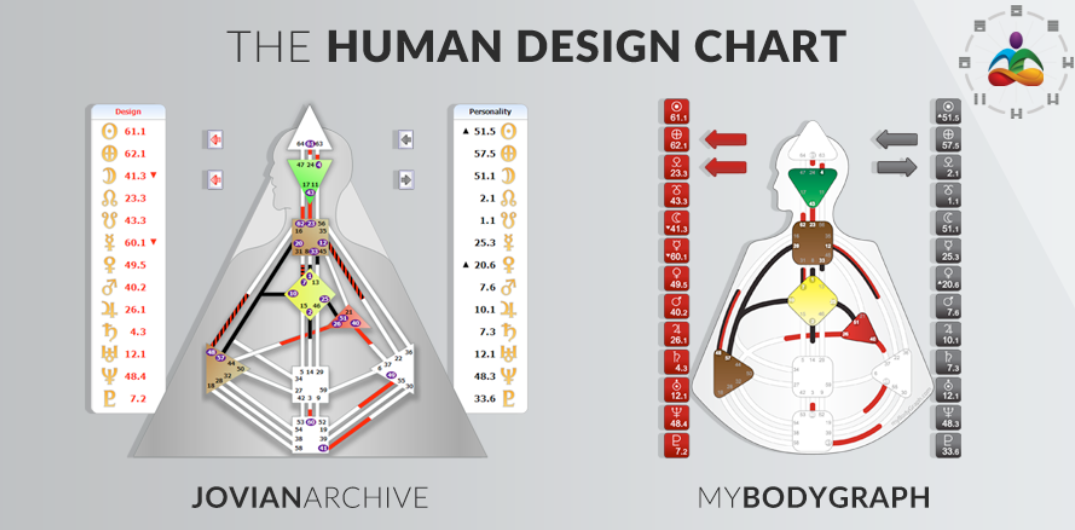
Assignment to Types: Generators, Manifestors, Manifesting Generators, Projectors, Reflectors
The assignment to “Type” is the system’s most immediately prescriptive act. The distribution is weighted: Generators and Manifesting Generators together are said to comprise 65-70% of the population, Projectors roughly 20%, Manifestors less than 10%, and Reflectors about 1%.
Generators are positioned as the energetic “builders” of society, equipped with the most robust and sustainable work energy (Sacral Center defined). Their strategy is to wait for something in their environment to respond to, fostering right action (and thus satisfaction) rather than initiating (which leads to frustration).
Manifesting Generators are described as a sub-type, combining the Generators’ work energy with some of the Manifestor’s inclination to initiate. They are “multi-passionate,” thrive on juggling many projects, and also must respond rather than initiate, although they reportedly act more quickly than standard Generators.
Projectors are guides and leaders, whose strength is recognizing and honing the talents of others (but lacking a defined Sacral Center, and thus the “sustainable-work” energy of Generators). Projectors are meant to wait for recognition/invitation and thrive in environments where their input is sought and valued.
Manifestors are the original initiators, with the archetypal role of leadership, capable of initiating new endeavors and movements. Their strategy is to inform others before acting, the idea being that this mitigates resistance and encourages smoother execution of their vision.
Reflectors are rare “mirrors” for their communities, with all Centers undefined—hence, highly sensitive to environment and the energies of those around them. Their strategy is to wait a full lunar cycle (about 28 days) before making major decisions, reflecting the system’s lunar calibration to their unique needs.
The system posits that when individuals align their choices with their chart-given Type, Strategy, and Authority, they experience greater satisfaction, success, and harmony, while violations lead to “Not-Self themes” (frustration, anger, bitterness, disappointment). This alignment is framed as paramount to living an authentic, deconditioned life.
However, critics argue that the Type assignment creates a potentially limiting, deterministic worldview—one that risks fostering self-justifying explanations for behavior, abdication of responsibility, or feelings of superiority/inferiority after being “typed.” Within communities of practice, stories abound of the system being used to rationalize career failures, relationship choices, or to prescriptively restrict life paths, sometimes to the detriment of autonomy and personal agency.
Biography of Ra Uru Hu (Robert Allan Krakower): Origins, Mystical Experience, and Controversies
Ra Uru Hu was born as Robert Allan Krakower on April 9, 1948, in Montreal, Canada. Krakower’s early professional life spanned creative and business endeavors: he was reportedly an accomplished composer and musician, an advertising executive, magazine publisher, and media producer.

In the early 1980s, after a period of personal crisis, Krakower abandoned his Canadian family and business career, traveling to Europe and eventually settling on the Spanish island of Ibiza, where he spent years as a schoolteacher and retreated into relative anonymity.
The pivotal event in the Human Design origin story is Krakower’s eight-day mystical experience in January 1987. As Ra Uru Hu, he claimed to have been “contacted” by a non-human intelligence—referred to only as “The Voice”—an intelligence “far superior to anything he had ever experienced.” According to his accounts, this Voice dictated to him the entire corpus of the Human Design System, which he transcribed in detail over those eight days and nights.
Ra interpreted this experience as both a personal awakening and a revelation for humanity, situating himself as the “Clarion” (messenger or harbinger) of a new era. Shortly after, he legally changed his name to Ra Uru Hu and framed his life’s mission around teaching and propagating Human Design.
Following this experience, Ra spent the next several years developing and codifying Human Design. By 1989, he produced the “Rave I’Ching”, his adaptation of the classic text and a central pillar of Human Design. Over the ensuing decades, he built an institutional infrastructure—teaching seminars, writing foundational texts, and developing training and certification programs for Human Design analysts and coaches. He was the founder of the International Human Design School (IHDS) and Jovian Archive, both of which disseminate official materials and maintain rights to his intellectual property.
Ra traveled widely to teach, living in Ibiza, Germany, and the United States, but he eventually settled back in Ibiza, where he lived until his death on March 12, 2011. Posthumously, his estate and the organizations he founded manage his writings, recordings, and the continued operation of the Human Design “movement.”
Ra Uru Hu often claimed the authority of prophecy and unique insight, positioning himself not merely as a synthesizer of past traditions, but as a conduit of revelation. He advanced the notion that humanity is in a period of evolutionary transition—from “seven-centered” to “nine-centered” beings, and further predicted a future mutation (beginning in 2027) into “Rave Children,” heralding a new species with a collective consciousness.
His style in lectures, writings, and personal interactions could be authoritarian and polarizing. Supporters describe him as a visionary, fiercely dedicated and uncompromising in his truth. Detractors—including some high-profile ex-disciples and former associates—accuse him of narcissism, financial exploitation, and fostering a rigid dogma. Allegations even surfaced that he playfully or cynically acknowledged putting personal biases into the system—such as a preference for women with defined Sacral Centers, or articulating teachings that justified his personal idiosyncrasies.
Reports also indicate significant concern about Ra’s management of finances, with critiques that his desperation for money colored his relationships with students and drove a commercialization of the Human Design System that prioritized profit over integrity.
Current Leadership and Management of the Human Design Movement
Following Ra Uru Hu’s death, the mantle of authority was assumed by the organizations he founded: Jovian Archive and the International Human Design School (IHDS). These entities are now recognized as the intellectual property “stewards” of the Human Design System, overseeing all official educational materials, training, licensing, and certification of practitioners and analysts.
His estate manages the publication and distribution rights to Ra’s books, lectures, and proprietary Human Design content, and the official websites serve as the primary digital repositories for Human Design courses, community news, and downloads. Practitioners seeking official recognition are often required to train through IHDS or affiliated organizations using “Ra-approved” materials and curricula.
Despite the official hierarchy, Human Design has grown into a decentralized global movement. There are numerous offshoots, splinter groups, and independent practitioners—some closely aligned with the original teachings, others innovating with their own interpretations, integrating psychology, coaching, or neuroscience, or even “quantum Human Design” and psychotherapy approaches to broaden the system’s appeal.
Human Design training has become a lucrative international business, with practitioners offering courses, readings, coaching, and retreats, frequently marketing to high-achieving professionals, corporate leadership, and wellness communities. The commercial programs often promise not only personal enlightenment, but also certifications for new practitioners who are encouraged to “bring Human Design to the world” for a fee.
There is no universally recognized “leader” as Ra had no appointed spiritual or organizational successor. However, various first-generation teachers—many formerly trained and approved by Ra—maintain their own followings, respected as authorities in the movement. The system itself is now characterized by both official leadership through the original structures and a multiplicity of loosely affiliated or splinter practitioners and influencers liberally interpreting the material, especially on social media, YouTube, and in the online personal development economy.
Cult Criticism: Hierarchy, Prophecy, Commercialization, and Isolation
The Human Design movement, especially in its original organizational incarnation, often exhibits characteristics associated with cultic structures. At the core is the central authority figure (Ra Uru Hu) as the channeled seer; a cadre of early students forming an inner circle; and a system of certifications, licenses, and exclusive “official” materials administered from the top down.
Other critics have argued that the rigid stratification between licensed and unlicensed practitioners, the official and non-official system teachings, and the elevation of proprietary terminology, all foster an us-versus-them mentality. This is compounded by the designation of “official” knowledge as authentic and the rest as incomplete, mistaken, or even dangerous. This hierarchical orientation is a common feature of cult dynamics, where access to higher knowledge is controlled and conferred by recognized teachers.
One of the most dramatic features of Human Design’s doctrine is its eschatological prophecy: the predicted mutation and global transformation in 2027. Ra Uru Hu’s teachings specify that on February 15, 2027, humanity will enter the “Cross of the Sleeping Phoenix,” ending the current 400-year cycle (the Cross of Planning). This change supposedly ushers in an age of radical individualism, subtle energy shifts, and the birth of “Raves,” a new species embodying collective awareness. The prophecy includes predictions of the breakdown of social, economic, and religious hierarchies; collapse of trust in institutions; and the necessity of living by one’s Design in order to survive the transition.
These apocalyptic narratives, with their language of “mutation,” salvation, and existential risk for those who “do not live their Design,” are archetypal cult themes—paralleling other new religious movements throughout history that leverage looming world-shifts or crises to anchor adherence and justify exclusivity.
The Human Design economy has blossomed into a sophisticated commercial enterprise. Official Human Design charts, readings, coaching, business consultations, and multi-tiered training programs are premium-priced, with advanced certifications costing thousands of dollars. Training often progresses through levels, with escalating costs, and access to “deeper” teachings is gated by expensive, often recurring courses or annual memberships.
Critics decry this heavy commercialization—arguing it creates pressures to continually up-sell followers, extract further investment from committed participants, and even create “Human Design MLMs” where trained practitioners are encouraged to recruit and develop new practitioners beneath them. In online spaces, Human Design-based HR or corporate consulting firms promise organizational transformation, while influencers monetize self-help and dating content through Human Design analysis and matchmaking.
A frequent critique is that by codifying people into fixed Types and Authority roles, Human Design can foster division and isolation: not only between “human design-aware” and “unaware,” but also among family and colleagues who are rigidly typed, leading to deterministic thinking (e.g., “Generators can’t lead,” “Manifestors can never work a 9-5,” or “Reflectors must avoid commitment”). There are claims of adherents abandoning relationships, jobs, or projects “not aligned” with their design, sometimes to their own detriment or the detriment of dependents (such as children).
Within Human Design circles, especially among the more zealous, practitioners may begin to attach life misfortunes or relationship failures to “not living their design,” or externalize responsibility for difficult behavior (e.g., “I was just manifesting as a Manifestor,” “I’m a Projector so I’m not built to work,” or “My Reflector child must be protected from all stress”). Critics argue this fosters both a rationalization for navel-gazing self-absorption and a tendency to eschew maturity, growth, or compromise.
Comparing Different Voices
Critical Voices
- Absence of Scientific Legitimacy: Academic and skeptical commentators lambaste Human Design’s lack of empirical foundation. Its core premises are derived from mystical revelation, not testable hypotheses, and its superficial scientific trappings are seen as marketing rather than substantiation.
- Arbitrary Typology: Critics question the validity and ethics of categorizing people into fixed types based on birth data; these are likened to horoscopes or the Myers-Briggs Type Indicator but with greater determinism built in. There is clinical concern about parents raising children strictly according to these “types” and potentially stunting psychological development or causing emotional harm.
- Cult Accusations: Former insiders and critical outsiders describe cult behaviors: discouraging questioning, stratifying the movement by “knowledge level,” ostracizing dissenters, and focusing group activity around the founder or central authority and apocalyptic future visions. Some online forums explicitly warn about abusive or exploitative tendencies in Human Design communities.
- Financial Exploitation: There are widespread complaints about the steep price of readings, courses, and certifications, with some framing it as a “spiritual MLM” that coaxes people to chase deeper truths by spending ever more money, creating cycles of dependence and debt.
- Isolation and Reification: Personal testimonies highlight the dangers of codifying oneself or others rigidly by type, leading to inertia (“waiting to respond”) or justification for anti-social or non-productive behaviors.
Supportive Voices
- Empowerment, Clarity, and Personal Growth: Many clients and practitioners report that Human Design offers profound validation of individuality and difference, helping them to embrace their idiosyncrasies, give up the treadmill of conventional success, and craft lifestyles in tune with their energetic makeup.
- Leadership, Coaching, and Team Dynamics: In executive coaching, organizational consulting, and therapy, supporters argue that Human Design provides a framework for optimizing team roles, clarifying individual needs, and increasing self-awareness for improved relationships and communication.
- Healing and Acceptance: Testimonials describe Human Design readings as moments of great relief or transformation, often compared to key insights in therapy or other personality systems. For some, it becomes a valuable complement to psychological methods rather than a substitute or replacement.
- Experimental/Pragmatic Use: Human Design’s “experiment” framework (living one’s Strategy and Authority as an empirical test rather than a faith stance) is praised by some as practical and non-dogmatic, with room for skepticism and reinterpretation.
Mixed or Cautious Endorsements
- Some professionals, even those trained in Human Design, urge a pragmatic, “do no harm” approach—advocating its use as a coaching or introspective tool only in combination with critical thinking, psychological insight, and explicit rejection of deterministic or cultic interpretations.
My Final Thoughts
The Human Design System is among the most intricate and syncretic of modern esoteric personality frameworks. Its appeal rests on a compelling story—a mystical channeling, a unifying cosmology, and the hope of effortless authenticity. Its structure channels identity through a blend of ancient wisdom, scientific gloss, and modern personality psychology. Its aura of secret knowledge and stepwise initiation, coupled with commercialized training and apocalyptic prophecy, invite both passionate loyalty and serious concern.
Supporters argue that Human Design empowers individuals to own their uniqueness and offers practical tools for navigating social, emotional, professional, and organizational challenges. Critics, meanwhile, see it as pseudoscientific, deterministic, and cultic—perpetuating new-age commercialism, spiritual narcissism, and social isolation.
The reality of the movement is hybrid: an official core jealously guards Ra Uru Hu’s legacy, while a worldwide cohort of coaches and self-help entrepreneurs spread the system in endless variations, some faithful, others freely re-invented. As with all belief systems purporting to offer total answers to life’s complexity, critical thinking, ethical practice, and humility before the richness of human difference are essential. Human Design’s experiment may deliver real subjective value to some, but its popularity and risks warrant careful scrutiny and self-inquiry, lest it become another instrument of hierarchy, exclusion, or exploitation.
By Beth Gibbons (Queen of Karma)
Beth Gibbons, known publicly as Queen of Karma, is a whistleblower and anti-MLM advocate who shares her personal experiences of being manipulated and financially harmed by multi-level marketing schemes. She writes and speaks candidly about the emotional and psychological toll these so-called “business opportunities” take on vulnerable individuals, especially women. Beth positions herself as a survivor-turned-activist, exposing MLMs as commercial cults and highlighting the cult-like tactics used to recruit, control, and silence members.
She has contributed blogs and participated in video interviews under the name Queen of Karma, often blending personal storytelling with direct confrontation of scammy business models. Her work aligns closely with scam awareness efforts, and she’s part of a growing community of voices pushing back against MLM exploitation, gaslighting, and financial abuse.




Leave A Comment