


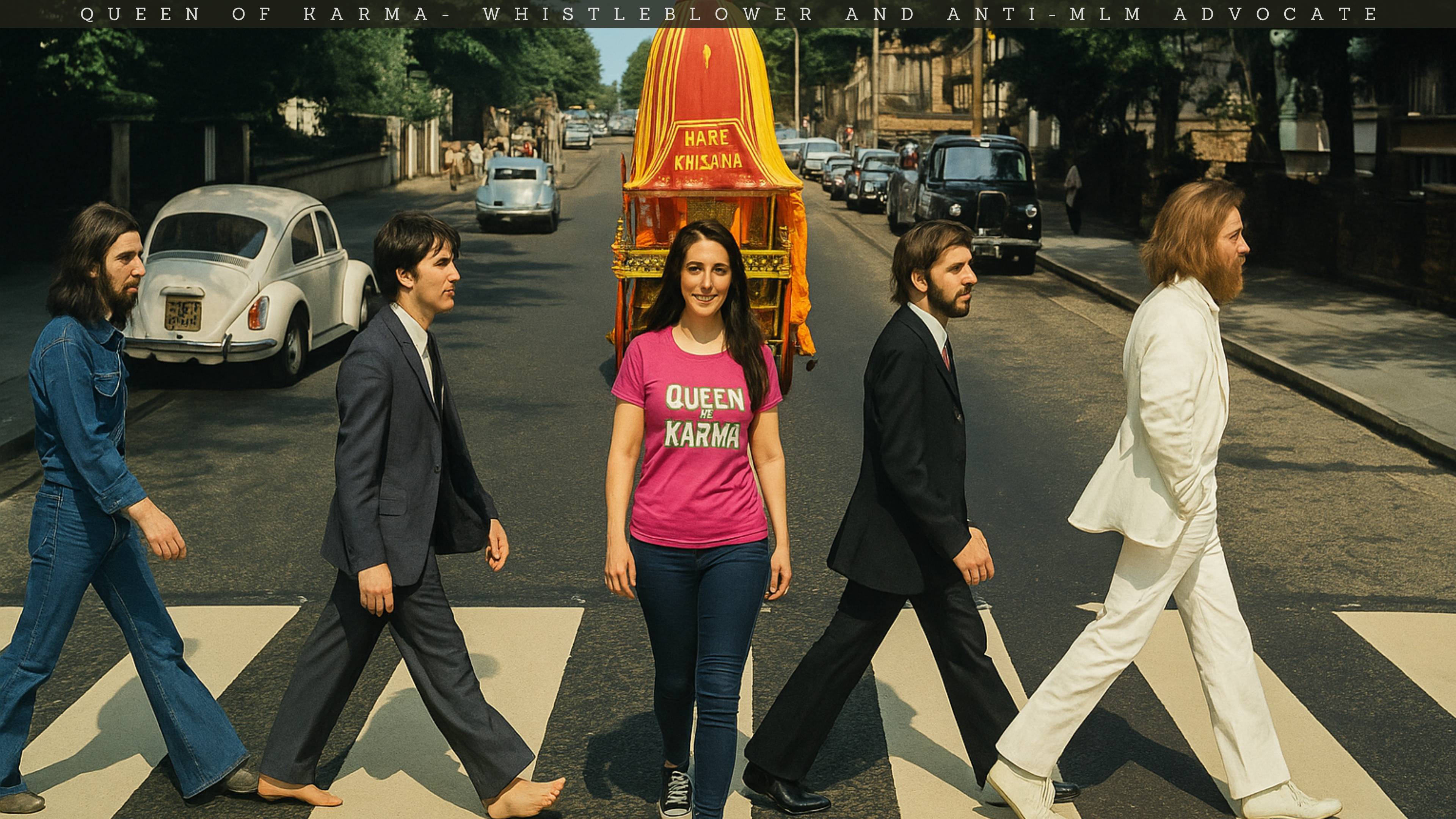
I grew up listening to The Beatles, and like many people, I always knew about their strange, indirect connection to Charles Manson’s “Family” cult through the song Helter Skelter.
Manson twisted their music into a violent prophecy, forever linking the Beatles’ art to one of America’s darkest cult stories. But what if I told you that the Beatles also had a direct connection to another cult — the Hare Krishna movement?
Unlike Manson’s delusions, this was not a misinterpretation from the outside. This was a relationship the Beatles themselves helped cultivate, and it gave the Hare Krishna movement a global platform that masked its darker reality.
The Beatles’ Spiritual Turn
The Beatles were more than just a band. Emerging from Liverpool in the early 1960s, they became the most influential music group of the 20th century. John Lennon, Paul McCartney, George Harrison, and Ringo Starr transformed popular music with their songwriting, experimentation, and cultural impact. By the mid-1960s, they were not only shaping music but also fashion, politics, and spirituality.
As fame consumed them, the Beatles began searching for deeper meaning. Their 1968 trip to Rishikesh, India, to study meditation with the Maharishi Mahesh Yogi marked a turning point. While Lennon and McCartney eventually drifted back toward Western skepticism, George Harrison became increasingly devoted to Indian philosophy and spirituality. His fascination with the sitar, his friendship with Ravi Shankar, and his study of Vedic texts all pointed him toward a lifelong spiritual quest. That quest would lead him directly into the orbit of the Hare Krishna movement.
How the Beatles Met the Hare Krishnas
The International Society for Krishna Consciousness (ISKCON), better known as the Hare Krishna movement, was founded in 1966 by A.C. Bhaktivedanta Swami Prabhupada. To outsiders, it appeared as a joyful group of saffron-robed devotees chanting in the streets. But beneath the surface, ISKCON was a high-control religious organization that used love-bombing, isolation, and rigid rules to recruit and retain members.
By 1968, ISKCON’s disciples in London were struggling to gain traction. One of them, Shyamasundar Das (Sam Speerstra), deliberately targeting the Beatles, knowing that a single endorsement could catapult the movement into mainstream visibility. He eventually met Harrison at Apple Records, and soon the devotees were invited to Abbey Road Studios.
In 1969, Harrison produced the single “The Hare Krishna Mantra” with the London Radha Krishna Temple. Released on the Beatles’ Apple label, it reached No. 12 on the UK charts and was performed on Top of the Pops. A full album followed in 1970, selling tens of thousands of copies across Europe.
That same year, Harrison’s solo hit “My Sweet Lord” wove the Hare Krishna mantra into its chorus, blending it with Christian “Hallelujahs.” The song topped charts worldwide, embedding Krishna devotion into mainstream pop. Later albums like Living in the Material World (1973) included even more explicit references to Krishna.
Even John Lennon briefly engaged with the movement. In September 1969, Prabhupada himself stayed at Lennon’s Tittenhurst Park estate with 18 disciples, giving lectures and chanting with Lennon, Harrison, and Yoko Ono. Ringo Starr’s It Don’t Come Easy (1971), co-written with Harrison, also featured Krishna chants in its backing vocals.
Through these recordings and encounters, the Hare Krishna mantra was carried into millions of homes, normalized by the Beatles’ cultural authority.
Bhaktivedanta Manor: Harrison as ISKCON’s “Archangel”
Harrison’s support went far beyond music. In 1973, when ISKCON’s London Temple outgrew its space, he purchased a Mock Tudor mansion in Hertfordshire and donated it to the movement. Named Bhaktivedanta Manor after ISKCON’s founder, it became the group’s largest property in the UK and remains one of the most important Krishna centers in Europe.
Prabhupada himself described Harrison as ISKCON’s “archangel.” Harrison co-signed leases for temples, funded ISKCON publications, and used his fame to shield the group from criticism. At his death in 2001, Harrison was surrounded by Krishna devotees chanting the mantra, and his ashes were scattered in the Ganges.
For ISKCON, Harrison was not just a supporter — he was their most powerful cultural ally.
The Hippie Counterculture and the Cult Boom
The Beatles’ embrace of Eastern spirituality didn’t happen in isolation. The hippie counterculture of the 1960s created fertile ground for groups like ISKCON to thrive.
Young people were disillusioned with consumerism, war, and traditional religion. Psychedelics, communal living, and “free love” blurred boundaries and made seekers more open to radical ideas. Eastern religions, yoga, and meditation were rebranded as spiritual cures for Western malaise.
The openness was not inherently bad, but it created a marketplace for manipulation. Alongside Hare Krishna, dozens of other cults flourished: the Children of God, the Unification Church (“Moonies“), Scientology, and countless New Age sects. What united them was a pattern of charismatic leaders, rigid rules, isolation from family, and financial or sexual exploitation.
The hippie dream of peace and love became, for many, a nightmare of control and abuse.
Behind the Chant: The Dark Side of ISKCON
While the public saw smiling devotees and celebrity endorsements, insiders experienced something very different. Investigations and survivor testimonies have revealed:
- Financial exploitation: Members pressured to hand over wages, inheritances, and assets.
- Child abuse: ISKCON’s boarding schools became notorious for widespread physical, emotional, and sexual abuse in the 1970s and 1980s. Survivors later won multimillion-dollar settlements.
- Criminal activity: Communities like New Vrindaban in West Virginia became centers of fraud, drug smuggling, and even murder under leaders like Kirtanananda Swami.
- Psychological control: Members were told that leaving meant spiritual ruin, creating deep fear and dependency.
These were not isolated incidents — they were systemic patterns of cultic control.
The Beatles’ Complicated Legacy
It would be unfair to suggest the Beatles knowingly promoted abuse. Harrison, in particular, seems to have been sincere in his spiritual search. But the fact remains: their global fame gave ISKCON a platform that helped it grow into a powerful, high-control organization.
This is the danger of celebrity endorsement. A movement that looked like harmless chanting in the park was, in reality, a cult with a documented history of coercion, exploitation, and abuse.
The story of the Beatles and Hare Krishna is not just history — it’s a warning.
Culture can be co-opted. Music, art, and celebrity can be powerful recruitment tools for cults.
Spiritual hunger can be exploited. The same openness that drives people to seek meaning can make them vulnerable to manipulation.
The counterculture’s legacy is double-edged. It gave us creativity, activism, and new ideas — but also opened the door to cults that preyed on idealism.
After the Music Stopped
I grew up loving the Beatles’ music, but as I’ve learned more, I see how their spiritual explorations intersected with the rise of cults in the late 1960s. Helter Skelter may have been twisted by Charles Manson into a prophecy of violence, but the Beatles’ direct connection to Hare Krishna shows how even the most beloved cultural icons can unintentionally amplify a cult’s reach.
The story is not just about one band or one movement. It is about how celebrity, culture, and spiritual hunger can collide in ways that reshape society. The Beatles were sincere seekers, but their fame made them powerful conduits. When they sang the Hare Krishna mantra, millions listened — and many assumed it must be safe, even enlightened, because it came wrapped in the Beatles’ aura of authenticity.
But history shows us that charisma and chanting can conceal coercion and control. ISKCON’s abuses — from financial exploitation to child abuse in its schools — remind us that behind the saffron robes and joyful music was a system of manipulation. The hippie counterculture, with its openness and idealism, created fertile ground for both creativity and exploitation. Out of the same soil that gave us Woodstock and protest songs also grew cults that preyed on vulnerability.
This is why the Beatles’ Hare Krishna connection matters today. It is not just a quirky footnote in rock history. It is a case study in how cults gain legitimacy, how they use art and celebrity to mask darker realities, and how easily seekers can be drawn into systems of control.
As we look back, the lesson is clear: we must separate the beauty of music from the dangers of manipulation. We can celebrate the Beatles’ artistry while also acknowledging the harm their endorsement helped enable. And we can honor the survivors of ISKCON and other cults by refusing to let history repeat itself.
The counterculture promised liberation, but it also opened the door to exploitation. The challenge for us today is to keep the creativity, the questioning, and the hunger for meaning — while guarding against those who would twist those same impulses into tools of control.
I guess in the end, the chants you take are not always the truths you make.
By Beth Gibbons (Queen of Karma)
Beth Gibbons, known publicly as Queen of Karma, is a whistleblower and anti-MLM advocate who shares her personal experiences of being manipulated and financially harmed by multi-level marketing schemes. She writes and speaks candidly about the emotional and psychological toll these so-called “business opportunities” take on vulnerable individuals, especially women. Beth positions herself as a survivor-turned-activist, exposing MLMs as commercial cults and highlighting the cult-like tactics used to recruit, control, and silence members.
She has contributed blogs and participated in video interviews under the name Queen of Karma, often blending personal storytelling with direct confrontation of scammy business models. Her work aligns closely with scam awareness efforts, and she’s part of a growing community of voices pushing back against MLM exploitation, gaslighting, and financial abuse.



Leave A Comment