


Eckankar, the New Age Spiritual Movement founded in 1965, has entered a historic new chapter with the appointment of Sri Doug Kunin as its fourth Living Eck Master.
While the leadership transition was framed as divinely guided, the announcement has sparked mixed reactions among members — some embracing the change, others voicing unease and disappointment.
What Is Eckankar?
Eckankar, often described as the “Religion of the Light and Sound of God,” was founded in 1965 by Paul Twitchell. It presents itself as a modern spiritual path focused on direct personal experience from the divine through practices such as Soul travel, dream exploration, and chanting the sacred word “Hu.”
At the heart of Eckankar is the belief in a Living Eck Master — a spiritual leader who serves as both an Outer Master (teaching through talks and writings) and an Inner Master (guiding followers in dreams and inner journeys). This figure is considered the essential link between Soul and God, making leadership transitions profoundly significant.
The Transition: From Klemp to Kunin
On October 25, 2025, at the Worldwide Soul Adventure Seminar in Minnesota, longtime leader Sri Harold Klemp formally introduced Sri Doug Kunin as his successor. Klemp had served since 1981, making this the first leadership change in 44 years and only the fourth succession in Eckankar’s history.
Kunin, a longtime student and teacher within the movement, now carries the mantle of Mahanta, the Living Eck Master. According to official Eckankar statements, his role is to “awaken the God-knowledge already within each Soul” and to guide seekers toward spiritual freedom.
A Life Shaped by Eckankar
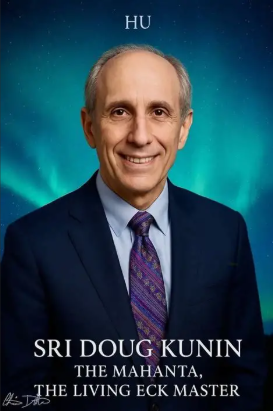
Doug Kunin‘s biography is inseparable from his family’s deep ties to Eckankar. His spiritual names are Sri Doug Kunin or Rezash and he was born in 1956. He was born to parents Everett “Tom” Kunin (b. October 28, 1930 – d. January 29, 2012) and Elsa “Bunny” Kunin (b. April 15, 1931 – d. September 17, 2009). Both the Everett and Elsa obituaries explicitly list “Doug” among surviving children, linking them to Doug Kunin. Both obituaries were posted in the San Diego Union-Tribune, suggesting Doug spent most of his formal years in the San Diego area.
His Mother’s Obituary reads:
“Bunny Gotthelf grew up in New Rochelle, NY; graduated from Syracuse University; married Everett Kunin in 1952, and started their family in Worcester, MA. They moved to New Rochelle, and then to Woodland Hills, CA in 1961. They later lived in San Antonio, Indio, Palm Springs, and San Diego. Preceded in death by her parents Sol and Stella Gotthelf, and sister Harriet Paul (Gotthelf), she lovingly leaves behind her husband Everett, sons Chuck and Doug, brother Hank Gotthelf, daughters-in-law Hollie and Sharon, grandchildren Noah, Anna, Chelsea, and Elisse, and many nieces and nephews.“
His Father’s Obituary reads:
“Born on October 28, 1930, in Worcester, MA, graduate of Syracuse, married Elsa “Bunny” Kunin, father of sons Chuck and Doug. Everett’s buoyant smile, hearty laughter, and lively personality touched many; he befriended people of all cultures and walks of life. Artist, graphic designer, salesman, radio executive, and restaurant owner, he loved his family, the ocean, the desert, sports (mainly baseball and the art of bunting), politics, military history, Freemasonry, photography, animals, humor, food, Israel, and America.“
His wife Sharon Kunin is described in public profiles as a longtime partner and collaborator of Doug Kunin; some reports refer to her as his second wife. She was a devoted Eckist who publicly documented her spiritual journey from Presbyterianism to Eckankar in the 1970s. Her writings reveal how Eckankar’s teachings reshaped her worldview and family life, embedding the movement deeply into the household.
The Kunin family’s visibility within Eckankar’s Minnesota hub, the Temple of ECK in Chanhassen, positioned them as pillars of the community. Doug was groomed for leadership long before his succession was announced. His rise reflects not just personal devotion but a dynastic continuity that cults often rely on to maintain legitimacy.
Before his succession, Kunin was listed as a Vice President At Eckankar. So he was already part of the organizational leadership, managing administration and spiritual responsibilities. The organization emphasizes his spiritual role rather than personal details, which is typical of high-control groups that prefer to present leaders as mystical figures rather than ordinary people. The absence of basic biographical data underscores the secrecy and control mechanisms that are characteristic of cults, making it difficult for outsiders and even members to critically assess the leader’s qualifications or accountability.
Why the Announcement Sparked Division
While Eckankar’s leadership framed the succession as seamless and spiritually ordained, many members were not happy with the news. Several factors explain the discontent:
- Lack of Transparency: The process of succession was kept secret until the public announcement. For a movement that emphasizes inner truth, some members felt blindsided and excluded from a decision that shapes their spiritual lives.
- Attachment to Klemp: After more than four decades, Harold Klemp was not just a leader but a deeply ingrained spiritual presence. For many, his departure created a sense of loss, even abandonment.
- Concerns About Authority: Some ex-members and critics argue that Eckankar’s hierarchical structure concentrates too much spiritual authority in one figure. The sudden shift to Kunin raises questions about legitimacy and whether the “inner confirmation” of his role was truly universal.
- Generational Divide: Older members who grew up under Klemp’s leadership expressed skepticism about Kunin’s ability to carry the same gravitas. Younger seekers, meanwhile, are more likely to question the very premise of needing a singular spiritual master.
- Cult Allegations: Longstanding criticisms of Eckankar as high-control group resurface during transitions. Former members have described feelings of betrayal when leadership changes are presented as divinely mandated rather than organizationally managed.
The Broader Context
Leadership transitions in new religious movements often test stability. In Eckankar’s case, the mythos of the Living Eck Master makes succession not just administrative but existential. If the Master is the sole spiritual channel, then doubts about his legitimacy can shake the entire foundation of belief.
This moment also comes at a time when spiritual seekers are increasingly skeptical of hierarchical authority. Movements that once thrived on charismatic leadership now face pressure to adapt to a culture of transparency, accountability, and decentralized spirituality.
Looking Ahead
For Eckankar, the appointment of Doug Kunin is both a continuation and a gamble. Supporters see it as the dawn of a new spiritual era, while critics such as myself view it as a test of whether the movement can survive beyond the long shadow of Harold Klemp.
The coming years will reveal whether Kunin can inspire loyalty, adapt Eckankar’s teachings for a new generation, and address the disillusionment among members who feel left behind.
For a movement built on the promise of direct spiritual experience, the true test will be whether followers find in Kunin the inner confirmation they seek — or whether this transition accelerates the quiet exodus already underway.
*Editors Note: We incorrectly identified Sharon Kunin as the mother of Doug Kunin in an earlier version of this article. That statement was wrong and we have corrected the copy. Public reporting and biographical material describe Sharon Kunin as a longtime partner and collaborator of Doug Kunin; some profiles refer to her as his wife.
We strive for accuracy and take responsibility for this error. When researching personal and family details we rely on the best available public records, contemporary reporting, and archival notices. Sometimes those publicly available sources are incomplete, inconsistent, or user‑generated, and that can lead to mistakes even when we research carefully. Errors are not intentional and do not reflect a lack of effort or expertise.
If you believe we have factual information wrong, we welcome corrections and supporting documentation. Please provide sources or pointers in a polite manner so we can verify and, where appropriate, correct the record. We will review any submission promptly and transparently, and publish corrections when they are warranted.
We regret the mistake and thank readers who help improve our work.*
By Beth Gibbons (Queen of Karma)
Beth Gibbons, known publicly as Queen of Karma, is a whistleblower and anti-MLM advocate who shares her personal experiences of being manipulated and financially harmed by multi-level marketing schemes. She writes and speaks candidly about the emotional and psychological toll these so-called “business opportunities” take on vulnerable individuals, especially women. Beth positions herself as a survivor-turned-activist, exposing MLMs as commercial cults and highlighting the cult-like tactics used to recruit, control, and silence members.
She has contributed blogs and participated in video interviews under the name Queen of Karma, often blending personal storytelling with direct confrontation of scammy business models. Her work aligns closely with scam awareness efforts, and she’s part of a growing community of voices pushing back against MLM exploitation, gaslighting, and financial abuse.




“His mother, Sharon Kunin, was a devoted Eckist who publicly documented her spiritual journey from Presbyterianism to Eckankar in the 1970s. Her writings reveal how Eckankar’s teachings reshaped her worldview and family life, embedding the movement deeply into the household.
Doug grew up in an environment where Eckankar’s discourses, spiritual exercises, and community rituals were central to daily existence.”
Sharon Douse b. 1954 is Doug Kunin’s second wife, not his mother. Doug b. 1956 joined Eckankar in 1976. His parents are Everett Leonard Kunin 1930-2012 and Elsa Sheila Gotthelf 1941-2009. They married in 1952. A Jewish rabbi officiated the wedding.
Cleary, your ‘research’ is grossly in error.
Hello Dick,
Thank you for flagging the error. Great catch! We’ve corrected the article to reflect that Sharon is not Doug Kunin’s mother and updated the family details accordingly.
• On tone: We welcome corrections, but civility matters. Calling our work “grossly in error” doesn’t help the verification process.
• On sourcing: We rely on publicly available records and published reporting. If you have specific sources for the claims you shared (e.g., marriage records, obituaries, archived articles), please include them so we can verify quickly and accurately.
• On privacy: We do not dig into private or nonpublic information; we use what is responsibly available. Sometimes public sources conflict or are incomplete, and mistakes can happen despite careful research.
• What we’ve done: The misattribution has been fixed, and we’ve added an editor’s note acknowledging the mistake and our correction.
• What would help next time: Sharing links or citations with corrections (record indexes, newspaper archive URLs, certificates, or credible profiles) prevents a “wild goose chase” and speeds up the update for everyone.
We appreciate readers who help improve accuracy and will promptly review any sources you provide in future.
Thank you so much for your help and have a wonderful day!
Dear Karma Queen- Why use the derogatory term “cult” to describe a religion? The term immediately cancels any attempt in your journalism to present an unbiased look at a spiritual movement. For 300 years or more, early Christianity was deemed a cult by Roman law. Often any belief system that isn’t orthodox or currently accepted is denigrated by the dominant culture and its orators. Historically, for example, Women’s rights, homeopathy, the scientific writings of Galileo, were frowned upon- sometimes inviting execution or excommunication from the church.
Consider the Dali Lama- the leader of a respected and historic spiritual path. The inner, spiritual workings of a religion, new or old does not need to work on the principles of a publicly held corporation or even democratic government.
Also, please check the readily available public information on the spiritual name of Sri Doug Kunin. Thank you!
https://www.eckankar.org/sri-doug-kunin/
Dear Don,
Thank you for your response to my article. I want to be very clear about why I use the word *cult* to describe Eckankar. This is not a casual insult or a dismissal of minority faiths — it is a precise sociological and psychological classification for high‑control groups that rely on manipulation, secrecy, and coercion to exploit members. Survivors consistently describe Eckankar in these terms, and my research confirms those patterns. I have been researching Eckankar as a cult for several years now and have written many publications about it. Naming things accurately matters, because softening the language obscures the harm and leaves people vulnerable.
It’s true that dominant cultures have historically suppressed minority beliefs, but there is a crucial difference between marginalized ideas and organizations that actively harm their members. Eckankar is not simply “unorthodox.” It is structured around authoritarian leadership, unverifiable spiritual claims, and a system that discourages questioning. That is why researchers and survivors alike identify it as a cult.
Under Harold Klemp, Eckankar has also taken on the structure of a business. Membership fees, paid discourses, tightly controlled publishing, and monetized spiritual teachings are not incidental — they are central to how the organization sustains itself. Klemp consolidated authority while turning Eckankar into a revenue‑generating enterprise, which is a hallmark of cultic exploitation.
Comparisons to the Dalai Lama miss the point. Tibetan Buddhism is a centuries‑old tradition with scholarship, accountability, and transparency. Eckankar, by contrast, is opaque, with authority concentrated in one leader and practices that cannot be independently verified. Survivors describe the environment as isolating and manipulative, not liberating. It’s actually a plagarized religion at best and a cult at worse.
I will review factual details such as Sri Doug Kunin’s spiritual name, because accuracy matters. I guess this information must have changed since I got it from the website originally. But correcting a name does not change the larger issue: Eckankar’s practices fit the definition of a cult, and naming them honestly is part of protecting people from harm.
Sincerely,
Beth Gibbons (Queen of Karma, not Karma Queen)