


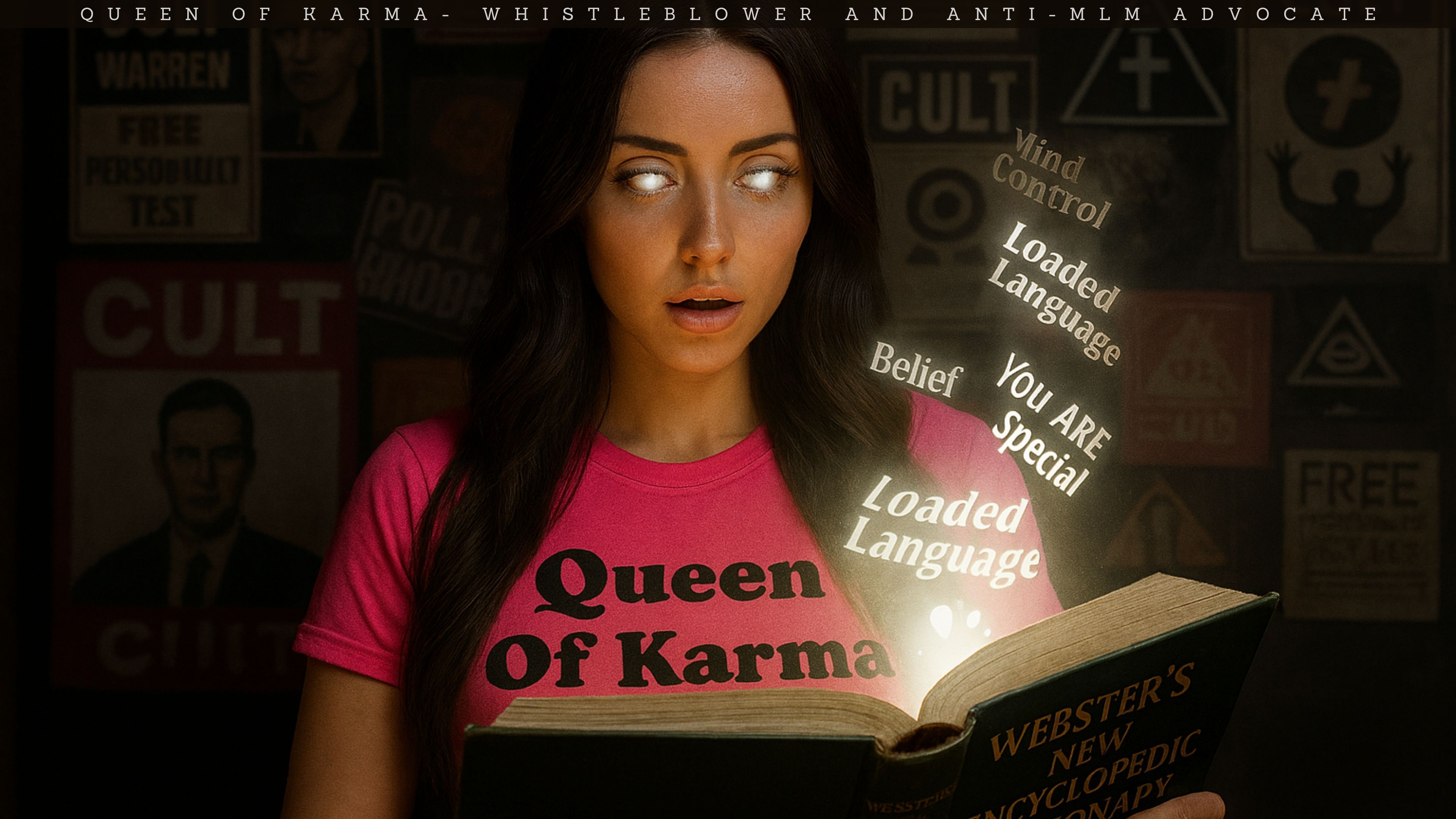
Language is more than just a communication tool — it is a cognitive framework, a social glue, and, in the wrong hands, a mechanism of control.
From cult indoctrination to political propaganda, certain linguistic strategies can subtly reshape perception, limit critical thinking, and redefine identity.
Language Shapes Thought
The Sapir-Whorf Hypothesis (or linguistic relativity) proposes that the structure and vocabulary of a language influence — and its stronger form, determine — how its speakers perceive and conceptualize the world.
- Linguistic Determinism: The strong form — language limits thought.
- Linguistic Relativity: The weaker form — language influences thought.
For example, the Hopi language treats time differently from English, potentially shaping how speakers experience temporal concepts. Similarly, Russian distinguishes between light blue (goluboy) and dark blue (siniy), affecting color discrimination speed.
If you control vocabulary, you control concepts. Limiting or redefining words can restrict the range of possible thoughts — a principle exploited in ideological movements and totalitarian regimes.
Words with Emotional Payloads
Loaded Language refers to words and phrases designed to trigger strong emotional responses, bypassing rational analysis. Terms like “traitor,” “patriot,” “pure,” or “corrupt” carry moral and emotional weight that can polarize opinion without presenting evidence.
Psychologically, this works through affective priming, where emotional words activate the amygdala and influence decision-making before the prefrontal cortex has a chance to engage in critical evaluation. People often rely on emotional valence as a cognitive shortcut, which reduces mental effort but increases vulnerability to manipulation.
From a neurophysiological perspective, amygdala activation rapidly tags stimuli with emotional significance, while prefrontal cortex modulation means that emotionally charged words can bias reasoning and memory retrieval. When such language aligns with in-group beliefs, it can even trigger dopamine release, reinforcing loyalty and making the message more persuasive over time.
Controlling the Conversation
Discursive Isolation occurs when a group’s language practices limit members’ exposure to alternative viewpoints. This can happen through the creation of specialized jargon that outsiders cannot easily understand, the redefinition of common words to fit the group’s worldview, or the active discouragement — even punishment — of engagement with outside discourse.
Psychologically, this taps into social identity theory, where language strengthens in-group identity while reinforcing out-group differentiation. It also feeds confirmation bias, as restricting discourse reduces cognitive dissonance by filtering out conflicting information.
From a neurophysiological perspective, the reward pathways in the brain are activated when members receive social approval for using in-group speech patterns. Over time, neural pruning can occur: reduced exposure to alternative linguistic frames weaken the brain’s ability to process them, making dissent not only socially risky but cognitively more difficult.
Culture Embedded in Communication
Speech Code Theory explores how each community develops its own historically enacted, socially constructed system of communication. These codes dictate not only what is said, but how it is said, and which meanings are socially acceptable.
For example, in Philipsen’s “Teamsterville” Study, men avoided verbal conflict, preferring physical action to resolve disputes — a speech code that reflected and reinforced the community’s cultural values. By shaping the speech code, leaders can embed ideological values into everyday conversation, making them feel natural and unchallengeable.
Linguistic Influence
The effectiveness of these tactics lies in a combination of psychological and neurophysiological processes. Psychologically, the framing effect ensures that the way information is presented changes how it is interpreted. Cognitive dissonance is reduced when language aligns with group norms, and social proof reinforces perceived truth when others use the same terms.
On the neurophysiological level, Hebbian learning — the principle that “neurons that fire together wire together” — means that repeated linguistic patterns strengthen neural associations. Mirror neurons activate when hearing in-group language, fostering a sense of belonging, while loaded language can trigger the stress response, narrowing focus and reducing the brain’s capacity for critical thinking.
Real-World Applications — and Dangers
These linguistic mechanisms are not inherently malicious. They are tools used in marketing through brand slogans and emotionally charged messaging. In politics, they shape public opinion through framing, selective terminology, and rhetorical repetition. In religion, they can be used to create sacred vocabularies that reinforce belief systems.
However, these same tools are also central to the functioning in cults. High-control groups often develop insular vocabularies that redefine everyday words to fit the group’s ideology. This not only limits members’ ability to think outside the group’s framework, but also creates a linguistic barrier between insiders and outsiders. Phrases like “worldly people,” “the elect,” or “spiritually dead” are not just descriptors — they are identity markers that reinforce loyalty and discourage dissent.
In the commercial world, multi-level marketing (MLM) organizations adopt cult-like linguistic patterns. Terms such as “financial freedom,” “dream lifestyle,” or “family” are loaded with aspirational meaning, while negative terms like “quitters” or “negative people” are used to stigmatize those who leave or question the system. This binary framing — success versus failure, believer versus doubter — mirrors the us-versus-them language of cults, because MLMs are commercial cults so of course, they adopt their language.
The digital age has amplified these dynamics. Many online communities — from extremist political forums to toxic fandoms — use specialized slang, memes, and coded language to signal belonging, mock outsiders, and police ideological purity. The anonymity and speed of online communication allow these linguistic patterns to spread rapidly, creating echo chambers where discursive isolation is intensified. In such spaces, loaded language and speech codes can be weaponized to harass, radicalize, or manipulate members, often under the guise of humor or “just asking questions.”
Conclusion
Language is not a neutral tool — it is a force that shapes thought, identity, and reality itself. The Sapir-Whorf Hypothesis, loaded language, discursive isolation, and speech code theory reveal how words can be engineered to influence perception, control behavior, and bind people to a shared worldview.
In cults, these tactics create closed systems of meaning that make dissent nearly unthinkable. In MLM commercial cults, they transform financial recruitment schemes into moral crusades. In malicious online communities, they turn slang and memes into ideological weapons. Across all these environments, the same underlying mechanisms are at work: limit the language, limit the thought, control the conversation, control the community.
Understanding the psychology and neurophysiology behind these tactics — from amygdala activation to Hebbian learning — is not just an academic exercise. It is a form of mental self-defense. By recognizing when language is being used to manipulate, isolate, or indoctrinate, we can resist its pull, reclaim our capacity for critical thinking, and protect the integrity of our own inner voice.
By Beth Gibbons (Queen of Karma)
Beth Gibbons, known publicly as Queen of Karma, is a whistleblower and anti-MLM advocate who shares her personal experiences of being manipulated and financially harmed by multi-level marketing schemes. She writes and speaks candidly about the emotional and psychological toll these so-called “business opportunities” take on vulnerable individuals, especially women. Beth positions herself as a survivor-turned-activist, exposing MLMs as commercial cults and highlighting the cult-like tactics used to recruit, control, and silence members.
She has contributed blogs and participated in video interviews under the name Queen of Karma, often blending personal storytelling with direct confrontation of scammy business models. Her work aligns closely with scam awareness efforts, and she’s part of a growing community of voices pushing back against MLM exploitation, gaslighting, and financial abuse.




Leave A Comment