


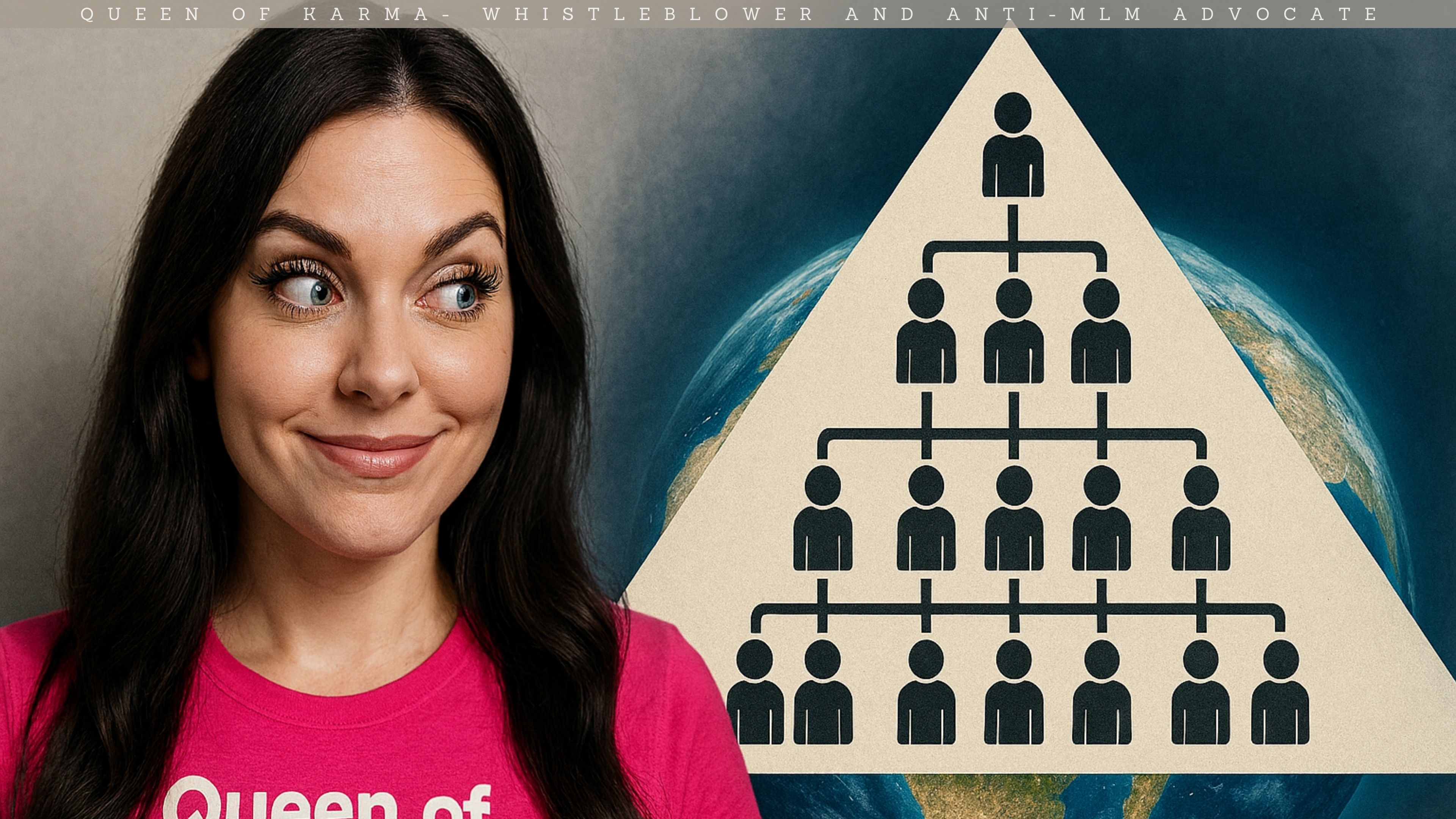
Multi-level marketing (MLM) is often sold as a path to financial freedom, but behind the glossy success stories lies a system that overwhelmingly benefits those at the very top. Few companies illustrate this better than Amway, founded by Richard DeVos and Jay Van Andel, whose fortunes have been used to shape political influence and protect the MLM model.
By tracing Amway’s origins, we can see how this model keeps the wealthy elite insulated while the majority of participants lose out.
The DeVos-Amway Connection
Amway’s story begins in 1959, but its roots go back to Nutrilite, a supplement company where DeVos and Van Andel were top distributors in the late 1940s. Nutrilite pioneered one of the first multi-level commission plans in 1945, paying distributors not only for their own sales but also for the sales of people they recruited — and the recruits of those recruits. This tiered structure was replicated almost exactly when Amway launched, and in 1972 the company purchased a controlling interest in Nutrilite, cementing the connection.
The DeVos family has used the wealth generated by Amway to build a powerful political machine. Betsy DeVos, who married into the family, served as U.S. Secretary of Education, while the family’s political donations have consistently supported policies that protect the MLM model.
How MLM Money Moves in Washington
The MLM industry is politically strategic. When the PRO Act threatened the independent contractor status that MLMs rely on, a cluster of MLM-aligned political action committees and executives — including Alticor (Amway’s parent), Isagenix, Nu Skin, USANA, Mary Kay‘s executive chair, and Herbalife — directed contributions to lawmakers opposing the bill.
The industry’s main lobby, the Direct Selling Association (DSA), connects many of these companies and works to preserve the legal framework that allows recruitment-driven sales to flourish.
The FTC’s Landmark Amway Case
In 1979, after a multi-year investigation, the Federal Trade commission (FTC) ruled that Amway was not a statutory pyramid scheme — but still ordered it to stop price fixing and misrepresenting earnings. This decision created a legal template: if a company enforces certain rules on paper, it can avoid the pyramid label, even if the vast majority of participants lose money.
Consumer advocates, such as myself, argue that this loophole has allowed the MLM industry to operate largely unchanged for decades.
The Role of the DSA
In 2019, the DSA partnered with Better Business Bureau (BBB) National Programs to launch the Direct Selling Self-Regulatory Council (DSSRC), promoted as an independent body to address misleading claims. While the DSSRC has reported thousands of claim removals and referrals to the FTC, critics argue that self-regulation often functions more as damage control than as meaningful accountability.
Cult-Like Parallels: MLMs and Scientology
Although there is no evidence that Amway or Nutrilite copied Scientology (or vice versa), the structural similarities are striking. Both systems use a tiered path to advancement, require financial investment to progress, develop insider language that reinforces group identity, frame failure as personal, and present recruitment as a mission.
These parallels exist because both tap into the same human motivators —the desire for status, belonging, and the promise of transformation — rather than because one directly inspired the other.
The Universal Pyramid Progression Model
This model appears in many contexts — commercial, religious, military, and recreational — and shares common features:
- A wide base of entry, narrowing to an elite apex.
- Clearly defined stages or ranks, each promising greater rewards.
- Investment of time, money, or effort required to advance.
- Social proof from those at higher levels.
- A narrative that frames advancement as both a personal achievement and contribution to a larger mission.
In MLMs, this structure keeps most participants striving for a level that only a tiny fraction will ever reach, while those at the top enjoy the bulk of the rewards. In the case of the DeVos family, the wealth generated by this model has been leveraged into political influence, reinforcing the very system that sustains it.
A Route to Reform
Reform would require tightening the legal definition of pyramid scheme to focus on verifiable retail sales to outside customers, banning deceptive claims with enforceable penalties, and insulating regulators from industry influence. In Canada, provincial consumer protection laws and the Competition Act could be used to demand independent audits of retail sales and ensure that trade association membership is not mistaken for genuine compliance.
Closing Thought
Whether it is sold as financial freedom, spiritual salvation, or professional mastery, the pyramid progression taps into the same human drives. MLMs like Amway and religious movements like Scientology may have different origins, but they converge on a structure that keeps people climbing — and paying — for the promise at the top.
By Beth Gibbons (Queen of Karma)
Beth Gibbons, known publicly as Queen of Karma, is a whistleblower and anti-MLM advocate who shares her personal experiences of being manipulated and financially harmed by multi-level marketing schemes. She writes and speaks candidly about the emotional and psychological toll these so-called “business opportunities” take on vulnerable individuals, especially women. Beth positions herself as a survivor-turned-activist, exposing MLMs as commercial cults and highlighting the cult-like tactics used to recruit, control, and silence members.
She has contributed blogs and participated in video interviews under the name Queen of Karma, often blending personal storytelling with direct confrontation of scammy business models. Her work aligns closely with scam awareness efforts, and she’s part of a growing community of voices pushing back against MLM exploitation, gaslighting, and financial abuse.



This is possibly even worse than the Military Industrial Complex, they are so entrenched.