


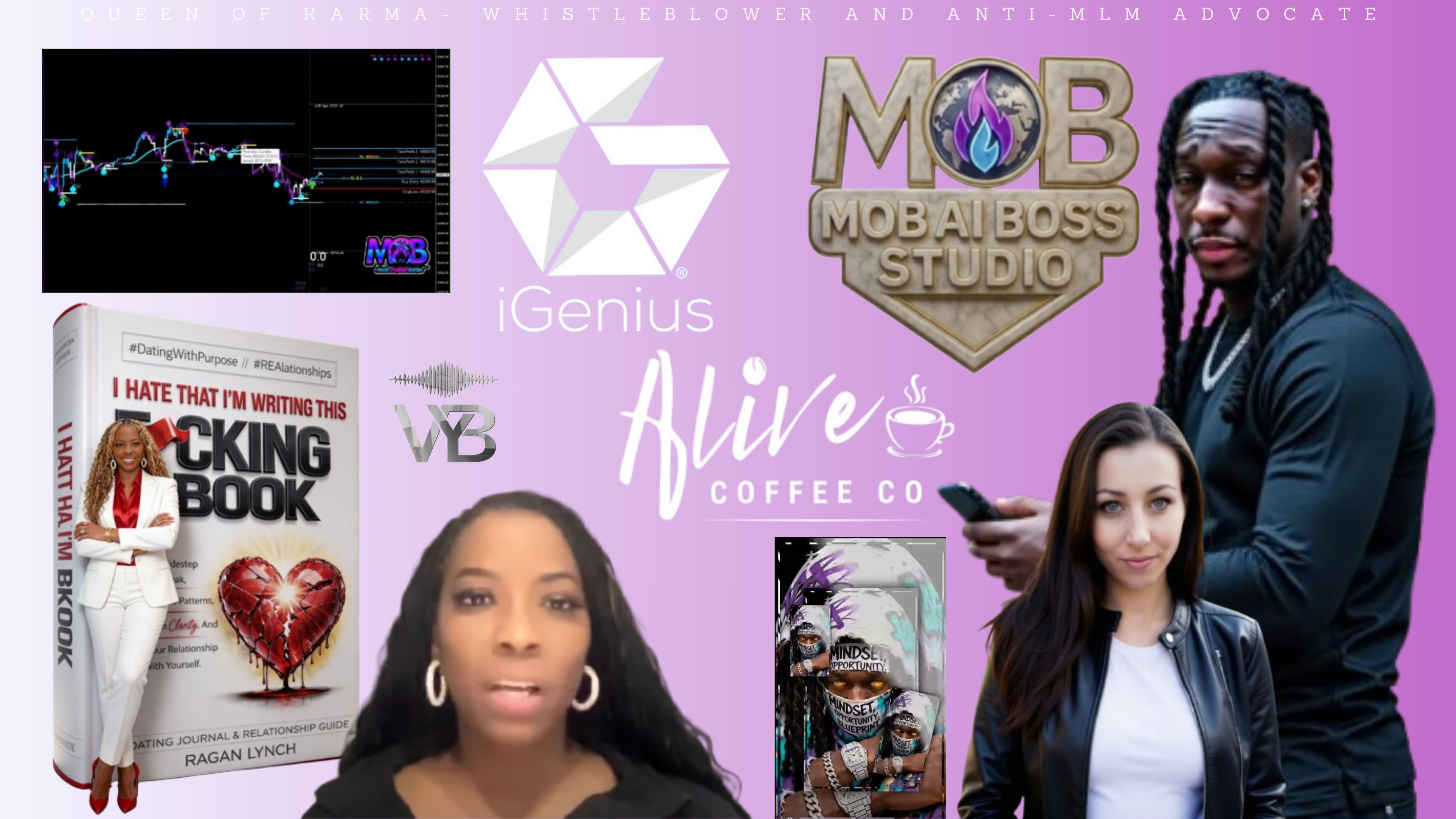
Last night, I did what any self-respecting consumer advocate with a cup of coffee and a high tolerance for nonsense would do: I livestreamed Megan Lynch‘s Connectiv/iNVU Zoom call. If you’ve followed my work, you already know the ecosystem — Investview, iGenius, Connectiv, and now the acquisition of VYB — a hydra of rebrands, hype cycles, and “AI” claims that never seem to involve actual AI.
But when I wasn’t prepared for the levels of chaos, delusion, and digital snake oil they rolled out this time. Because this call featured a “special guest”: Mob Boss Tazz Smith…and it was insanity.
A Short Recap
If you’ve been following my work, you know this isn’t new. We’ve already documented:
- Investview’s long regulatory history
- VYB Relaunches: Megan and Ragan Lynch’s Controversial Venture
- VYB, iGenius, Peptide Coffee and a Manipulative Rank-Up
- the pattern of hype → collapse → rebrand → repeat
- the misuse of “AI” as a marketing tool
- the forex “bots” that are never actually bots
- the “automation systems” that are just Google Forms and Canva graphics
This call was simply the next chapter in the same story.
Publicly Traded $3M in Coffee
Megan Lynch opened the call with her usual warm “hello everyone,” and then immediately introduced her special guest, Tazz Smith, with the kind of enthusiasm you’d expect if she was unveiling a Nobel Prize winner rather than a man whose entire online presence is built on AI selfies and neon-lit motivational posters.
Before handing the mic to Tazz, Megan launched into a rapid-fire explanation of what Investview/Connectiv/iGenius allegedly is — and she repeated the phrase “publicly traded company” so many times I started to wonder if she gets commission every time she says it.
Then came the coffee. Yes, the Alive coffee. She proudly announced that that coffee, which she introduced on a previous call, had generated over $3 million in sales in the last several months. No receipts. No documentation. No breakdown. Just a big round number tossed into the air like confetti.
Then she handed the floor to Tazz.
A Whole Lot of AI Theater
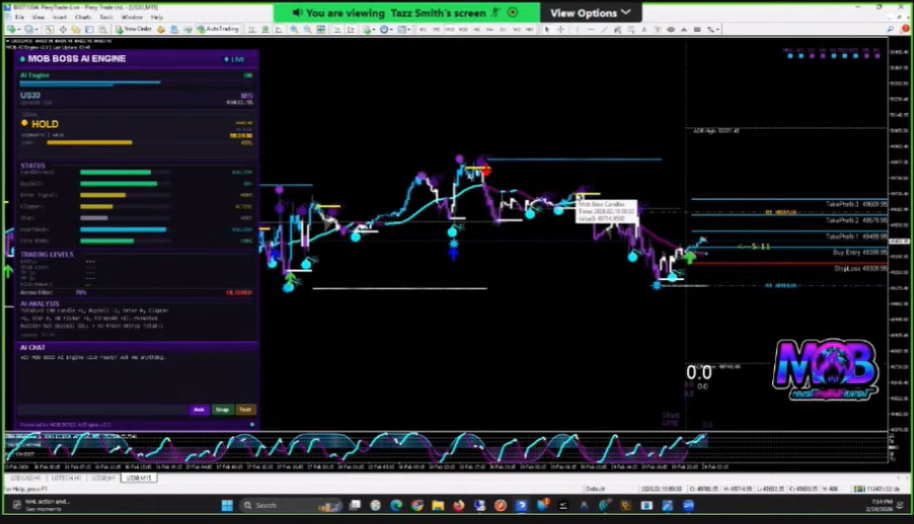
When Tazz took over the call, he launched into what he framed as a demonstration of their “AI trading bot.” And this is where the entire presentation shifted from questionable to outright theatrical. Instead of showing a real system with real logic, he pulled up a TradingView chart and began interacting with it as though it were a fully autonomous.
This looked busy and technical at first glance: percentages, buy/sell ratios, entries, stop losses, take-profit levels, a heat map, sentiment scores, and a TradingView chart covered in indicators. To someone unfamiliar with trading, it might have looked impressive.
But here’s the truth: Nothing on that screen was actually being generated by AI.
And then came the performance.
Tazz didn’t just show the AI bot — he talked to it. Out loud. Yes, he spoke to it as if it were actively analyzing the chart in front of him. He asked it questions about the market, paused dramatically, and waited for its “response.” The bot then read out a handful of numbers — generic market data that could have come from anywhere — and concluded with the extremely vague statement that:
“Right now is not a good time to trade.”
That was the entire “analysis.” No strategy. No reasoning. No explanation. No connection to the chart on the screen. Just a canned warning that could apply to any moment of any trading day.
And yet, after Tazz wrapped up, Megan came back on, told everyone to join as if we had just witnessed a legitimate technical breakthrough, and ended the call. That was the whole pitch.
This is the core issue with these presentations: they rely on theatrics, not technology. They rely on the assumption that the audience won’t know what real AI looks like. And they rely on spectacle — not substance — to sell the dream, even if the CEO hasn’t accomplished the dream yet.
The Legality Problem: AI Bots Giving Financial Advice
The most concerning part of the entire demonstration wasn’t the theatrics — it was the implication that this bot, the same one reading numbers aloud and telling Tazz “right now is not a good time,” is allegedly part of the MOB Boss AI Engine shown by Tazz on the screen. The way he presented it, the voice bot and the chart were working together as a single system, analyzing the market in real time and advising users on when to enter or avoid trades.
This is not harmless. This is not entertainment. That is financial advice. Unless this company is registered as a financial advisor, licensed to provide trading recommendations, and compliant with relevant securities regulations, what they are doing is — at best — deeply irresponsible, and at worst, illegal.
The bot was giving direct, actionable trading guidance tied to a specific chart, a specific market, and a specific moment. That crosses a line. When a company positions an AI tool as something that can tell you when to trade, when not to trade, and how to manage your entries and exits, they are stepping into regulated territory.
The irony is that the bot wasn’t even doing anything sophisticated. It wasn’t analyzing the chart on screen. It wasn’t reacting to indicators. It wasn’t processing data. It was simply reading out generic numbers and delivering a vague message. But the presentation was designed to make viewers believe they were witnessing a legitimate AI-powered trading system.
When you combine:
- unlicensed financial advice
- AI theatrics
- a vulnerable audience
- and a pay-to-join business model
you don’t get innovation. You get a regulatory nightmare waiting to happen. Another one, since Investview has so many under it’s belt already.
Tazz Smith: A Timeline of a Manufactured Persona
If you only saw him on last night’s call, you’d think he was some kind of AI visionary. But the receipts tell a different story.
2019 — Just a regular guy posting about NBA 2K20
No business persona.
No trading.
No AI.
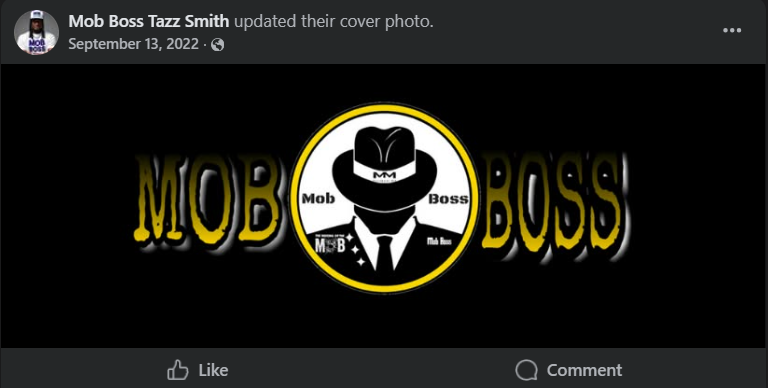
September 2022 — Birth of the “Mob Boss” persona
He uploads his first “Mob Boss” cover photo: fedora silhouette, gold lettering, mafia-inspired branding.
October 2022 — Persona expansion
Luxury car.
White suit.
“Master Trader.”
“Coach.”
“Mentor.”
Still no evidence of actual trading expertise.
2024 — Credit repair flyer era
Budgeting, credit restoration, identity monitoring, Rocket Lawyer — the usual credit-repair MLM bundle.
July-August 2025 — Forex hype era
Suddenly he’s promoting “Big Green Machine EA,” MetaTrader bots, manual trading screenshots, and MACD indicators. This is standard forex-influencer content.
September 2025 — AI business funnel era
He launches “MOB AI Boss Academy,” where he claims you can “clone your time with AI.” This is sold as a $197/month subscription. He is also posting “Comment CLONE” as engagement bait. However, there is still no actual technology.
2026 — Connectiv adopts him
Now he’s the face of “MOB Boss AI Engine,” “Boss Studio,” “AI Digital Clone,” “AI influencers.” Except everything is JotForm, Fanbasis, AI selfies, TradingView overlays, and free scheduling apps.
This is not a tech company. This is a persona-driven funnel being sold as enterprise AI. Especially since Tazz Smith has deleted any social media presence of himself from before 2019, scrubbing the internet of his past.
What Is MOB AI Boss Studio?
MOB AI Boss Studio is not a technology platform. It is not an AI system. It is not automation. It is, quite simply, a personal brand dressed up as a futuristic solution. Once you peel back the neon graphics and buzzwords, what you actually find is a personal brand wrapped around a handful of basic tools. The “studio” is not a platform and certainly not a piece of proprietary technology. It is a funnel — one built around the persona of “Mob Boss Tazz,” and sold to Connectiv members as if it were a corporate AI suite.
The entire offer revolves around three image bundles: a $30 package, a $75 package, and a $100 package, each one promising a different quantity of AI-generated portraits, influencer-style shots, and stylized avatars. These are not photographs, not professional branding sessions, and certainly not new technology. They are simply AI-generated slop created used publicly available tools, repackaged and resold at markup.
The $30 package is the entry-level tier, offering a small batch of AI-generated portraits meant to serve as “starter content.” The $75 package expands the quantity and variety, adding more stylized influencer-type images. The $100 package is positioned as the premium option, promising a larger set of images and more “customization,” though the customization is limited to whatever prompts are typed into the AI generator. None of these packages include real photography, real branding strategy, or any form of actual automation. They are image bundles — nothing more.
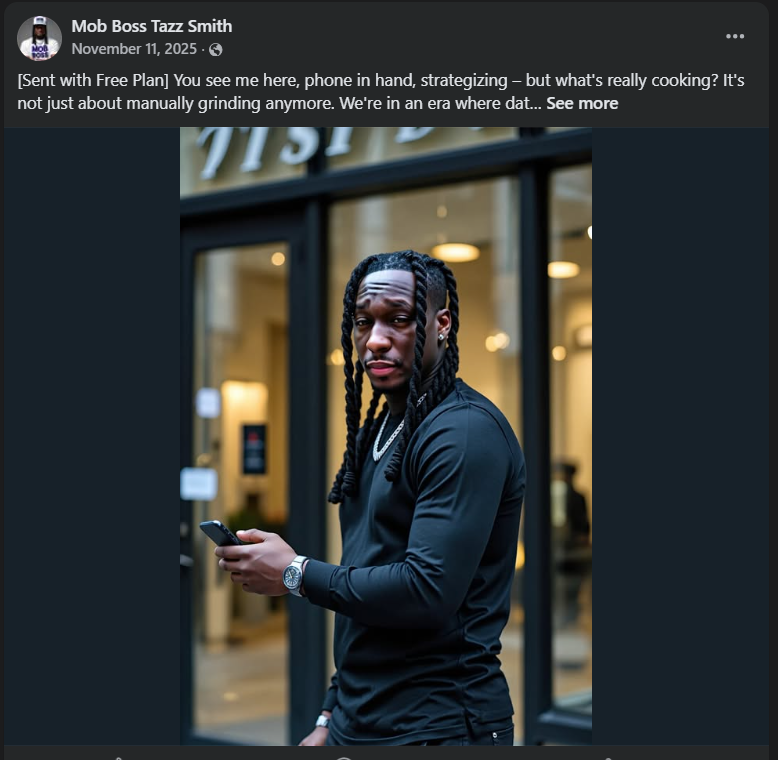
Despite this, the studio is being marketed as if it were a full-scale AI automation system. The sales pitch claims that MOB AI Boss Studio can create your “AI twin,” manage your social media, build AI influencers for your brand, and post content while you sleep. In reality, the onboarding process is handled through a basic JotForm, payments are routed through Fanbasis, and the “automation” is nothing more than a free social media scheduler — the same that watermarks Tazz’s own posts with “Sent with free plan.”
The so-called “AI trading engine” is simply a TradingView chart with some decorative labels and a chat box that openly admits it cannot perform real analysis.
There is no proprietary software behind any of this. There is no backend infrastructure, no engineering team, no AI model, and no automation system. What exists is a persona — Mob Boss Tazz Smith — and a set of AI-generated images being sold as if they were part of a revolutionary business suite. Connectiv is presenting this as their new “AI system,” but what they are actually selling is a funnel built around a character he created in 2022.
The entire offering is aesthetic, not technical. It is branding, not innovation. It is a costume, not a company.
Ragan Lynch and the Push Toward Synthetic Influencers
One of the most revealing — and frankly unsettling — parts of the call came when Megan proudly announced that her twin sister, Ragan Lynch, is using AI-generated influencer images to promote her new book titled I Hate That I’m Writing This Fucking Book. And Megan wasn’t embarrassed by this. She was excited. She presented it as a breakthrough, a strategy, a model for everyone else on the call to follow. Tazz did the same. The m essage was clear: Why bother with authenticity when you can just generate a synthetic version of yourself and call it marketing?
This is where the entire operation veers from laughable to genuinely concerning. We are already living in a digital landscape where misinformation, deepfakes, and AI-generated personas are eroding trust at every level. Industries are scrambling to figure out how to maintain authenticity in a world where AI can fabricate anything — and here comes Conenctiv, proudly encouraging their members to lean into the problem. They are telling people to skip real content entirely and replace it with AI-generated influencers, AI-generated product slots, and AI-generated versions of themselves.
It’s not innovation. It’s not empowerment. It’s not “working smarter.” It’s a shortcut — and a dangerous one.
When a company starts normalizing the idea that authenticity is optional and synthetic personas are the future, what hey are really doing is teaching people to build businesses on illusions. They are encouraging deception as a marketing strategy. They are blurring the line between reality and fabrication, and they are doing it with a straight face, as if this is the natural evolution of entrepreneurship rather than a massive ethical red flag.
Ragan’s book may be real, but the marketing strategy they’re pushing around it is not. It’s a manufactured aesthetic designed to look effortless and aspirational, while quietly training people to accept a world where nothing online is real — not the influencers, not the branding, not the “AI twins,” and certainly not the business opportunities being sold to them.
This is not the future of marketing. It’s the future of confusion, manipulation, and synthetic identity, and Connectiv is proudly leading the charge.
Why This Should Alarm You
At this point, it’s impossible to pretend that any of this is harmless. Investview (iNVU), Connectiv, iGenius, VYB, Alive, and now MOB AI Boss Studio are all operating from the same tired playbok: take a trending buzzword, wrap it in hype, and sell it as a life-changing opportunity. They did it with forex. They did it with crypto. They did it with “signals.” They did it with “education.” And now they are doing it with AI — the one topic guaranteed to confuse people just enough to make the sales pitch sound plausible.
But the reality is painfully simple: none of this is technology. The “AI clones” are just image bundles. The “AI influencers” are Midjourney-style portraits. The “automation” is a free scheduler. The “AI trading bot” is a TradingView chart with stickers on it. And the “AI engine” literally admits it cannot perform real analysis. This isn’t innovation. It’s theater. It’s a performance designed to look futuristic while delivering nothing of substance.
The people being targeted are not tech experts. They’re everyday consumers who want financial stability, a side income, or a way to build something of their own. They’re people who trust the word “AI” because they assume it means something sophisticated, something engineered, something legitimate. Instead, they’re being handed a handful of synthetic images and a motivational speech.
This is where the harm becomes real. When a company encourages people to build businesses on illusions — fake influencers, AI-generated personas, synthetic branding, and a trading bot that can’t trade — they are not empowering anyone. They are setting people up to fail. They are selling the idea of entrepreneurship without providing the tools required to succeed.
Consumers deserve better than this. They deserve transparency, honesty, and tools that actually function. They deserve education that isn’t tied to recruitment. They deserve opportunities that don’t require them to pretend to be someone they’re not — or worse, someone who doesn’t exist at all.
The Curtain Falls on AI Theatrics
After sitting through this entire performance — from Megan’s “publicly traded company” mantra, to the $30-$100 AI image bundles, to the MOB Boss persona, to the staged conversation with a bot pretending to analyze a chart — it became painfully clear that none of this is innovation. None of this is technology. None of this is the future of AI. This is AI Theatrics: a show designed to look impressive, sound futuristic, and distract people from the fact that there is no real substance behind any of it.
What matters now isn’t the spectacle, it’s the implications. When theatrics are used to sell paid packages, recruitment funnels, and unlicensed financial “guidance,” the risks become real. People are encouraged to trust automation that doesn’t exist, rely on analysis that isn’t happening, and make financial decisions based on tools that aren’t regulated, verified, or even functional. That’s not innovation. That’s a liability disguised as opportunity.
The danger isn’t the technology they claim to have. It’s the performance being used to sell it. And that’s where the story ends for now: not with a breakthrough, but with a warning.
By Beth Gibbons (Queen of Karma)
Beth Gibbons, known publicly as Queen of Karma, is a whistleblower and anti-MLM advocate who shares her personal experiences of being manipulated and financially harmed by multi-level marketing schemes. She writes and speaks candidly about the emotional and psychological toll these so-called “business opportunities” take on vulnerable individuals, especially women. Beth positions herself as a survivor-turned-activist, exposing MLMs as commercial cults and highlighting the cult-like tactics used to recruit, control, and silence members.
She has contributed blogs and participated in video interviews under the name Queen of Karma, often blending personal storytelling with direct confrontation of scammy business models. Her work aligns closely with scam awareness efforts, and she’s part of a growing community of voices pushing back against MLM exploitation, gaslighting, and financial abuse.



Leave A Comment