


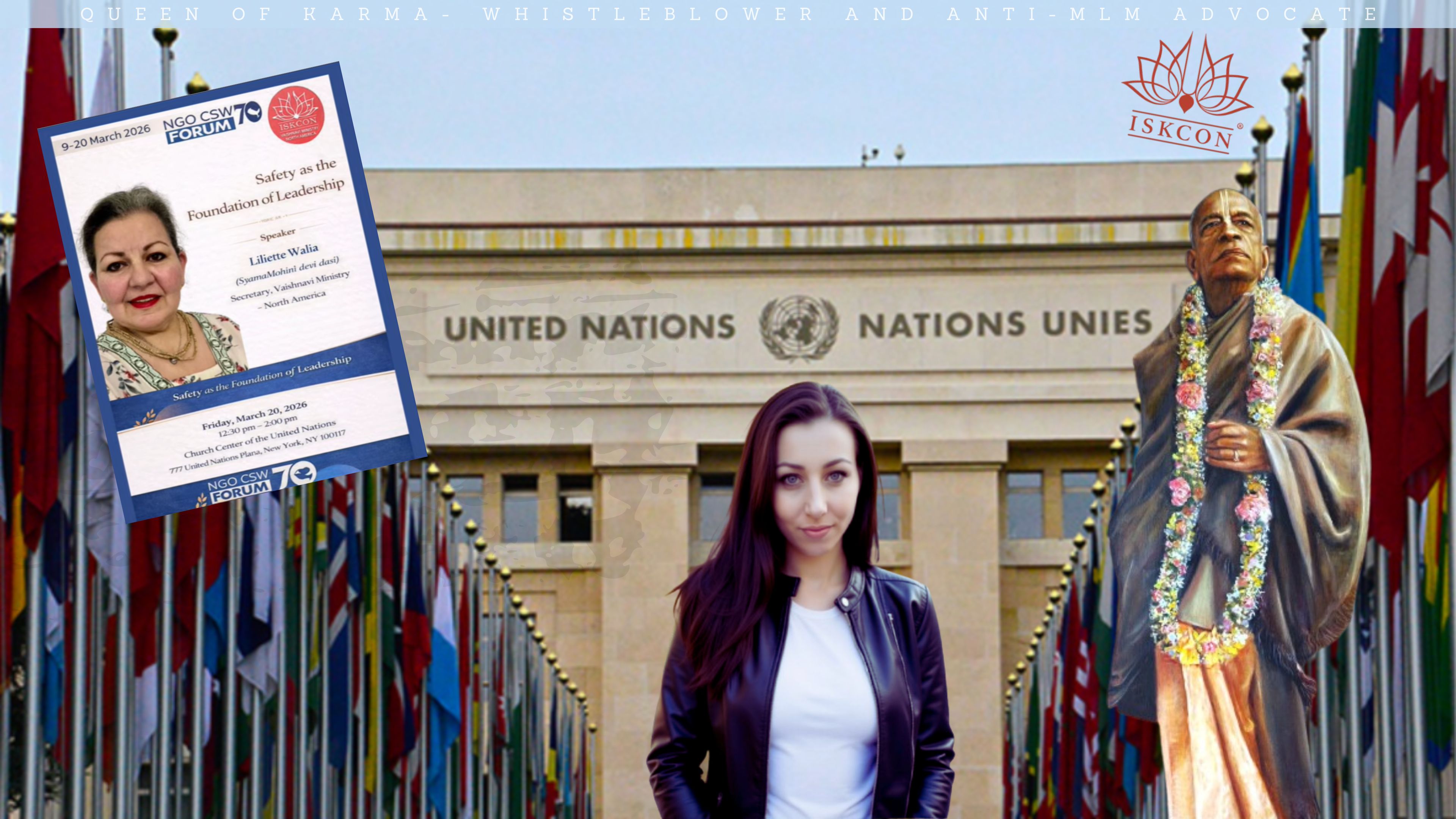
There are moments when the world feels slightly off its axis, when something so contradictory appears in a space meant for justice that it forces you to stop and ask whether anyone is actually awake at the wheel. Seeing ISKCON — the Hare Krishna movement — advertised as a speaker on women’s safety and leadership at an NGO CSW event was one of those moments. A high-control religious organization with a documented history of misogyny, child marriage endorsement, and systemic abuse was being welcomed into a UN-adjacent women’s rights forum as if it were a legitimate feminist voice. The cognitive dissonance is staggering, but the danger is real.
This is not an isolated oversight. It is a part of a long, deliberate strategy: the laundering of patriarchal doctrine through the language of empowerment, the sanitizing of harmful teachings through polished branding, and the quiet infiltration of global institutions that rarely vet he groups they platform. ISKCON has learned how to speak the vocabulary of modern feminism while preserving the worldview of its founder — a worldview that is anything but liberating.
How I Found a Cult at the UN…
I came across this story the way so many modern investigations begin: not through a press release, not through a whistleblower, but through a fellow creator doing the work mainstream institutions refuse to do. I learned about it because my dear friend and fellow antiCult advocate ItsMikeSandoval came online specifically to Expose It. Mike spent twenty years inside the Hare Krishna movement. He knows the doctrine, the culture, the abuse, the misogyny, the manipulation — not as an outsider, but as someone who lived it. When he goes live to warn people, it’s because something is genuinely wrong.
During his livestream, he pulled up a flyer that stopped me cold. I could hear it in his voice — that mix of anger, disbelief, and the kind of grief only survivors understand. ISKCON, the very movement that taught him women were inferior, untrustworthy, and in need of male control, was being platformed at a global women’s rights forum. He wasn’t just upset; he was shaken. And I agreed with him instantly.
Because when someone who survived a high-control group tells you, “This is dangerous,” you listen.
That livestream is how I found out that ISKCON (a movement whose founder openly taught women had tiny brains) was being welcomed into a UN-adjacent space to speak on women’s safety and leadership.
The contradiction is so severe it borders on surreal.
The Flyer That Sparked This Investigation
The flyer Mike showed on his screen advertised an event titled “Safety as the Foundation of Leadership” which was hosted by ISKCON’s Vaishnavi Ministry, scheduled to take place inside the Church Center of the United Nations.
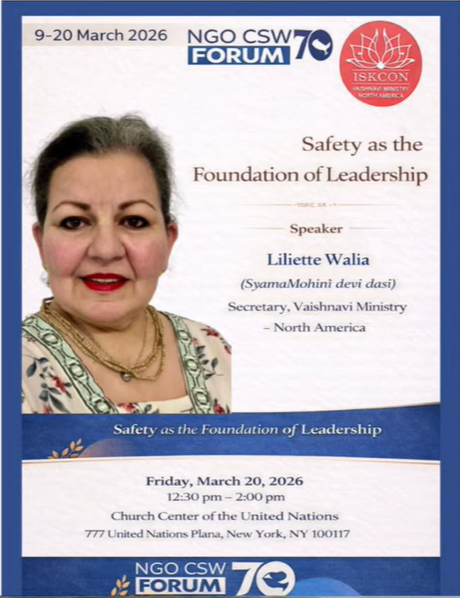
The branding is clean. The language is modern. The presentation is polished. Nothing about it hints at the movement’s actual teachings about women, girls, marriage, or autonomy. Nothing signals that the speaker represents a group whose founder taught that women are spiritually weak. Nothing acknowledges the movement’s history of abuse, coercion, or the child-marriage doctrine embedded in its theology.
This flyer is the perfect example of how high-control groups launder their ideology through the language of empowerment. It is harm wrapped in soft colors and professional design.
And it is being platformed in a space meant to protect women in only a few days…
The Feminist Mask: ISKCON’s Carefully Curated Public Image
In public, ISKCON now speaks in soft, palatable tones about “spiritual equity,” “sacred feminine energy,” and “women’s leadership in devotional life.” Their representatives appear at conferences in elegant saris, offering workshops on safety, empowerment, and leadership. To the untrained eye, it looks progressive — even enlightened.
But this is a performance, not transformation. Behind the stage lights and the feminist vocabulary lies a doctrinal foundation built on the teachings of A.C. Bhaktivedanta Swami Prabhupada, the founder ISKCON treats as infallible. His writings, lectures, and commentaries are not ambiguous. They are explicit in their belief that women are inherently inferior, intellectually limited, and spiritually dependent on men. These teachings are not historical relics: they remain central to ISKCON’s internal culture, shaping marriage practices, leadership structures, and the daily lives of women in temples around the world.
The contradiction between the public messaging and the internal doctrine is not subtle. It is structural, and it is intentional. ISKCON knows that Western audiences will not accept the movement’s actual teachings on women, so if offers a sanitized version — a spiritualized feminism that collapses under the weight of its own contradictions.
What Prabhupada Actually Taught About Women
Prabhupada’s teachings on women are Well-Documented and widely circulated within the movement. He described women as “less intelligent,” “easily misled,” and “prone to illusion.” In one lecture, he stated plainly that “a woman’s brain is smaller,” using this as justification for why women should not hold positions of authority. In another, he said that women are “not very trustworthy,” and that their minds are “always flickering.” These statements were not offhand remarks; they were presented as spiritual truths rooted in scripture.
He insisted that women should never be independent and must always be under the control of a man — first the father, then the husband, then the son. He taught that women’s primary duty was to serve men and children, and that their spiritual advancement depended on their obedience. In his commentary on the Bhagavatam, he wrote that a woman’s virtue lies in her chastity and her willingness to accept male authority.
He also argued that women should not be educated in the same way as men, stating that too much education would make them “proud” and “difficult to control.” He discouraged women from taking leadership roles, teaching publicly, or holding positions of authority over men. In his view, women were spiritually weaker and required male guardianship for their own protection.
This is the ideology being quietly repackaged as “women’s empowerment” in UN-adjacent spaces.
The Child Marriage Doctrine ISKCON Doesn’t Want You to Remember
One of the most disturbing aspects of Prabhupada’s teachings is his endorsement of child marriage. He openly defended the practice, calling it “good for society” and “protective for girls.” He criticized modern laws that banned child marriage and argued that girls should be married before puberty to prevent “immorality.”
Prabhupada himself married an 11-year-old girl when he was 22 — a fact that ISKCON rarely acknowledges publicly but is part of the historical record. In one lecture, he stated that girls “should be married at twelve or thirteen,” and lamented that modern society had “spoiled” this tradition. He framed early marriage as a safeguard against female sexuality, reinforcing the belief that girls must be controlled before they develop autonomy.
This doctrine stands in direct opposition to the Convention on the Rights of the Child, CEDAW, and every modern human rights framework. Yet representatives of this movement are being welcomed into spaces dedicated to women’s safety and empowerment. The contradiction is not just uncomfortable — it is dangerous.
The Rhetoric of Control: How ISKCON Speaks to Women
Like many high-control groups, ISKCON uses a dual-layered rhetorical system. Externally, they speak the language of empowerment, equality, and spiritual upliftment. Internally, they teach that women must obey men, that women’s independence is dangerous, and that women’s safety comes not from autonomy but from male control.
This rhetorical sleight of hand allows ISKCON to present itself as progressive while maintaining the patriarchal structure of Prabhupada established. It is a form of spiritual gaslighting: the promise of empowerment that leads only to obedience. Women are told they are “equal souls,” but in practice, they are expected to accept a lifetime of subservience. They are told they are “leaders in devotion,” but only within the narrow confines of male-defined roles. They are told they are “protected,” but the protection is indistinguishable from control.
This is not empowerment. It is rebranded subservience.
Why High-Control Groups Target UN-Adjacent Spaces
NGO CSW is not the United Nations itself. It is a civil-society forum that runs parallel to the UN Commission on the Status of Women. And here lies the vulnerability: any registered NGO can host a “parallel event.” There is no doctrinal vetting, no human-rights screening, no accountability mechanism, and no requirement to demonstrate alignment with feminist principles.
This loophole allows groups with deeply patriarchal or authoritarian structures to present themselves as feminist actors simply by showing up with a polished flyer and a speaker who knows how to perform empowerment. ISKCON is not the first to exploit this vulnerability, and it will not be the last. Scientology, Falun Gong, and the Unification Church have all used similar strategies to gain legitimacy.
When a group with a history of misogyny, child marriage endorsement, and systemic abuse is allowed to speak on women’s safety at a global forum, the consequences extend far beyond optics. It confuses the public, misleads survivors, and gives harmful organizations a veneer of credibility they have not earned. It also undermines the work of genuine feminist activists who must now share space with groups that fundamentally oppose women’s autonomy.
The Cost of Silence
The presence of ISKCON at a women’s rights forum is not a harmless oversight. It is a failure of institutional responsibility. It is a reminder that feminist spaces are not immune to infiltration by groups that seek legitimacy rather than accountability. And it is a warning that the language of empowerment can be weaponized by those who do not believe in women’s autonomy at all.
When a movement whose founder taught that women are intellectually inferior and should be married as children is given a microphone at a women’s right event, something has gone profoundly wrong. This is not about religious freedom. It is about protecting women’s rights spaces from groups that actively undermine women’s rights.
The question is not whether ISKCON should be allowed to exist. Not right now. I have already discussed that in full HERE. The question is why institutions dedicated to gender equality are giving them a platform. And the answer, at least for now, is that no one is watching close enough.
By Beth Gibbons (Queen of Karma)
Beth Gibbons, known publicly as Queen of Karma, is a whistleblower and anti-MLM advocate who shares her personal experiences of being manipulated and financially harmed by multi-level marketing schemes. She writes and speaks candidly about the emotional and psychological toll these so-called “business opportunities” take on vulnerable individuals, especially women. Beth positions herself as a survivor-turned-activist, exposing MLMs as commercial cults and highlighting the cult-like tactics used to recruit, control, and silence members.
She has contributed blogs and participated in video interviews under the name Queen of Karma, often blending personal storytelling with direct confrontation of scammy business models. Her work aligns closely with scam awareness efforts, and she’s part of a growing community of voices pushing back against MLM exploitation, gaslighting, and financial abuse.



Leave A Comment