


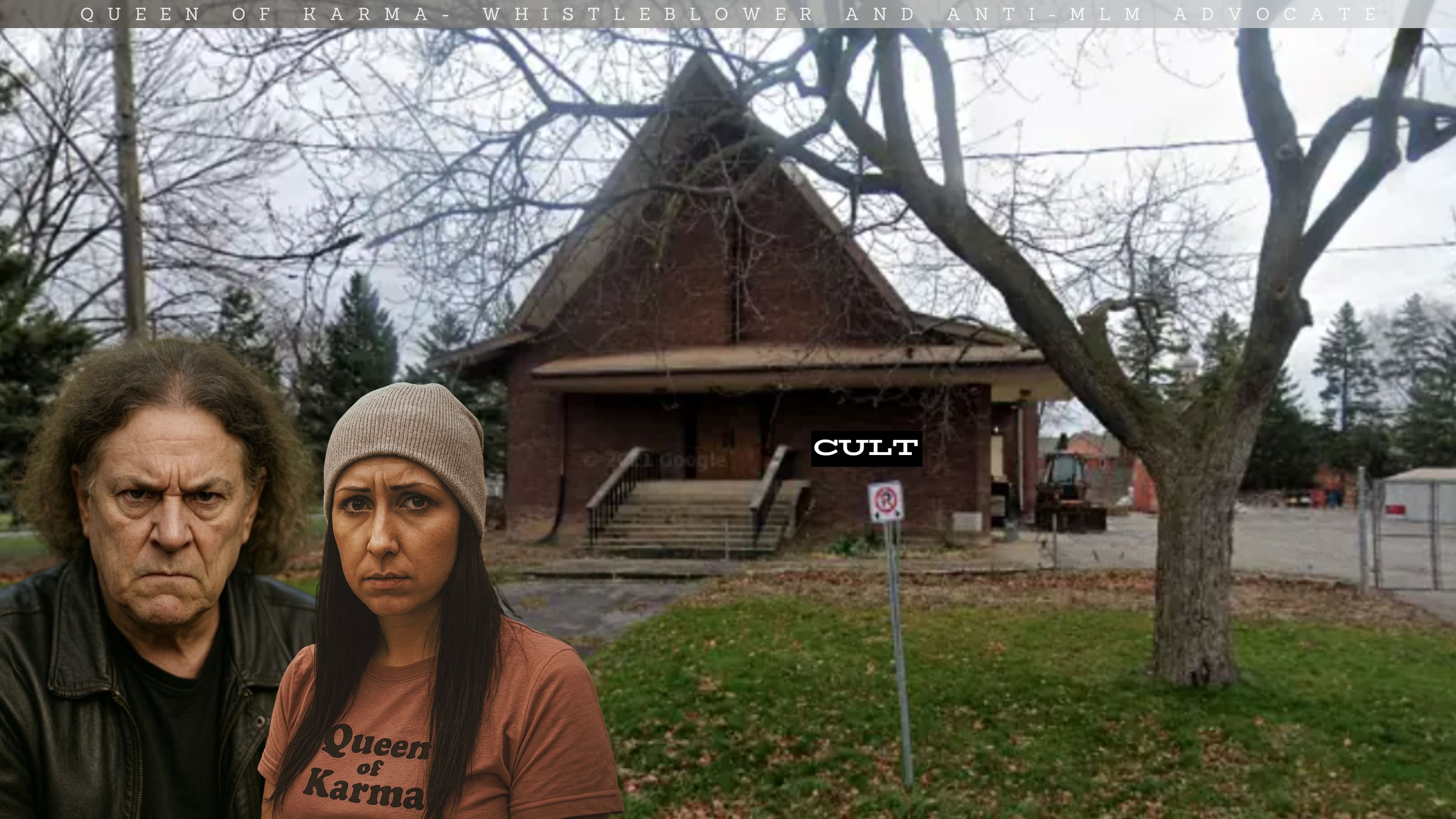
When police cruisers first rolled up to 114 Second Street in Welland, Ontario on the morning of December 19, 2025, they weren’t responding to a violent crime. They were there to assist bylaw officers with what should have been a routine enforcement matter. Instead, a Niagara Regional Police officer was shot in the chest, a neighborhood was locked down, and a 24-hour standoff unfolded inside a building that has spent years caught between two identities: a registered Buddhist charity on paper, and a self-styled spiritual compound in practice.
The man accused of opening fire, 59-year-old Daniel (Daniele) Tronko, surrendered the next morning. But the story of how his confrontation came to be stretches back nearly a decade — through zoning disputes, ideological entrenchment, and the slow transformation of a once-legitimate religious charity into the center of a small, insular sect that neighbors say has been in conflict with the city for years.
This is the story of how a dormant Buddhist charity became the shell for a breakaway group, how its self-appointed leader framed the property as sovereign religious land, and how a fence dispute escalated into gunfire.
A Routine Bylaw Call Turns Violent
According to the Niagara Regional Police Service, officers from 3 District (Welland/Pelham) arrived at the Second Street residence at approximately 7:45 a.m. to assist bylaw staff. Media reporting indicates the issue involved a fence that was obstructing sightlines — a mundane but legitimate safety concern.
Moments after officers arrived, police say a man inside the building opened fire. One officer was struck in the chest and rushed to hospital with non-life-threatening injuries. She was later released. Tronko then barricaded himself inside the building, prompting a full tactical response.
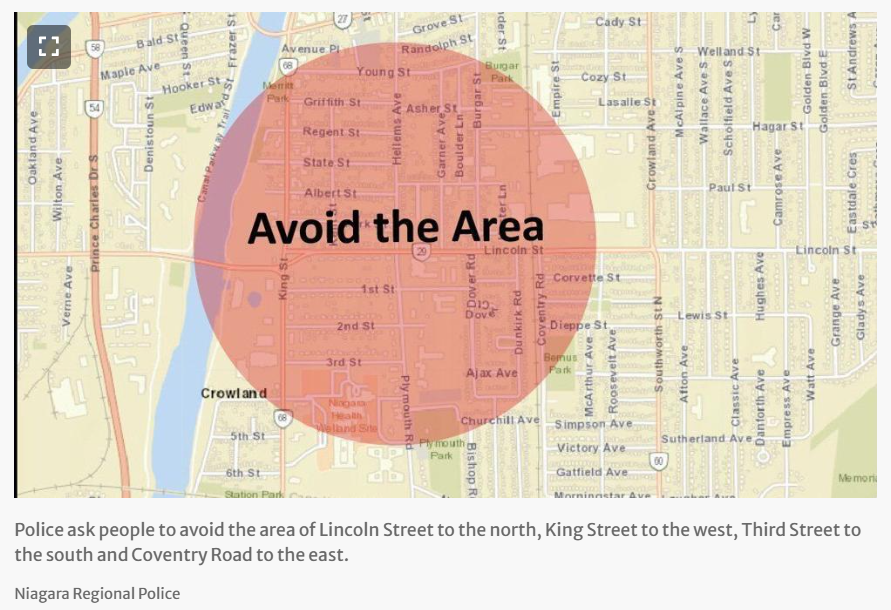
Police quickly identified the suspect as Daniel Tronko (also known as Daniela Tronko), a longtime occupant of the property. A shelter-in-place order was issued for the surrounding blocks, schools and the nearby hospital were placed under lockdown, and tactical units established a perimeter around Second Street and Plymouth Road. For nearly 24 hours, Tronko remained barricaded inside the building — a former Hungarian Presbyterian church — before surrendering shortly after 7:30 a.m. the next day.
He now faces an attempted murder charge, with additional charges expected. For this article, we will continue to use male pronouns since those are the pronouns used in other sources. However, Daniel Tronko may have been transgendered and it appears he also went by Daniela Tronko.
The Building With Two Histories
The building at the center of the standoff is not just any residential property. It is the registered address of a legitimate Buddhist charity, that some refer to as a cult, also called The Church of Higher Consciousness, recognized by the Canada Revenue Agency. The charity’s stated purpose is to:
“advance and teach the religious tenets, doctrines, observances and culture associated with the Buddhist faith.”
But the group involved in the standoff is not Buddhist. It has no public congregation, no visible leadership structure, and no connection to Buddhist doctrine. Instead, it appears to be a small sect built around Tronko himself — a man who, for years, has described the property as a spiritual compound and himself as its “Elder.”
The overlap in name and address has caused confusion, but the explanation is increasingly clear: the Buddhist charity once operated at 114 Second Street, but at some point became inactive. Tronko, who owned or occupied the building, continued using the charity’s name and religious designation to legitimize his own group. This pattern — the repurposing of dormant religious entities by fringe leaders — is well-documented in other cases across Canada and the United States.
There is no evidence that the Buddhist charity is involved in the standoff or in Tronko’s activities. But its former identity appears to have provided a convenient shield for a group that bore little resemblance to the organization on paper. It does, however, bore resemblance to a cult now.
The 2017 Letter: A Warning in Plain Sight
The clearest window into Tronko’s worldview comes from a letter he wrote in August 2017 to Welland city officials, including the mayor, council members, and planning staff. In it, he signs himself as “Elder of the Church of the Higher Consciousness” and argues passionately against proposed zoning changes affecting 114 Second Street.
The letter (found in an Archived Reddit Thread) is framed a a plea for religious freedom. Tronko describes the property as a sacred space intended for “Meditation Gardens” and accuses the city of discrimination. He compares his group to long-established churches in the area, arguing that they have been granted special zoning protections for decades and that his “church” deserves the same treatment.
The tone is peaceful, almost poetic, but the underlying message is unmistakable: Tronko believed the city had no right to interfere with what he saw as religious land. He portrays municipal zoning as an infringement on spiritual rights and positions himself as the defender of a persecuted faith community.
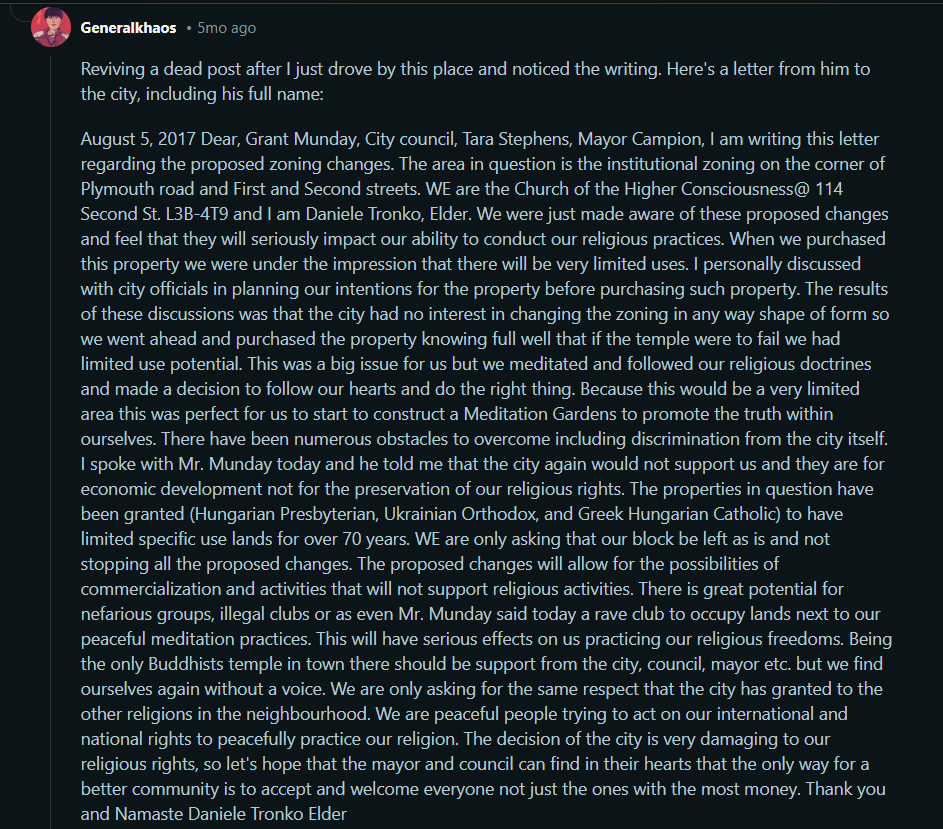
This letter, written eight years before the standoff, shows a man already deeply entrenched in a belief that his property was sovereign religious territory, a belief that would later collide violently with municipal enforcement.
The 2019 Council Minutes
Two years later, Tronko appeared before Welland’s General Committee as a formal delegate. The minutes from March 26, 2019 record his presentation as “Daniele Tronko, Elder, Church of the Higher Consciousness,” requesting permission to establish a meditation garden on city-owned land adjacent to his property.
The committee received the presentation and questioned the group’s legitimacy, ownership status, and its relationship to The Hope Centre. a related staff report directed city staff to implement the city’s land sale policy, suggesting Tronko was actively seeking to expand the group’s footprint through formal channels.
This appearance confirms that Tronko was publicly representing the group and actively seeking to legitimize and grow its presence — not just resisting enforcement, but attempting to claim more land for spiritual use.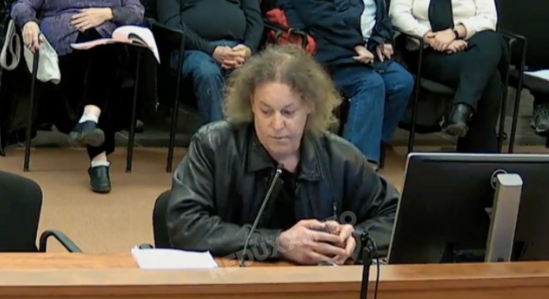
A Long History of Conflict
According to community sources, Tronko purchased the former Hungarian Presbyterian Church at 114 Second Street in 2012. Over the years, neighbors and city officials raised repeated complaints about the property, including a barbed-wire fence partially on city land, bonfires, guard dogs, and painted signs declaring the site the “Independent state of Bhudan.”
These details suggest that Tronko was not only resisting municipal authority but actively reframing the property as a sovereign compound. His self-identification as “Elder” of the Church of the Higher Consciousness, paired with the use of Buddhist language and religious framing, points to a hybrid ideology — one that blended spiritual claims with anti-government beliefs and ultimately escalated into violence.
Neighbors and at least one longtime member of the group told reporters that the standoff did not come as a surprise. One member described it as “a long time coming,” citing years of tension between Tronko’s group and the City of Welland over property standards, zoning, and the use of the building.
The property, once a church, had been modified and fortified over the years. Tronko reportedly viewed it as a compound, a place he was prepared to defend. His 2017 letter suggests he saw the city’s attempts to regulate the property not as routine governance, but as persecution.
This mindset aligns with Sovereign-Citizen-Style Ideology, even if only One Source explicitly labels him as such. The hallmarks are present: rejection of municipal authority, reframing enforcement as discrimination, invoking religious rights to resist regulation, and treating a private property as exempt from the laws that govern everyone else. This mindset also has all the hallmarks of a cult of personality.
A Dormant Charity, a Breakaway Sect, and a Violent Endgame
Taken together, the evidence points to a clear trajectory.
A legitimate Buddhist charity once operated at 114 Second Street. This was after it was once a Hungarian Presbyterian church. Over time, the charity appears to have become inactive, leaving behind a name, a registration number, and a building still zoned for religious use. Tronko, who occupied the property, adopted the charity’s name and religious identity, positioning himself as its “Elder” and using the designation to resist zoning changes and enforcement.
His 2017 letter shows he was already framing the property as sacred land and the city as an oppressor. Neighbors describe years of conflict. And when bylaw officers arrived in December 2025 over a fence dispute, Tronko allegedly responded not as a homeowner facing a citation, but as a man defending a compound he believed was spiritually and legally sovereign.
The result was a police officer shot, a neighborhood locked down, and a community forced to confront a crisis that had been quietly building for years.
What Now?
The Welland Standoff is not just a local incident. It is a case study in how dormant religious entities can be repurposed by fringe leaders, how spiritual language can be used to mask anti-government ideology, and how municipal disputes can escalate when one party refuses to recognize the authority of the state.
It is also a reminder of the limits of municipal enforcement when ideology hardens into absolutism. Zoning bylaws, property standards, and safety regulations rely on a shared understanding that the law applies to everyone. When that understanding breaks down, even the smallest dispute — a fence, a setback, a sightline — can become the spark for violence.
The building at 114 Second Street carries two histories: one of Buddhist practice, and one of ideological defiance. The standoff in December 2025 was the moment those histories collided with the reality of law enforcement.
And for the residents of Welland, it was a stark reminder that the most dangerous conflicts are often the ones that simmer quietly for years before finally boiling over.



Leave A Comment