White Island
Billowing clouds of gas, steam and ash are spewing out from the crater and you hesitate to move. An explosion seems imminent but the guide appears relaxed and in control.
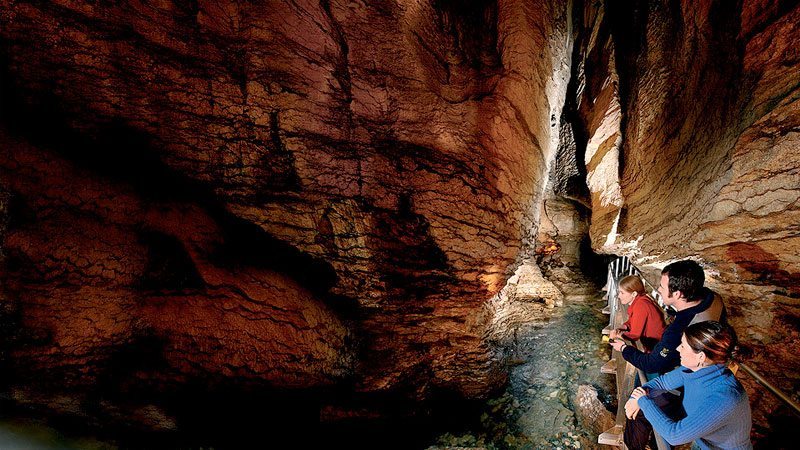
Suddenly, as you look upwards you realize the entire roof of the cavern is a mass of ghostly pale green twinkling lights, so densely packed together that it resembles the Milky Way galaxy.
The track winds through a 'moonscape' of bizarre lava sculptures and up onto the shoulder of a towering volcanic cone, draped with a skirt of shifting cinders. Onward it goes, past red cliffs, active geothermal areas, silent emerald and blue lakes.
The Waimangu Cauldron steams away at a seething 53° Centigrade as you stroll downhill past Frying Pan Lake, the world's largest hot spring. Nearby is Inferno Crater, an inverted cone with strangely fluctuating water levels and a swirling head of steam.
It takes some mental agility to visualise just how the Dart Valley looked 18,000 years ago, at the peak of the last ice age, when the formidable Dart Glacier gouged Lake Wakatipu down to bedrock.
The pancake-like columns of rock are drenched in spray, highlighting the curious stylobedding process that weathers these layers of limestone seabed strata, stripping off the softer, less compacted areas, to leave the tottering towers.
The ridge-top road winds its undulating way through a patchwork of paddocks and a sparse human population. Otago Harbour is a long ribbon of silky-smooth water far below and Dunedin City, the 'Edinburgh of the South' nestles in its green belt against a dramatic backdrop of forested hills.
Birdsong resounds through the beech forest and occasional gaps in the foliage reveal the deep blue waters of a glacial lake and a breathtaking backdrop of snowy mountains, draped in forest to the 1,000 metre 'bushline.'
Travel anywhere in the Taranaki region and you will have the constant presence of this striking, dormant, strato-volcano (also known as Mt Egmont). From most scenic viewpoints the old volcano appears as a perfectly symmetrical cone, tapering to a 2,518 metre summit in the classic style of Japan's Mt Fuji.
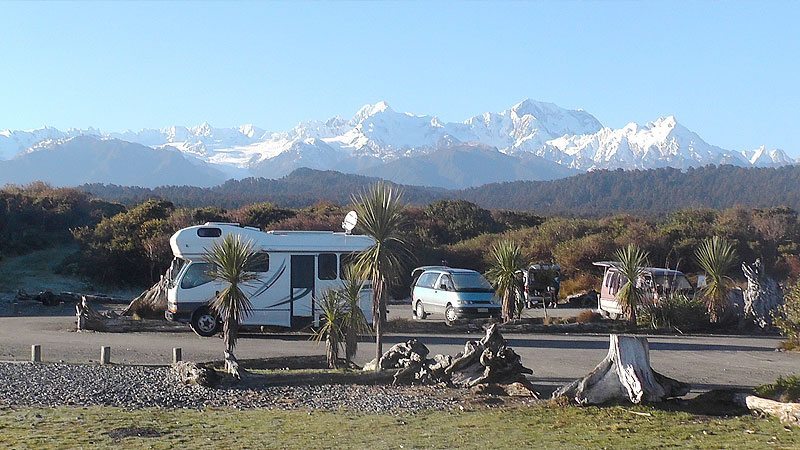
Drive along Lake Pukaki's shoreline and you will be impressed by its pale glacial blue colour. On a sunny day the sky will be a contrasting deep blue and at a certain turn in the road the huge white bulk of the Cook Range will suddenly be revealed.
The tour coach zig-zags down into the depths of the Cleddau Canyon and turns under a dense canopy of rainforest into the village at the head of the sound. Across the silky-black waters, a sharp-edged pyramid of rock rises abruptly out of the depths and soars 1,700 metres to a conical peak that appears to pierce the sky.
Ease your kayak around a bushclad headland and drift silently under overhanging branches into a secret cove. The dark green foliage of the forest is reflected in the calm, clear water, and streaks of sunlight seem to dance over the ripples from your wake.